






















Context graph vs ontology: Structural differences
Permalink to “Context graph vs ontology: Structural differences”Context graphs and ontologies represent different abstraction layers in knowledge representation, each optimized for distinct purposes in AI systems.
Context graph vs ontology: Comparison at a glance
Permalink to “Context graph vs ontology: Comparison at a glance”| Dimension | Ontology | Context Graph |
|---|---|---|
| Purpose | Semantic consistency across systems | AI agent grounding in execution context |
| Nature | Static, versioned schemas | Dynamic, continuously updated |
| Content | Classes, axioms, logical rules | Decision traces, temporal markers, provenance |
| Focus | Cross-system interoperability | AI consumption and hallucination reduction |
| Node types | Abstract concepts and classes | People, assets, documents, decisions |
| Edge semantics | Logical relationships (subClassOf, partOf) | Operational relationships (approved-by, depends-on) |
| Temporal model | Timeless or versioned releases | Event-sourced with temporal validity |
| Update mechanism | Deliberate governance processes | Continuous capture from agent activity |
Ontology structure and purpose
Permalink to “Ontology structure and purpose”Ontologies provide formal specifications of shared conceptualizations within domains. Research from Stanford defines ontologies as explicit specifications that capture concepts, relationships, and constraints relevant for modeling knowledge domains.
Core ontology components:
- Classes and concepts: Define entity types (Customer, Product, Transaction)
- Properties: Describe characteristics and relationships between entities
- Hierarchies: Model subsumption relationships (Manager is-a Employee is-a Person)
- Axioms: Encode logical rules and constraints that entities must satisfy
- Formal semantics: Enable automated reasoning and inference
The W3C Web Ontology Language (OWL) provides computational logic for representing rich knowledge across distributed systems, ensuring machines can interpret and reason over domain knowledge consistently.
Context graph structure and purpose
Permalink to “Context graph structure and purpose”Context graphs extend knowledge graphs with operational intelligence optimized for AI consumption. According to Foundation Capital positions context graphs as living records of decision traces stitched across entities and time, where precedent becomes searchable.
Essential context graph elements:
- Decision nodes: Capture specific actions taken (approval granted, exception made, escalation triggered)
- Temporal markers: Track when decisions occurred and what entity states existed at decision time
- Provenance chains: Link decisions to supporting evidence, stakeholders, and reasoning
- Permission boundaries: Enforce access control so retrieval respects data policies
- Confidence signals: Include recency decay and source trust for relevance ranking
Modern context graphs prioritize token efficiency and relevance ranking for LLM consumption, delivering minimal decision-aware projections rather than comprehensive storage. This optimization ensures AI systems receive the most relevant context without exceeding token limits.
Context graphs and ontologies solve different problems in the same ecosystem. Atlan’s Context Hub maps the full context layer landscape — from definitions and engineering to architecture and AI readiness — across 40+ in-depth guides.
When to use ontology vs context graph
Permalink to “When to use ontology vs context graph”Choosing between ontologies and context graphs depends on your primary use case, domain stability, and whether you need upfront schema design or emergent structure from execution.
Use ontologies when domain knowledge is stable
Permalink to “Use ontologies when domain knowledge is stable”Organizations benefit from ontology-first approaches when domain knowledge is stable and formal semantics enable critical interoperability.
Domain standardization requirements
Healthcare organizations use FHIR ontologies to ensure Patient, Medication, and Observation entities have consistent meanings across hospital systems. Financial services rely on ontologies for regulatory compliance where Customer and Transaction definitions must remain stable.
Cross-system integration needs
When data flows between multiple platforms, ontologies provide semantic glue. Research shows ontologies enable database interoperability across heterogeneous systems by making domain assumptions explicit.
Automated reasoning requirements
If your use case requires logical inference, ontologies excel. Systems automatically deduce that if “Employee is-a Person” and “Manager is-a Employee,” then “Manager is-a Person” through subsumption reasoning.
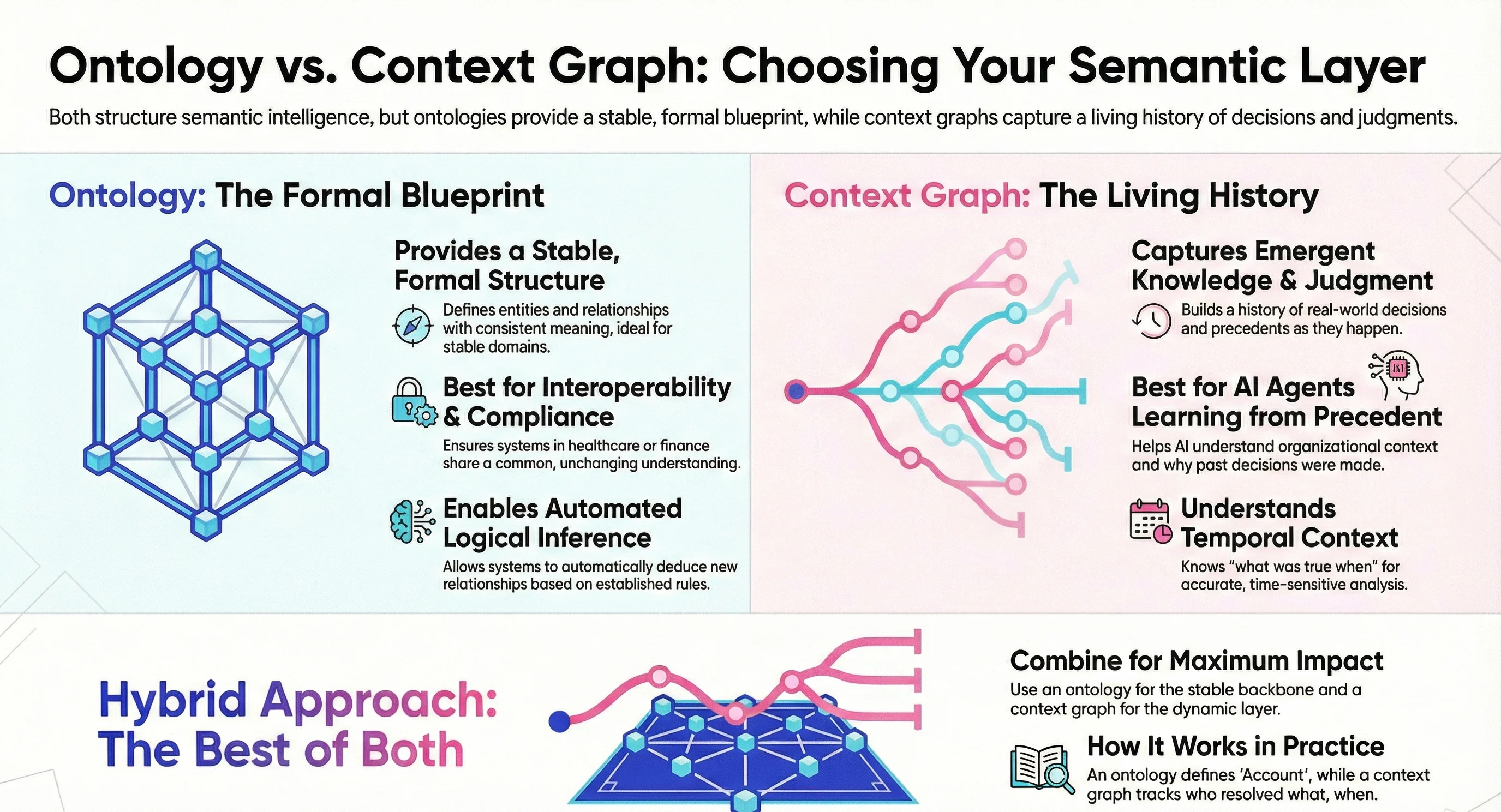
When to use ontology vs context graph. Image by Atlan.
Use context graphs when AI agents need organizational context
Permalink to “Use context graphs when AI agents need organizational context”Context graphs provide value when AI agents need to understand organizational judgment and learn from historical decisions.
AI agent decision-making in real workflows
When agents handle workflows like reviewing deals or resolving tickets, they encounter gray areas requiring judgment. Industry analysis shows context graphs solve this by capturing decision traces as agents work, building queryable histories of real-world precedents.
Temporal decision context
If understanding “what was true when” matters, context graphs capture temporal validity. A sales agent needs to know a customer’s tier status at approval time, not just current status, to understand why discounts were granted.
Permission-aware retrieval
Context graphs enforce access control before content reaches models, critical for enterprise AI where different users should see different organizational knowledge subsets. Atlan’s permission-aware retrieval ensures AI agents respect data access policies automatically.
Emergent organizational patterns
Rather than designing entity schemas upfront, context graphs let structure emerge from how work actually happens. As teams approve exceptions and override policies, these patterns become visible without manual ontology engineering.
Hybrid approaches provide the best of both
Permalink to “Hybrid approaches provide the best of both”Most sophisticated implementations combine both. Ontologies provide the stable backbone of entity types and core relationships, while context graphs capture the living layer of decisions and temporal context on top.
Real-world example: Consider a customer success platform where an ontology defines Account, Contact, and Case entities with standard relationships. The context graph captures which support engineer handled which escalation when, what approval chains were invoked, and how similar cases were resolved. The ontology ensures consistent entity understanding; the context graph enables agents to learn from precedent.
What is the role of ontology in building context graphs
Permalink to “What is the role of ontology in building context graphs”Ontologies serve as foundational schemas for context graphs, providing semantic structure while allowing operational intelligence to layer on top.
Ontology as the semantic backbone
Permalink to “Ontology as the semantic backbone”Context graphs rarely start from scratch. Analysis from Graphlit argues that entity types like Person, Organization, Account, and Event don’t need to be learned through agent trajectories. These stable primitives are better served by established ontologies.
Existing standards provide strong starting points including Schema.org for web entities, Microsoft Common Data Model for enterprise entities, FHIR for healthcare domains, and industry-specific ontologies for finance or retail.
Building context graphs on ontology foundations accelerates deployment. Teams leverage pre-defined entity types and core relationships, focusing engineering effort on capturing decision traces rather than reinventing semantic wheels.
From static schema to living context
Permalink to “From static schema to living context”Ontologies provide the “what” (entity types and logical relationships). Context graphs add the “who, when, why” (decision traces and temporal context).
A financial services example: The ontology layer defines Customer, Account, Transaction entities with is-a and has-a relationships. The context graph layer captures which analyst approved which exception for which customer, when approval occurred, what policy was evaluated, and what precedents informed the decision.
Research on ontology-driven RAG shows this layering enables AI systems to leverage formal semantic structure while grounding responses in organizational execution context.
Identity resolution and entity linking
Permalink to “Identity resolution and entity linking”Ontologies provide canonical entity definitions that enable context graphs to resolve references correctly. When a context graph encounters “customer_id: 12345” in one system and “acct_12345” in another, ontology-based identity resolution confirms these refer to the same Customer entity.
Atlan’s approach connects ontologies with operational metadata through automated lineage and relationship discovery. The platform maps technical data assets to business concepts while capturing who uses what and how assets connect through transformations.
Modern platforms make iterative refinement practical by treating semantic models as versioned, governable assets. Teams propose ontology updates, stakeholders review changes, and systems track evolution while maintaining backward compatibility.
Who builds the context graph? Platform vs. application
Permalink to “Who builds the context graph? Platform vs. application”The question of who owns context graphs sparked significant debate in early 2026. Jaya Gupta’s “Context Graphs: AI’s Trillion-Dollar Opportunity” thesis argued that vertical agent startups sitting in execution paths would capture context graphs, since they see decisions as they’re made.
Atlan’s co-founder Prukalpa Sankar offered a counterargument focused on enterprise heterogeneity: while vertical agents see execution paths deeply, most enterprise decisions pull context from 6-10+ systems simultaneously. A single renewal decision might require data from CRM, support tickets, usage analytics, communication platforms, and semantic layers across different vendor combinations.
This heterogeneity challenge - the fact that every enterprise runs different system combinations - suggests context graphs may be fundamentally a platform problem rather than an application one. The discussion reached over 174,000 impressions and over 90 retweets. Read the full exchange on X.
Context graph vs ontology for RAG applications
Permalink to “Context graph vs ontology for RAG applications”Retrieval-Augmented Generation systems face a critical choice in knowledge representation that significantly impacts retrieval quality, hallucination rates, and operational effectiveness.
Ontology-driven RAG patterns
Permalink to “Ontology-driven RAG patterns”Ontologies enhance RAG by providing semantic structure for retrieval. Research on ontology-grounded RAG demonstrates that encoding domain knowledge in formal ontologies improves factual accuracy and enables deductive reasoning over retrieved content.
Key capabilities:
- Semantic traversal: Rather than relying solely on vector similarity, ontology-driven RAG traverses semantic relationships—when a query asks about “product performance,” the system understands Product entities relate to Metrics, Teams, and TimePeriods, enabling structured multi-hop retrieval
- Query disambiguation: Ontologies resolve ambiguity in natural language queries—if a user asks about “accounts,” the ontology distinguishes between financial accounts and customer accounts based on context, improving retrieval precision
- Consistency guarantees: Formal semantic structure prevents retrieving logically incompatible information together
Context graph-driven RAG patterns
Permalink to “Context graph-driven RAG patterns”Context graphs optimize RAG for organizational decision-making by grounding retrieval in execution traces and temporal validity.
Key capabilities:
- Decision-trace retrieval: When agents need to understand “how we handled similar situations before,” context graphs retrieve relevant decision sequences with full provenance—Microsoft Research on GraphRAG shows graph-based approaches vastly improve retrieval relevance by populating context windows with higher-relevance content connected through relationships
- Permission-aware context: Context graphs enforce access control during retrieval—if a user queries customer data, the system retrieves only accounts and interactions the user has permission to see, preventing information leakage through AI responses
- Temporal awareness: RAG systems can answer “what did we know at decision time?” by retrieving entity states as they existed when actions were taken, critical for audit trails and understanding historical decisions
- Relevance signals: Context graphs incorporate recency decay and confidence scoring in retrieval—older decision traces receive lower relevance scores unless they represent established precedents, helping LLMs weight information appropriately
Hybrid RAG architectures combine both approaches
Permalink to “Hybrid RAG architectures combine both approaches”Sophisticated RAG implementations layer context graphs over ontology foundations. A customer support RAG system demonstrates this workflow:
- Query arrives: “How should we handle enterprise churn risks?”
- Ontology resolves entities: Enterprise (customer segment), Churn (event type), Risk (indicator)
- Ontology-based retrieval: Fetches relevant Customer, Account, Support_Case entities with proper relationships
- Context graph enhancement: Adds decision traces showing which escalation paths worked for similar customers, when applied, who approved them, and what outcomes followed
- Permission filtering: Removes cases the user can’t access
- Temporal ordering: Prioritizes recent precedents while preserving important historical patterns
Atlan’s architecture supports this hybrid pattern through its unified context layer. The platform ingests semantic models and business glossaries (ontology layer) while capturing active metadata about usage, lineage, and governance (context layer).
Organizations using context-aware RAG report 5x improvements in response accuracy when systems have access to rich metadata including definitions, relationships, and operational context rather than just raw database schemas.
Dynamic context graphs vs static ontologies
Permalink to “Dynamic context graphs vs static ontologies”The contrast between dynamic and static knowledge representation fundamentally shapes how AI systems adapt to organizational change.
| Characteristic | Static Ontologies | Dynamic Context Graphs |
|---|---|---|
| Evolution approach | Deliberate governance processes with release cycles | Continuous evolution from organizational work and decisions |
| Update mechanism | Teams propose changes, experts review, versions publish with migration paths (W3C standards support backward compatibility) | Every agent action, approval, or exception automatically becomes part of the graph (Foundation Capital analysis describes this as natural byproduct of work) |
| Consistency model | Agreed-upon conceptualizations prevent semantic drift—all systems use same “Customer” definition | Emergent patterns from usage—relationships surface organically when teams link document types to approval chains |
| Knowledge capture | Explicit modeling exercises where subject matter experts formalize domain understanding before use | Real-time capture as work happens, revealing organizational patterns through actual behavior |
| Temporal handling | Timeless definitions or versioned releases | Time-stamped entity states with validity periods enabling “what was true when” queries |
| Error correction | Requires formal schema updates and governance approval | Human-in-the-loop corrections become part of institutional memory, improving future retrievals |
| Best suited for | Regulatory compliance requiring stable definitions, cross-organizational interoperability, stable domain knowledge with formal reasoning needs, consistency over responsiveness | Frequently changing business rules, common exceptions and edge cases, informal cross-functional patterns, quickly decaying decision context |
Modern data platforms like Atlan bridge this gap by supporting both versioned business glossaries (ontology-like stability) and active metadata capture (context graph-like dynamics), letting teams choose appropriate trade-offs for different knowledge domains.
How modern platforms streamline context and ontology management
Permalink to “How modern platforms streamline context and ontology management”Managing context graphs and ontologies at enterprise scale requires platforms that unify semantic modeling, operational metadata capture, and AI-ready context delivery.
Unified context layers replace fragmented tools
Permalink to “Unified context layers replace fragmented tools”Traditional approaches forced teams to choose between formal ontology management tools and operational metadata platforms. Modern solutions integrate both capabilities into unified context layers.
Atlan’s platform exemplifies this integration by treating metadata as active context rather than passive documentation:
- Automatically discovers relationships between data assets through lineage and usage patterns
- Allows teams to layer semantic definitions and business context on top of technical metadata
- Creates foundations serving both human collaboration and AI reasoning needs
Automated discovery with semantic enrichment
Permalink to “Automated discovery with semantic enrichment”Rather than manual ontology engineering, platforms now combine automated discovery with human expertise:
- Entity discovery: Automatically identify entity types and relationships from data lineage, usage patterns, and transformation logic
- Context enrichment: Teams add business meaning, ownership, and governance policies to discovered entities
- Living ontologies: Create semantic models that reflect actual system behavior rather than theoretical designs
Leading organizations treat context as a product with clear ownership and iteration cycles. Workday’s approach with Atlan involves co-building semantic layers that AI needs, starting with end-user prompts and including domain experts in development processes.
Permission-aware context for enterprise AI
Permalink to “Permission-aware context for enterprise AI”Enterprise AI requires context systems that understand access control, ensuring agents never expose information users shouldn’t see:
- Propagate access controls from source systems through metadata layers
- Automatically filter context based on user permissions during retrieval
- Prevent information leakage through AI responses while maintaining functionality
Continuous context refinement through feedback loops
Permalink to “Continuous context refinement through feedback loops”Context quality improves through iterative feedback rather than one-time design exercises:
- Human-in-the-loop corrections: Users fix AI misinterpretations inline, improving future retrievals
- Usage telemetry: Track which context proved useful for which queries, surfacing gaps
- Quality scoring: Automated assessment of context completeness with enrichment suggestions
- Version control: Track definition changes with full audit trails for governance
Context activation across tools and workflows
Permalink to “Context activation across tools and workflows”The most sophisticated implementations don’t just store context—they activate it where teams work:
- Model Context Protocol servers: Bring metadata into ChatGPT, Claude, and Cursor
- Bidirectional sync: Integrate with BI tools, notebooks, and transformation frameworks
- Active metadata: Flow context to where teams work rather than requiring context switching
Organizations using integrated platforms report 60% faster policy approval cycles by automating context retrieval and governance workflows.
Real stories from real customers: Leveraging context for AI readiness
Permalink to “Real stories from real customers: Leveraging context for AI readiness”
Context as culture: Workday's AI-ready semantic layer
"As a part of Atlan's AI labs, we are co-building the semantic layers that AI needs with new constructs like context products that can start with an end user's prompt and include them in the development process."
Joe DosSantos, Vice President of Enterprise Data & Analytics
Workday
Workday achieved 5x improvements in AI analyst response accuracy
Watch Now →
Context by design: Mastercard's foundation-first approach
"At Mastercard, we've learned you can't just bolt things on at the end. We've learned that from privacy by design and now we're going to make sure we do that with context by design. You have to build it in from the get-go because when you do that, you can not just keep up with AI, but you can build trust in your journey."
Andrew Reiskind, Chief Data Officer
Mastercard
Mastercard's building context from the start
Watch Now →Key takeaways
Permalink to “Key takeaways”Context graphs and ontologies serve complementary roles in the AI era. Ontologies provide stable semantic foundations ensuring consistent entity understanding across systems. Context graphs layer operational intelligence on top, capturing decision traces and temporal validity that enable AI agents to learn from organizational precedent.
- Select ontologies for stable domain modeling, cross-system interoperability, and formal reasoning requirements.
- Choose context graphs for AI agent decision-making, temporal awareness, and permission-aware retrieval.
- Most sophisticated implementations combine both—ontologies define the conceptual backbone while context graphs capture the living layer of execution traces.
Atlan’s unified context layer bridges these approaches by unifying semantic modeling with active metadata capture, providing foundations for both human collaboration and AI reasoning.
Context graphs are the next $1T opportunity – but who owns them?
Register for The Great Data Debate 2026 →FAQs about context graphs and ontologies
Permalink to “FAQs about context graphs and ontologies”1. Can context graphs replace ontologies for enterprise AI?
Permalink to “1. Can context graphs replace ontologies for enterprise AI?”No. Context graphs complement ontologies rather than replace them. Ontologies provide semantic foundations ensuring consistency. Context graphs add operational layers enabling AI agents to act appropriately. Most production systems need both for stable conceptual grounding and dynamic execution context.
2. How do ontologies improve RAG accuracy compared to vector search alone?
Permalink to “2. How do ontologies improve RAG accuracy compared to vector search alone?”Ontologies reduce hallucinations by providing semantic structure for retrieval. Rather than relying solely on text similarity, ontology-driven RAG understands relationships between concepts, enabling multi-hop retrieval respecting semantic constraints, query disambiguation based on entity types, and consistency checking preventing logically incompatible information retrieval.
3. What makes context graphs “dynamic” compared to traditional knowledge graphs?
Permalink to “3. What makes context graphs “dynamic” compared to traditional knowledge graphs?”Context graphs update continuously from agent activity. Every decision, approval, or exception becomes a new node with temporal markers and provenance chains. Traditional knowledge graphs require deliberate curation. Context graphs self-populate from execution traces, allowing organizational patterns to emerge naturally.
4. Should we build ontologies first or start with context graphs?
Permalink to “4. Should we build ontologies first or start with context graphs?”Start with lightweight ontologies for core entity types using existing standards like Schema.org. Then let context graphs capture operational patterns as teams work. Attempting comprehensive ontology design before understanding actual workflows often produces overly abstract models. The iterative approach delivers value faster.
5. How do context graphs handle permissions for AI agents?
Permalink to “5. How do context graphs handle permissions for AI agents?”Context graphs enforce access control during retrieval by filtering nodes and edges based on user permissions before content reaches models. Each entity and relationship carries permission metadata. When an AI agent queries on behalf of a user, the system retrieves only context that user has rights to see.
6. What’s the relationship between semantic layers and context graphs?
Permalink to “6. What’s the relationship between semantic layers and context graphs?”Semantic layers define business metrics and dimensions for analytics. Context graphs extend this by adding operational metadata—who uses which metrics, how definitions evolved, which decisions relied on which metrics. Together they create comprehensive context: semantic layers provide the “what” while context graphs add the “who, when, why.”
Share this article