























Why are context graphs gaining popularity as essential infrastructure for AI success?
Permalink to “Why are context graphs gaining popularity as essential infrastructure for AI success?”As agentic AI moves from experimentation into enterprise production, a foundational gap has emerged: AI agents can act, but they cannot reliably remember or reason about how an organization actually operates. Context graphs are purpose-built to close that gap.
Context graphs are a response to a structural problem that is already playing out inside enterprises today. Organizations are deploying hundreds of AI agents, copilots, and agentic applications — each with its own partial view of the world, its own embedded definitions, and its own isolated context window.
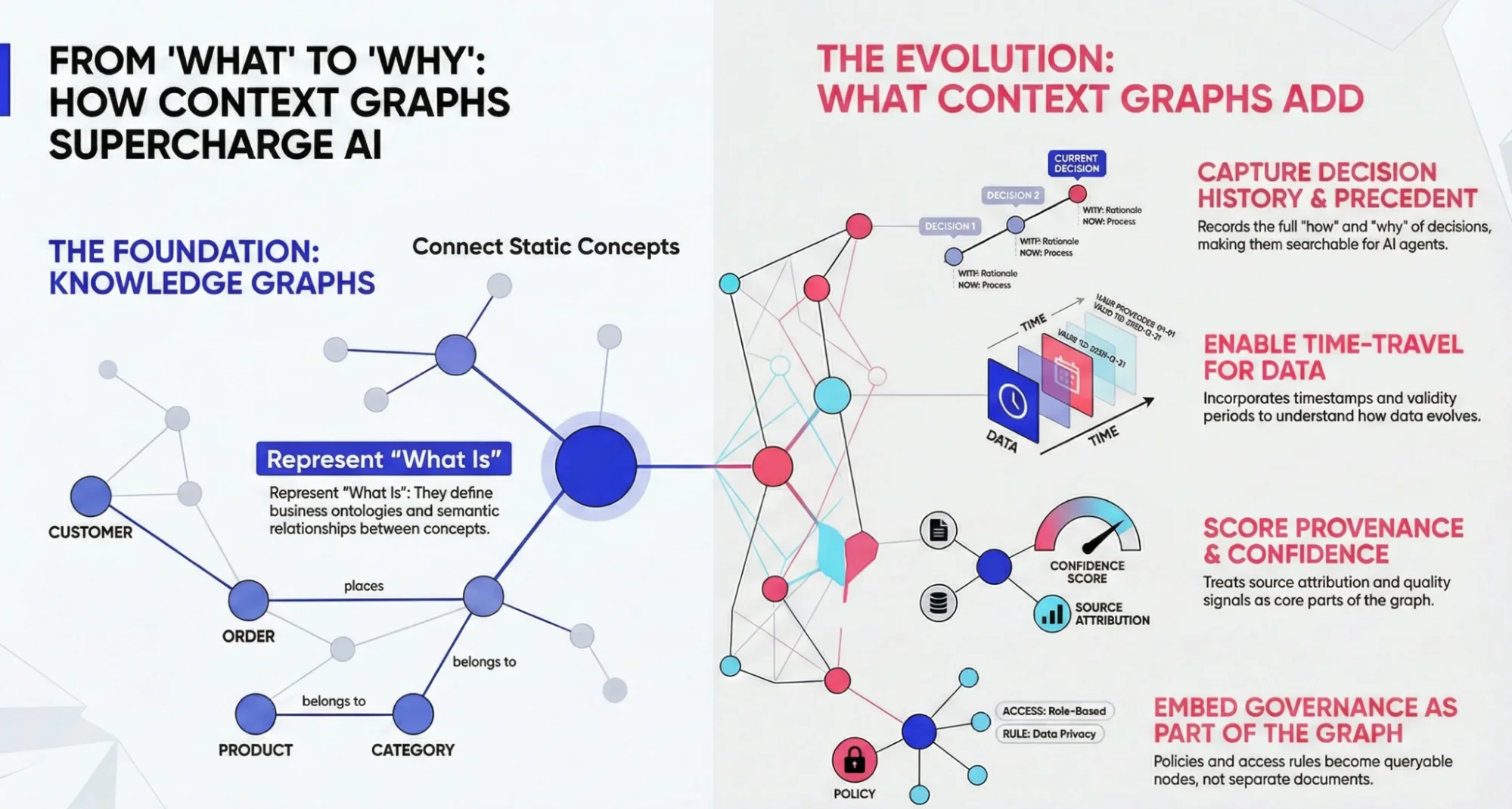
A quick overview of the context graphs concept - Image by Atlan.
This isn’t a future risk; it’s already happening. Atlan co-founder Prukalpa Sankar observes the phenomenon in this X post:
“We have all kinds of agentic tools (Sierra, Writer, Google Agentspace, Snowflake Cortex) and none of them talk to each other. I want a common layer of context so I don’t need to context-engineer every single one of them.”
— An Atlan customer underscoring the need for unified context [3]
The resulting fragmentation in context provides an incomplete and inconsistent view of an organization’s decision-making. For agentic AI to succeed, they need a connective tissue between data and decisions, maintaining a record of why outcomes happened, not just that they happened.
And that is precisely the gap that context graphs, through the mechanism of decision tracing, are designed to fill.
What is decision tracing and why does it matter for trustworthy AI?
Permalink to “What is decision tracing and why does it matter for trustworthy AI?”Decision tracing captures the logic, the “why”, behind outcomes. Most enterprise systems of record–CRMs, ERPs, data warehouses–are built to capture outcomes. However, they don’t capture the logic (decisions, workflows, tribal knowledge) that produced those decisions and that’s the problem decision tracing solves.
Decision tracing records the actual procedural path: what triggered a decision, what context informed it, what rules governed it, and what outcome it produced. In short, it captures the “why” and the “how” that systems of record have always left behind.
Consider the example of a single renewal agent deciding whether to offer a 20% discount. It requires context from six different systems, as illustrated below.
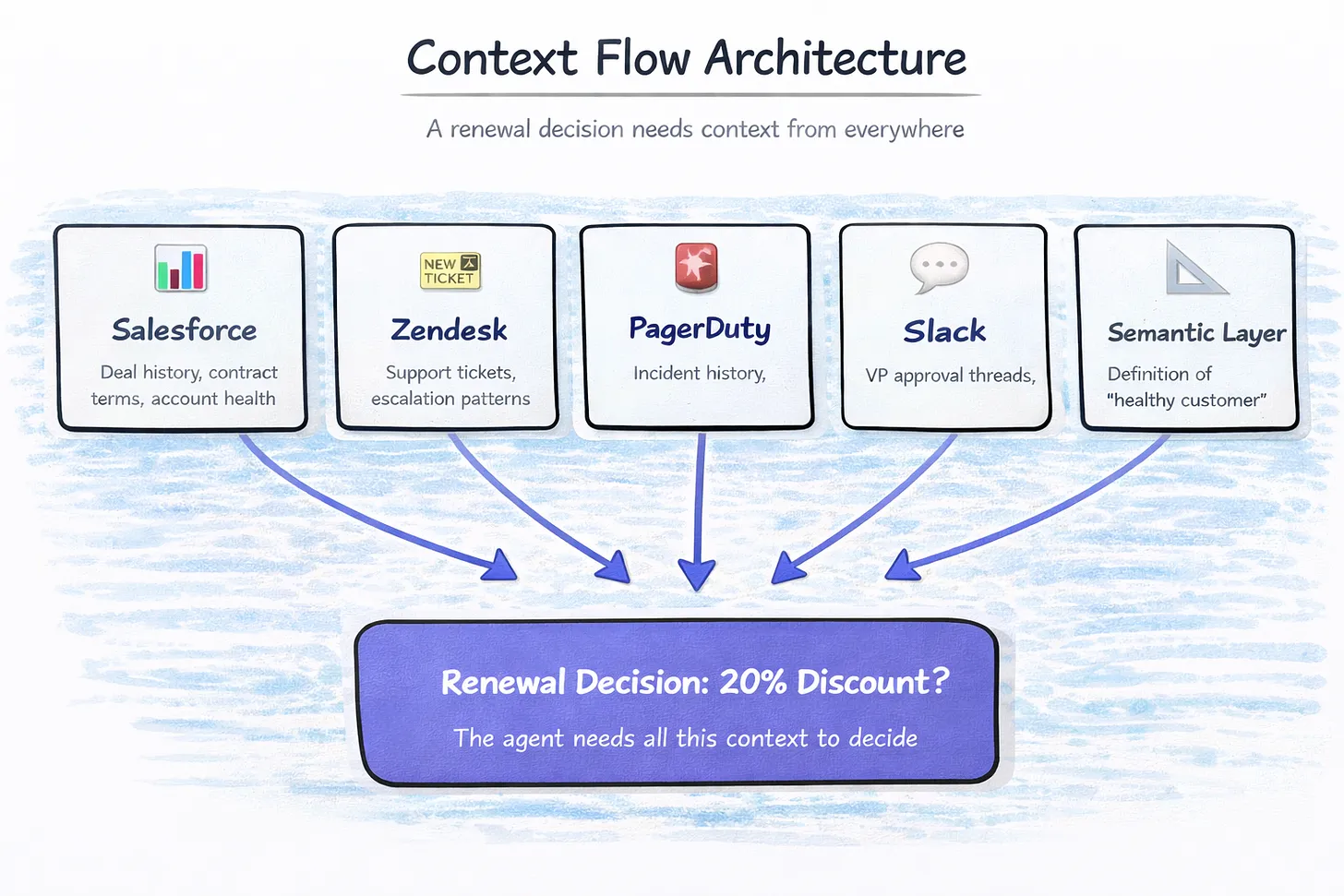
The complexity behind a single decision-making process for a renewal agent. Source: Prukalpa Sankar on X
Each system reflects a different slice of the decision context. Without decision traces connecting these inputs to the logic that governed past decisions, the agent has data but no judgment.
“The missing piece is the “why” and the “how,” especially if decision elements happened outside of their system.” [1]
Decision traces provide searchable, replayable records of how situations like this have been handled before, enabling agents to ground their reasoning in institutional reality rather than statistical inference alone.
Gartner is direct on this point: decision tracing is paramount for agents, providing the foundation for guardrailing, observability, evaluation, and self-learning, i.e., the four pillars of trustworthy agentic systems at enterprise scale.
Build Your AI Context Stack — Get the blueprint for implementing context graphs across your enterprise.
Get the Stack GuideGartner identifies the category; Atlan’s Context Hub goes deeper — 40+ guides on context graphs, context layers, and context engineering implementation for enterprises acting on the analyst research.
What are Gartner’s top 3 insights on context graphs?
Permalink to “What are Gartner’s top 3 insights on context graphs?”1. Decision logic is vital for building robust agentic systems
Permalink to “1. Decision logic is vital for building robust agentic systems”“Context graphs track not only data context but also decision flows and event traces, enabling more informed and effective business decision making by AI agents.” [1]
This is a meaningful distinction from prior approaches to AI grounding. Vector search and knowledge graphs have been the dominant methods for staging knowledge for AI systems. Both have delivered value, but both are limited by their focus on state — what things are, what data exists, what relationships have been defined.
Context graphs encode how decisions unfold, how state changes propagate, how workflows are navigated, and how entities interact over time.
If your organization is building agentic systems on knowledge graphs and vector search alone, the foundation is incomplete. Context graphs are the missing piece of the equation, and central to this concept is context engineering.
2. Context engineering is central to improving the reliability of AI agents
Permalink to “2. Context engineering is central to improving the reliability of AI agents”Context engineering is a newer discipline, and one that Gartner identifies as critical for organizations serious about production-grade agentic AI. It targets the connections between data elements and the processes that agents are designed to execute, going well beyond the prompt-focused, manual approaches that have characterized early AI implementations.
Gartner predicts that, “by 2028, context engineering features will be built into 80% of software tools used to build AI applications. Through 2028, context engineering improvements will enhance agentic AI accuracy by at least 30%.” [2]
Gartner recommends extending context engineering beyond traditional vectorization and knowledge graphs by capturing decision workflows and business logic, building a persistent enterprise memory layer that includes process context.
Such a layer draws from three sources:
-
Existing process metadata from operational systems.
-
Tribal knowledge extracted from fragmented communication channels.
-
New reasoning traces generated by AI agents in production.
The result is a context engineering discipline that is implicit and automated, continuously enriching the institutional memory available to AI agents.
3. Context graphs won’t replace, but augment knowledge graphs
Permalink to “3. Context graphs won’t replace, but augment knowledge graphs”A common misconception worth addressing directly: context graphs are not a replacement for knowledge graphs. Gartner is explicit on this point.
“Knowledge graphs are not replaced by context graphs, but are augmented by them and work together for supporting AI agents’ knowledge and decision layers.” [1]
Knowledge graphs provide the semantic layer—entities, ontologies, taxonomies, and conceptual relationships—that gives AI agents domain understanding. What context graphs add is the procedural layer, i.e., the dynamic, continuously evolving record of how the organization actually operates.
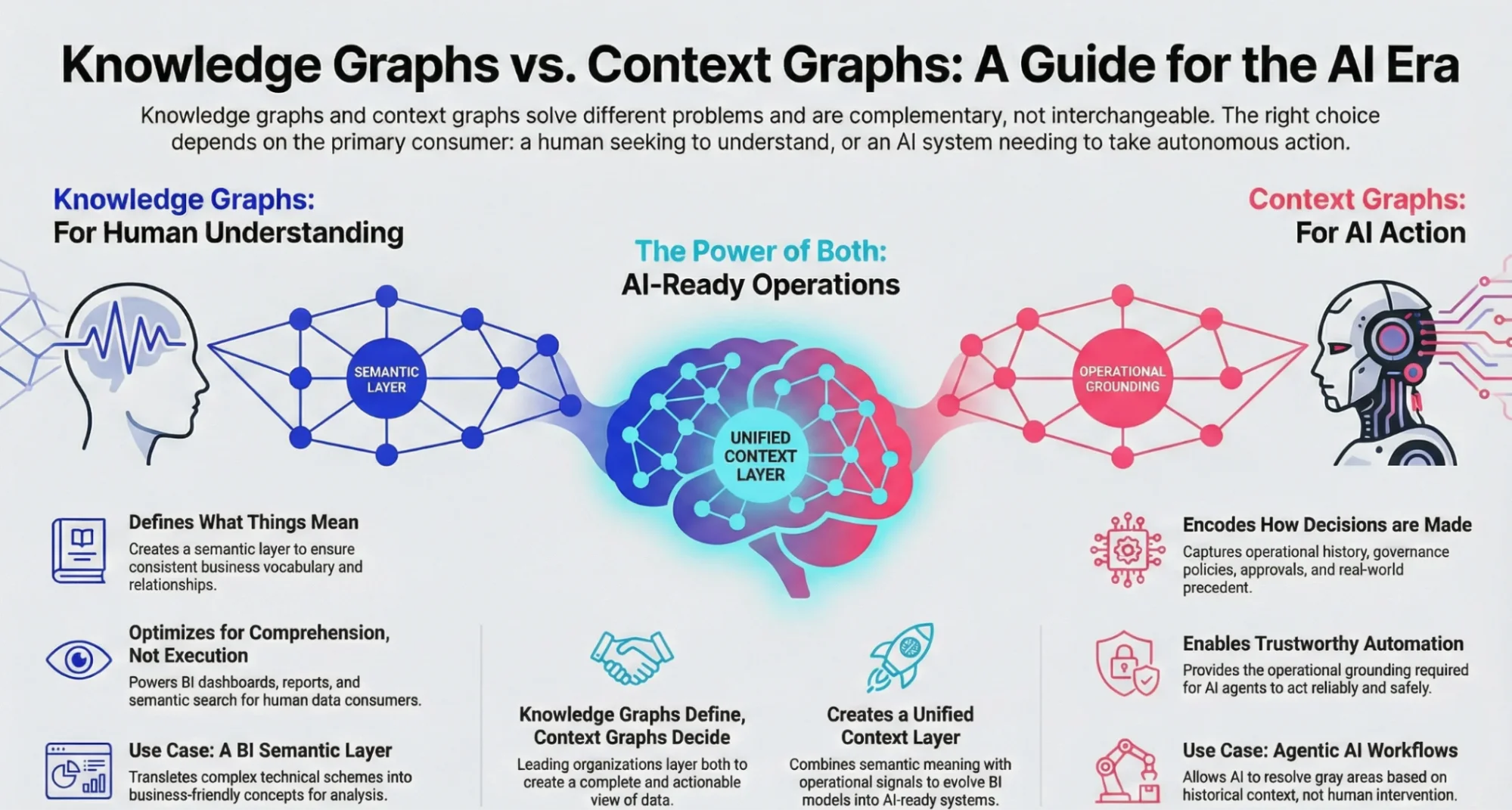
A quick comparison of knowledge graphs and context graphs - Image by Atlan.
Together, they give AI agents both the understanding and the judgment needed to act reliably in complex enterprise environments.
Going deeper? Read the CIO's guide to context graphs — covering strategy, architecture, and implementation recommendations.
Get the CIO GuideWhat are the critical capabilities needed to build effective context graphs?
Permalink to “What are the critical capabilities needed to build effective context graphs?”Gartner outlines four high-level capabilities that are necessary for robust context graph implementations. The best solution should stitch context across workflows, systems, and the heterogeneous mess of enterprise technology.
1. Capture decision traces
Permalink to “1. Capture decision traces”The raw material for a context graph exists in most organizations today; the challenge is capturing and structuring it systematically.
The first critical capability, according to Gartner, is a “robust system for capturing, documenting, mapping decision traces” from existing processes, workflows, communication channels (messaging, email, meeting transcripts), and outcomes of agentic systems.
The architectural foundation that makes this possible at scale is a metadata lakehouse. By providing a single layer that ingests, stores, and unifies metadata from disparate sources, a metadata lakehouse ensures that decision traces from across the organization can be systematically captured and made available to the context graph.
2. Build context-aware lineage graphs
Permalink to “2. Build context-aware lineage graphs”The second is graph building, informed by the decision traces listed earlier. This emerges from execution data rather than starting from a predefined schema. Context graphs are allowed to learn directly from decision traces, letting structure emerge as the organization’s workflows are observed and recorded. This makes them inherently more adaptive, as the graph evolves alongside the organization.
Automated, cross-system data lineage is what gives this adaptability its depth. By tracking how data moves and transforms across systems, lineage provides the directional backbone of the context-aware graph. When decision traces are layered on top of lineage, the graph captures both the data journey and the decision journey, producing a far richer and more reliable foundation for agent reasoning.
Where Does Your Organization Fall on the AI Context Maturity Ladder?
Take the Assessment3. Enable AI observability
Permalink to “3. Enable AI observability”The third is to activate the setup by connecting AI agent orchestration with the context graphs. This enables guardrailing, deep observability, governance, and agent evaluation in both the agent-building and productionalization stages.
As a result, agents read from the context graph and their actions and decisions are written back to it as auditable traces, enabling continuous evaluation against real decision logic.
Central to this is agentic data stewardship. These are AI agents purpose-built to automatically generate and enrich the context enterprises need, thereby reducing manual adoption overhead, shortening time-to-value, and ensuring consistent change management.
4. Build in continuous learning mechanisms
Permalink to “4. Build in continuous learning mechanisms”The fourth capability is a continuous learning system that allows AI agents to improve over time through decision flow simulation. This is where the compounding value of context graphs becomes most visible.
Critically, this learning system must be designed bidirectionally to support both the automation of new business processes and the ongoing documentation and improvement of existing workflows.
Operationalizing this capability is challenging as most organizations already have significant context sitting inside their data platforms. They struggle with making all the existing context available in a form that AI agents can actually understand and use.
That’s where a comprehensive Context Studio can help by transforming what already exists into an agent-ready context model, so that your systems can reason safely and reliably with:
-
Metadata and meaning
-
Relationships and lineage
-
Usage and ownership
-
Governance signals and policies
When these above capabilities work together, the business impact is measurable and compounding. Next, let’s look at the top benefits.
What are the biggest benefits of implementing context graphs successfully?
Permalink to “What are the biggest benefits of implementing context graphs successfully?”Organizations that implement context graphs effectively can expect value to compound across five distinct dimensions:
-
Holistic organizational memory: Every decision trace added to the context graph deepens the institutional procedural and decision logic memory available to agents.
-
Competitive differentiation: As LLM capabilities commoditize and horizontal agent platforms proliferate, proprietary organizational context becomes the primary differentiator. Organizations with richer, more accurate context graphs will consistently build more capable domain-specific agents.
-
Stronger compliance and risk governance: Context graphs directly improve AI governance quality by providing immutable audit trails of agent decision-making and enabling automated, scalable evaluation loops.
-
Accelerated enterprise ROI: Because context graphs map directly to business processes and measurable outcomes, they make it significantly easier to connect AI investments to business value.
-
Lower implementation cost and technical debt: According to Gartner, out-of-the-box domain-specific context graph accelerators can eliminate costly custom implementation work, compress delivery timelines, and prevent the buildup of technical debt that typically accompanies rapid agentic expansion. [1]
How can data leaders prepare for successful context graph implementation?
Permalink to “How can data leaders prepare for successful context graph implementation?”Preparing for context graph implementation requires both a strategic posture and a practical roadmap. Gartner emphasizes that data leaders should expand their investment in semantic layers and context graphs within the next 6-18 months.
Top Gartner recommendations include:
-
Own your context–decision logic, tribal knowledge, and institutional memory–and establish an open, federated context platform that any agent can read from, humans can govern, and the organization can improve over time.
-
Build the organizational memory layer by ‘expanding investment in semantic layers and data pipelines that capture, transform, and map domain-specific process metadata.’
-
Templatize complex business processes to ensure that institutional logic captured in one implementation carries forward to the next.
-
Implement AI agent evaluation techniques from day one. Connect evaluation directly to the context graph by covering task completion, goal attainment, trajectory assessment, and automated judgment techniques.
-
Treat context graph implementation as an incremental, domain-driven effort rather than an enterprise-wide transformation. Pick the workflows most critical to business outcomes, or the domains where agent failures carry the most cost. Measure concrete results: impact analysis time, AI answer accuracy, policy compliance rates.
Lastly, pick a platform that creates a universal context layer to help all of the enterprise data and AI systems work together. This layer should support cross-system connectivity, context synthesis and management by capturing all kinds of metadata, context delivery at inference time, feedback loops at scale, and governance for data and AI assets.
Moving forward: Context graph implementation for 2026 and beyond
Permalink to “Moving forward: Context graph implementation for 2026 and beyond”Context graphs represent the next foundational layer of enterprise AI infrastructure. The problem they solve is real and already visible: hundreds of AI agents operating with fragmented, inconsistent context, each building its own isolated view of the organization.
Gartner predicts that by 2028, the majority of enterprise AI agent systems are projected to be built on context graph foundations. The organizations that begin building that foundation now — starting with high-value domains, measuring concrete outcomes, and treating context as owned infrastructure rather than a vendor feature — will be the ones with a significant headstart.
An AI-ready metadata control plane like Atlan can help you bring your enterprise context layer to life and make sure that context stays alive over time: continuously generated, enriched, and maintained by a suite of AI agents. Book a personalized demo to know more.
FAQs about Gartner context graphs
Permalink to “FAQs about Gartner context graphs”1. How does Gartner define context graphs?
Permalink to “1. How does Gartner define context graphs?”Gartner defines context graphs as an evolution of traditional knowledge graphs, purpose-built to enhance AI model performance and specifically engineered for agentic AI grounding. Unlike knowledge graphs, which model static entities and relationships, context graphs extend into decision logic, workflow management, and event tracing.
2. What are decision traces?
Permalink to “2. What are decision traces?”Decision traces are the observable digital records of how a decision actually unfolded, capturing the why and the how. They cover what triggered a decision, what context informed it, what rules governed it, and what outcome it produced.
For AI agents, decision traces are searchable, replayable records that ground agent reasoning in real organizational logic rather than statistical inference. This makes agent behavior more accurate, auditable, and trustworthy over time.
3. What is a semantic layer and how is it different from a context graph?
Permalink to “3. What is a semantic layer and how is it different from a context graph?”A semantic layer defines the meaning of data with metric definitions, business entities, and how key terms like “revenue” or “customer health” are calculated. A context graph goes further, capturing how that data is used in decisions, who acted on it, and why. You can think of the semantic layer as the vocabulary and the context graph as the institutional memory of how that vocabulary gets applied in practice.
4. What is context engineering and why is it important for successful AI-assisted decisions?
Permalink to “4. What is context engineering and why is it important for successful AI-assisted decisions?”Context engineering is the discipline of establishing the connections between data elements and the business processes AI agents are designed to execute. It goes beyond prompt design to build a persistent, automated layer of organizational knowledge that agents can draw from at inference time.
5. How exactly do context graphs solve AI’s institutional memory problem?
Permalink to “5. How exactly do context graphs solve AI’s institutional memory problem?”AI agents fail in production because they lack the connective tissue between data and decisions — the logic, precedents, workflows, and tribal knowledge. Context graphs solve this by capturing decision traces, workflow logic, and procedural knowledge from across the organization and making it continuously available to agents.
Every decision an agent makes adds to this memory. As a result, better context produces more accurate decisions, which generate richer traces, further improving the context available to every AI agent.
6. How can you implement context graphs across your enterprise?
Permalink to “6. How can you implement context graphs across your enterprise?”Gartner recommends starting with a metadata foundation that continuously captures context across pipelines. The natural process would be expanding investments in existing semantic layers. Next, build graph-native lineage across critical pipelines, then integrate business glossaries, governance policies, and domain ontologies as active graph elements. After that, enable AI agents to navigate the graph for decision-making context and continuously add context to maintain a relevant, continuously updated enterprise-wide infrastructure.
Consider investing in a metadata control plane like Atlan that unifies all your existing semantic definitions and wraps them with the context AI and BI actually need. This sets the stage for an open, interoperable, governed, and deeply connected data and AI estate.
Share this article