

A platform-native context layer is vendor-specific infrastructure that resolves context only within its own ecosystem. Enterprise AI agents typically query three to five platforms simultaneously, and single-platform context architectures cannot resolve the governance gaps, semantic inconsistencies, and vendor lock-in that multi-platform estates produce by design.
The agent returns two answers to the same question. The CFO asks for Q4 recognized revenue. One agent, querying Snowflake’s semantic layer, surfaces $480M. Another agent, querying the dbt metric layer, surfaces $512M. Neither agent is malfunctioning. Neither data source is wrong. The enterprise data stack is working exactly as designed. The problem is that each platform defines recognized_revenue_q4 independently, and no layer above them resolves the conflict before it reaches the agent.
This is the production reality for enterprises running AI agents across multi-platform data stacks. The failure is not in the model. It is not in the data. It is in the context architecture.
| Quick Fact | Detail |
|---|---|
| What it is | A platform-native context layer provides semantic definitions, governance, and data lineage within a single vendor’s ecosystem (e.g., Snowflake, Databricks, AWS). It does not span multiple platforms. |
| Key problem | Enterprise AI agents typically query three to five platforms simultaneously. Platform-native context layers stop at the vendor boundary, creating governance gaps, conflicting metric definitions, and broken lineage chains. |
| Who’s affected | Data Architects and AI Platform Teams at enterprises running multi-platform stacks, typically 6-18 months post-POC when production agent queries begin touching multiple platforms. |
| Root cause | Market structure, not technology limitation. No single vendor’s context layer spans a competitor’s platform. The enterprise data estate is inherently multi-vendor; the context layer is not. |
| Solution type | Cross-platform context layer: infrastructure that sits above all platforms simultaneously, unifying semantic definitions, enforcing governance at inference time, and maintaining multi-hop data lineage. |
| Key metric | UC Berkeley researchers found leading multi-agent LLM frameworks fail up to 86.7% of the time on standard benchmarks (Cemri et al., arXiv:2503.13657, 2025), a failure rate primarily attributable to cross-platform context architecture gaps. |
What a platform-native context layer actually does
Vendor-specific infrastructure that gives AI agents access to semantic definitions, business glossaries, and governed data within a single platform’s ecosystem (such as Snowflake, Databricks, or AWS). A platform-native context layer resolves context within its own boundary; it does not span multiple data platforms or enforce governance across vendor boundaries.
Contrast with: enterprise context layer: infrastructure that operates above all platforms simultaneously, unifying definitions and enforcing governance regardless of data source.
Snowflake Cortex Analyst, Databricks Unity Catalog, and AWS Bedrock Knowledge Bases each solve context within their own ecosystem. None spans the full enterprise data estate.
Each of these tools represents genuine engineering investment. Snowflake Cortex Analyst lets agents query governed Snowflake data using natural language, grounded in the semantic models and business glossaries defined within Snowflake. Databricks Unity Catalog provides column-level governance, data lineage, and access controls across the Databricks lakehouse. AWS Bedrock Knowledge Bases lets agents retrieve relevant content from documents stored and managed in the AWS ecosystem.
These capabilities matter. The limitation is not what they do inside their ecosystems. It is what stops at the ecosystem boundary. A platform-native context layer is infrastructure that enriches AI agent queries with semantic definitions, access controls, and data lineage within a single vendor’s ecosystem. It makes agents context-aware inside that platform. It does not resolve entity conflicts, unify business glossaries, or enforce governance policies across platforms from different vendors. For a deeper comparison of the architectures, see context layer vs. semantic layer.
Why enterprises run three to five platforms: the structural root cause
The average enterprise runs three to five data platforms simultaneously. Snowflake handles analytics workloads. Databricks serves ML and data science teams. Salesforce and SAP store operational and financial data. BI tools like Tableau or Looker sit on top. dbt handles transformations. This multi-platform stack is not the result of poor planning. It is the result of decade-long acquisition and consolidation decisions, each rational in isolation.
Enterprises did not consolidate onto one vendor because no single vendor serves every workload well. Databricks was chosen for ML capabilities that Snowflake did not match at the time. Salesforce was not replaceable by a data warehouse. SAP carried years of operational history and compliance requirements that made migration impossible for most organizations. Best-of-breed decisions compounded into a multi-vendor reality.
No single vendor’s context layer spans this stack. No vendor has a financial incentive to make a competitor’s platform work better for the enterprise. A Snowflake context layer improves agent performance on Snowflake. It does not help agents that also query Databricks. No product roadmap update will close this gap. It is a market structure condition. For more on how context-aware AI agents address this challenge, see the linked resource. The framing of three to five platforms as the enterprise baseline is supported by a16z’s analysis of data agent infrastructure requirements (a16z, “Your Data Agents Need Context,” 2026).
The four failure modes of platform-native context in production
Platform-native context layers produce four specific failure modes in production. Semantic boundary failure creates conflicting metric definitions across platforms. Governance enforcement gaps leave access controls that stop at platform boundaries. Context fragmentation produces inconsistent knowledge graphs across platforms. Vendor lock-in escalation forces teams to rebuild context from scratch when adding new platforms. Each failure mode has a structural cause that single-vendor tools cannot resolve.
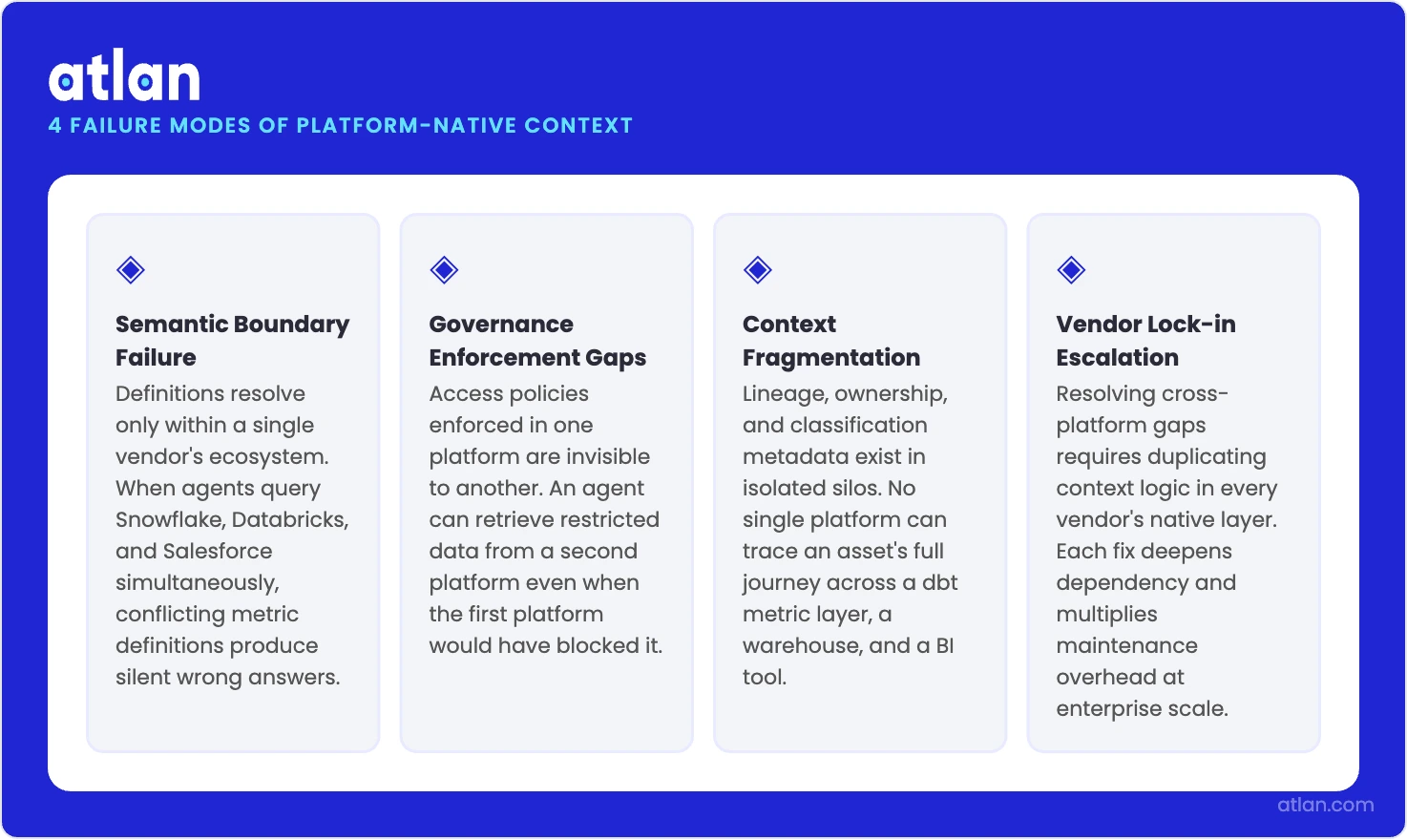
Why single-vendor context layers break enterprise AI agents across multi-platform environments. Source: Atlan.
What is semantic boundary failure and why do platform-native context layers cause it?
Semantic boundary failure occurs when the same business metric, such as recognized_revenue_q4, is defined differently in Snowflake’s semantic layer and the dbt metric layer, causing AI agents querying both platforms to produce divergent answers from the same underlying data.
When two agents return divergent revenue figures from different platforms, this is not an edge case. It is the default outcome when a business glossary is maintained independently inside each platform. Snowflake’s semantic model does not inherit dbt metric definitions, and vice versa. The only resolution point is a layer above both platforms that enforces a single governed definition. Without it, agents are not producing wrong answers. They are producing correct answers to different questions, which is worse.
If you asked the same revenue question to two different agents (each connected to a different platform), would you get the same number?
What is the governance enforcement gap in platform-native context layers?
Governance enforcement gaps occur when platform-native access controls govern data within the platform but cannot enforce policies when agents move data or context across platform boundaries.
Column-level governance in Databricks Unity Catalog works exactly as designed, within Databricks. When an AI agent makes a federated query that joins Databricks data with a Salesforce operational record, the column-level permissions defined in Unity Catalog do not propagate to the Salesforce side of that query. A data analyst restricted from PII columns in Databricks receives that PII if the agent’s cross-platform query bypasses the restriction.
This creates audit risk that CDOs cannot explain to compliance teams. Platform vendors cannot close this gap without a layer above them, because they cannot enforce access policies on another vendor’s platform. For the architectural model that addresses this, see the discussion of data governance and metadata layer for AI governance.
Can you demonstrate to an auditor that governance policies applied in one platform were enforced when an agent queried data from a second platform?
What is context fragmentation across multi-platform data stacks?
Context fragmentation occurs when each platform maintains its own context state, causing agents orchestrating across platforms to inherit inconsistent knowledge graphs that contradict each other at runtime.
An agent using LangGraph to orchestrate a workflow that touches Snowflake, Databricks, and a Salesforce operational database inherits the context state from each platform separately. These context states were not built to reconcile with each other. The same customer entity may have different identifiers, different attribute values, and different access permissions across each system. At runtime, the agent is not working from a unified knowledge graph. It is improvising a reconciliation between three incompatible ones.
Context fragmentation is not a data quality problem. The data is correct within each system. It is a context architecture problem: the agent lacks the cross-system mapping layer that would tell it these three records refer to the same entity.
Why does vendor lock-in escalate with each new platform added?
Vendor lock-in escalation occurs when adding a new platform to the data stack requires rebuilding context from scratch within that platform’s proprietary context framework, compounding the fragmentation with each new platform added.
When a new data platform enters the enterprise stack, the context layer work begins again. Business glossary terms must be re-entered in the new platform’s format. Governance policies must be reconfigured using the new vendor’s admin tooling. Entity mapping between the new platform and existing ones must be handled manually. Each new platform added to the stack multiplies the context maintenance burden across all existing platform-native context layers. The fragmentation compounds rather than converges.

Platform-native vs. cross-platform context layers: what each vendor covers
All five major platforms provide some form of context layer for AI agents. The differences emerge at the platform boundary: which capabilities extend across the full data estate, and which stop at the vendor’s own ecosystem. The table below maps specific capabilities against each platform. For a deeper look at the architecture distinction, see context layer vs. semantic layer.
All five platforms in this table are serious enterprise products that advance the state of the art within their ecosystems. The comparison is not a critique. It is a structural inventory.
| Platform | Semantic layer / business glossary | Cross-system entity resolution | Governance at inference time (cross-platform) | Cross-platform lineage | What it misses for multi-platform enterprises |
|---|---|---|---|---|---|
| Snowflake Cortex Analyst | Yes, within Snowflake | No | No, stops at Snowflake boundary | Snowflake-only | Cannot resolve entity conflicts with Databricks or Salesforce; governance does not propagate to federated queries |
| Databricks Unity Catalog | Partial, within Databricks lakehouse | No | No, stops at Databricks boundary | Databricks-only | No business glossary reconciliation with external systems; governance does not extend to Snowflake or operational queries |
| AWS Bedrock Knowledge Bases | No, RAG retrieval only; no structured semantic layer | No | No, limited to AWS-hosted data | AWS-only | Enterprise semantic layer; cross-vendor entity resolution; governance at inference for non-AWS data; blind to Snowflake and Databricks unless manually bridged |
| Google Agentspace | Partial, Google Cloud and BigQuery grounding | No | No, cross-cloud context not supported | Google Cloud-only | Non-Google platform governance; identity resolution beyond Google ecosystem; same structural limitation as all platform-native solutions |
| Atlan | Yes, cross-platform, spanning Snowflake, Databricks, dbt, Looker, Tableau, Salesforce, and 108 connectors in total | Yes | Yes, governance enforced at the inference boundary regardless of source system | Yes, multi-hop lineage across all connected systems | Designed as a cross-platform layer above all platforms, not a peer |
Note: Microsoft Copilot Studio has equivalent limitations to Google Agentspace for non-Microsoft platforms and is omitted from the main table for visual clarity.
Every platform-native tool in this table has a governance and context story. Every platform-native tool’s governance ends at its own boundary. The pattern is universal and structural, not the result of any individual vendor’s product decisions.
See how Atlan spans your entire data estate, not just one platform.
Talk to a context layer expertWhy cross-platform architecture is the only structural solution
A cross-platform context layer does three things platform-native tools cannot. It unifies semantic definitions across all data platforms into a single governed business glossary. It enforces access controls at the inference boundary regardless of data origin. It traces multi-hop data lineage across every system an AI agent touches. These three capabilities determine whether enterprise agents are trustworthy in production.
1. Unified semantic definitions
When an agent asks about revenue, the answer should be the same regardless of which platform the underlying data lives in. A cross-platform context layer enforces this by maintaining a single governed business glossary that all connected platforms reference. Snowflake’s semantic layer still exists; it inherits the definition from the cross-platform layer above it rather than maintaining its own. The $480M vs. $512M scenario becomes impossible when one governed definition propagates to all platforms simultaneously. This requires an active metadata capability: when a dbt model changes, the context updates across all connected platforms automatically rather than waiting for a manual sync. For a deeper look at how active metadata enables this, see active metadata 101.
2. Governance at inference time
“Governance at inference time” means access controls that follow the data, not the platform boundary. When an agent makes a cross-platform query, the governance layer intercepts that query, checks the access policies of every data source involved, and enforces the most restrictive applicable policy regardless of which platform hosts the data. A column-level restriction in Databricks Unity Catalog propagates to the query result even when the agent is pulling Salesforce records into the same response. For a CDO, this means audit trails that span platform boundaries, not platform-specific lineage that stops at each vendor’s edge. McKinsey’s State of AI 2025 found that fewer than one-third of organizations have begun scaling AI across the enterprise, with governance and context infrastructure consistently cited as blockers ahead of model selection.
3. Complete lineage provenance
A CDO who asks “where did this revenue forecast come from?” should receive a single provenance chain, not three partial chains that each stop at a platform boundary. A cross-platform context layer maintains column-level lineage across all connected systems: the Snowflake warehouse, the Databricks transformation, the dbt model, and the BI layer above them. An agent’s recommendation becomes auditable end-to-end. For the design of this infrastructure, see how to implement an enterprise context layer and Atlan’s enterprise context layer architecture.
Promethium reports (2025) that unifying five levels of enterprise context can achieve 94-99% AI accuracy, compared to 10-20% with schema information alone. Promethium publishes no methodology behind either figure, so treat the shape of the curve as the claim, not the precision.
What Atlan’s cross-platform context layer does
Atlan is a cross-platform context layer recognized as a Gartner Magic Quadrant Leader in both Metadata Management (2025) and Data and Analytics Governance (2026). Integrated with 108 connectors as of September 2026, Atlan enforces a single governed context layer above Snowflake, Databricks, dbt, Tableau, and operational systems simultaneously, deployed across global enterprises in financial services, technology, and capital markets.
| Challenge | Manual / platform-native approach | Atlan-automated |
|---|---|---|
| Business glossary consistency | Each platform maintains its own glossary; teams manually reconcile conflicts across systems | Single governed glossary propagated across all connected platforms; agents always receive the same definition |
| Cross-platform governance enforcement | Governance teams manually replicate policies in each platform’s admin console; cross-platform gaps remain | Governance policies defined once in Atlan; enforced at the inference boundary regardless of data source |
| Cross-system entity resolution | Data engineers write custom mapping tables; mapping degrades as systems change | Active metadata layer automatically resolves entity conflicts across connected systems |
| Multi-hop lineage | Lineage traced manually per platform; cross-platform chain requires analyst time | Column-level lineage traced automatically across all connected systems; complete provenance available on demand |
Atlan customers using the cross-platform context layer report a 75-87% POC win rate against alternatives and a 5x increase in data adoption across the organization (Atlan customer data, 2025). Learn more about Atlan’s enterprise context layer and the context layer hub for architecture and deployment resources.
What to do if you are already using a platform-native context layer
Platform-native context layers are not sunk costs when a cross-platform layer is added. Snowflake Cortex Analyst and Databricks Unity Catalog become governed inputs to the cross-platform layer above them. The transition is additive: existing semantic models and governance policies are preserved and extended, not replaced.
Step 1: Map your cross-system entity conflicts
Identify the 20-30 business metrics defined in more than one platform. Document the discrepancies. Revenue, margin, customer count, and ARR are the most common conflict points. This inventory becomes the foundation for the governed business glossary in the cross-platform layer.
Step 2: Identify your governance boundary gaps
List the access control policies active in each platform and map which ones fail to propagate across platform boundaries. PII restrictions and row-level security policies are the highest-risk categories. Each gap is a compliance exposure that platform-native tools cannot close without external intervention.
Step 3: Run a 90-day context layer assessment
Deploy a cross-platform context layer above existing tools and instrument it to capture governance gaps and metric conflicts automatically. A 90-day assessment with the 20-30 top metrics, the three highest-volume entity types (customer, product, account), and column-level access controls enforced at the inference boundary addresses the majority of production agent failures.
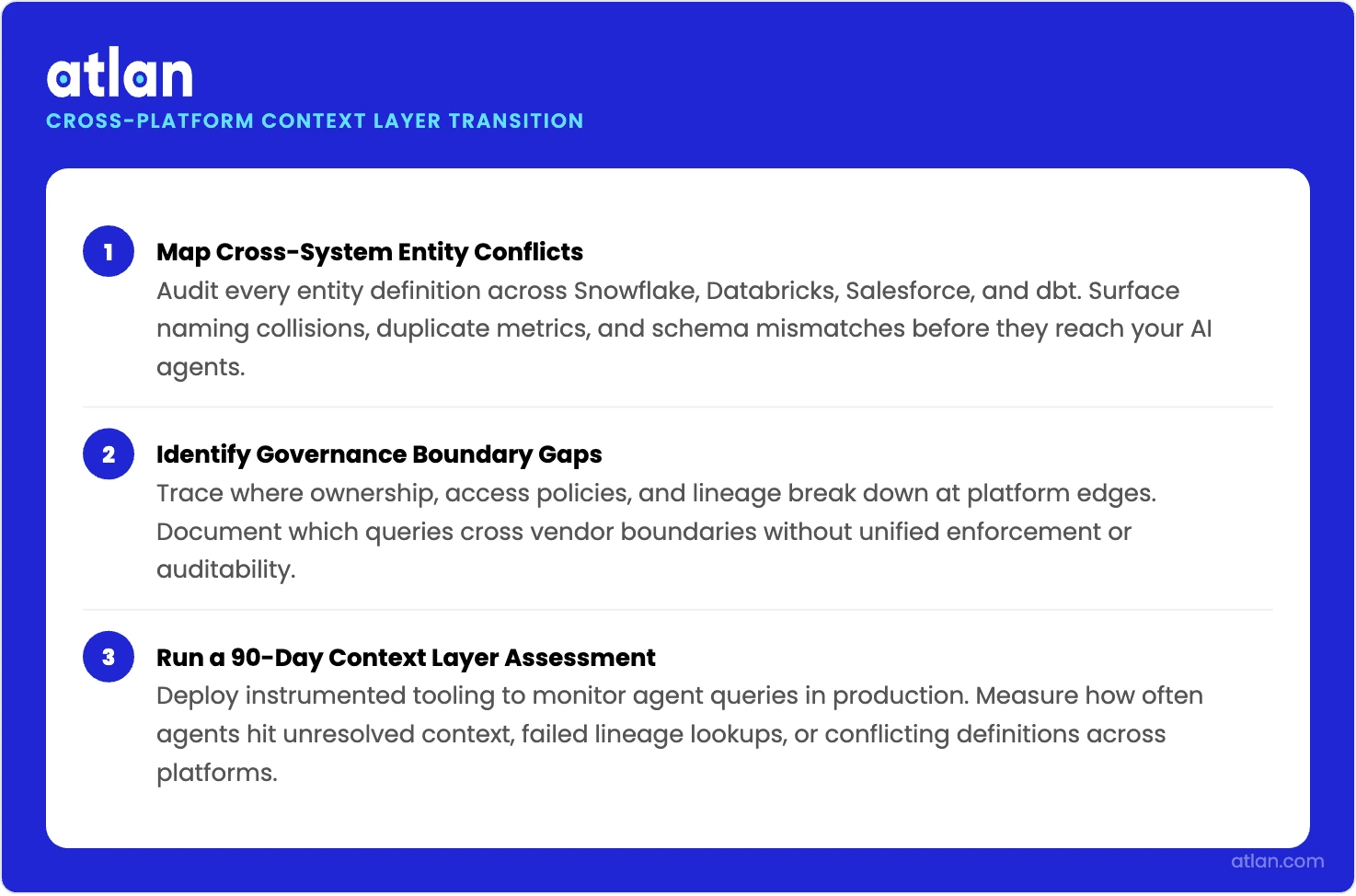
Map conflicts, close governance gaps, and assess your context layer in 90 days. Source: Atlan.
The assessment is not a rip-and-replace project. It is an additive layer that makes existing platform investments more reliable. Platform-native tools continue working exactly as before, with a governed reconciliation layer above them. See how to implement an enterprise context layer for a detailed implementation framework.
FAQs about platform-native context layers and enterprise AI agents
What is a platform-native context layer, and do we still need a cross-platform context layer after deploying Snowflake Cortex?
A platform-native context layer, such as Snowflake Cortex Analyst or Databricks Unity Catalog, provides semantic models, business glossaries, and governance enforcement within a single vendor’s ecosystem. An enterprise context layer operates above all platforms simultaneously, resolving entity conflicts, enforcing governance at the inference boundary, and maintaining cross-system lineage regardless of data source.
Snowflake Cortex solves context within the Snowflake ecosystem. If all enterprise AI agents query only Snowflake data, Cortex is sufficient within that boundary. If agents also access Databricks, Salesforce, operational databases, or BI tools, Snowflake Cortex leaves cross-system entity resolution, governance enforcement, and multi-hop lineage unaddressed. A cross-platform layer reconciles these gaps above the platform level.
How is a context layer different from just giving the agent a system prompt?
A system prompt is static and cannot query live data systems, enforce access controls at runtime, or resolve entity conflicts across platforms. A context layer is active infrastructure: it retrieves the right context at inference time, applies governance policies, checks data lineage, and delivers business definitions from a governed source, dynamically, for every agent request.
Who owns the context layer, and how do we prevent context drift as business definitions change?
In most enterprises, context layer ownership is split and unclear, which is a governance risk in itself. The data team owns semantic definitions and the business glossary. The AI team owns agent behavior and routing logic. The platform team owns infrastructure. A cross-platform context layer requires joint governance: data and AI teams must co-own the policies that determine what context agents receive and from which source.
Context drift occurs when business definitions evolve in one system but are not propagated to the context layer agents consume. Prevention requires treating business glossary updates as governed change events: versioned, reviewed, and propagated automatically. A cross-platform context layer with active metadata capabilities detects definitional changes at the source and updates the context all agents receive, rather than waiting for a manual sync.
Can a vector database or Model Context Protocol replace a context layer for enterprise AI agents?
Vector databases solve semantic retrieval, finding relevant passages in unstructured content. They do not solve structured enterprise context: business metric definitions, column-level access controls, cross-system entity resolution, or data lineage. For agents querying analytical data, a vector database without a governance layer above it returns semantically similar but factually incorrect results when underlying data has conflicting definitions across platforms.
Model Context Protocol (MCP) standardizes how agents request and receive context from external systems. It is a delivery protocol, not a governance layer. MCP tells agents where to look; an enterprise context layer determines what they see and what they are permitted to access. For production enterprise deployments, MCP is most effective when the context sources it connects to are governed, versioned, and cross-platform by design.
What is the minimum viable context layer to get agents working in 90 days?
A 90-day minimum viable context layer requires three components: a governed business glossary covering the 20-30 most queried metrics, cross-system entity resolution for the top three entity types (customer, product, account), and column-level access controls enforced at the inference boundary. These three components address the majority of production agent failures. Full ontology coverage, multi-hop lineage, and enterprise memory can be added in subsequent sprints.
Platform by platform
- AWS: Amazon Quick Suite, its semantic layer, the Amazon Q, QuickSight and Glue bundle, Bedrock Knowledge Bases, managed knowledge base vs. a custom RAG pipeline, DataZone vs. a cross-cloud governance platform, DataZone vs. Atlan and data governance on AWS.
- Google Cloud: Knowledge Catalog, and Knowledge Catalog vs. a neutral catalog for BigQuery.
- Databricks: a context layer for Databricks, and Omnigent vs. a neutral context layer.
- Snowflake: a context layer for Snowflake.
- Salesforce: Agentforce vs. an independent context layer.
- SAP: enterprise alternatives to SAP Master Data Governance.
- Microsoft: the Microsoft Fabric guide.
When the platform boundary becomes the production ceiling
Snowflake, Databricks, AWS, and Google have each built genuine context infrastructure. Snowflake Cortex Analyst handles natural language queries against governed Snowflake data with real precision. Databricks Unity Catalog provides column-level governance that data teams trust for sensitive lakehouse workloads. These are not partial products. They are complete solutions to the problem they were designed to solve.
The production ceiling appears when an AI agent’s query leaves that ecosystem. No single vendor can serve the full enterprise data estate because the full enterprise data estate was never built on a single vendor. For a CDO running AI agents across Snowflake, Databricks, Salesforce, and dbt simultaneously, the cross-platform context layer is not a future-state architecture consideration. It is the infrastructure condition for production reliability right now.
The question CDOs and AI Platform Teams face is not “should we replace our platform-native context layer?” It is “what layer do we add above it so that enterprise agents are reliable across our full data estate, not just within one platform’s boundary?”
