

AI platform architecture is the layered system of gateways, guardrails, and orchestration that runs models in production, and the published reference architectures from Databricks, AWS, Microsoft, and AtScale each concentrate on part of it. Atlan’s four-layer model, Agent Execution Layer, AI Control Plane, Context Layer, and Data Estate, names both floors as one system with one shared failure mode.

Atlan approaches this stack through its Context Agents, Orion the Ontologist, Sage the Metric Arbiter, Vera the Quality Scorer, and Atlas the Domain Classifier, which mine and govern the Context Layer so whatever sits above it inherits disambiguated, current meaning instead of raw keyword matching. The Context Lakehouse delivers that context through the protocols a Control Plane already speaks: MCP, A2A, SQL, and REST+Graph API. Most vendor content still treats the Control Plane as the whole story, stopping at the AI control plane and skipping the governed layer beneath it.
The stack has four layers (detailed below), and the split matters because each layer fails differently. Gartner (Feb 2026) projects AI-governance spend will hit $492M in 2026, and separately that by 2030, roughly 50% of AI agent deployment failures will trace back to insufficient governance enforcement, exactly the failure a disconnected Control Plane and Context Layer produce.
How does AI platform architecture work?
| Layer | Owned By | Fails When |
|---|---|---|
| Agent Execution Layer | Product and application teams | Agents duplicate context in local memory instead of pulling from a shared source |
| AI Control Plane | Platform, infra, and SRE teams | Guardrails and evals judge business terms they were never given the meaning of |
| Context Layer | Data and platform teams, contested | Left as a data team problem to solve later |
| Data Estate | Data engineering | Sources are ungoverned or undocumented, so the Context Layer above has nothing reliable to draw from |
Atlan’s own framing states the dependency directly: the AI Control Plane is a subsystem within the Context Layer, because a gateway or guardrail has nothing to check requests against until the layer beneath it is governed. Verizon is building an enterprise-wide agent platform for 23,000 engineers and found context doesn’t transfer across Gemini Enterprise, LangGraph, and other runtimes: “the root cause isn’t tooling, it’s architecture.” Lowe’s maps its stack as agent layer, thin memory, control plane, context layer, stating directly: “we have not created a context layer.” Rebuilding context from scratch per agent, per runtime, instead of reusing a portable, governed context layer, is the pattern both describe.
According to Databricks (2025), data governance is “the backbone of responsible AI architecture,” yet its reference architecture names governance as an input, not a distinct layer with its own owner. AWS’s prescriptive guidance for agentic AI (2026) is strong on orchestration but frames governance mostly as identity and access control. For the build sequence, see how to build a centralized AI platform. Most enterprises already have a control plane; the question is whether it sits on a governed foundation.
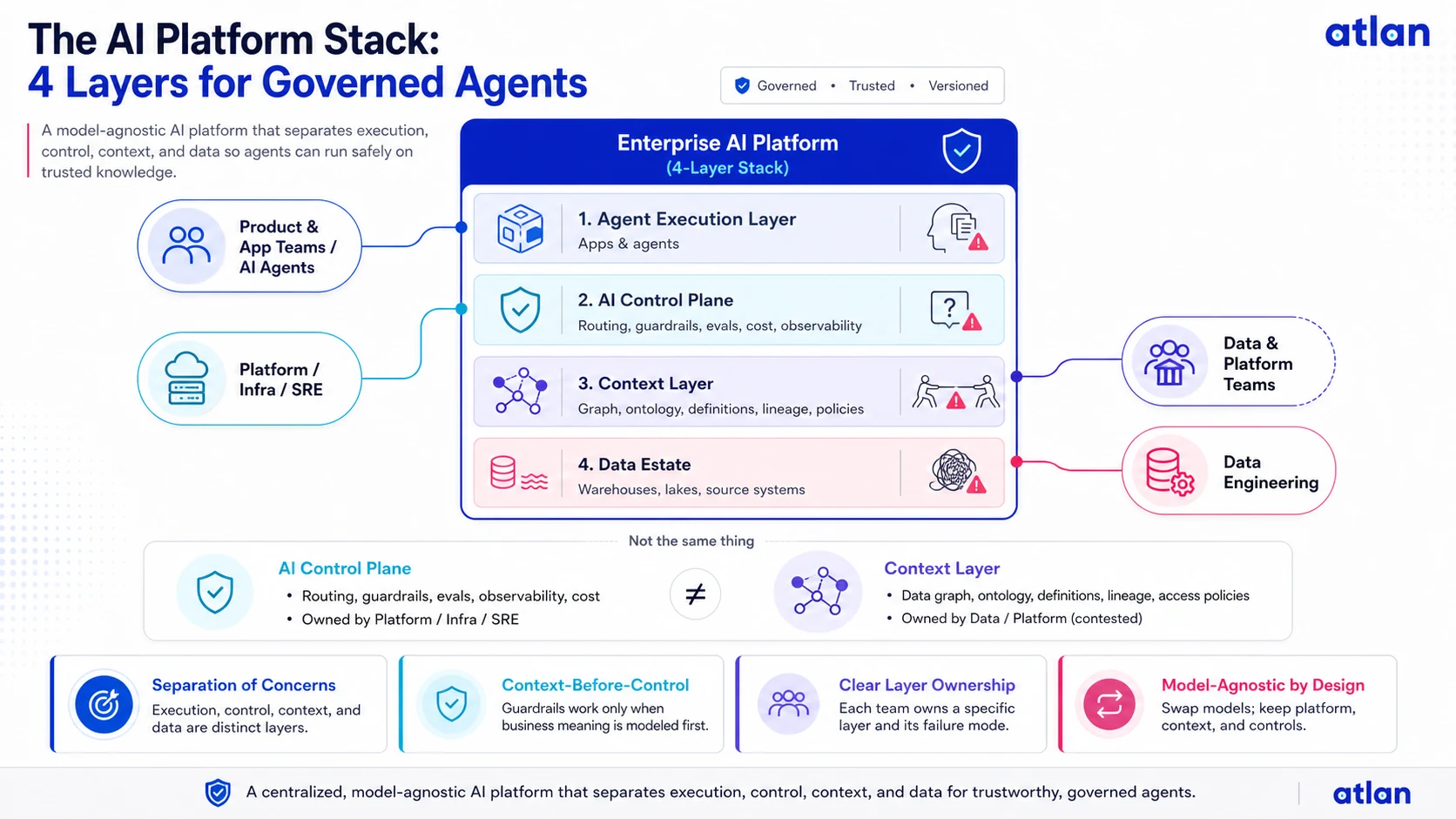
The four-layer AI platform stack. Source: Atlan.
AI control plane vs Context Layer: what’s the difference?
The AI Control Plane and the Context Layer are architecturally distinct but share one source of truth, not two silos or one undifferentiated blob, the tension Al-Futtaim and Cargill were both debating live about their own agentic architecture.
| Dimension | AI Control Plane | Context Layer |
|---|---|---|
| Owns | Routing, guardrails, evals, observability, cost and policy enforcement | Data graph, ontology, business definitions, lineage, access policy on meaning |
| Fails When | It has no governed context to check requests against | It’s built, but nothing above it consumes it via a shared protocol |
| Example Tools | LiteLLM, Portkey Gateway | Context Lakehouse, knowledge graph, semantic layer |
| Typical Owner | Platform, infra, and SRE | Data and platform, contested, see context layer ownership |
Get the Context Layer Ebook
A practical breakdown of why the layer beneath your control plane is the one that actually determines whether guardrails and model councils work.
Get the EbookCargill is standing up an LLM gateway, an MCP gateway, and guardrails, describing it plainly: “the LLM gateway is our control plane.” Atlan sits underneath as the Context Layer, so agents answer over governed data rather than raw tables. Al-Futtaim positions Atlan as sitting “between your different systems… and your agentic architecture,” providing “the single layer of consistency” plus portability, and flagged that Databricks is announcing its own ontology and knowledge-graph capabilities.
Kearney frames the problem as context portability: “if you’re not having a shared layer, all of those new agents, they have to rebuild all of that context from scratch,” served to agents “via MCP, SQL, APIs, whatever your preferred integration flavor is.” AtScale’s own architecture glossary gets closest to this among the vendors reviewed, framing the layer around metrics and dimensional modeling. AtScale delivers those governed metrics to agents through its own MCP server; what a glossary entry on architecture does not cover is the knowledge graph that carries ownership, policy, and lineage alongside the metric.
Use whatever AI gateway you already run. The Context Layer underneath decides whether its guardrails understand the business, not a replacement for the gateway itself.
Why do AI control plane failures trace back to the Context Layer?
Guardrail misfires, model-council delays, prompt sprawl, and cost opacity read like four separate bugs. Each traces to the same missing piece: a control-plane tool making a judgment call without a governed source to check it against.
Guardrails misfire without governed business context
Guardrails built without a Context Layer flag valid business vocabulary as violations, having no domain-specific meaning to check against, the gap Cargill and Al-Futtaim are both debating whose job it is to close. A guardrail pattern-matching against static rule lists cannot tell a genuine violation from an ordinary term in your own business glossary that resembles one.
Model councils review models blind to the context those models touch
Model councils, the AI council and model-risk teams enterprises are standing up, trade speed for risk while operating blind to the Context Layer, reviewing Intelligence without reviewing Context. A council can audit training data and guardrails and still have no visibility into whether the context engineering framework feeding it is current or stale.
Prompt sprawl and cost opacity are context problems wearing different costumes
Enterprises describe engineers each writing bespoke system prompts, resolved only once prompts move into a shared library backed by governed context. The same shows up in cost conversations: LLM cost comes up alongside agent sprawl and unclear ownership, a context and inventory problem wearing a FinOps costume, needing LLM cost management tied to a governed definition of query meaning.
According to VentureBeat’s “Control Gap” survey of 145 enterprises (2026), 32% name the lack of a single accountable owner as their top governance barrier, and 17% say no role holds formal accountability at all. The AGL-1 arXiv paper (2026) reaches a similar conclusion: governance layers must span identity, policy, provenance, memory, and knowledge integrity together.
How to build an AI agent harness covers the execution-layer half of this: a harness with no agent memory architecture tied to governed context reproduces the same prompt-sprawl and drift problems.
How to evaluate an AI platform architecture
| Criterion | What to Look For |
|---|---|
| Context portability | A shared context layer queryable across runtimes, not per-agent memory |
| Protocol support | MCP, A2A, SQL, and REST+Graph API support, not one proprietary interface |
| Explicit ownership | A named owner for Context Layer decisions, distinct from Control Plane ownership |
| Guardrail-context connection | Guardrails that query governed business terms, not just static keyword lists |
| Model-council visibility | Council review that includes what data and context a model will touch |
| Governed metadata source | An existing catalog and lineage layer the context layer builds from |
Ask vendors directly: can your context layer serve MCP, A2A, SQL, and API consumers from one governed source? Who owns a definition when data and AI/platform teams disagree? Databricks’ own semantic layer guidance is useful here, though it stops short of the full knowledge-graph and MCP-delivery scope.
For the operational lifecycle discipline alongside this architecture, see what is LLMOps and LLMOps vs MLOps. For gateway options, best LLMOps platforms, LiteLLM vs Portkey vs Bedrock Gateway, what is an AI gateway, and model router vs gateway define the routing terms assumed here.
Score Your Own Stack
Run the criteria above against your current architecture in a few minutes and see where the Context Layer gap actually sits.
Take the AssessmentWhat common mistakes do enterprises make in AI platform architecture?
Building gateways, guardrails, and evals first, then treating the Context Layer as a data team problem, is the most common sequencing error. Databricks names data governance as a control-plane input, never a distinct box with its own owner; AWS and Microsoft treat context largely as a vector-store detail inside RAG. The second mistake is letting every new agent rebuild its own context in local memory instead of pulling from one portable source: one team put it plainly, they can already build agents across Google ADK, Salesforce, ServiceNow, and Workday, but “moving that context everywhere and drawing upon it when you need it is the thing we don’t have an answer for.” The third mistake is assuming governance equals security and identity-and-access controls alone. AI agent access control and AI agent governance both matter, but neither disambiguates a business term’s meaning. AI security and data governance vs AI governance cover identity, not meaning.
According to Forbes Technology Council (March 2026), the business context gap is what undermines enterprise AI deployments, not a shortage of models or compute. Teams that treat AI model versioning and AI agent risk and guardrails checklists as sufficient governance optimize the layer easiest to instrument, not the one that determines whether it means anything. An enterprise AI agent guardrails checklist helps only once checked against a governed source of meaning.
Each mistake optimizes a layer that’s easy to see and skips the layer that’s easy to defer, moving the failure downstream to whichever guardrail, council, or cost report hits it first.
How Atlan approaches AI platform architecture
Enterprises furnish the Control Plane, gateways, guardrails, evals, observability, while the Context Layer underneath stays ungoverned, treated as a data team problem instead of a peer architectural layer, the exact assumption why AI agents need an enterprise context layer argues against. In Verizon’s own words: “the root cause isn’t tooling, it’s architecture.”
Atlan’s Context Agents, Orion the Ontologist, Sage the Metric Arbiter, Vera the Quality Scorer, and Atlas the Domain Classifier, mine and govern the Context Layer so whatever sits above it inherits disambiguated, current meaning instead of raw keyword matching. The Context Lakehouse, a knowledge graph paired with Iceberg-native storage and vector search, delivers that context through the protocols the Control Plane already speaks: MCP, A2A, SQL, and REST+Graph API, without ripping out what’s built; see how to implement an enterprise context layer for AI for the sequence.
Kearney engaged directly with this framing, asking how the enterprise data graph connects to systems of record, confirming this is a live debate, not a one-way pitch. Al-Futtaim adopted the same framing for its single layer of consistency plus portability. Both treated the Context Layer as the missing piece determining whether the Control Plane could be trusted, why Context Layer ROI is a board-level question, not a data-team line item.
Context Layer ROI Calculator
Estimate what a governed Context Layer is worth against the guardrail rework, prompt rewrites, and cost blind spots your control plane is already absorbing.
Calculate ROIReal stories from real customers: governing the floor beneath the control plane
"We're excited to build the future of AI governance with Atlan. All of the work that we did to get to a shared language at Workday can be leveraged by AI via Atlan's MCP server…as part of Atlan's AI Labs, we're co-building the semantic layer that AI needs with new constructs, like context products."
— Joe DosSantos, VP of Enterprise Data & Analytics, Workday

"Atlan is much more than a catalog of catalogs. It's more of a context operating system…Atlan enabled us to easily activate metadata for everything from discovery in the marketplace to AI governance to data quality to an MCP server delivering context to AI models."
— Sridher Arumugham, Chief Data & Analytics Officer, DigiKey

Why the Context Layer decides whether your control plane works
AI platform architecture is not one layer, it’s four: Agent Execution, AI Control Plane, Context Layer, and Data Estate. Enterprises furnishing only the top two are the ones whose guardrails misfire, model councils operate blind, and costs stay opaque. Databricks, AWS, Microsoft, and AtScale each cover pieces of this stack well. The connective line this page draws, from a Control Plane decision back to the layer it depends on, is the argument Atlan is making, not a gap any of them has published.
Verizon and Lowe’s both describe that same diagnosis: the root cause is architecture, not tooling. Whatever gateway is already in place, the fix doesn’t require replacing it, it requires governing the floor underneath, the floor Kearney and Al-Futtaim are actively working through right now.
FAQs about AI platform architecture
1. What are the four layers of AI platform architecture?
The Agent Execution Layer (agents and copilots), the AI Control Plane (gateway, guardrails, evals, observability), the Context Layer (data graph, context engineering, lakehouse), and the Data Estate (warehouses, lakes, SaaS systems). Most enterprises invest in the top two, leaving the Context Layer ungoverned.
2. What is the difference between AI infrastructure and AI platform architecture?
Infrastructure is the compute, storage, and networking that runs models. Architecture is the blueprint connecting infrastructure to governance, orchestration, and the business context models need to answer correctly.
3. What is an AI control plane?
The subsystem handling gateway routing, guardrails, evals, and observability, unifying identity, policy, and cost, working best as a subsystem within a governed Context Layer, not a standalone category.
4. What is AI governance in an enterprise context?
Policy enforcement, access control, and accountability for how models and agents are approved, monitored, and audited. Gartner projects spend reaching $492M in 2026, with roughly 50% of agent failures by 2030 tracing to insufficient governance.
5. Why is a vector database needed for AI platform architecture?
It supports RAG via semantic search over unstructured content, one input into the Context Layer, not a substitute for a governed data graph or ontology.
6. How can you prevent drift in production AI systems?
Treat the Context Layer as a continuously governed source, monitor for schema changes, and route guardrails and evals against current business terms rather than static rule lists.
7. What is a model council, and how does it relate to AI platform architecture?
A governance body approving which models and agents can go live. Without visibility into the Context Layer those models touch, a council reviews Intelligence without reviewing Context.
Sources
- Agentic AI Architecture in the Enterprise, AWS Prescriptive Guidance: https://docs.aws.amazon.com/prescriptive-guidance/latest/govern-architect-agentic-ai/enterprise-architecture.html
- AI Architecture Glossary, AtScale: https://www.atscale.com/glossary/ai-architecture/
- Gartner Global AI Regulations Fuel Billion-Dollar Market for AI Governance Platforms, Gartner Newsroom: https://www.gartner.com/en/newsroom/press-releases/2026-02-17-gartner-global-ai-regulations-fuel-billion-dollar-market-for-ai-governance-platforms
- Gartner Announces Top Predictions for Data and Analytics in 2026, Gartner Newsroom: https://www.gartner.com/en/newsroom/press-releases/2026-03-11-gartner-announces-top-predictions-for-data-and-analytics-in-2026
- The Control Gap: Enterprise AI Organizations Have an Ownership Problem, VentureBeat: https://venturebeat.com/resources/the-control-gap-enterprise-ai-organizations-have-an-ownership-problem-not-a-technology-problem-and-most-are-governing-it-by-hand
- AGL-1: The Enterprise AI Governance Layer as a Control Plane for Trusted Enterprise Intelligence, arXiv: https://arxiv.org/abs/2607.03516
- The Business Context Gap Undermining Enterprise AI, Forbes Technology Council: https://www.forbes.com/councils/forbestechcouncil/2026/03/12/the-business-context-gap-undermining-enterprise-ai/
- LiteLLM, GitHub: https://github.com/BerriAI/litellm
- Portkey Gateway, GitHub: https://github.com/Portkey-AI/gateway
