

The 2026 tool landscape for agent context layers spans at least 17 distinct platforms across 5 functional categories, from enterprise context layers with 108 connectors to temporal knowledge graphs with 30,985 GitHub stars. Picking the right tool starts with understanding which category of context problem you are actually solving, because a retrieval-first vector database and a governed cross-platform context layer are not interchangeable, even if both claim to “provide context to AI agents.”
This directory organizes every major tool by use case, not alphabetically, so you can identify the right category before evaluating individual products. For a side-by-side feature comparison matrix, see Agent Context Layer Tools Compared.
For teams comparing these tools, WTF Is the Context Layer, a 42-page field guide, sets out what a production context layer needs across retrieval, memory, and governance, so the tooling choice follows the architecture.
What are agent context layer tools?
Agent context layer tools supply AI agents with the structured inputs they need to act accurately: business definitions, entity relationships, data lineage, policy constraints, and memory of past interactions. They solve the problem that context engineering practitioners call “context starvation”: agents receiving raw schemas and table names instead of governed business meaning.
Datadog’s 2026 State of AI Engineering found that 69% of all input tokens in enterprise LLM traces are consumed by system prompts, instructions, policies, and tool descriptions repeated on every call. That is a structural problem, and context layer tools are the structural fix.
| Quick Facts | |
|---|---|
| Tools in this directory | 17 |
| Use-case categories | 5 |
| Tools with a vendor-documented first-party MCP server | 7 of 17 |
| MCP ecosystem installs (March 2026) | 97M+ monthly |
| MCP servers available (May 2026) | 14,000+ |
| Most-starred OSS tool in directory | LangChain (~100K GitHub stars, May 2026) |
| Fastest-growing enterprise category | Cross-platform context layer |
For a conceptual foundation before diving into specific tools, read What Is an Agent Context Layer? and Core Components of a Context Layer.
The complete agent context layer tools directory
The table below covers all 17 tools in this directory. Each entry includes the tool’s functional type, its primary use case, and whether it is open-source or commercial. MCP (Model Context Protocol) support is included because MCP has reached 97M monthly downloads as of March 2026 and is now a baseline expectation for agent-ready infrastructure.
| Tool | Type | Best For | Open-Source or Commercial | MCP Support |
|---|---|---|---|---|
| Atlan | Enterprise context layer | The context layer for AI: 100+ data sources, native MCP server, AI-bootstrapped context, one shared layer for every agent and tool | Commercial (SaaS) | Yes - native governed MCP server |
| Snowflake Cortex | Platform-native AI agent framework | Agents running fully inside Snowflake; warehouse-native five-layer context framework | Commercial | Yes (MCP connectors in GA) |
| Databricks Unity Catalog | Lakehouse governance / context layer | Lakehouse-native semantic layer; UC Business Semantics GA April 2026; Genie Ontology (Public Preview) adds inferred context; multi-tenant governance | Commercial (OSS fork ~7K stars) | Yes - Unity AI Gateway; Genie One MCP server returns answers grounded in Genie Ontology |
| Neo4j | Graph database / knowledge graph platform | Knowledge graphs, multi-hop entity reasoning, decision-trace capture, GraphRAG | Community Edition is GPL v3, which reaches a product you distribute; Enterprise and AuraDB are commercial | Partial (API-accessible; MCP server available) |
| Zep + Graphiti | Temporal knowledge graph / agent memory | Temporal reasoning: tracking when facts change, CRM-style entity memory, compliance workflows | Graphiti open-source (Apache 2.0); Zep Cloud commercial | Yes - Graphiti MCP Server 1.0 |
| Cognee | Knowledge graph memory / memory control plane | Multi-format ingestion (PDFs, Slack, Notion, audio) into queryable local knowledge graphs | Open-source (Apache 2.0) + Cognee Cloud commercial | Yes - Cognee MCP |
| LlamaIndex | Data framework / retrieval-first agent infrastructure | Large document collections, advanced retrieval (sub-question decomposition, hybrid search), 160+ connectors | Open-source (MIT) + LlamaCloud commercial | LlamaHub connectors, which are not MCP |
| Weaviate | AI-native vector database / retrieval platform | Multi-tenant SaaS platforms, hybrid semantic + keyword retrieval without a separate BM25 layer | BSD-3-Clause core, plus a licence-key-gated wl/ directory; Weaviate Cloud commercial |
Yes - MCP server inside the core binary, GA at v1.38 |
| Pinecone | Managed vector database / knowledge execution layer | Billion-vector scale with zero infrastructure management; cited context artifacts via Nexus | Commercial only | Yes - MCP servers for the database and for each Assistant |
| Redis Iris | Context and memory platform / real-time context engine | Real-time CDC-fed context via Redis Data Integration; sub-millisecond session memory | Commercial (Redis Cloud add-on) | Yes - Context Retriever auto-generates MCP tools |
| LangChain / LangMem / LangGraph | Agent orchestration framework + memory SDK | Teams building LangGraph agents who need orchestration + episodic, semantic, and procedural memory in one stack | Open-source (MIT) + LangSmith commercial | Partial - community plugins |
| Letta (MemGPT) | Stateful agent platform / memory-first framework | Long-running agents that learn from experience; four documented memory tiers; self-modifying behavior | Open-source self-hosted (Apache 2.0) + Letta Cloud commercial | Documented first-party MCP; server-side MCP integrations are being sunset |
| Mem0 | Universal memory layer for AI agents | Drop-in personalization for chatbots and assistants; YC-backed. SOC 2 and HIPAA readiness belongs to the managed Platform, not the self-hosted SDK | Apache-2.0 SDK (65,589 GitHub stars) + managed Platform | Yes - Mem0 MCP server, a Platform feature |
| Microsoft Agent Framework | Enterprise AI orchestration SDK / agent framework | Azure / Copilot-centric multi-agent patterns; built-in connectors for Azure AI Search, Elasticsearch, Qdrant | Open-source (MIT; 27,930 GitHub stars) | Yes - native MCP integration |
| Anthropic MCP | Open protocol standard for agent-tool connectivity | Connecting any AI agent to external tools, databases, and data sources; the connectivity standard for the ecosystem | Free and open standard; the spec repo is mid-transition from MIT to Apache 2.0, with docs under CC BY 4.0 | IS the standard |
| Qdrant | High-performance vector database | Filtering over high-cardinality payloads; Rust-native performance; open source, Managed, Hybrid or Private Cloud | Open-source (Apache 2.0) + Qdrant Cloud commercial | Semantic Kernel and LangChain integrations, which are not MCP |
For a full side-by-side feature matrix covering governance depth, lineage support, compliance certifications, and pricing, see Agent Context Layer Tools Compared.
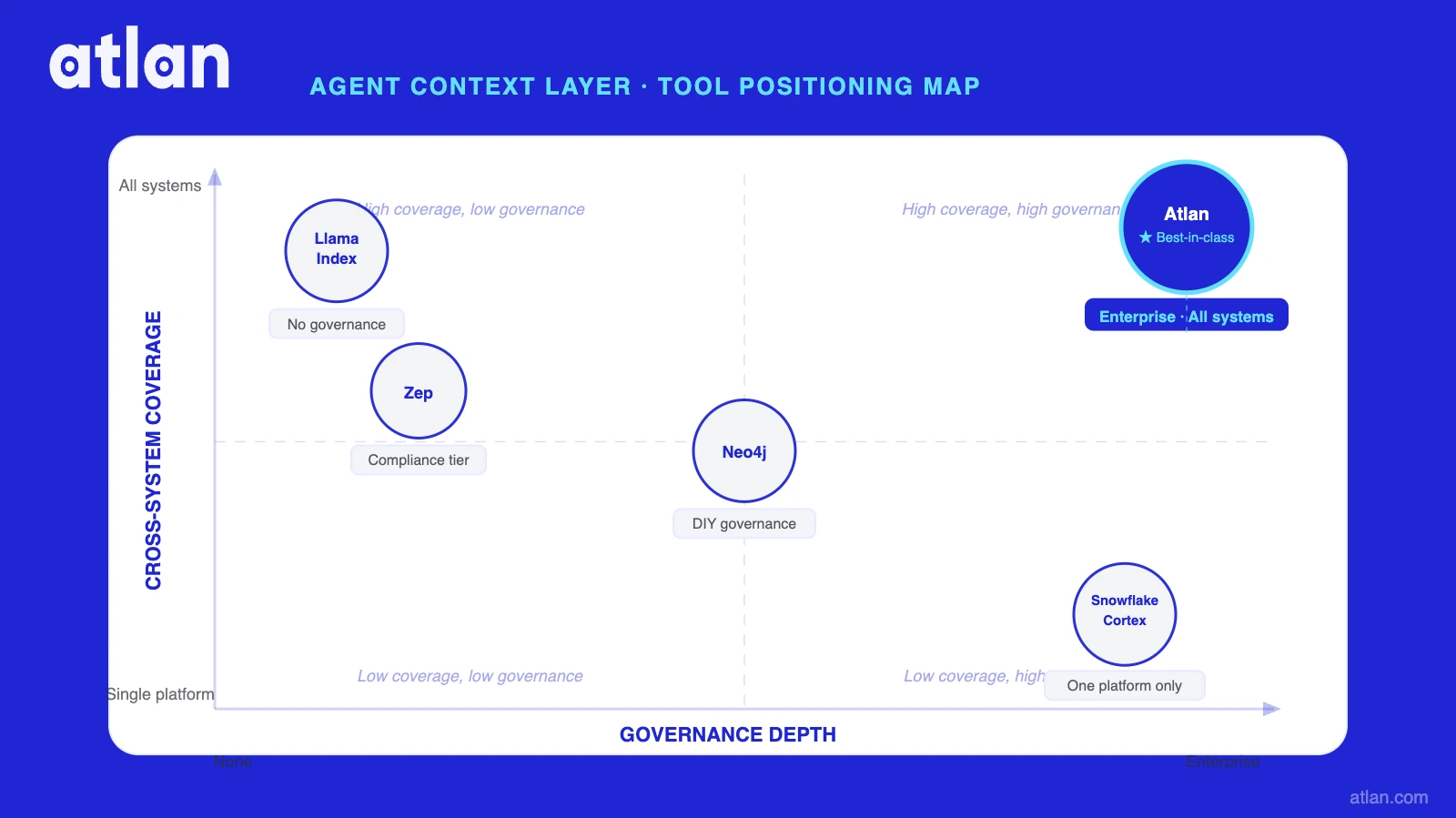
Five categories: choosing by use case
The right tool depends on which context problem your agents face. The five categories below are organized by job-to-be-done, not by technology type. Most production teams end up combining tools from two or three categories.
A. Cross-platform enterprise context
Tools in this category: Atlan
Use this category when your agents span multiple data systems: warehouse, BI layer, SaaS applications, ERP, and operational databases, and you need a single governed context layer that works across all of them. The defining requirements are cross-system lineage, policy enforcement at runtime, and business glossary access for any agent framework - not just agents running inside one cloud platform.
Atlan is the context layer for AI – the missing layer between enterprise data and AI systems that gives agents the business meaning, lineage, quality, and ownership signals they need to act on trusted data. Its Enterprise Data Graph spans 108 connectors as of September 2026 and delivers certified definitions, column-level lineage, and access policies to any MCP-compatible agent – Snowflake Cortex Analyst, Claude, OpenAI, Gemini – through a single native MCP server. Crucially, AI bootstraps 80–90% of the context layer from existing signals (SQL history, BI semantics, lineage, pipeline code); humans refine and certify the last mile through Context Engineering Studio. One context layer. Every agent. Any tool. In a controlled study across 522 enterprise queries, agents grounded in Atlan’s context layer produced a 38% improvement in SQL accuracy (p<0.0001) over agents using semantic definitions alone. Workday reported 5x improvement in AI analyst response accuracy after grounding their agents in shared context via Atlan’s MCP server.
When Atlan is NOT the right fit: single-application agents, developer-side conversational memory, or pure document retrieval where a RAG stack is sufficient. See Do Enterprises Need a Context Layer? for a decision framework.
B. Platform-native context
Tools in this category: Snowflake Cortex, Databricks Unity Catalog
Use this category when your agents run entirely within a single cloud data platform and you want context management without adding tooling outside that platform’s perimeter. Both Snowflake Cortex and Databricks Unity Catalog provide strong context capabilities within their ecosystems: Snowflake’s five-layer agent context framework (analytic context, relationship mapping, operational playbooks, provenance, and conversational memory) and Databricks’ Unity Catalog Business Semantics (GA April 2026, open-sourced) cover the context needs of warehouse-native agents well.
Databricks also documents Genie Ontology, a context layer in Public Preview that combines Unity Catalog semantics (metric views, domains, and Pages) with inferred snippets that Genie extracts from existing assets and usage. Each snippet carries an authority score and is gated by Unity Catalog permissions. Genie One and Genie Code search it, and the Genie One MCP server returns answers grounded in it.
The key constraint: neither platform is designed for cross-warehouse or cross-SaaS entity resolution. Snowflake’s own research found that adding an ontology layer improved agent accuracy by 20% and reduced tool calls by 39% - evidence that structured context matters even inside a warehouse. For teams whose agents will eventually cross platform boundaries, a complementary layer like Atlan provides the unified context layer coverage these platforms lack. See Context Layer for Snowflake for a patterns guide on combining both.
C. Graph-based context
Tools in this category: Neo4j, Zep + Graphiti, Cognee
Use this category when your agents need to reason over relationships between entities, track how facts change over time, or ingest knowledge from unstructured and multi-format sources. Graph-based context tools excel in domains where the connections between things matter as much as the things themselves: CRM, compliance, research, and scientific workflows.
- Neo4j is the production infrastructure choice for knowledge graph deployments requiring full graph traversal, visualization, and GraphRAG. Following its $100M GenAI investment, it now provides a dedicated MCP server for graph-based memory and reasoning.
- Zep + Graphiti (30,985 GitHub stars on Graphiti, 18 Sep 2026) is built for temporal reasoning: Graphiti models facts as triplets carrying
valid_atandinvalid_atwindows, so agents can see when a fact changed rather than only what it says now. Zep’s SOC 2 Type II, HIPAA BAA and EU DPA sit on the Enterprise tier, not on Zep Cloud generally. - Cognee reports 5M+ SDK runs per month and names Bayer as a production customer in its own case study. It ingests documents, code and app data into a knowledge graph you can query and improve over time, reachable through Cognee MCP.
D. Retrieval-first context
Tools in this category: LlamaIndex, Weaviate, Pinecone, Redis Iris, Qdrant
Use this category when your primary context challenge is retrieving the right document chunks, data snippets, or structured records at inference time. These tools handle large corpora, hybrid search, and real-time data freshness. For the conceptual difference between retrieval and a full context layer, see Agent Context Layer vs RAG and Advanced RAG Techniques.
- LlamaIndex (~49,644 GitHub stars as of May 2026) is the most widely adopted retrieval framework for production RAG pipelines, with 160+ data connectors and advanced retrieval patterns including sub-question decomposition and recursive retrieval.
- Weaviate fits multi-tenant SaaS: native BM25 plus vector in one pass, fused by Relative Score Fusion, with a dedicated shard per tenant. Its core is BSD-3-Clause; code under the
wl/directory ships under the separate Weaviate License and needs a licence key. - Pinecone leads on fully managed simplicity at billion-vector scale with no infrastructure to run. Nexus reached GA in August 2026, compiling enterprise data into cited artifacts agents query. KnowQL queries carry intent, filter, provenance, shape, confidence and budget, returning grounded answers with citations.
- Redis Iris, launched in preview May 2026, bundles context retrieval, agent memory, CDC and search. Its source-system coverage comes from Redis Data Integration, so check the RDI connector list against the systems you actually run.
- Qdrant (Apache 2.0) is the performance-first self-hosted option. Its payload indexes extend the HNSW graph, so filters apply during the search rather than before or after it. Managed, Hybrid and Private Cloud deployments exist alongside the open-source build.
One important note: retrieval alone is not a governed context layer. These tools need a semantic or governance layer - such as a business glossary, lineage graph, or policy store - to deliver enterprise-grade accuracy. See Enterprise RAG Platforms Compared for a full evaluation.
E. Conversational memory
Tools in this category: Mem0, Letta, LangChain / LangMem / LangGraph, Microsoft Agent Framework
Use this category when you need agents to remember what they have done across sessions, personalize responses to individual users, or coordinate multiple specialized agents with shared state. These tools solve the session continuity problem: they are memory and orchestration layers, not governance layers. For the distinction, see Memory Layer vs Context Layer and Types of AI Agent Memory.
- Mem0 (65,589 GitHub stars, 18 Sep 2026) is the drop-in choice for personalization. Mem0 has raised $24M across seed and Series A, led by Kindred and Basis Set, and describes itself as SOC 2 and HIPAA ready, with SSO, audit logs and on-prem at the Enterprise tier. Mem0 says AWS chose it as exclusive memory provider for the Strands Agents SDK. One thing to plan around: Mem0 removed graph memory from its open-source SDK, so the hybrid graph, vector and key-value store is now a paid Platform feature.
- Letta (formerly MemGPT; 24,786 GitHub stars, 18 Sep 2026) now documents four memory tiers: memory blocks, files, archival memory and external RAG. Letta’s own docs organize these by scale and importance rather than the RAM-and-disk metaphor the MemGPT paper used. Read its March 2026 direction post before you design around the hosted service; Letta is moving to git-backed memory files and client-side orchestration, and sunsetting server-side memory tools, templates, identities and MCP integrations.
- LangChain / LangMem / LangGraph is the natural choice for teams already in the LangChain ecosystem: LangMem adds episodic, semantic, and procedural memory (including agents rewriting their own system instructions) on top of LangGraph’s workflow orchestration and state checkpointing.
- Microsoft Agent Framework (GA April 2026; merges Semantic Kernel + AutoGen; 27,930 GitHub stars as of May 2026) is the enterprise choice for Azure and Copilot-centric shops, with multi-agent patterns and built-in connectors for Azure AI Search and Qdrant.
See Best AI Agent Memory Frameworks 2026 for a head-to-head evaluation and Agent Memory Architectures for architectural patterns.
What to look for when evaluating agent context layer tools
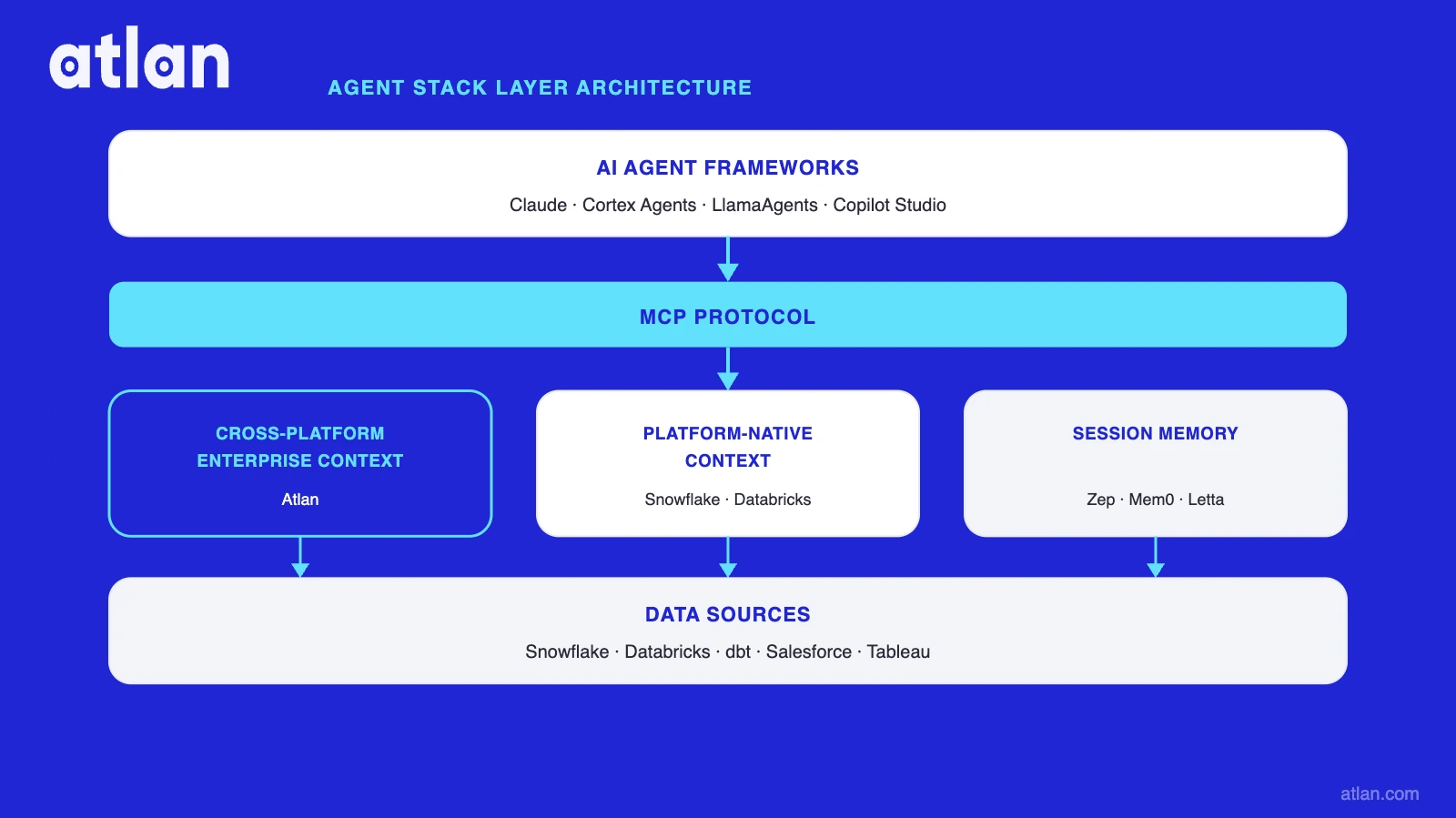
Choosing a context layer tool requires going beyond feature checklists. These eight criteria surface the dimensions that matter most in enterprise production environments.
1. Governance depth. Does the tool enforce access policies, data classifications, and business definitions at runtime, or does it simply retrieve whatever is in the index? Tools in Category A include governance; most tools in Categories D and E do not.
2. MCP support. The Model Context Protocol has become the connectivity standard for agentic AI infrastructure, with 14,000+ servers and 97M monthly downloads as of 2026. Native MCP support means your context layer can serve any MCP-compatible agent without custom integration work.
3. Cross-platform coverage. Does the tool cover your full data estate, or only assets within one platform? Platform-native tools (Snowflake Cortex, Databricks UC) are excellent within their perimeters but do not resolve entities across warehouse, SaaS, and operational systems. See Unified Context Layer for a framework.
4. Lineage and provenance. Can the tool tell an agent not just what a field means, but where it came from? Column-level lineage is the difference between a context-aware AI agent that understands “revenue” and one that conflates three different revenue definitions. This capability is present in Category A tools and partially in Category B; it is absent in most Category D and E tools.
5. Freshness and real-time ingestion. How quickly does the context layer reflect changes in upstream data? Tools using CDC pipelines (Redis Iris) or incremental graph construction (Graphiti) update context in near-real-time. Batch-indexed tools introduce staleness that compounds in fast-moving environments.
6. Multi-agent support. Multi-agent systems require context stores that handle concurrent reads and writes without state collisions. LangGraph’s explicit StateGraph schema, Mem0’s multi-scope tagging, and Atlan’s context layer MCP server (Context Repos let different agents receive different certified context slices from the same substrate) all address this; general-purpose vector databases typically do not. See Agent Memory Architectures for patterns.
7. Auditability. Regulated industries need a record of what context was retrieved, by which agent, at what time. This is a distinguishing feature of governed context layers (Category A) and graph tools with decision traces (Neo4j). Few retrieval-first or memory tools provide this by default.
8. Developer experience. Does the tool integrate with your existing framework (LangGraph, CrewAI, custom)? GitHub star counts signal community health. Read from the GitHub API on 18 September 2026: Mem0 65,589, Graphiti 30,985, Letta 24,786. LangChain (~100K), LlamaIndex (~49,644) and Microsoft Agent Framework (~27,930) were last counted in May 2026, so treat those three as floors rather than current figures.
For the context engineering framework that connects tool selection to architectural decisions, and the four context engineering strategies teams use to assemble these tools, those two pages provide the structural foundation. For business context for AI - the semantic layer that turns raw data into agent-ready meaning - see the dedicated guide.
Deeper comparisons and evaluations
Once you have identified the right category for your use case, the following pages provide structured evaluations to help you select and implement specific tools.
Agent Context Layer Tools Compared - The full side-by-side matrix: governance depth, MCP support, lineage, compliance certifications, pricing tiers, and self-hosted vs. managed options for all 17 tools in this directory. Start here if you are ready to shortlist.
Context Engineering Platforms Comparison - A broader evaluation of platforms that support the full context engineering lifecycle: ingestion, enrichment, retrieval, and governance. Useful if you are evaluating whether to build a custom stack or buy a platform.
Enterprise RAG Platforms Compared - A dedicated evaluation of retrieval-first platforms for teams where document-scale retrieval is the primary context problem. Covers LlamaIndex, Weaviate, Pinecone, Qdrant, and others with enterprise deployment criteria.
Best AI Agent Memory Frameworks 2026 - A head-to-head evaluation of Category E tools: Mem0, Letta, LangMem, and Microsoft Agent Framework. Covers benchmark performance (LongMemEval, DMR), compliance certifications, and pricing tiers for each.
Agent Context Layer vs Knowledge Base - If you are evaluating whether a knowledge base or wiki-style tool can substitute for a purpose-built context layer, this page maps the structural differences and where each approach breaks down at scale.
Metadata Layer for AI - A guide to how metadata infrastructure underpins enterprise context layers, and why context catalogs are becoming a distinct product category separate from traditional data catalogs.
Frequently asked questions
1. What is the difference between a context layer and a memory layer?
A context layer provides the structured, governed knowledge your agent needs to understand your business: data definitions, lineage, policies, and entity relationships. A memory layer stores what the agent has done across sessions: conversation history, user preferences, and learned behaviors. Most production agents need both. See Memory Layer vs Context Layer for the full distinction.
2. Do I need a context layer if I already have a vector database?
A vector database solves retrieval: it finds relevant chunks at inference time. It does not solve governance: it does not know which “revenue” definition is certified, which datasets are access-restricted, or how a field in one system relates to a field in another. If your agents query governed enterprise data, you need a context layer on top of, or instead of, a raw vector database. See RAG Accuracy Problems for the evidence on why retrieval alone fails at enterprise scale.
3. Which tools in this directory support the Model Context Protocol (MCP)?
Seven ship a first-party MCP server the vendor documents itself: Atlan (a native governed MCP server), Zep and Graphiti (Graphiti MCP Server 1.0, with nine preconfigured entity types), Cognee (Cognee MCP, with setup guides for Claude Code, Cursor and Cline), Weaviate (an MCP server built into the core binary, preview from v1.37.1 and GA at v1.38, served over Streamable HTTP at /v1/mcp on the main REST port), Pinecone (an MCP server for the database plus one per Assistant, either as a managed remote endpoint or self-hosted in Docker), Mem0 (a Platform MCP server at mcp.mem0.ai), and Redis Iris (its Context Retriever auto-generates MCP tools).
Count carefully, because three things get filed as MCP that are not. Agent Skills is Anthropic’s Skills format, which works with Claude Code, Cursor, GitHub Copilot, VS Code and Gemini CLI; Weaviate shipped an Agent Skills library in February 2026 and Pinecone ships one too, and neither is MCP. Both vendors happen to run real MCP servers as well, which is why they appear on the list above, but the skills libraries are not the evidence for it. Qdrant’s Semantic Kernel and LangChain integrations and LlamaIndex’s LlamaHub connectors are framework and connector plumbing, also not MCP. Letta is the row to watch: its docs describe first-party MCP support with its own server API across stdio, SSE and streamable HTTP, while its March 2026 direction post lists MCP integrations among the server-side features it is sunsetting. Read the vendor’s own MCP documentation before you design around any row here.
4. Is LlamaIndex a context layer?
LlamaIndex is a retrieval framework, not a governed context layer. It excels at document ingestion, chunking, indexing, and advanced retrieval patterns. It does not enforce business definitions, column-level lineage, or access policies at runtime. For knowledge-intensive document retrieval, LlamaIndex is a leading choice; for enterprise governed context, it should be combined with a Category A tool.
5. How does Graphiti differ from Zep?
Graphiti is Zep’s open-source framework (Apache 2.0, 30,985 GitHub stars as of 18 September 2026). Zep is the managed cloud product. The two are no longer the same engine: Graphiti’s own README describes Zep’s production service as running a proprietary Context Graph Engine with no third-party graph database required, while Graphiti stays bring-your-own graph store, self-hostable on Neo4j, FalkorDB or Amazon Neptune. Both model facts as triplets carrying validity windows, recording when a fact became true and when it was invalidated. On compliance, read the tier: Zep’s SOC 2 Type II, HIPAA BAA and EU DPA are Enterprise-tier, not standard on Zep Cloud.
6. When should I use a graph-based tool vs. a retrieval-first tool?
Use a graph-based tool (Neo4j, Zep/Graphiti, Cognee) when the relationships between entities matter: CRM history, compliance audit trails, entity disambiguation across documents, or reasoning that requires multi-hop traversal. Use a retrieval-first tool (LlamaIndex, Weaviate, Pinecone) when your primary challenge is finding the right chunks in a large document corpus at inference time. Many production stacks use both: a vector database for document retrieval and a knowledge graph for entity context. See What Is a Context Graph? and Advanced RAG Techniques for architectural guidance.
Sources
- Datadog, “State of AI Engineering 2026,” datadoghq.com/state-of-ai-engineering/ - 69% input token finding
- VentureBeat, “Context architecture is replacing RAG as agentic AI pushes enterprise retrieval to its limits,” May 2026 - venturebeat.com/data/context-architecture-is-replacing-rag-as-agentic-ai-pushes-enterprise-retrieval-to-its-limits
- Anthropic, “Introducing the Model Context Protocol,” anthropic.com/news/model-context-protocol - MCP launch and 97M installs figure
- Wikipedia, “Model Context Protocol,” en.wikipedia.org/wiki/Model_Context_Protocol - MCP timeline and facts
- Getzep/Graphiti GitHub repository, github.com/getzep/graphiti - 30,985 stars and Apache 2.0 license, read 18 September 2026
- Zep research paper: “A Temporal Knowledge Graph Architecture for Agent Memory,” arXiv 2501.13956 (January 2025) - an unreviewed preprint written by Zep staff, including its CEO
- Mem0ai/Mem0 GitHub repository, github.com/mem0ai/mem0 - 65,589 stars and Apache-2.0 license, read 18 September 2026
- Mem0 Series A announcement, mem0.ai/series-a, October 2025 - $24M across seed and Series A; YC-backed
- Microsoft Semantic Kernel GitHub, github.com/microsoft/semantic-kernel - star count and April 2026 GA confirmation
- Databricks, “Redefining the Semantics Data Layer for the Future of BI and AI,” databricks.com/blog - Unity Catalog Business Semantics GA April 2026
- Snowflake, “Enterprise AI Agent Platform,” snowflake.com/en/blog/enterprise-ai-agent-platform/ - Cortex scale claims and five-layer framework
- Redis, “Context Is All You Need,” redis.io/blog - Redis Iris launch, May 2026
- Weaviate, “Weaviate Agent Skills,” weaviate.io/blog/weaviate-agent-skills, February 2026 - Anthropic’s Skills format, distinct from Weaviate’s MCP server at docs.weaviate.io/weaviate/configuration/mcp-server
- Pinecone, “Knowledge Infrastructure for Agents,” pinecone.io/blog - Nexus and KnowQL details; Nexus GA announced 6 August 2026 at pinecone.io/blog/pinecone-nexus-generally-available/
- Neo4j, “Create Context Graph,” github.com/neo4j-labs/create-context-graph - full-stack context graph agent app
- Letta-ai/Letta GitHub repository, github.com/letta-ai/letta - 24,786 stars and Apache-2.0 license, read 18 September 2026; memory tiers at docs.letta.com/guides/core-concepts/memory/context-hierarchy/ and the March 2026 direction post at letta.com/blog/our-next-phase/
- Atlan, “Enhanced Metadata Improves Query Accuracy,” atlan.com/know/enhanced-metadata-improves-query-accuracy/ - 38% SQL accuracy lift, 522-query study
- Run-llama/LlamaIndex GitHub repository, github.com/run-llama/llama_index - star count verification
- Neo4j LICENSE.txt, github.com/neo4j/neo4j/blob/2026.08/LICENSE.txt - GPL v3 for Community Edition, read 21 September 2026
- Topoteretes/Cognee LICENSE, github.com/topoteretes/cognee/blob/main/LICENSE - Apache 2.0, read 21 September 2026
- Model Context Protocol LICENSE, github.com/modelcontextprotocol/modelcontextprotocol/blob/main/LICENSE - MIT to Apache 2.0 transition, docs CC BY 4.0, read 21 September 2026
- Introducing Genie One, Genie Agents, and Genie Ontology, Databricks (June 2026)
- Genie Ontology, Databricks documentation
- Genie One MCP server, Databricks documentation
