

In an internal, qualitative sweep this quarter, not a scored survey, eight enterprise AI deployments described the same wall in their own words: prompts hardcode business logic that should live in governed context instead. Even mature vendor tooling, AWS Bedrock, Langfuse, ships RBAC and versioning with no link to a governed definition. This guide covers the five-step rollout for Context-Sourced Prompt Management: centralize the tooling, then extract hardcoded logic into context every agent reads through Atlan’s Context Lakehouse.
| Field | Value |
|---|---|
| Time to complete | 3 to 6 weeks tooling-only; 10 to 14 weeks with Step 5 |
| Difficulty | Intermediate: versioning is easy, extraction needs cross-team buy-in |
| Prerequisites | Prompt inventory, a named owner, a target for governed context |
| Tools needed | Registry (Langfuse, PromptLayer, LangSmith), eval framework, context source |
The five steps below: centralize storage, add version control, apply RBAC, gate with evals, extract hardcoded logic into context.
Why centralize prompt management for enterprise AI?
Prompt sprawl starts as a people problem before a tooling one. First Central: “you have every other person in the organization…building their own bespoke agents,” many with “system prompts which most of them are not too great.” PayPal named the end state as “context sprawl where you have 30 different agents…a bunch of different sources of truth.” Neither lacked tooling; both lacked a shared source for what their prompts assumed.
Centralizing storage, versioning, and RBAC gives real visibility. But per Google’s own developer blog, several anti-patterns, detailed below, keep recurring even after teams adopt a registry, because a registry answers where a prompt lives, not what it assumes. Extracting that hardcoded logic into a source every agent can read is what closes the gap: Context-Sourced Prompt Management, not just centralized storage.
This isn’t a Day-1 requirement. The threshold arrives once more than a handful of agents exist without a shared inventory, or two teams have independently defined the same term. P&G: teams computing “same data but completely different business questions and…formulas.” HubSpot: “the decision tree of where to define this logic is still kind of very muddy for me.”
Readers needing the fundamentals first should start with what prompt engineering is, a subset of the broader discipline in what LLMOps is and LLMOps vs MLOps, which this guide doesn’t re-litigate.
What do you need before centralizing prompt management?
| Prerequisite | Type | Why it matters |
|---|---|---|
| Full prompt inventory | Technical | Can’t centralize what you can’t see |
| A named owner per domain | Organizational | Prevents unowned, invisible sprawl |
| Eval framework in CI/CD | Technical | Step 4 requires gating, not spot-checks |
| Sponsorship for extraction | Organizational | Step 5 needs cross-team agreement |
| A target for governed context | Technical | Step 5 needs somewhere to move logic to |
First Central’s first ask was “a library of all the agents, what they do.” Practitioner estimates: a prompt lead at 20 to 30% FTE, domain experts for disputes, an engineer for registry and eval wiring. Readers scoping where context should live can review how to implement an enterprise context layer for AI and the context layer glossary. Teams that skip these prerequisites centralize storage, then never touch the harder half of the job.
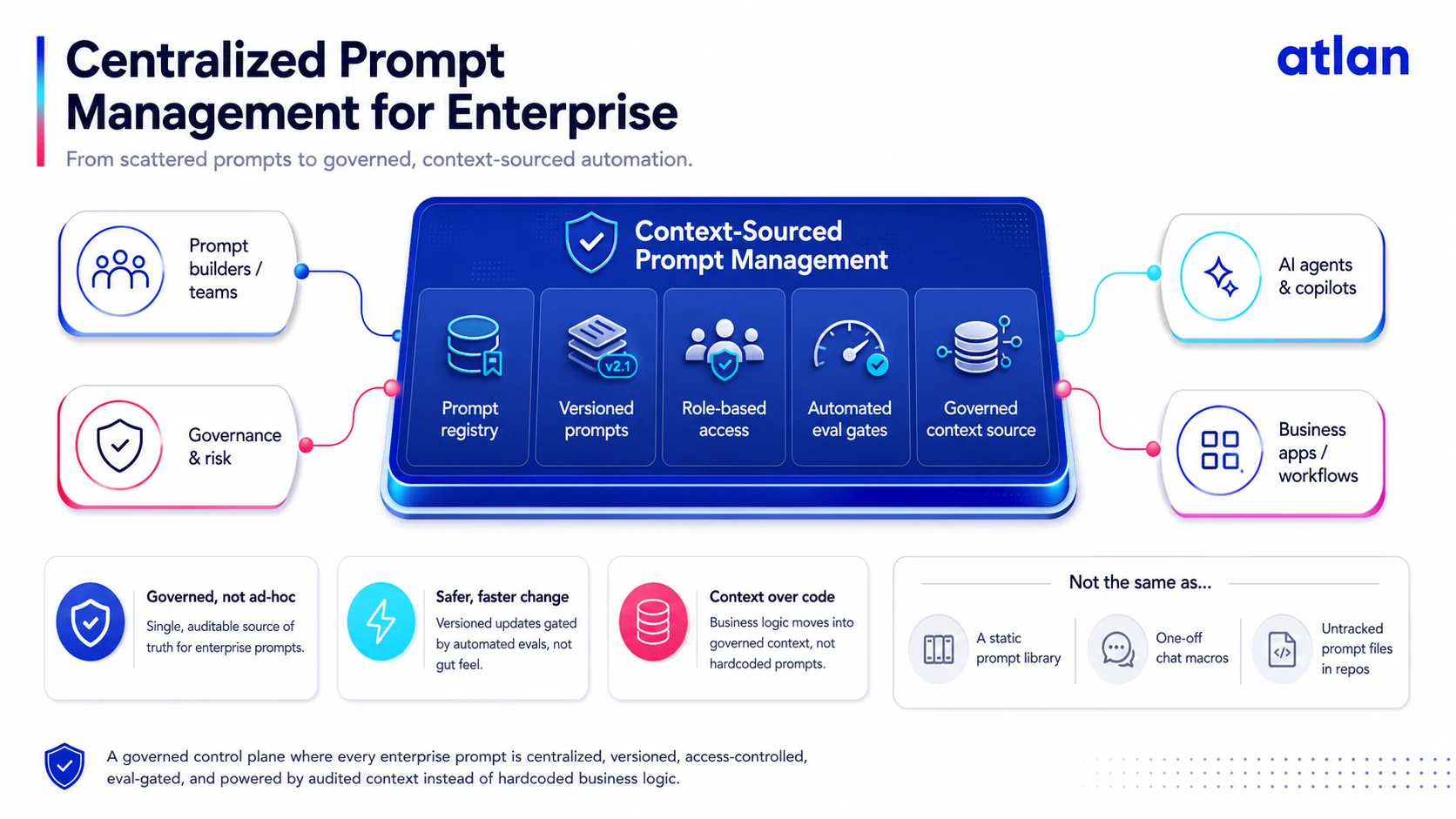
Context-sourced prompt management for enterprise AI. Source: Atlan.
Step 1: Centralize prompt storage in a registry
Replace ad hoc storage, inline code, scattered docs, with a single registry every team can query. GAP and Tredence: “the prompt you see isn’t as part of the code…they’re going to lie in a separate entity which is a prompt library.”
| Tool | Versioning/RBAC | Glossary linkage |
|---|---|---|
| AWS Bedrock | Yes, IAM-based | Variables resolve as plain text |
| Langfuse | Versioning yes, Git-style; project-level RBAC is Self-Hosted Enterprise | Not documented |
| PromptLayer / LangSmith | Yes | Not documented |
| Atlan Context Lakehouse | Not a storage tool | Yes, via MCP |
AWS’s official docs confirm Bedrock ships native RBAC actions (bedrock:CreatePrompt, bedrock:GetPrompt, bedrock:CreatePromptVersion), but substitution stays plain-text, no link to its own Business Glossary. Langfuse documents the same versioning pattern in its MIT core, though project-level RBAC and audit logs sit on its Self-Hosted Enterprise tier. Mature tooling here solves storage and access control, not meaning. Compare gateways in LiteLLM vs Portkey vs AWS Bedrock Gateway, or prompt engineering for data retrieval.
Pick a registry, migrate every prompt tagged by agent and domain, retire code-embedded versions. The common miss: migrating only what engineers remember exists; First Central’s roughly 100 Copilot Studio agents show how much hides outside that set.
Inside Atlan AI Labs: The 5x Accuracy Factor
How resolving business context before it hits a prompt changes what the prompt has to carry, with the accuracy math behind it.
Get the 5x Accuracy EbookStep 2: Add version control for every prompt
Every prompt change becomes a tracked, revertible version, closing a gap CIO.com names: “just like code, no prompt hits production without a dual-check.” Enable version history, require a named reviewer to approve, and keep prior versions queryable. Editing production prompts directly while versioning the registry defeats the point.
Step 3: Apply role-based access control
Scope edit and publish rights per prompt or domain, mirroring AWS Bedrock’s own IAM model. That RBAC is solved at the tooling layer is exactly why this step is necessary but not sufficient, Step 5 is where the real gap sits. Define roles, viewer, editor, publisher, and log every change. Treating RBAC as the finish line is the most common misread: it controls who can edit a prompt, not whether its logic is correct.
Step 4: Gate every prompt change with automated evals
No prompt version ships without passing an eval suite first, the second half of CIO.com’s dual-check principle, the same CI/CD pattern platforms like Braintrust and Maxim AI apply. Define a small eval suite covering accuracy, tone, and refusal behavior, wire it into the promotion pipeline, and block on failure instead of flagging it. Running evals manually before a launch, then skipping small edits, is where obscured blast radius shows up later. The same discipline extends to AI agent guardrails: an eval gate and a guardrail are both centrally managed checks on behavior a team decided matters.
Step 5: Extract hardcoded business logic into governed context
The harder, often-skipped move: pulling metric definitions, entity names, and policy text out of prompt text and sourcing them from governed context, what makes this Context-Sourced rather than just centralized. GAP and Tredence is already mid-flight: “None of the prompts would remain in the code…they’re going to lie in a separate entity which is a prompt library,” with column context “moving to more vector based mapping.”
Identify which content is business logic, metric formulas, entity definitions, versus instruction text. Move that logic into a governed source. Bedrock and Langfuse both document variable substitution as plain text at compile time, so a definition pasted into a prompt stays a string rather than a reference. Wire agents to read it via MCP instead of hardcoding the answer.
The most common conflation: treating decoupling prompts from code, Step 1, as decoupling business logic from prompts, this step. Confirm the variable resolves against a shared, governed context layer definition, the same AI control plane foundation every guardrail and gateway decision depends on: MCP delivers business context once the source exists.
Steps 1 through 4 give visibility a team didn’t have before. But they decide only where prompts live, not what they mean.
Context Maturity Assessment
Score how governed your business definitions actually are today, before deciding how much of Step 5's work your team needs to take on.
Take the AssessmentWhat goes wrong in centralized prompt management?
1. Monolithic prompting
The entire control plane, instructions, tone, business logic, gets crammed into one instruction file. Lululemon: “this is our system prompt, we write this huge system prompt.” Split instruction text from business logic, moving it to Step 5’s context, a split in harness engineering vs prompt engineering.
2. Copy-paste drift
Shared logic, a metric definition, a safety policy, gets duplicated across prompts, then drifts as one copy updates and others don’t. Lululemon: “copying a single skill into multiple repos.” Centralize the logic once and reference it, per skill engineering vs prompt engineering.
3. Obscured blast radius
A small edit to one prompt breaks unrelated behavior because logic is buried inside instruction text with no visibility into dependents. P&G: each “genie space…is isolated from the rest and there’s no real reusability behind context.” Keep logic in a governed source so change propagates deliberately.
4. Deferred runtime errors
A prompt library gets adopted, but context stays scoped to one agent, so a gap surfaces only when a second agent needs the same logic. Waste Management runs a prompt library and evaluations, but “that context is only limited to this particular agent.” Design the source to be portable from the start.
All four share one root cause: logic living inside prompt text instead of a governed context layer every agent can reference. Confusing where prompt engineering ends and context engineering begins lets these patterns recur.
Best practices for centralized prompt management
Centralize storage first; a team can’t version, gate, or govern what isn’t centralized. Assign a named owner per domain: CIO.com calls unowned sprawl the most cited failure mode. Require a dual-check before production: “a third, unbiased, human-in-the-loop audits and approves.” Separate business logic from instruction text as a distinct step, GAP and Tredence’s pattern is the clearest template. Design for portability, per PayPal: “how do you keep your context portable…moving to different agents?” Marshall Ridge Consulting: prompts “should be subject to the same discipline as any other governed asset,” the discipline a semantic layer or agent context layer applies generally, the same question in what a context engineer actually does. Teams treating these as sequential checkpoints stay centralized.
How does Atlan approach centralized prompt management?
Even teams that adopt a registry, versioning, and RBAC still hit the Step 5 wall. First Central’s ungoverned Copilot Studio agents, P&G’s duplicated formulas, and Waste Management’s single-agent context all show tooling adoption stops short of shared, governed meaning, what the tooling was never built to solve.
Atlan’s Context Agents, Orion, Sage, Nexus, and Atlas, mine and govern that meaning once. Orion maps what a term means in context; Sage resolves conflicting metric definitions and locks in one answer; Nexus bridges technical column names to business terms; Atlas classifies assets into domains. The Context Lakehouse, a knowledge graph with Iceberg-native storage and vector search, stores what those agents mine, and the Atlan MCP Server serves it into an agent’s runtime context, so a prompt references governed context instead of hardcoding it.
The Context Engineering Studio’s build, test, review, approve, deploy, learn lifecycle applies that shape to context rather than prompt text, the direction GAP and Tredence is already moving. Teams wiring that path can follow the MCP server implementation guide; teams weighing the effort can review how to build an AI agent harness, the same logic applied one layer up.
What to do after centralizing prompt management
Measure success by reduction: are definitions still getting retyped into new prompts, or read from governed context on day one? That ratio, not a checklist, is the real health metric, an ongoing practice, not a project with an end date.
This sits inside the broader AI control plane, alongside managing multiple LLM providers at scale and managing LLM cost. Teams building that picture should read AI platform architecture, LLM cost optimization strategies, and how to build a centralized AI platform for the full-stack view.
Real stories from real customers: shared vocabulary at enterprise scale
"AI initiatives require more context than ever. Atlan's metadata lakehouse is configurable, intuitive, and able to scale to hundreds of millions of assets. As we're doing this, we're making life easier for data scientists and speeding up innovation."
Andrew Reiskind, Chief Data Officer, Mastercard

"Context is the differentiator. Atlan gave our teams the shared vocabulary and lineage to move from reactive data management to proactive AI enablement."
Kiran Panja, Managing Director, Cloud and Data Engineering, CME Group

Atlan in Action: Live Context Layer Demos
See how governed context, the piece a prompt registry alone cannot provide, gets served into a live agent's runtime.
Watch the DemoWhy versioning and RBAC alone never close the gap
A registry, version control, and RBAC are what most teams mean by “centralized prompt management,” and all three are necessary. But AWS Bedrock’s own documentation proves the ceiling: even a Tier-1 vendor’s native tooling ships RBAC and versioning while leaving substitution as plain text, no link to a governed definition. Eight enterprise customers described hitting that exact ceiling this quarter, unprompted.
The fix isn’t a better prompt tool. A prompt is only a pointer to meaning that has to live elsewhere, governed, versioned, shared, the same way ontology work governs a term before any knowledge graph is built on it, and the way reranking in RAG only works once retrieval has something disambiguated to score. Centralizing storage is the control-plane half of the job; sourcing it from governed context, Step 5’s move, decides whether the next agent needs its own bespoke prompt or can read the meaning that already exists.
FAQs about centralized prompt management for enterprise
1. What is the difference between prompt management and LLMOps?
Prompt management is a subset of LLMOps focused on the prompt lifecycle: authoring, versioning, access control, evaluation. LLMOps covers the broader surface, serving, routing, cost, observability, it sits inside.
2. How do you version prompts without redeploying code?
Move prompts into a registry, Langfuse, PromptLayer, or LangSmith, that versions natively. Agents fetch the approved version at runtime via API, so an update ships independently of a deploy.
3. What are the best open-source prompt management tools for 2026?
Langfuse, at 34.9k GitHub stars as of September 2026 and now owned by ClickHouse, is the most widely adopted self-hostable option. Its core is MIT except the ee folders, and project-level RBAC and audit logs sit on its Self-Hosted Enterprise tier. Agenta and Helicone are actively maintained gateway-adjacent alternatives.
4. How does the EU AI Act affect prompt engineering and documentation?
It pushes toward documented, auditable changes for high-risk systems. Version history and an approval trail become compliance evidence, not just hygiene.
5. Can you A/B test system prompts for autonomous agents?
Yes, most registry tools support side-by-side comparison. The harder part is ensuring both variants reference the same governed definitions, so the test measures wording, not two facts.
6. How do you connect a business glossary to a system prompt?
AWS and Langfuse both document prompt variables as compile-time string substitution: Bedrock resolves them as plain text, and Langfuse compiles {{variable}} placeholders against values you pass in. Neither documents resolving a variable against a governed definition. What works: govern the definition once, then have the agent read it at runtime.
7. How many prompts or agents before you need centralized management?
No fixed number, but two signals mean it’s time: more than a handful of agents exist without a shared inventory, or two teams have independently defined the same term.
Sources
- AWS Bedrock Prompt Management, official documentation: https://docs.aws.amazon.com/bedrock/latest/userguide/prompt-management.html
- Building scalable AI agents with modular prompt transpilation, Google Developers Blog: https://developers.googleblog.com/en/building-scalable-ai-agents-with-modular-prompt-transpilation/
- Langfuse, Prompt Management docs: https://langfuse.com/docs/prompts
- LangSmith, Manage Prompts how-to guide: https://docs.smith.langchain.com/how_to_guides/prompts/manage_prompts
- Portkey, Prompt Library docs: https://docs.portkey.ai/docs/product/prompt-library
- GitHub: langfuse/langfuse: https://github.com/langfuse/langfuse
- GitHub: Agenta-AI/agenta: https://github.com/Agenta-AI/agenta
- GitHub: Helicone/helicone: https://github.com/Helicone/helicone
- Prompt governance is the new data governance, CIO.com: https://www.cio.com/article/4130960/prompt-governance-is-the-new-data-governance.html
- Enterprise Prompt Governance: An Operating Model for AI at Scale, Marshall Ridge Consulting: https://marshallridgeconsulting.com/insights/enterprise-prompt-governance-an-operating-model-for-ai-at-scale/
- The Production Generative AI Stack: Architecture and Components, The New Stack: https://thenewstack.io/the-production-generative-ai-stack-architecture-and-components/
