

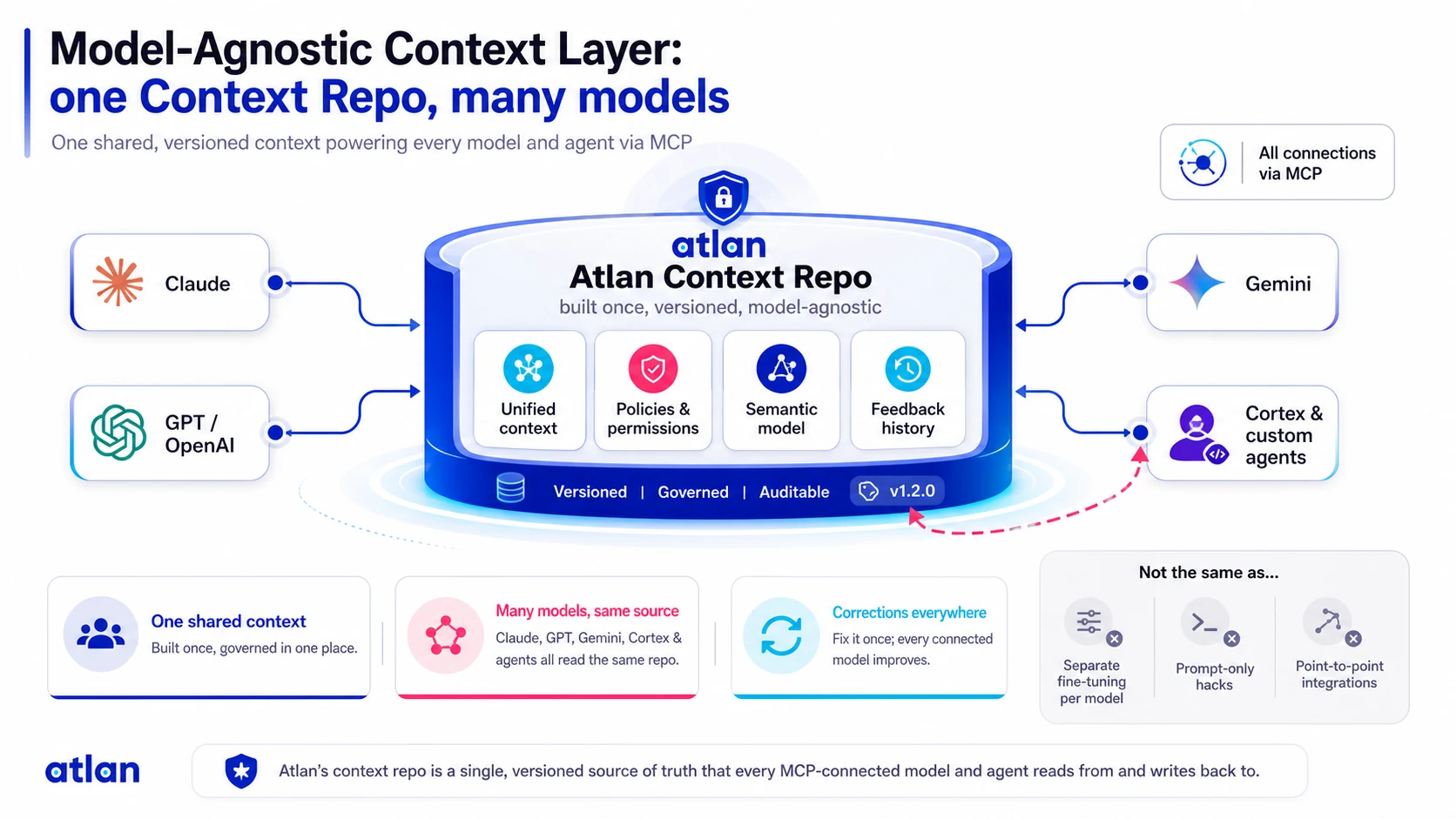
A model-agnostic context layer is the infrastructure that supplies AI agents with consistent business context (definitions, relationships, policies, lineage), independent of which model or agent platform consumes it. It exposes that context through open protocols such as the Model Context Protocol (MCP), so any compliant model reads the same context unit rather than learning its own version of the business.
A model-agnostic context layer supplies:
- Consistent definitions: What “revenue” or “active customer” means, per domain, with certified owners.
- Relationship mapping: How entities, tables, and metrics connect across the estate, the same territory covered by an agent context graph.
- Policy context: Approval rules and access boundaries agents must check before acting, delivered through a governed context API.
- Cross-system lineage: Where a number came from and every transformation it passed through.
Atlan is the Context Layer for AI, built open and portable by design. Its Context Repos are model-agnostic and exposed through MCP, so any agent or tool that speaks the protocol reads from the same shared context: Snowflake Cortex Analyst, OpenAI models, Claude, Gemini, and custom agents alike. You build context once and every model benefits from it. Nothing is locked to a single AI vendor, which is the same design goal behind a well-built agent context layer more broadly.
Why is model lock-in expensive for enterprise AI?
Models change fast and most enterprises run several at once, with teams routing each workload to whichever model fits its cost, latency, and accuracy profile. This multi-model reality comes with a cost.
A global pharmaceutical company hit the consequence directly. Their data and AI leadership described the failure mode plainly: when each platform learns on its own, the different agent tools end up speaking a different version of the truth. Locking context inside one model’s platform creates two recurring bills:
- Re-migration on every swap: Context encoded in one vendor’s prompts, semantic models, or fine-tunes has to be rebuilt by hand when a better model arrives.
- Forked truth on every new platform: Each added agent tool starts from zero and learns its own definitions, so answers drift apart as platforms multiply, the same pattern documented in enterprise context silos research.
Analysts see the same pattern at industry scale. According to Gartner (2025), vendor lock-in is one of the generative AI blind spots that will divide enterprises that scale AI safely and strategically from those that end up locked in, outpaced, or disrupted from within by 2030.
The same forking shows up one level down, inside a single model’s own memory. Teams that lean on agentic AI memory instead of a shared context layer run into an identical problem: each agent’s memory store becomes its own island, and multi-agent memory silos reproduce the forked-truth failure mode even inside one vendor’s stack. OpenAI’s own agent rollouts have hit this wall too. What OpenAI Frontier’s governance gap reveals is that model capability alone does not solve the context problem; the context has to live somewhere the model does not own.
Context is IP
Model independence and ownership are the same question. The definitions, business logic, and lineage your teams encode over years are institutional knowledge. This knowledge lives inside one vendor’s model layer and belongs, in practice, to that vendor’s roadmap.
Storing context in open formats reverses that. Atlan’s enterprise context layer keeps context in Apache Iceberg tables you can query with your own engines, in your own cloud storage, whether or not any particular model sits on top. That is also what separates a genuine context layer from a relabeled data catalog: a catalog indexes what exists, a context layer owns and serves what things mean, in formats the enterprise controls.
How do you build context once and reuse it across Claude, GPT, Gemini, and custom agents?
Three properties make a context layer model-agnostic:
- Open protocols: Any model consumes context over standards it already speaks, never a proprietary integration per vendor.
- Portable units: Context ships as versioned, bounded packages in open formats, readable outside the platform that created them.
- No proprietary coupling: Definitions and policies live below the model layer, so nothing breaks when the model changes.
How MCP makes context model-independent
MCP gives every model one interface to the same context. In 2024, Anthropic introduced it as an open standard for connecting AI systems to external context sources, and adoption crossed vendor lines fast.
Governance of the protocol is now neutral too. In 2025, Anthropic donated MCP to the newly formed Agentic AI Foundation, a directed fund under the Linux Foundation, which means the interface your context depends on is not controlled by any single model vendor.
MCP is not the only agent interoperability protocol in play. Google’s A2A protocol handles agent-to-agent handoffs rather than context delivery, and teams evaluating a stack often end up comparing MCP against A2A directly, or asking when MCP beats a plain API integration for context delivery specifically. The practical distinction most teams miss first is MCP versus function calling: function calling wires one model to one tool, while MCP matters for AI agents precisely because it standardizes that wiring across every model that adopts it.
A Fortune 500 retail company, one of Atlan’s customers, drew the practical conclusion. Their data leadership chose to build context in one open layer and connect agents to it over MCP, because that layer sees everything across their stack rather than one model’s slice.
How shared Context Repos ensure one truth across many models
A shared Context Repo is the unit that makes “build once” real. Every MCP-capable agent reads the same repo, so a correction made against one model propagates to all of them instead of dying inside a single platform’s memory. That is a meaningfully different design than agent memory frameworks that scope recall to one agent’s own session; a context repo is shared infrastructure, not a private notebook, and it needs its own context versioning discipline to stay trustworthy as more agents write corrections back into it.
Build Your AI Context Stack
Get the blueprint for implementing context graphs across your enterprise. This guide walks through the four-layer architecture, from metadata foundation to agent orchestration, with practical implementation steps for 2026.
Get the Stack GuideHow to evaluate a model-agnostic context layer: 5 must-have capabilities
Evaluate model-agnostic context layer solutions using the following capabilities as benchmark:
- Context Repos: This is the heart of “model-agnostic.” Build context once, every MCP-capable model reads the same unit, and swapping models doesn’t touch the context.
- Open protocol support: Any model or tool consumes context through the interface it already speaks, with no per-model custom integration.
- A single context workspace: Build context once and manage it centrally rather than re-encoding it inside each model’s prompts.
- Compounding learning loops: Corrections made against one model improve context for all of them, the opposite of each platform learning its own truth.
- Connector support: The context source stays constant as the models on top of it change.
Treat these five as a pass/fail gate, not a nice-to-have checklist. A vendor missing even one of them turns “model-agnostic” back into a single-model integration with better marketing, and you inherit the re-migration cost the next time a model changes. The Agent Context Layer Tools directory is a useful place to run this checklist against a longer vendor list, and the context layer evaluation criteria guide covers the broader disqualifier set (ownership, correctness, auditability) that model-agnosticism is one part of.
What does a model-agnostic evaluation actually look like in a demo?
Vendor demos are built to show the best case. Your evaluation should test the case that actually matters: what happens the day you add a fourth model, or drop one you have outgrown.
| Question to ask | What a good answer sounds like | Red flag |
|---|---|---|
| Can you swap the underlying model live, without touching context delivery? | Yes, shown over an open protocol in the demo itself | A vague “yes” with no live demonstration |
| Where does context physically live, and can I export all of it today? | An open format, export path shown live | “That lives in our proprietary format” |
| Does a correction made in one model’s session reach every other model? | Yes, the correction is written to the shared repo, not the session | Corrections stay trapped in one chat history |
| Can a brand-new agent platform connect without re-encoding definitions? | Yes, it reads the same context repository over MCP | Each new platform starts a fresh onboarding project |
| Is the context layer distinct from any one model’s memory? | Yes, it is infrastructure the models call, not a feature of one of them | The “context layer” turns out to be one vendor’s chat memory |
If a vendor cannot answer the model-swap question live, in the room, the rest of the checklist is not worth running. This is the same discipline that a good enterprise RAG platform comparison or RAG system evaluation demands: don’t take the architecture diagram’s word for it, make the vendor prove it against a model swap on the spot.
How does Atlan set up a model-agnostic context layer for your enterprise?
As the context layer for enterprise AI, Atlan delivers the following capabilities:
- Context Repos: Versioned, bounded, model-agnostic units of context exposed via MCP, tracked through their own context versioning history so every correction is traceable.
- Open protocol support with Context Lakehouse: Delivers context over MCP, A2A, SQL, and REST/Graph APIs, the same open-storage foundation described in Snowflake Horizon context and the Atlan context layer and built on Apache Iceberg so nothing sits in a proprietary format.
- Context Engineering Studio: Build, test, approve, and ship context through a governed lifecycle, distinct from a semantic layer for AI agents that only handles metric definitions.
- Compounding learning loops: Evals, traces, and corrections from every agent feed back into the shared layer, with ai agent observability surfacing what changed and why.
- Connectors: Mine context from 100+ source systems, including Snowflake context, regardless of which model sits downstream.
Enterprises rolling this out across teams tend to organize the work by function. Data engineering teams start with context management strategies for enterprise AI, while platform owners lean on context management software to keep the rollout auditable at CDO scale, a concern covered directly in context management at CDO enterprise scale. None of this requires abandoning multi-agent context management practices already in place; a model-agnostic layer sits underneath them and gives every agent the same starting point instead of a fresh one.
Get the CIO Guide to Context Graphs
See how enterprise and AI leaders are building a portable context graph that stays model-agnostic across Claude, GPT, Gemini, and whatever comes next.
Get the Context Graph GuideReal stories from real customers: building a model-agnostic context layer
"Atlan captures Workday's shared language to be leveraged by AI via its MCP server. As part of Atlan's AI labs, we're co-building the semantic layer that AI needs."
— Joe DosSantos, VP Enterprise Data & Analytics, Workday

"Atlan is our context operating system to cover every type of context in every system including our operational systems. For the first time we have a single source of truth for context."
— Sridher Arumugham, Chief Data Analytics Officer, DigiKey

Moving forward with the model-agnostic context layer
The model layer will keep churning. Whatever is best today on cost or reasoning will be second-best within a quarter, and your teams will want to switch when it happens.
Context is the part of the stack that shouldn’t churn with it. Definitions, relationships, policy context, and lineage take years to encode and seconds to fork, so the practical move is to put them in a layer every model reads and no model owns. That single design choice is what separates a durable business context layer from a bet on whichever model happens to be winning this quarter.
With Atlan’s Context Repos, Context Lakehouse, and MCP support, you build context once, own it outright, and carry it with you through every model generation. Teams that treat context this way stop re-litigating agent context layer design decisions every time a new model ships, and instead spend that time on the questions that actually compound: what should the context cover next, and who owns getting it right. For teams ready to move from evaluation to build, how to implement an enterprise context layer for AI is the practical next read, alongside how Atlan’s enterprise memory approach extends the same model-agnostic design to long-running agent state.
FAQs about the model-agnostic context layer
1. What is a model-agnostic context layer, in one sentence?
A model-agnostic context layer is the infrastructure that supplies every AI model and agent with the same business context (definitions, relationships, policies, lineage) through open protocols, independent of which model consumes it.
2. What makes a context layer model-agnostic vs. tied to one vendor?
Three tests separate them. Context is served over open protocols like MCP rather than a proprietary API, it is stored in portable open formats you can read independently, and nothing about the context changes when the consuming model changes.
3. What happens to your context when you switch models or add a new agent platform?
In most enterprises today, context doesn’t transfer. Definitions live in one platform’s prompts, semantic models, or fine-tunes, so a model switch means re-encoding that knowledge by hand and re-testing every answer against it. Adding a platform creates another version of context from scratch, while the old context keeps running. The two drift apart, and teams get different answers to the same question depending on which agent they ask. A model-agnostic context layer is the exception to this default: new models connect to the existing layer over MCP and read the same repos every other agent reads.
4. How does MCP enable model independence?
MCP is an open client-server standard: the context layer runs a server, and any compliant model acts as a client. Because OpenAI, Anthropic, Google, and Microsoft all support the protocol, one server-side investment in context serves every current and future model.
5. Who owns the context: you or the model vendor?
If context lives in open formats in your own storage, you own it and can query it with your own tools. If it lives inside a model vendor’s prompts, fine-tunes, or platform memory, ownership is contractual at best, which is why open storage is the ownership test to apply.
6. How do corrections stay consistent across different models?
Corrections are written to the shared context layer rather than to any single model. Every agent reading that layer picks up the fix on its next retrieval, and the correction can become a regression test so the error stays fixed across model swaps.
Sources
- Introducing the Model Context Protocol, Anthropic. https://www.anthropic.com/news/model-context-protocol
- Donating the Model Context Protocol and establishing the Agentic AI Foundation, Anthropic. https://www.anthropic.com/news/donating-the-model-context-protocol-and-establishing-of-the-agentic-ai-foundation
- Gartner Identifies Critical GenAI Blind Spots That CIOs Must Urgently Address, Gartner. https://www.gartner.com/en/newsroom/press-releases/2025-11-19-gartner-identifies-critical-genai-blind-spots-that-cios-must-urgently-address0
- Model Context Protocol, Official Documentation. https://modelcontextprotocol.io/
- Apache Iceberg, Apache Software Foundation. https://iceberg.apache.org/
