

Making individual agents context-aware is not enough once several of them collaborate on the same task. In a multi-agent system, a planner, a data agent, a policy agent, and a narrative agent each need a dependable answer to the same question: which version of a definition, policy, or record is current and approved right now. Context management for multi-agent systems is the operating layer that answers that question, and it is a different problem from agent memory, which tracks what one agent remembers about a session rather than what the whole system agrees is true.
Why do multi-agent systems need context management?
Multi-agent systems do not fail only because agents lack context. They fail when no one can decide which context is official, which slice belongs in each step, and when it should expire. That is an operations problem, not just an architecture problem.
The broader architecture for context engineering in multi-agent systems covers agents, handoffs, memory, and governance. Context management goes one layer deeper: how teams package, approve, deliver, refresh, and trace the context those agents depend on.
Teams often rely on shared state, the workflow record of messages and task status, but that record cannot decide which context is trusted, current, or allowed. Every multi-agent system needs the same things settled: where context comes from, who approved it, and how its use gets recorded. In practice, that means five decisions:
| Context decision | What the team must define |
|---|---|
| Source | Which repo, glossary, model, and policy set each agent can use |
| Scope | Which slice of that context each agent receives for its role |
| Handoff | Which evidence, caveats, and trace IDs move to the next agent |
| Lifecycle | Which context is temporary, reusable, or expires |
| Audit | Which context version shaped the final answer |
This matters most once agents reuse each other’s outputs. A renewal workflow may pull contract terms, usage, and risk notes, each accurate alone, but the workflow fails if nothing says which source is current.
When those decisions are missing, the same failure modes repeat:
- Unowned packages: No domain owner has approved the bundle an agent retrieved.
- Unscoped retrieval: A narrow sub-agent gets more context than its task requires.
- Stale permissions: Context was indexed before access rules changed.
- No conflict rule: Two systems disagree, and the agent quietly picks the cleaner-sounding answer.
- Missing trace: The answer looks reasonable, but nobody can prove which version shaped it.
That is why context engineering needs a management layer for multi-agent systems.
Build Your AI Context Stack
Get the blueprint for implementing context graphs across your enterprise: the four-layer architecture, from metadata foundation to agent orchestration, with practical steps for 2026.
Get the Stack GuideWhat should a shared context store contain?
A shared context store is the managed source of business context that multiple agents query before they act. It is not only a vector database, a prompt file, or a memory tool. Those can help, but none decide which definition is certified or which context version an agent used.
In an enterprise setup, the shared store should combine several context types:
| Context type | What it includes | How agents use it |
|---|---|---|
| Business meaning | Glossary terms, metric definitions, domain rules | Resolve what the user means by revenue, customer, or risk |
| Semantic structure | Models, dimensions, joins, measures | Build correct queries, avoid shadow metric logic |
| Technical evidence | Schemas, data lineage, owners | Find trusted assets, explain where answers came from |
| Governance context | Classifications, access policies, approval rules | Decide what an agent can retrieve, show, or update |
| Quality context | Freshness, certifications, incidents | Warn, defer, or fail closed when data isn’t fit for use |
| Procedural and eval context | Runbooks, golden questions, reviewer feedback | Run repeatable workflows, prove the context is agent-ready |
This is where the context layer differs from a normal retrieval index. A retrieval index selects similar content. A context layer carries meaning, provenance, policy, and lifecycle state.
For multi-agent systems, the goal is not to give every agent everything. The goal is a minimum viable, governed context: the smallest approved bundle that allows each agent to complete its role safely. In practice, that bundle becomes a Context Repo: a bounded, versioned package of definitions, policies, metadata, quality signals, and evaluation traces for a domain or use case.
What does a Context Repo look like in practice?
Think of it less as one giant memory bank and more as a release artifact for context: a unit teams can review, test, promote, roll back, and reuse across agents. Without it, nobody knows which definitions or policies were in play, or whether a new version broke a workflow.
For a finance revenue workflow, the Context Repo would spell out the approved definitions, owners, agents, and policies in one place. The example below uses YAML as a compact way to show the fields a repo would carry:
name: finance-revenue-context
version: 2026.06.13
owners:
  business_owner: finance-analytics
  data_owner: revenue-data-products
  governance_owner: data-governance

allowed_agents:
  - planner_agent
  - revenue_data_agent
  - policy_agent
  - crm_context_agent
  - narrative_agent

definitions:
  - term: ARR
    certified_definition: "Annual recurring revenue from active subscription contracts"
    owner: finance-analytics
    review_cycle: monthly
  - term: active_customer
    certified_definition: "Customer with an active paid contract during the reporting period"
    owner: revops
    review_cycle: quarterly

semantic_model:
  certified_metrics:
    - arr_current_period
    - arr_previous_period
    - expansion_arr
    - contraction_arr
  approved_dimensions:
    - region
    - segment
    - product_line

governance:
  classifications:
    - customer_sensitive
    - finance_confidential
  access_rules:
    - redact_customer_names_for_non_finance_roles
    - require_approval_for_account_level_export

quality:
  freshness_sla: 24h
  required_checks:
    - source_table_fresh
    - revenue_reconciliation_passed

evals:
  golden_questions:
    - "What drove ARR changes this quarter?"
    - "Can this user see account-level ARR?"

trace_requirements:
  record_repo_version: true
  record_context_ids: true
  record_policy_decisions: true
This is not a required syntax; the format will differ by platform. But context must be explicit enough for teams to review, test, deploy, and trace.
Each repo needs six properties: bounded scope (one domain, not the entire company), clear ownership (business, data, and governance owners named), certified sources (agents know which definitions and dashboards are approved), role permissions (different agents get different views), tests (golden questions and policy tests before deployment), and trace requirements (every run records which version shaped the answer).
If finance updates the ARR definition, that change moves through the revenue Context Repo without touching the repo used for supplier risk. A policy owner can block a version from production, or revert to a previous one if it produces poor answers.
For Data Leaders Evaluating Where to Start
Atlan's CIO guide walks through the four-layer architecture, from metadata foundation to agent orchestration.
Get the CIO GuideHow should the multi-agent context architecture work?
A strong architecture separates agent coordination from context management. Coordination decides which agent acts next. Context management decides what the agent may know, which source to trust, how fresh the context is, and what gets recorded after use.
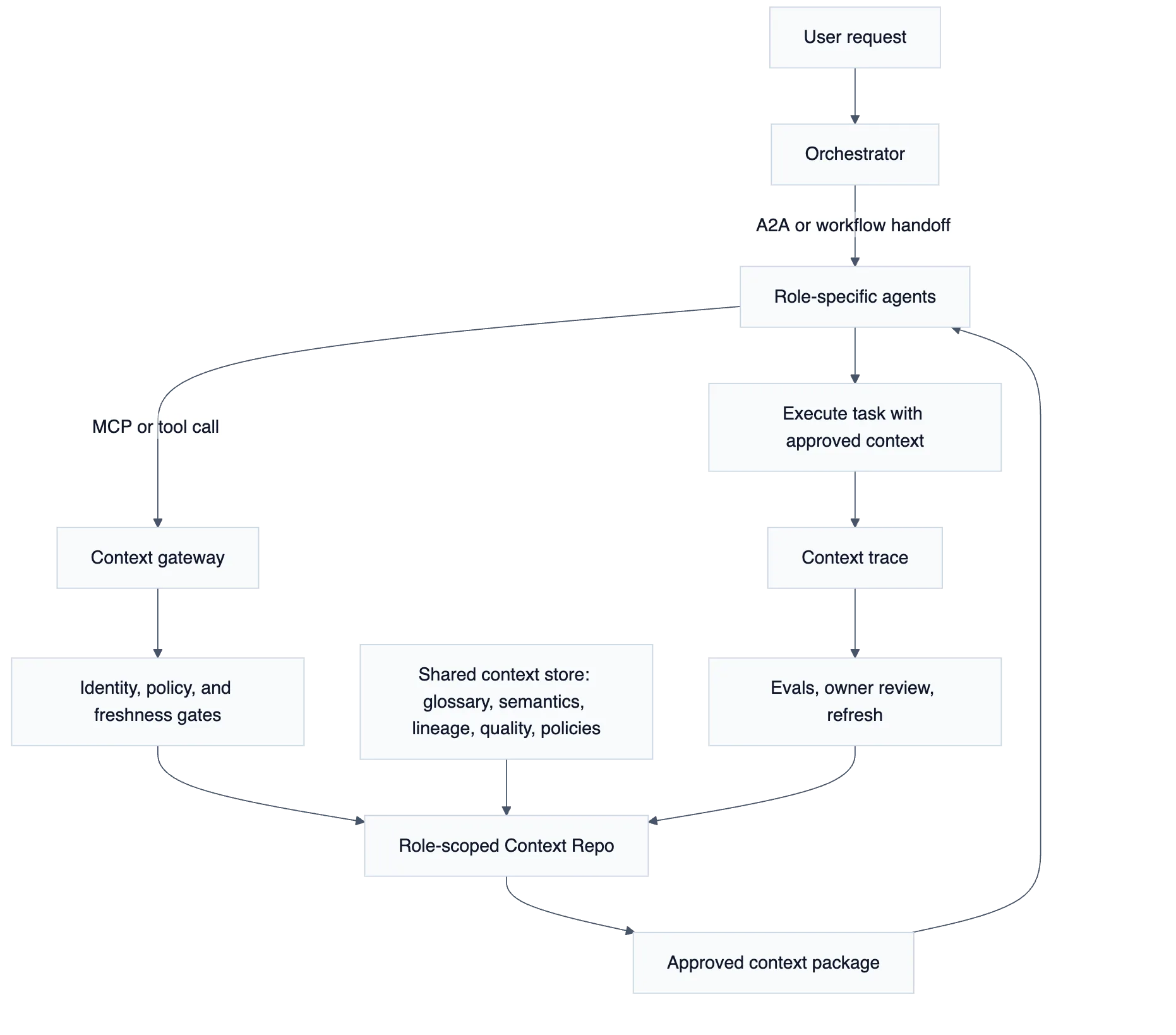
Two protocols matter here, but they solve different problems. MCP gives AI applications a standard way to connect to external systems and tools, a good delivery path between agents and the shared context store. A2A helps agents communicate, discover capabilities, and coordinate work when they come from different systems.
MCP and A2A do not replace the context layer. They move context and tasks. The shared store decides what context is correct, governed, fresh, and fit for each role, a distinction that matters most in regulated workflows, where NIST’s AI Risk Management Framework and the EU AI Act’s data governance article treat governance as a lifecycle practice, not a one-time check.
How should teams scope context for sub-agents?
Sub-agents work best when their context is narrow, echoing Anthropic’s guidance on context engineering for agents: context is finite, and sub-agents isolate detailed work while returning condensed outputs to the lead agent. For a revenue workflow, scoping can look like this:
| Agent | Context it needs | What it sends back |
|---|---|---|
| Planner agent | User intent, available agents, task constraints, risk level | Task plan and open questions |
| Data agent | Certified revenue model, lineage, SQL examples, quality warnings | Query result, assumptions, source IDs |
| Policy agent | User identity, classifications, access rules, approval thresholds | Allow, deny, redact, or escalate |
| Narrative agent | Approved summaries, policy decision, metrics, caveats, trace IDs | Final answer with caveats and citations |
The rule is simple: sub-agents return evidence, caveats, and trace IDs, not their full private working context. That keeps the lead agent focused and stops a low-trust sub-agent from polluting the workflow with context it was never authorized to hold.
How should teams resolve context conflicts?
Multi-agent systems surface conflicts that single-agent systems often hide: one agent retrieves a certified definition, another a region-specific exception, a third a dashboard label using the same term differently. Pass every result into the final answer unchecked, and the narrative agent has to guess which truth wins.
| Conflict type | Resolution rule |
|---|---|
| Certified vs uncertified | Prefer certified context and flag the stale source |
| Global vs local | Apply the repo’s domain and region scope |
| Current vs historical | Prefer current policy unless the task asks for historical analysis |
| Owner disagreement | Escalate to steward review rather than pretend one is canonical |
Some conflicts aren’t technical problems; they’re governance problems made visible by AI. When one can’t resolve automatically, the agent should say less, not more: a qualified answer or an escalation, with the trace recording the conflict and the policy applied.
How do you govern and refresh context over time?
Context management pays off once it extends beyond a single workflow. The shared store needs an operating loop: draft from glossaries and owner notes, test against golden questions and policy checks, get owner approval, deploy a versioned repo, observe how agents use it, refresh as schemas and policies change, and roll back a version that breaks a run.
That loop only works when it runs on signals, not a calendar. Live context turns schema edits, policy updates, and quality incidents into triggers for review, testing, approval, or rollback.
For the step-by-step operational playbook, with timelines and validation checklists for each phase, see How to Manage Context Across Multiple AI Agents.
Who should own multi-agent context management?
Context ownership cannot sit only with the AI platform team; platform teams rarely own the definition of ARR or why one region uses a different approval threshold. The better model is federated: AI platform owns the runtime and context gateway, data platform owns lineage and semantic models, governance owns policies and access rules, and domain owners own the business definitions.
Writing this down before scaling past one workflow avoids the finger-pointing that shows up later, once three teams each assume someone else is validating the shared repo. A short RACI for the context repo, reviewed alongside the repo itself, settles who signs off on a new definition, who approves a schema change, and who gets paged when a golden question starts failing.
How does Atlan support multi-agent context management?
In a multi-agent setup, Atlan supports the layer beneath the orchestrator and model: the governed enterprise context agents need to answer, plan, query, or act. That means building the context layer from metadata, definitions, lineage, and quality signals; packaging it into reusable Context Repos; and providing delivery paths, such as MCP, so agents retrieve trusted context without rebuilding their own copy.
Key capabilities include:
- Context Lakehouse: Metadata, business terms, lineage, policies, and quality signals in one place.
- Context graph: Connects assets, owners, terms, and policies into one governed slice per agent.
- Policy and access controls: Apply policies and audit expectations to the context agents use, not just the final answer.
- Context Engineering Studio: Packages context into Context Repos teams can test, deploy, and improve.
- MCP server: A runtime path to search assets, inspect lineage, and check quality.
The practical value: a finance agent in Cortex, an analyst agent in Genie, and a LangGraph workflow agent can share the same Context Repo instead of each maintaining its own copy, which is exactly the multi-agent memory silo problem a shared repo is built to prevent.
What should teams do next?
Start with one high-value workflow where the business already cares about consistency: revenue analysis, customer renewal, or supplier risk. Define the context repo before adding more agents: one domain, one shared repo, one context gateway, one eval suite, one trace model.
Still diagnosing readiness? Start with a context maturity assessment.
What changes when context becomes shared infrastructure
The strongest multi-agent systems do not make every agent smarter in isolation. They make every agent read from the same governed context foundation. Definitions, policies, lineage, quality signals, and feedback loops have to be packaged, scoped, refreshed, and traced before agents can reuse them safely.
Book a demo to see how Atlan helps teams build, test, deploy, and observe shared context for enterprise AI agents.
FAQs about context management for multi-agent systems
-
Is context management the same as agent memory?
No. Agent memory captures preferences, session notes, or task history. Context management covers the governed business knowledge agents use to act: definitions, policies, lineage, and approved examples. Multi-agent systems need both, but they aren’t the same layer. -
How is shared context different from shared state?
Shared state records what happened in the current workflow. Shared context explains what those events mean according to approved definitions, policies, and quality signals. State helps agents coordinate tasks; context keeps them aligned on business meaning. -
Where do MCP and A2A fit in context management?
MCP connects agents to external context through a standard interface. A2A handles agent-to-agent communication and task coordination. Neither protocol decides which business context is certified, fresh, or allowed. That belongs in the context layer. -
What is the first context repo a team should build?
Start with the domain where wrong context creates a visible business risk: finance revenue, privacy review, supplier risk, or customer renewal. It should be small enough for domain owners to review and important enough for multiple agents to reuse.
Sources
- Introduction, Model Context Protocol. https://modelcontextprotocol.io/docs/getting-started/intro
- A2A: A New Era of Agent Interoperability, Google Developers Blog. https://developers.googleblog.com/en/a2a-a-new-era-of-agent-interoperability/
- AI Risk Management Framework, NIST. https://www.nist.gov/itl/ai-risk-management-framework
- EU AI Act, Article 10: Data and Data Governance. https://artificialintelligenceact.eu/article/10/
- Effective Context Engineering for AI Agents, Anthropic Engineering. https://www.anthropic.com/engineering/effective-context-engineering-for-ai-agents
