

Microsoft names four third-party providers for data governance beyond OneLake: Atlan, Alation, Collibra, and Informatica. In its November 17, 2026 post, Microsoft announced a strategic partnership with Atlan and calls Atlan its preferred data governance partner. If your team runs governance on Purview, you have until November 12, 2027 to pick a new home, and a wrong pick means rebuilding the glossary your analysts and AI agents rely on.
Below, you get what Microsoft says, what each provider documents for Fabric, and how to choose. If you came for the retirement itself, start with the Purview Data Governance retirement guide.
A partner list can mislead if you read it as a ranking. Microsoft’s posts say who it works with and what it calls each role. They do not say which one fits your estate. That depends on where your data lives and what your team built in Purview.
| Quick facts | What Microsoft says |
|---|---|
| Providers named | Atlan, Alation, Collibra, and Informatica, in that order |
| Source | The November 12, 2026 post: Fabric “integrates with other 3rd party providers” |
| Atlan | A strategic partnership, and Microsoft’s preferred data governance partner (November 17, 2026 post) |
| Microsoft’s own tool | The OneLake catalog, built into Fabric |
| End of support | Purview Data Governance, November 12, 2027 |
| Not affected | Purview Data Security and Compliance |
Which vendors does Microsoft name after the Purview Data Governance retirement?
Microsoft names Atlan, Alation, Collibra, and Informatica. In its November 12, 2026 announcement, Microsoft says “Fabric also integrates with other 3rd party providers such as Atlan, Alation, Collibra and Informatica.”
The same post says support for Purview Data Governance ends November 12, 2027. It calls Microsoft Fabric “our data governance solution.” Purview, in Microsoft’s words, stays focused on data security and compliance.
The November 17 post went further on one name. Microsoft announced a strategic partnership with Atlan and calls Atlan its preferred data governance partner.
Microsoft lists the four names in alphabetical order and does not rank them. Treat them as names to test. A shortlist of two or three providers that match your data beats testing all four. The full side-by-side lives in Purview Data Governance alternatives, which also covers the OneLake catalog.
Microsoft’s list tells you who it works with. Your estate tells you who to test.
How do the OneLake catalog and a third-party provider work together?
The OneLake catalog is the center, and a third-party provider extends it. In the November 17 post, Microsoft says the OneLake catalog is “now Microsoft’s data governance product.”
It covers three tasks. You explore data with lineage, permissions, and business context. You govern it with insights and recommended actions. You secure it with OneLake security roles.
Microsoft says the catalog governs data that lives in or is connected to OneLake: native items, federated catalogs, IQ Shares, Shortcuts, and Mirrored databases. A shortcut is a pointer that makes data stored elsewhere appear inside OneLake without copying it. Microsoft also calls the catalog “a new model, not a feature-for-feature replacement for Purview Data Governance,” so the move is a redesign.
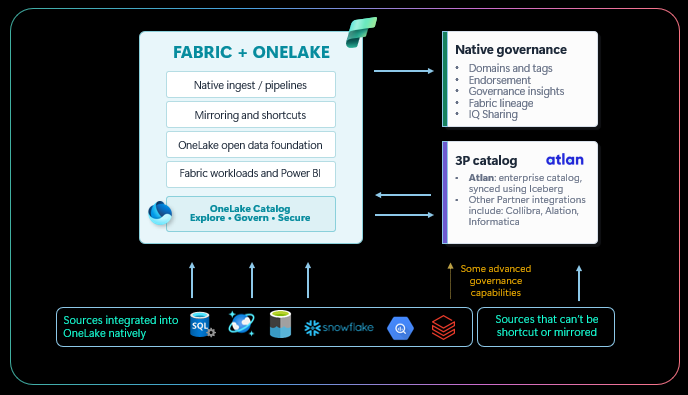
OneLake catalog governance, extended by a third-party catalog like Atlan. Source: Microsoft
Microsoft’s diagram shows the arrangement. OneLake governance sits on one side, and a third-party catalog extends it on the other. Microsoft says OneLake and Fabric customers can use Atlan to extend governance beyond OneLake.
Teams with most data in Fabric may find the OneLake catalog enough. Teams with Snowflake, Databricks, or SAP alongside Fabric have a gap. Microsoft says governance in Fabric is included in Fabric capacity, so a provider is a separate purchase.
Read OneLake catalog explained for what the catalog covers. Coexist, extend or replace Purview shows how teams divide the work.
If your data lives in more than one place, plan for the OneLake catalog plus one provider, and test that pairing.
What does Microsoft say about Atlan’s role?
Microsoft says Atlan extends governance beyond OneLake. The November 17 post says: “OneLake and Fabric customers can use Atlan, Microsoft’s preferred data governance partner, to extend governance beyond OneLake.”
It adds that Atlan provides granular, cross-estate lineage across non-Microsoft data sources. It also names richer governance constructs, such as usage and popularity stats. Microsoft says Atlan supports customers moving from Purview Data Governance to Fabric with tooling to carry their existing metadata forward.
Lineage is the map of how data flows from source systems to reports. Test it first. A wrong number in a Power BI report should trace back to a source column, even outside Fabric.
Atlan’s connector docs list what its Fabric connector crawls. It reads lakehouses and warehouses down to columns. It also reads mirrored databases, semantic models, reports, dataflows, and data pipelines. Atlan connects to more than 100 sources in all.
The Atlan and Microsoft partner page has the current description. How to migrate from Purview Data Governance walks through the steps.
Test Atlan’s lineage on your own data before you commit, as you would for any provider.
How do the provider types differ in their Fabric documentation?
Each provider publishes its own Fabric docs, and each describes something different. Read them against your estate.
Alation. Microsoft names Alation as a third-party provider Fabric integrates with. We could not verify Alation’s current public Fabric docs at the time of writing, so we make no claim about its connector. Ask Alation for its Fabric docs and version history.
Collibra. Collibra’s product docs say that when you integrate Fabric, you bring Fabric metadata into the Collibra Platform. The integration creates assets from Fabric lakehouses (files and tables) and warehouses (schemas, tables, views, and columns). Mirrored Azure Databricks items are covered too. Notebooks and semantic models are listed as in preview. Metadata here means the technical facts about each table and column.
Informatica. Informatica has a blog post on Cloud Data Governance and Catalog scanners for Microsoft Fabric. It covers the Fabric Data Warehouse and the Lakehouse SQL endpoint. It was last published November 14, 2024. Its OneLake scanner extracts folder structures and file details at the file system level. Confirm the current scanner list with Informatica.
A connector, an integration, and a scanner each read metadata from Fabric. Each documents its scope in its own way. None of these sources says how a provider carries your Purview glossary, domains, or data products across. Ask each vendor, using the questions below.
What stays in Microsoft Purview, and what do you still need to move?
Purview Data Security and Compliance stays with Microsoft. The November 17 post lists four capabilities, not affected, that still protect your data in Fabric: Information Protection, Data Loss Prevention, Insider Risk Management, and Data Security Posture Management.
If you searched for a replacement for sensitivity labels or DLP, you do not need one. What stays in Microsoft Purview after the retirement covers the split in detail.
What you do need to move is the governance work your team built in Purview Data Governance. Microsoft’s Learn page on Unified Catalog lists its building blocks. They are governance domains, data products, glossary terms, critical data elements, objectives and key results, access policies, data quality, and health controls.
The Learn pages for Unified Catalog and the Data Map carry a notice. You can no longer create new accounts. Existing capabilities stay in maintenance mode through November 12, 2027. Microsoft says it is consolidating data governance in Microsoft Fabric.
Start by listing what your team built by hand: glossaries, domains, data products, custom attributes, owners, and hand-drawn lineage. That list becomes the test you give every vendor. Purview Unified Catalog explained and the classic catalog versus Unified Catalog page help you sort which objects sit where.
The retirement checklist puts dates on the work. Moving Purview domains, data products, and glossary covers each object type. Do not spend migration effort on tools that are staying put.
How should you read Microsoft’s wording on partners?
Read each phrase for what it says, and no more. Microsoft uses three phrases across two posts.
“Integrates with” appears in the November 12 post, in the sentence naming Atlan, Alation, Collibra, and Informatica. It tells you Fabric works with outside tools. It covers all four names equally.
“Strategic partnership” and “preferred data governance partner” appear in the November 17 post, in the section on Atlan. They are Microsoft’s words about Atlan’s role, attributed to Microsoft and linked to the post.
No phrase promises that a provider fits your estate or covers every Fabric item type. None promises an easy move of your Purview work. The post says Atlan supports customers moving from Purview Data Governance to Fabric with tooling to carry their existing metadata forward. That is a statement about tooling, so test any provider’s tooling on your own data.
If your Microsoft contract names a partner, or your industry has rules about vendors, ask your Microsoft account team first. Microsoft asks customers with contract duties, and customers in regulated industries, to engage early. Those cases are assessed one by one. Settle contract questions first, before you compare features.
Example: how does a mixed estate divide the work?
Picture a team with a Fabric lakehouse, a Snowflake warehouse, and SAP finance data. Its Purview glossary holds 600 terms that stewards wrote by hand, a made-up figure that shows the shape of the work.
The OneLake catalog governs the Fabric lakehouse, and the data connected to OneLake through shortcuts and mirroring. The Snowflake and SAP data sits outside that reach. A third-party provider governs those sources where they run, and traces lineage across all three.
The glossary needs a new home before November 12, 2027. The team asks each vendor to show how 20 sample terms carry across, with owners and linked assets. It runs both systems side by side until the results match.
That test shows which provider fits. The partner list does not.
How do you choose between these providers?
Start with where your data lives, then test every provider on the same four questions. The first answer often cuts the list.
- Where does your data live? Mostly in Fabric points to the OneLake catalog alone. Snowflake, Databricks, and SAP alongside Fabric points to a catalog that governs each source where it runs.
- What did you build in Purview? Ask each vendor how glossaries, domains, data products, and custom attributes carry across, and who does the mapping.
- How deep does lineage go? Give each vendor one report. Ask it to trace a number back to its source column, including sources outside Fabric.
- Will AI agents read your governance? Ask how certified definitions and owners reach an agent, and what the agent can see.
Run the test on your own data, not a demo dataset. Pick one glossary, one domain, and one report that matters. Ask each provider to show them working. A few weeks of that tells you more than a feature list.
The Atlan and Microsoft Purview comparison and the best data catalogs for Microsoft Fabric page give two more views. Microsoft Fabric governance lists what the platform includes, which sets the baseline a provider has to add to. Pick the provider that passes your own test, whatever order Microsoft lists the names in.
What should you ask every vendor before you sign?
Ask all of them the same questions, and write the answers down.
- Which of our Purview Data Governance objects carry across as they are: glossaries, domains, data products, custom attributes, classifications?
- Does the migration read Purview with read-only access, and does anything get written back?
- Is there a review before anything moves, and a report after?
- How do owners carry across, and what happens to owners who are not users yet?
- Can we run both systems side by side, and re-run a migration without duplicating what already landed?
- Which Fabric item types does the integration cover today, and which are in preview?
- How does the Fabric metadata reach an AI agent?
- Regulated teams: what evidence does the vendor give for the controls your auditors expect?
Score the answers. Do not trust a demo alone. The checklist skill above turns them into a matrix, with the knockout failures first. The same rule applies to every vendor on the list, Atlan included. A claim on a marketing page is weak proof. A behavior you tested on your own data is strong proof.
Regulated teams should also read the note on Microsoft account teams above. A vendor that cannot answer these in writing is not ready for your estate.
FAQs about Microsoft’s data governance partners
Short answers to the questions teams ask most.
1. Who are the Microsoft recommended Purview partners?
Microsoft’s November 12, 2026 post says Fabric integrates with other third-party providers such as Atlan, Alation, Collibra, and Informatica. Microsoft names them in that order, which is alphabetical. The post does not rank them.
2. Which data governance partner does Microsoft prefer?
In its November 17, 2026 post, Microsoft announced a strategic partnership with Atlan and calls Atlan its preferred data governance partner. Microsoft says OneLake and Fabric customers can use Atlan to extend governance beyond OneLake.
3. Is the OneLake catalog enough to replace Purview Data Governance?
The OneLake catalog is Microsoft’s data governance product, built into Fabric. Microsoft calls it a new model, not a feature-for-feature replacement for Purview Data Governance. Microsoft also says Fabric integrates with third-party providers, so teams with data beyond OneLake can add one.
4. Does Microsoft rank Atlan, Alation, Collibra, and Informatica?
Microsoft lists the four together in its November 12, 2026 post and does not rank them. Its November 17, 2026 post separately calls Atlan its preferred data governance partner.
5. What is Microsoft retiring in Purview, and what stays?
Purview Data Governance is retiring, and support ends November 12, 2027. Purview Data Security and Compliance stays. Microsoft lists Information Protection, Data Loss Prevention, Insider Risk Management, and Data Security Posture Management as not affected.
6. When does support for Purview Data Governance end?
Support for Purview Data Governance ends on November 12, 2027, a year after Microsoft announced the retirement on November 12, 2026.
7. How should you choose between these providers?
Start with where your data lives. Then ask each provider how it covers Fabric, carries your Purview work across, traces lineage, and serves AI agents.
8. What should regulated teams do first?
Talk to your Microsoft account team early. Microsoft asks customers with contractual obligations and in highly regulated industries to engage early, because those scenarios are assessed individually.
Related reads
- Purview Data Governance coverage: What Purview covered, and where its reach ended.
- Fabric governance evaluation questions: Questions to ask before you pick.
- Microsoft data governance tools: The Microsoft stack, tool by tool.
- Data domains in governance: How domains organize ownership.
- Business glossary upkeep: Keep terms current after a move.
- Data classification tools: What to check when tags move.
- Automated data stewardship: Scale stewardship work.
- Data lineage best practices: What good lineage looks like.
- Power BI column-level lineage: Trace a report number to its source.
- Fabric lineage proof of value: A lineage test for Fabric.
- Catalog migration best practices: Plan a catalog move.
- Owners and stewards: What each governance role needs.
- Agentic data catalog: How agents read governance.
Sources
- A next step in the evolution of the Microsoft Data Governance strategy, Microsoft Security Community Blog, November 12, 2026
- OneLake: the unified foundation for data, context, governance, and AI, Microsoft Fabric Community Blog, November 17, 2026
- Unified Catalog, Microsoft Purview, Microsoft Learn
- Data Map, Microsoft Purview, Microsoft Learn
- What does Atlan crawl from Microsoft Fabric, docs.atlan.com
- About the Microsoft Fabric integration, Collibra product documentation (productresources.collibra.com)
- Cloud Data Governance and Catalog scanner capabilities for Microsoft Fabric, Informatica blog, last published November 14, 2024 (informatica.com)

