

Microsoft is retiring Purview Data Governance, and many teams want to know what that means for the rest of Purview. Unified Catalog and the classic governance capabilities retire, while Microsoft says Information Protection, Data Loss Prevention, Insider Risk Management, and Data Security Posture Management are not affected. Governance work left in Unified Catalog loses support on November 12, 2027, so each team needs to know which side its Purview features fall on. The retirement guide covers the full announcement. In its November 17, 2026 post, Microsoft announced a strategic partnership with Atlan and calls Atlan its preferred data governance partner.
Purview is a family of products, and only one member has an end date. The others classify, label, and protect sensitive data. They sit on Microsoft’s not-affected list. The table below keeps the two lists apart so you can sort what your team uses.
| Retires with Purview Data Governance | Not affected, per Microsoft |
|---|---|
| Unified Catalog: governance domains, data products, glossary terms, critical data elements, OKRs, access policies, data quality, health controls, and actions | Information Protection, which includes sensitivity labels |
| Classic Purview data governance capabilities, including the Data Map as its Learn page describes it | Data Loss Prevention |
| New accounts are closed. Existing capabilities stay in maintenance mode through November 12, 2027 | Insider Risk Management |
| Data governance moves to Microsoft Fabric and the OneLake catalog | Data Security Posture Management |
What retires, and what stays in Microsoft Purview?
Microsoft’s November 12, 2026 announcement sets one date. It says “Support for Purview Data Governance will end Nov. 12, 2027.”
The same post says Purview stays focused on data security and compliance. Microsoft describes that work as classifying, labeling, and protecting sensitive data, and preventing data loss across the estate and AI.
Microsoft’s November 17, 2026 post gives names. It says the OneLake catalog is now Microsoft’s data governance product. It also lists what is not affected: “Purview Data Security and Compliance, including Information Protection, Data Loss Prevention, Insider Risk Management and Data Security Posture Management.” Those four names are the ones to rely on. Treat any other product as unconfirmed until you check it.
Microsoft’s Learn pages describe the four in plain terms. Information Protection helps you discover, classify, and protect sensitive information. DLP helps prevent unintentional sharing of sensitive items. Insider Risk Management helps you detect, investigate, and act on malicious and inadvertent activities.
DSPM scans for sensitive data, assesses risk, and recommends actions.
Each has its own Learn page, and the sections below walk through them. If you use a Purview product that is on neither list, jump to the section on compliance and audit.
What exactly retires with Purview Data Governance?
A banner on Microsoft’s Unified Catalog Learn page says Unified Catalog and classic Purview data governance capabilities, formerly Azure Purview, are being retired. Microsoft is consolidating its data governance capabilities in Microsoft Fabric.
You can no longer create new accounts. Existing capabilities remain in maintenance mode through November 12, 2027. The Learn page for the Data Map carries the same notice.
Unified Catalog holds most of the governance work. Microsoft’s page lists governance domains, data products, glossary terms, critical data elements, OKRs, access policies, data quality, health controls, and health actions. The Data Map is the foundation for discovery and governance in Purview. It captures metadata about data in analytics, SaaS, and operational systems across hybrid, on-premises, and multicloud environments.
Microsoft calls what comes next a new model. In its words, the OneLake catalog is “a new model, not a feature-for-feature replacement for Purview Data Governance.” So plan to move your work, not to copy every feature one for one.
For more, read Purview Unified Catalog explained and the classic catalog versus Unified Catalog. The guide to the Purview Data Map after retirement covers scanning and classification. What Microsoft Purview is shows the whole family.
How does the OneLake catalog differ from the parts that stay?
Think of three layers. Purview’s security and compliance products protect data.
The OneLake catalog, native to Fabric, governs data in or connected to OneLake. A third-party catalog covers governance for data beyond OneLake. Microsoft says more than 240,000 organizations use the OneLake catalog to govern more than 350 million data items.
The November 17 post says the OneLake catalog does three tasks. Explore helps people find and understand data, with lineage, permissions, and business context. Govern gives governance insights and recommended actions, with domains, tags, endorsements, and policies. Secure covers OneLake security roles and fine-grained permissions.
Microsoft says the catalog governs “the data that lives in or is connected to OneLake through native items, federated catalogs, IQ Shares, Shortcuts and Mirrored databases.” It also says OneLake and Fabric customers can use Atlan to extend governance beyond OneLake. The partner provides granular, cross-estate lineage and richer governance constructs, such as usage and popularity stats, across heterogeneous, non-Microsoft data sources. Lineage is the map of how data flows from source to report.
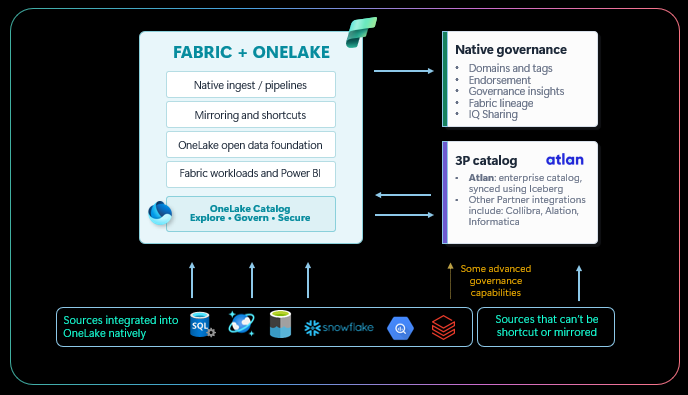
OneLake catalog governance, extended by a third-party catalog like Atlan. Source: Microsoft
The diagram shows the OneLake catalog with a third-party catalog beside it. Nothing in it replaces the security layer above. To see how the two catalogs divide the work, read the OneLake catalog explained and the Microsoft partner page. The side-by-side comparison is in OneLake, Atlan, and Purview Data Governance.
Are sensitivity labels and DLP affected by the retirement?
Microsoft says no. Its November 17 post names both as not affected and says they continue to protect your data in Fabric.
A sensitivity label is a tag on a file, email, or other item. It says how sensitive the item is and how to protect it.
Microsoft’s Information Protection Learn page says Information Protection helps you discover, classify, and protect sensitive information wherever it lives or travels. It describes sensitivity labels as a single labeling solution across apps, services, and devices. Microsoft’s November 12 post adds that in the OneLake catalog, the same permissions, sensitivity labels, endorsements, and lineage govern how AI uses data.
Data Loss Prevention, or DLP, is a set of policies that stop people from sharing sensitive items where they should not. Microsoft’s DLP Learn page says DLP policies identify, monitor, and automatically protect sensitive items. The locations include Exchange, SharePoint, OneDrive, Teams chat and channel messages, devices, and Fabric and Power BI workspaces.
One detail deserves a question to your account team. The Information Protection page lists labeling in the Purview Data Map as one of its capabilities.
Microsoft’s posts do not say how that labeling behaves once the Data Map’s governance role retires. Confirm it if you label data there. For how Purview treats AI agents, read Purview’s controls for AI agents.
Do Insider Risk Management and Data Security Posture Management continue?
Both appear on Microsoft’s not-affected list. Microsoft says they continue to protect your data in Fabric.
Insider Risk Management helps you spot risky actions by people inside your organization. Microsoft’s Insider Risk Management Learn page says it correlates signals to identify potential malicious or inadvertent insider risks, such as IP theft, data leakage, and security violations.
Policies, alerts, and cases form its workflow. Reviewers triage and investigate before they act. The page lists policy templates such as data theft by departing users, data leaks, and risky AI usage.
Data Security Posture Management, or DSPM, shows where sensitive data sits and how well it is protected. Microsoft’s DSPM Learn page says it continuously scans your environment to identify sensitive data, assess risk, and recommend actions to reduce exposure. It pulls in insights from Data Loss Prevention, Insider Risk Management, sensitivity labels, and Data Security Investigations. Microsoft says it answers four questions: what data you have, where it is stored, who can access it, and how it is protected.
The current version covers third-party SaaS and IaaS platforms, including Google Cloud Platform, Snowflake, and Databricks, through partner solutions. The page calls the earlier versions DSPM classic and DSPM for AI classic. Read the current documentation.
What covers compliance and audit once Purview Data Governance retires?
Microsoft’s posts answer part of this question. This section does not guess at the rest.
The November 12 post says Purview stays focused on data security and compliance. The November 17 post names four capabilities as not affected.
Neither post names Audit, eDiscovery, Communication Compliance, records management, or any other compliance product. Silence is not a statement that anything changes. The posts simply do not say.
Take three steps for any compliance product you use that is not on Microsoft’s list of four:
- Open that product’s page on Microsoft Learn and read its status banner. The Unified Catalog and Data Map pages carry a retirement banner, so an affected product will say so on its own page.
- Ask your Microsoft account team in writing. The November 12 post says customers with contractual obligations and in highly regulated industries should engage their account team early. It says these cases need to be assessed individually.
- Record the answer next to the control it supports, so your next audit has a dated source.
Your data governance catalog and your audit trail answer different questions. A catalog records what your data means and who owns it. A compliance product records what people did with it.
How does a team that keeps Purview for security add a governance layer?
Keep Purview for what Microsoft says continues. Then decide where governance lives for everything else.
Microsoft’s November 12 post says the OneLake catalog governs data across the estate, in Fabric, Azure, and third-party sources, through shortcuts, mirroring, and supported connectors. It also says governance is included in Fabric capacity rather than billed through separate meters. Per the same post, Fabric integrates with third-party providers such as Atlan. The November 17 post adds that Atlan supports customers moving from Purview Data Governance to Fabric, with tooling to carry their existing metadata forward.
Your team has three jobs to place:
- Protection: stays with Purview Data Security and Compliance, as Microsoft describes it.
- Governance inside OneLake: the OneLake catalog, with its domains, endorsements, and policies.
- Governance across the wider estate: the layer that extends governance beyond OneLake, with cross-estate lineage and usage and popularity stats.
If your glossaries, domains, and data products live in Purview Data Governance today, they need a new home before November 12, 2027. Decide where each one lands, export it through Microsoft’s Learn APIs, and validate the move before you switch anything off.
The five-step migration plan covers the work in order. Two sibling guides go further: moving domains, data products, and glossaries and the retirement checklist.
How does the split work in practice, with an example?
Start with a list. For every Purview feature your team uses, write down which side of the split it falls on.
Anything under Unified Catalog, the Data Map, or classic governance needs a plan. Anything on Microsoft’s list of four needs nothing from the retirement. The one exception is the Data Map labeling question above.
Here is an example. Say your team keeps glossary terms and data products in Unified Catalog. It runs DLP policies on Exchange and SharePoint. It labels documents with sensitivity labels.
The first item needs a destination and a plan. The other two sit on Microsoft’s not-affected list, so the retirement asks nothing of them.
Then bring three questions to your Microsoft account team:
- Which of the products we use are named as not affected?
- For the ones that are not named, what is their status?
- Does anything we set up through the Data Map, such as labeling, change when its governance role retires?
Last, choose the governance destination.
Coexist, extend, or replace Purview lays out how teams divide the work. Microsoft Fabric governance shows what the platform includes.
The Purview Data Governance alternatives page lists the options Microsoft names. Best data catalogs for Microsoft Fabric ranks catalogs by a stated rule. The guide to Microsoft data governance partners compares the partners.
Put dates on all of it. Support ends in a year, and moving curated governance takes longer than most teams plan for. Name an owner for each item on your list, and review the list monthly until every row has a destination and a date.
Related reads
- How Purview governs Fabric and Power BI: The Purview and Fabric split in practice.
- Purview Data Governance coverage: What the governance side covered.
- Microsoft data governance tools: The Microsoft stack, tool by tool.
- Fabric governance evaluation questions: Questions to ask before choosing.
- Keeping a business glossary current: Glossary upkeep after a move.
- Data domains in governance: How to structure domains.
- Owners and stewards: Who owns what.
- Snowflake to Fabric lineage: Lineage across a platform move.
- What is an agentic data catalog: Where governance goes next.
FAQs about what stays in Microsoft Purview
1. What exactly is shutting down in Purview, and what stays?
Purview Data Governance, meaning Unified Catalog and the classic governance capabilities, is shutting down, and support ends on November 12, 2027. Microsoft’s November 17, 2026 post says Information Protection, Data Loss Prevention, Insider Risk Management, and Data Security Posture Management are not affected.
2. Are sensitivity labels and DLP affected by the Purview Data Governance retirement?
Microsoft says they are not. Its November 17, 2026 post names Information Protection and Data Loss Prevention as not affected and says they continue to protect your data in Fabric. Sensitivity labels are part of Information Protection.
3. Is Data Security Posture Management affected by the Purview retirement?
Microsoft says no. Its November 17, 2026 post lists Data Security Posture Management among the Purview Data Security and Compliance capabilities that are not affected and continue to protect your data in Fabric.
4. Does Purview Insider Risk Management continue?
Yes, according to Microsoft. Its November 17, 2026 post names Insider Risk Management as not affected by the Purview Data Governance retirement and says it continues to protect your data in Fabric.
5. What covers compliance and audit once Purview Data Governance is retired?
Microsoft’s November 12, 2026 post says Purview stays focused on data security and compliance, and its November 17, 2026 post names four capabilities as not affected. Neither post names Audit or any other compliance product. Check Microsoft Learn for the product you rely on, and ask your Microsoft account team, especially if you have contractual obligations or work in a regulated industry.
6. Which data governance partner does Microsoft prefer?
In its November 17, 2026 post, Microsoft announced a strategic partnership with Atlan and calls Atlan its preferred data governance partner. Microsoft says OneLake and Fabric customers can use Atlan to extend governance beyond OneLake.
7. When does support for Purview Data Governance end?
Support for Purview Data Governance ends on November 12, 2027. Microsoft’s Learn pages say existing capabilities stay in maintenance mode until then and that you can no longer create new accounts.
Sources
- A next step in the evolution of the Microsoft Data Governance strategy, Microsoft Security Community Blog, November 12, 2026
- OneLake: the unified foundation for data, context, governance, and AI, Microsoft Fabric Community Blog, November 17, 2026
- Learn about Microsoft Purview Unified Catalog, Microsoft Learn
- Microsoft Purview Data Map overview, Microsoft Learn
- Microsoft Purview Information Protection, Microsoft Learn
- Learn about data loss prevention, Microsoft Learn
- Learn about Insider Risk Management, Microsoft Learn
- Learn about Microsoft Purview Data Security Posture Management, Microsoft Learn

