

Gartner’s Critical Capabilities for Data and Analytics Governance Platforms, published 12 November 2026, evaluates 16 vendors’ products for four use cases. It scores them on 11 critical capabilities and is the companion to the 2026 Magic Quadrant for the same market. Gartner clients can read it in full on gartner.com. You can also download a complimentary copy of the 2026 Gartner Magic Quadrant for D&A Governance Platforms, where Atlan is a Leader for the second time in a row.
| Quick facts | |
|---|---|
| Report | Gartner Critical Capabilities for Data and Analytics Governance Platforms |
| Published | 12 November 2026 |
| Authors | Sarah Turkaly, Anurag Raj, Lulu Wang, Dalia Naguib |
| Vendors evaluated | 16 |
| Use cases | Policy Setting; Policy Enforcement (Operational); Policy Enforcement (Analytical); Policy Enforcement (AI) |
| Critical capabilities | 11 |
| Companion research | Magic Quadrant for Data and Analytics Governance Platforms |
| Where to read it | gartner.com, for Gartner clients |
What is the Gartner Critical Capabilities report for D&A governance platforms?
Gartner publishes Critical Capabilities research next to some of its Magic Quadrants. On the document page, Gartner describes the research this way:
“Gartner Critical Capabilities research complements Gartner Magic Quadrant™ analyses by offering deeper insights into products and services provided by multiple vendors in specific markets, focusing on how well each product meets detailed functional requirements rather than on the vendors’ overall market positioning.”
For governance teams, that difference is practical. A data and analytics (D&A) governance platform is bought to do specific jobs, such as setting policy or enforcing it on the data that AI models use. A team that picks a platform on market reputation alone can end up with strong coverage for one job and gaps in the one it actually needs. Reading this report alongside the Magic Quadrant helps you check fit for your own use cases before the demos start.
How is Critical Capabilities different from the Magic Quadrant?
The two reports cover the same market and the same release date, but they answer different questions. One looks at vendors, the other at products for specific use cases.
| Magic Quadrant | Critical Capabilities | |
|---|---|---|
| The question it answers | How does each vendor stand in the market as a whole? | How well does each product fit a specific use case? |
| What it looks at | Vendors, on Ability to Execute and Completeness of Vision | Products, against named capabilities and use cases |
| What you get | A placement in one of four quadrants, with strengths and cautions | Product scores by use case |
| Best for | Framing a shortlist | Checking fit for the jobs you need done |
Source: Atlan
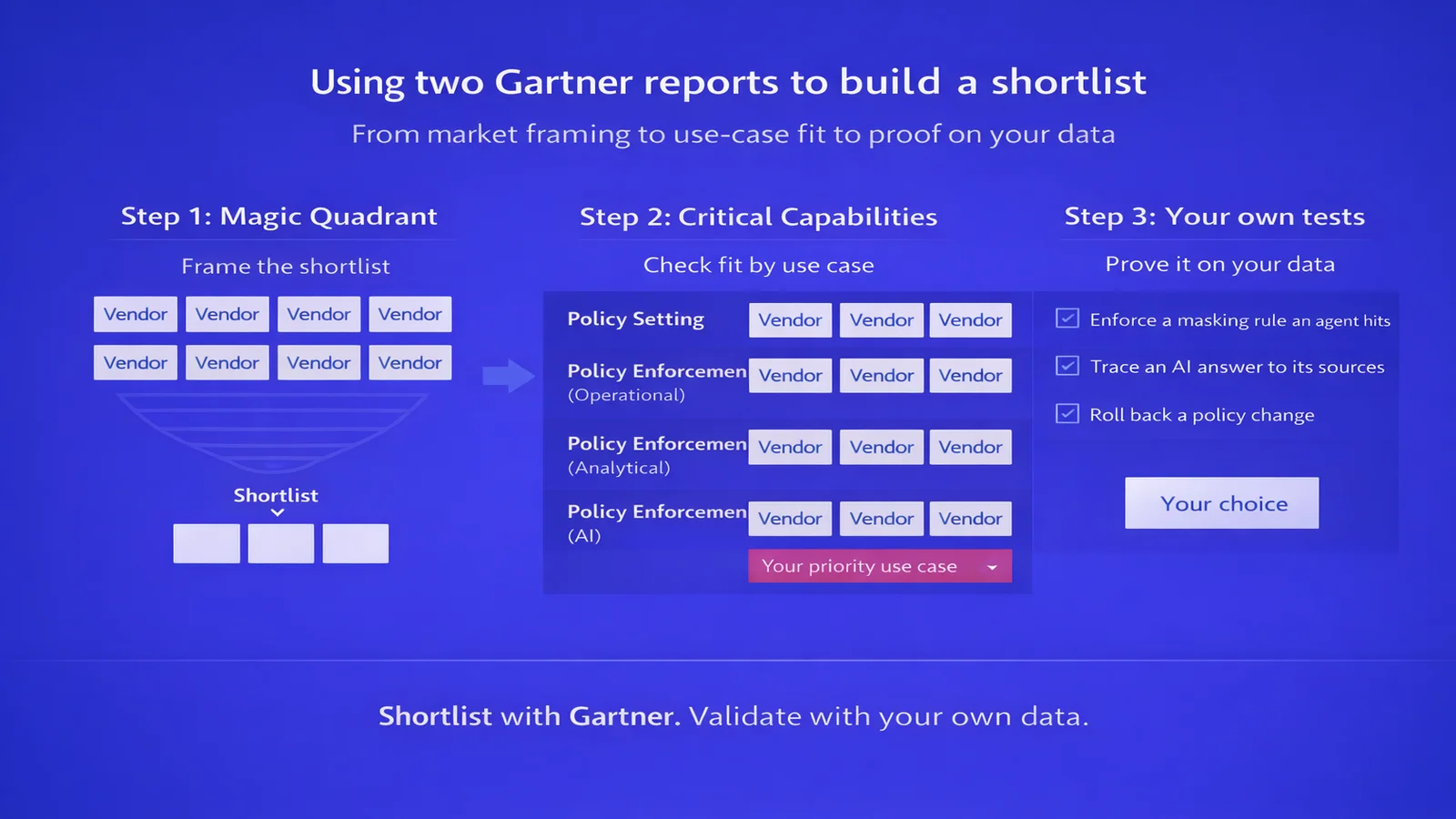
Read the Magic Quadrant first to see the market, then use Critical Capabilities to test the products on your shortlist against your use cases.
How does Gartner define the D&A governance platform market?
Both reports describe the same market. In the Critical Capabilities report, Gartner puts it this way:
“A D&A governance platform helps D&A leaders set, apply, and enforce governance policies designed through a strategic governance operating model.”
Keep that definition next to your own requirements. It is the scope every capability and use case in the report is measured against.
What does the Magic Quadrant evaluate, and how are vendors positioned?
The Magic Quadrant evaluates vendors in the same market and places each one in one of four quadrants: Leaders, Challengers, Visionaries and Niche Players. Placement is based on two scores, Ability to Execute and Completeness of Vision. The 2026 edition evaluates 16 vendors and names three significant innovations reshaping the market.
Atlan is a Leader for the second time in a row, positioned highest on Ability to Execute. Atlan’s page on the 2026 Magic Quadrant for D&A Governance Platforms covers that report, and you can get a complimentary copy of the Magic Quadrant.
What does the 2026 report contain?
The report scores each product against a set of critical capabilities, then rolls those scores up for four use cases. Here is the structure, so you know where to look; the definitions, weightings and scores are in the report.
Four use cases
Gartner evaluates the products for four use cases:
- Policy Setting
- Policy Enforcement (Operational)
- Policy Enforcement (Analytical)
- Policy Enforcement (AI)
The split matters. Most governance programs started with setting policy and enforcing it for analytics. In our experience, enforcing policy on operational systems and on AI is newer ground for many teams, and it is where platforms tend to differ most. If your priority is governing the data that AI models and agents use, the AI use case is the one to read first.
Eleven critical capabilities
The 11 capabilities in the 2026 report are:
- Data Catalog
- Semantic Model
- Policy Bench
- Reporting
- Workflow Management
- Data Lineage and Impact Analysis
- Rule Management
- Data Classification and Tag Management
- Security
- Match, Link, Merge
- AI Governance Support
Several of these are familiar from catalog evaluations. Others, like the policy bench, the semantic model and AI governance support, point to where governance platforms are heading: from documenting data to defining shared meaning and governing how AI uses it. A semantic model and data lineage for AI are good starting points if those terms are new to your team.
How should you use the report on a shortlist?
Critical Capabilities is most useful once you know which jobs the platform has to do. We suggest four steps.
- Name your use cases. Write down which of the four use cases your program needs today and which in the next two years. A team rolling out AI agents usually needs policy enforcement for AI sooner than it expects.
- Rank the capabilities that serve them. For each use case, pick the few capabilities that decide success for you, such as lineage depth or classification of unstructured data, and agree on them before any vendor demo.
- Read the report for those capabilities. Use the scores for your priority use cases, not the overall impression, to narrow the shortlist.
- Test what the report cannot. No report sees your data estate. Ask each vendor to show your own scenarios live: enforce a masking rule on a table an agent queries, trace an AI answer back to its sources, and roll back a policy change.
The data governance platform evaluation criteria page turns these steps into 22 behavior tests you can score in demos and proofs of concept.
How does Atlan approach these capabilities?
Atlan’s own product and approach are described here, not Gartner’s evaluation; for that, read the report.
We believe governance is moving from managing data for people to providing trusted context for people and AI agents. That belief shapes how Atlan delivers several of the capabilities above.
- Semantic model, built by agents and certified by people. Context Agents read SQL history and BI formulas, then write descriptions, metrics and ontology, each with a confidence score, and your experts certify what goes live. In 2026, 87% of customers rated Context Agents output on par with or better than human-written documentation.
- Policy and context governed like code. Definitions, metrics, ontologies, skills and policies get owners, versions, tests and rollback.
- AI governance on open, shared context. The Context Lakehouse stores context as open Apache Iceberg tables in your own cloud. Through MCP, an agent checks what an asset means, whether it’s certified and which policies apply, in a single call before anything executes.
Atlan is a Leader in the 2026 Gartner Magic Quadrant for Data and Analytics Governance Platforms for the second time in a row, positioned highest on Ability to Execute. A context layer for data governance teams explains how that approach works day to day.
Real stories from real customers: Governance at scale
Two Atlan customers on governed context at enterprise scale.
"AI initiatives require more context than ever. Atlan's metadata lakehouse is configurable, intuitive, and able to scale to hundreds of millions of assets."
— Andrew Reiskind, Chief Data Officer, Mastercard

"Context is the differentiator. Atlan gave our teams the shared vocabulary and lineage to move from reactive data management to proactive AI enablement."
— Kiran Panja, Managing Director, Cloud and Data Engineering, CME Group

Gartner clients can read the full Critical Capabilities report on gartner.com
Read it on GartnerFAQs about Gartner Critical Capabilities for D&A Governance Platforms
1. What is Gartner Critical Capabilities for Data and Analytics Governance Platforms?
Gartner’s evaluation of how well 16 vendors’ governance products fit four use cases, scored against 11 critical capabilities. The 2026 edition was published on 12 November 2026.
2. What use cases does the 2026 report cover?
Policy Setting, Policy Enforcement (Operational), Policy Enforcement (Analytical) and Policy Enforcement (AI).
3. How is Critical Capabilities different from the Magic Quadrant?
The Magic Quadrant places vendors across a whole market. Critical Capabilities scores products against capabilities for specific use cases. Teams often use the first to frame a shortlist and the second to check fit.
4. Where can I read the full report?
Gartner clients can read it on gartner.com. The companion Magic Quadrant is available as a complimentary copy from Atlan’s report page.
Sources
- Gartner, Critical Capabilities for Data and Analytics Governance Platforms, 12 November 2026, Sarah Turkaly Et Al.
- Gartner, Magic Quadrant for Data and Analytics Governance Platforms, 12 November 2026, Anurag Raj Et Al.
Gartner does not endorse any company, vendor, product or service depicted in its publications, and does not advise technology users to select only those vendors with the highest ratings or other designation. Gartner publications consist of the opinions of Gartner’s business and technology insights organization and should not be construed as statements of fact. Gartner disclaims all warranties, expressed or implied, with respect to this publication, including any warranties of merchantability or fitness for a particular purpose.
Gartner and Magic Quadrant are a trademark of Gartner, Inc., and/or its affiliates.

