

The 2026 Gartner Magic Quadrant for Data and Analytics Governance Platforms evaluates 16 vendors in the D&A governance platform market. Atlan is a Leader for the second time in a row, positioned highest on Ability to Execute. You can download a complimentary copy of the report for every vendor’s placement and Gartner’s full analysis.
| Quick facts | |
|---|---|
| Report | Gartner Magic Quadrant for Data and Analytics Governance Platforms |
| Published | 12 November 2026 |
| Authors | Anurag Raj, Sarah Turkaly, Lulu Wang, Dalia Naguib |
| Vendors evaluated | 16 |
| Innovations named | Policy as Code for Continuous and Runtime Enforcement; Dual Plane of Context and Control for Trusted AI; Agentic Stewardship |
| Atlan’s placement | Leader, second time in a row, positioned highest on Ability to Execute |
| Companion research | Critical Capabilities for Data and Analytics Governance Platforms |
What is the 2026 Gartner Magic Quadrant for Data and Analytics Governance Platforms?
The Magic Quadrant is Gartner’s evaluation of the vendors in the data and analytics (D&A) governance platform market. It places each vendor in one of four quadrants, Leaders, Challengers, Visionaries and Niche Players, based on two scores: Ability to Execute and Completeness of Vision.
Governance teams have used these platforms for years to document data and coordinate stewardship. In Gartner’s words, D&A governance platforms:
“serve (usually) as an abstracted, metadata-enabled layer across the multicloud, heterogeneous data ecosystem, allowing governance stakeholders, primarily nontechnical business personnel, to streamline and automate their governance tasks in collaborative workflows.”
That description was written for people. The question running through this edition is what happens when AI agents need the same definitions, owners, lineage and policies, and need them current every time the business changes. If your team is choosing, replacing or extending a governance platform, a wrong pick leaves policies documented but unenforced at the moment an agent queries the data.
What does the report contain?
The report has three parts: a description of the market, an evaluation of each vendor, and the criteria behind that evaluation. Here is the structure; the analysis itself is in the report.
The market and its capabilities
The report opens with Gartner’s definition of the market. It then lists the capabilities a platform needs, split into mandatory and optional groups. It then describes how the market is changing and which innovations are driving that change. Read this part first if you are writing requirements, because it gives your team a shared vocabulary before any vendor conversation.
What you get on each vendor
Each of the 16 vendors gets a placement on the Magic Quadrant graphic and a profile with strengths and cautions. The report also lists vendors added and dropped since the last edition, and honorable mentions.
The evaluation criteria
The last part explains the inclusion criteria and how each axis is scored. It is the part to read when you want to understand why a vendor sits where it does, rather than only where it sits.
For the placements, the vendor profiles and the scoring detail, get the complimentary report.
Which innovations does Gartner say are reshaping the market?
Gartner names three significant innovations in this market: Policy as Code for Continuous and Runtime Enforcement, Dual Plane of Context and Control for Trusted AI, and Agentic Stewardship. Each one moves governance further from documents that people read and closer to rules and context that systems and agents act on.
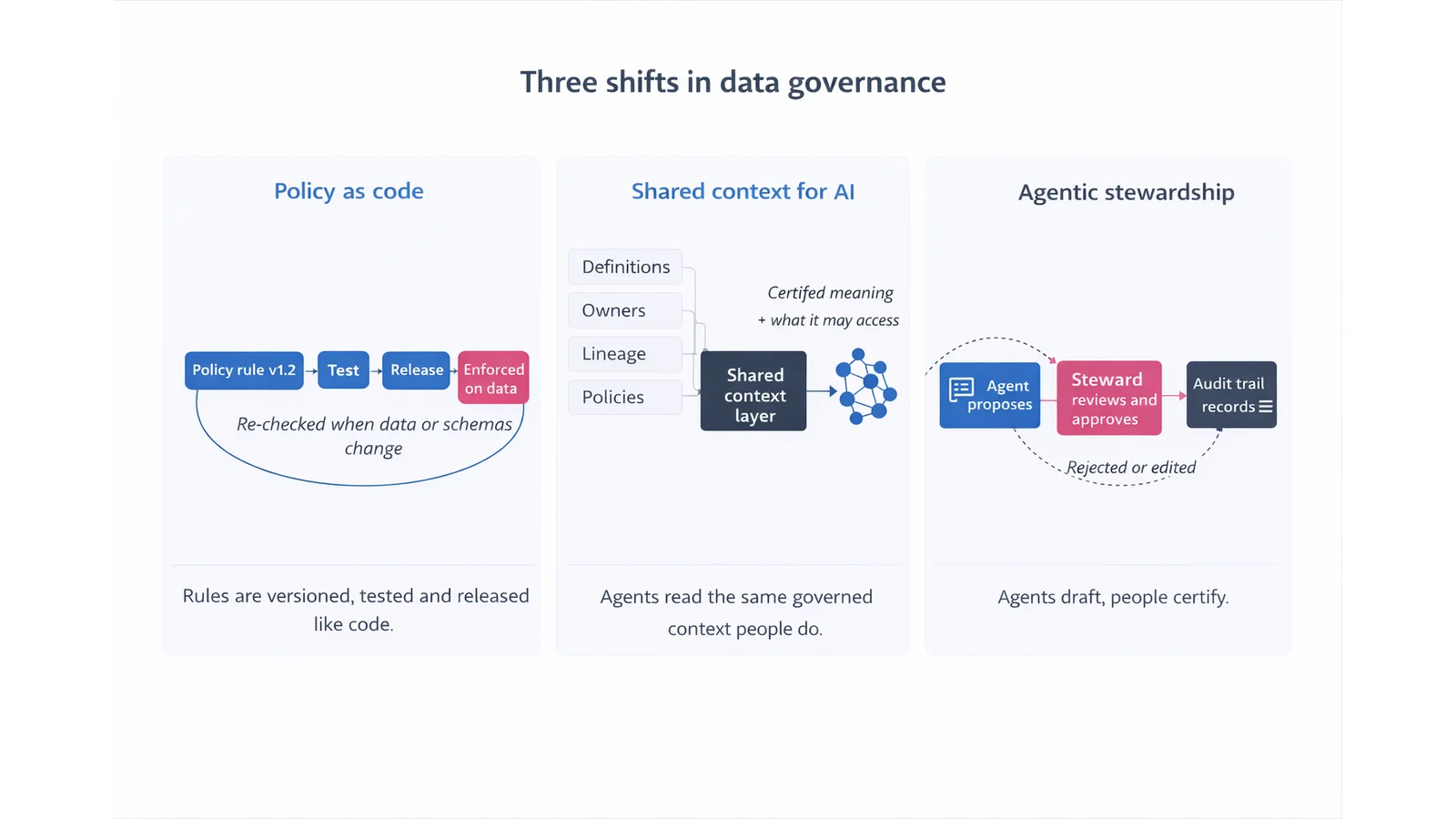
Source: Atlan
Policy as Code for Continuous and Runtime Enforcement
Gartner writes:
“The market is moving from documenting policies to defining them as versioned, machine-readable rules that can be tested and promoted through CI/CD, and continuously reevaluated as data, schemas, code or events change.”
In practice, that means a governance rule lives the way code does. A masking rule for a customer email column, for example, is written once, versioned, tested and released, instead of living in a policy document that someone has to interpret. Data contracts for AI and policy enforcement are where most teams meet this idea first.
Dual Plane of Context and Control for Trusted AI
Gartner writes:
“The market is extending its value proposition as a shared context layer that connects business definitions, policies, ownership, data quality, lineage and technical assets across structured, unstructured and AI-related data.”
For teams building AI, this is the innovation that matters most. An agent that can read certified definitions, owners and lineage at query time answers with the business’s meaning, and the same platform decides what that agent is allowed to touch. An agent context layer and AI agent access control are the two halves of that picture.
Agentic Stewardship
Gartner describes where agentic stewardship stands today:
“The market remains largely agent-assisted rather than fully agentic, with leading solutions combining automation with confidence scores, evidence, human review, permissions, audit trails, exception handling and rollback.”
For stewards, the job changes shape. More time goes to reviewing and certifying what agents propose, and less to writing documentation by hand. An agentic data catalog is one place this already shows up.
What do these innovations mean for governance teams?
To us, the three innovations describe one evolution. Governance is moving from managing data for people to providing trusted context for people and AI agents.
It is becoming a critical foundation for enterprise AI. Agents help with stewardship, people certify the results, and the same policies apply to every person and agent that uses them.
That shift is why we built Atlan to serve two kinds of users from the start: people, and the AI agents working beside them. Three principles follow from it.
- Context is created autonomously, and certified by humans. No company has enough stewards to write down everything its agents need to know. Agents draft context from the work the business already does, in SQL, dashboards and documents, and people stay on the loop for what ships.
- Context and policy are governed like code. Definitions, metrics, ontologies, skills and policies get owners, versions, tests and rollback, and they improve from how agents actually use them.
- Context stays open. Context is a company’s IP. It belongs in open formats on storage the company controls, readable by every engine, harness and model it chooses. Atlan keeps context in open formats on storage you control, so it stays portable across every engine and model you use.
If your governance program was built for people to look things up, the gap usually shows up first in AI projects: two agents give two different answers to the same business question. A context layer for data governance teams closes that gap by making certified context the thing agents read.
Why was Atlan named a Leader?
Atlan is a Leader in the 2026 Gartner Magic Quadrant for Data and Analytics Governance Platforms for the second time in a row, positioned highest on Ability to Execute. Atlan was recognized as a Visionary in the 2025 report.
We believe this recognition reflects our continuous innovation, with products like Context Agents and the Context Lakehouse. We also believe it reflects the progress we’ve made in helping enterprises move beyond traditional data governance, toward trusted context for humans and AI agents. Most of all, we feel it reflects the trust our customers have placed in us as they make that transition.
Context Agents: agents draft, people certify
Context Agents build your semantic model from the work your business already does. They read SQL history and BI formulas, then write descriptions, metrics and ontology, each with a confidence score, and your experts certify what goes live. In 2026, 87% of customers rated Context Agents output on par with or better than human-written documentation. Mastercard enriched 30,000+ assets in two weeks and saved 6,200 hours of steward time, with stewards reviewing every draft.
A Context Lakehouse built to govern humans and agents
In Atlan, people and AI agents work under the same definitions, the same policies and the same certifications. Underneath it all, the Context Lakehouse stores context as open Apache Iceberg tables in your own cloud, and agents reach it through MCP, A2A, SQL and APIs. When a definition changes, your agents get the certified version.
An open ecosystem across your stack
No governance team starts from zero. Atlan’s open App Framework runs partner- and customer-built apps as first-class parts of the platform. The observability, quality and security tools you already own work inside your governance program. With 120+ connectors, governance reaches every warehouse, lake, BI tool and pipeline you run.
Real stories from real customers: Governance at scale
Two Atlan customers on what shared, governed context changes for their teams.
"AI initiatives require more context than ever. Atlan's metadata lakehouse is configurable, intuitive, and able to scale to hundreds of millions of assets."
— Andrew Reiskind, Chief Data Officer, Mastercard

"Atlan is our context operating system to cover every type of context in every system including our operational systems. For the first time we have a single source of truth for context."
— Sridher Arumugham, Chief Data Analytics Officer, DigiKey

How should you use the report when choosing a platform?
A Magic Quadrant shows how Gartner sees each vendor across a whole market. Your shortlist has a narrower job: find the platform that fits your policies, your data estate and your AI plans.
We suggest using the report in three steps.
- Frame the shortlist. Read the market section and the vendor profiles, and note the strengths and cautions that touch your own priorities.
- Turn your priorities into tests. Ask each vendor to show, not tell. Promote a policy version through CI/CD and roll it back. Revoke a user’s access and ask an agent a question that needs it. Trace one AI answer back to its source tables and documents.
- Check fit by use case. Gartner’s companion Critical Capabilities research looks at product fit by use case, and pairs well with the Magic Quadrant at this stage.
The data governance platform evaluation criteria page turns these steps into a scored checklist.
Read every vendor's placement, strengths and cautions in Gartner's own words
Get the Gartner reportFAQs about the 2026 Gartner Magic Quadrant for D&A Governance Platforms
1. What is the Gartner Magic Quadrant for Data and Analytics Governance Platforms?
Gartner’s evaluation of the vendors in the D&A governance platform market. The 2026 edition was published on 12 November 2026 and evaluates 16 vendors.
2. Is Atlan a Leader in the 2026 Gartner Magic Quadrant for D&A Governance Platforms?
Yes. Atlan is a Leader for the second time in a row, positioned highest on Ability to Execute.
3. What innovations does the report name?
Gartner names three significant innovations: Policy as Code for Continuous and Runtime Enforcement, Dual Plane of Context and Control for Trusted AI, and Agentic Stewardship.
4. How is the Magic Quadrant different from Gartner Critical Capabilities?
The Magic Quadrant places vendors across a whole market. The companion Critical Capabilities research looks at how well products fit specific use cases. Teams often read both when they build a shortlist.
5. How can I get the full report?
Download a complimentary copy of the 2026 Gartner Magic Quadrant for Data and Analytics Governance Platforms from Atlan’s report page.
Sources
- Gartner, Magic Quadrant for Data and Analytics Governance Platforms, 12 November 2026, Anurag Raj Et Al.
Gartner does not endorse any company, vendor, product or service depicted in its publications, and does not advise technology users to select only those vendors with the highest ratings or other designation. Gartner publications consist of the opinions of Gartner’s business and technology insights organization and should not be construed as statements of fact. Gartner disclaims all warranties, expressed or implied, with respect to this publication, including any warranties of merchantability or fitness for a particular purpose.
Gartner and Magic Quadrant are a trademark of Gartner, Inc., and/or its affiliates.

