






















Snowflake Native vs Third-Party Governance: Quick Comparison
Permalink to “Snowflake Native vs Third-Party Governance: Quick Comparison”| Capability Category | Snowflake Horizon (Native) | Third-Party Tools | Best Use Case |
|---|---|---|---|
| Access Control & Security | ✓ RBAC, masking, row-level policies | ✓ Cross-platform policy management | Snowflake-only: Native / Multi-platform: Both |
| Data Discovery & Catalog | ✓ Snowflake assets only | ✓ Entire data stack (all tools) | Single warehouse: Native / Multi-cloud: Third-party |
| Cross-System Lineage | ✗ Snowflake-only lineage | ✓ End-to-end (source → BI) | Complex pipelines: Third-party required |
| Business Glossary | Limited (tags + descriptions) | ✓ Full glossary with workflows | Business-facing governance: Third-party |
| Collaboration Features | Basic (Snowsight comments) | ✓ Purpose-built (Slack, discussions) | Small teams: Native / Enterprise: Third-party |
| AI Governance | ✗ No model lineage | ✓ Model tracking + feature stores | AI initiatives: Third-party required |
| Cost Model | Included with Enterprise+ | Subscription ($50K-$500K+/year) | Budget-constrained: Start native |
| Implementation Time | Typically 4-8 weeks setup | Typically 8-12 weeks MVP, 4-6 months full | Quick start: Native / Scale: Both |
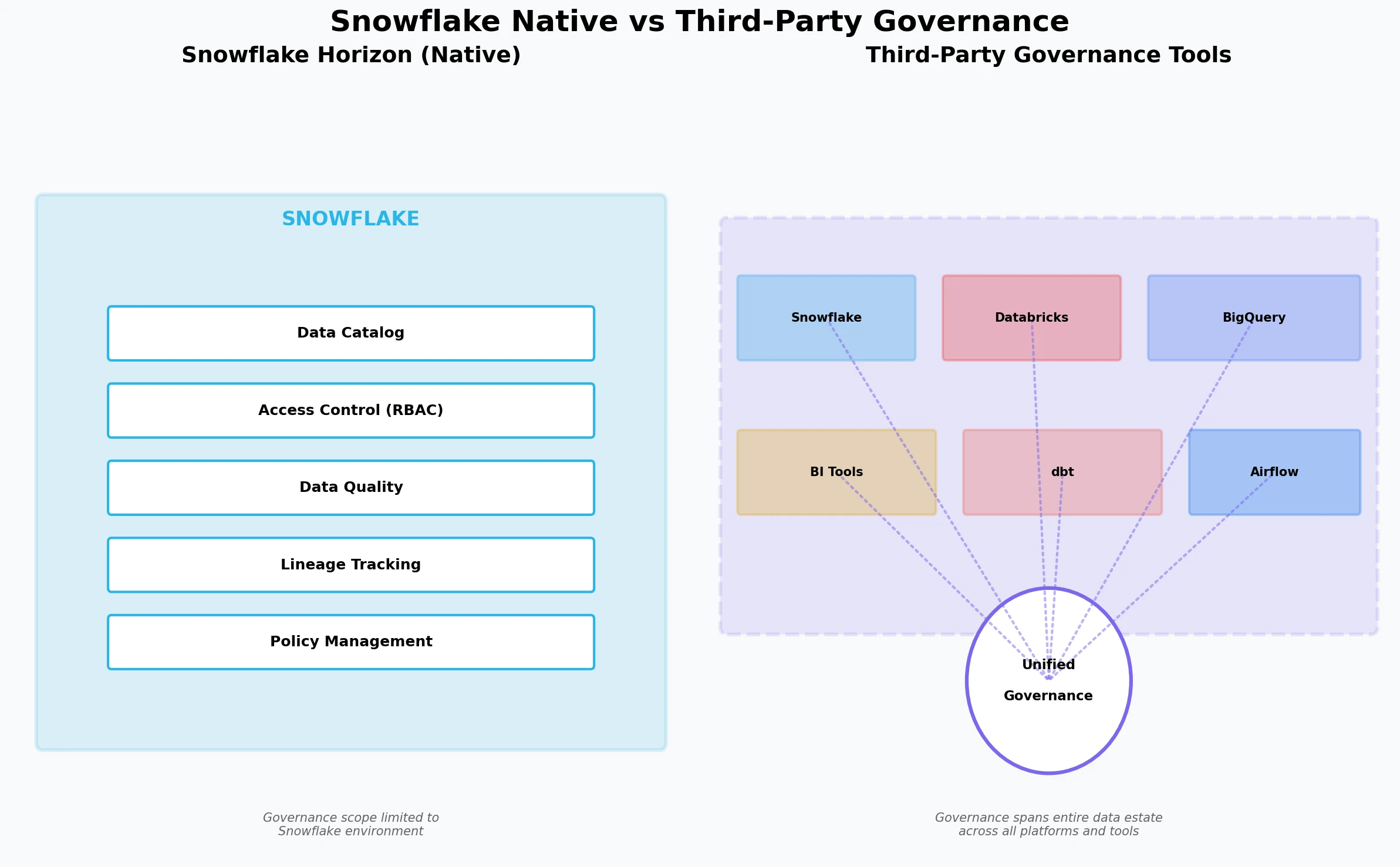
The core difference—Snowflake Horizon provides governance within its boundaries, while third-party tools extend governance across your entire data estate.
What is Snowflake native governance?
Permalink to “What is Snowflake native governance?”Snowflake native governance refers to the security and compliance features built directly into Snowflake, centered around Horizon Catalog—a unified interface released in 2024 for discovery, governance, and security. You get role-based access control (RBAC), dynamic data masking, row-level security, object tagging, and automated data classification without installing external tools. Horizon governs everything inside Snowflake: databases, tables, views, Iceberg tables managed by Snowflake, and Marketplace listings. The critical limitation—it governs only Snowflake assets. If you have Databricks, BigQuery, Tableau dashboards, or dbt transformations, Horizon can’t see them.
Horizon Catalog provides five core capabilities. First, compliance features let you protect and audit data with built-in monitoring and quality checks. Second, security features deliver continuous risk monitoring with granular authorization and RBAC. Third, privacy features enable differential privacy, aggregation policies, and data clean rooms for sensitive data collaboration. Fourth, discovery features power AI-driven search across Snowflake assets with rich metadata context. Fifth, interoperability features integrate with Apache Iceberg through Polaris Catalog and partner with external governance platforms.
Snowflake Native Governance Features
Permalink to “Snowflake Native Governance Features”| Feature | What It Does | Limitation |
|---|---|---|
| RBAC | Controls who accesses what data through role hierarchy | Snowflake-only; can’t manage access across BI tools |
| Dynamic Masking | Hides sensitive data at query time based on user role | Only masks data queried through Snowflake |
| Object Tagging | Labels tables/columns for classification and policy enforcement | Tags don’t propagate to external tools |
| Data Classification | Auto-detects sensitive data (PII, PHI) using ML | Limited to Snowflake tables; no cross-platform scanning |
| Native Lineage | Tracks dependencies between Snowflake objects | Stops at Snowflake boundary; can’t trace to source systems or BI |
| Horizon Catalog | Unified interface for discovery and governance | Snowflake-centric; no visibility into non-Snowflake assets |
The native approach works brilliantly for what it’s designed for—governing data within Snowflake’s walls. When your data pipeline starts in Snowflake and ends in Snowflake, Horizon provides enterprise-grade governance out of the box. Multi‑cloud and multi‑platform architectures are now the norm, not the exception.
What do third-party data governance tools provide?
Permalink to “What do third-party data governance tools provide?”Third-party data governance tools extend governance beyond Snowflake’s boundaries to cover your entire data ecosystem. While Horizon governs Snowflake, tools like Atlan, Alation, and Collibra govern Snowflake plus Databricks, BigQuery, BI platforms, orchestration tools, and data science environments—typically supporting 15-50+ connectors across your stack. You need these tools when data spans multiple platforms, which happens the moment you add Tableau dashboards, Airflow pipelines, or a second cloud warehouse.
The value proposition centers on four capabilities Horizon lacks. Cross-platform lineage traces data from original sources through transformations to final BI reports, showing the complete journey across Snowflake and external tools. Business glossaries provide semantic layers where business users define terms, metrics, and KPIs with approval workflows—not just technical tags. Collaboration features embed governance into daily workflows with discussions, Slack notifications, and purpose-built interfaces for non-technical users. Data product catalogs let teams package datasets with SLAs, contracts, and quality guarantees—treating data like APIs with clear ownership and consumption patterns.
What Third-Party Tools Add to Snowflake
Permalink to “What Third-Party Tools Add to Snowflake”| Capability | What It Enables | Example Vendors |
|---|---|---|
| Cross-System Lineage | Trace data from source → Snowflake → BI dashboards | Atlan, Alation, Collibra |
| Business Glossary | Centralized term management with semantic relationships | Atlan, Collibra, Alation |
| Data Products | Curated datasets with SLAs, contracts, and marketplace | Atlan, Informatica |
| Collaboration | Discussions, Slack alerts, embedded workflows | Atlan, Alation, Select Star |
| AI Governance | Model lineage, feature store tracking, responsible AI controls | Atlan, Collibra |
| Automation | Rule-based playbooks for tagging, ownership, certification | Atlan, Alation |
Modern tools use active metadata approaches—automatically ingesting technical metadata from all your systems, then helping teams apply governance where it matters most. Instead of asking analysts to document everything manually, these platforms continuously pull metadata from Snowflake, dbt, Looker, Airflow, and more. The Gartner 2025 Magic Quadrant for Data & Analytics Governance Platforms evaluates 15+ vendors in this space, with Leaders demonstrating comprehensive capabilities across policy management, automation, and cross-platform integration.
Without cross-system visibility, you can’t answer basic questions. Where did this Tableau metric come from? Which Snowflake tables feed this dashboard? If I change this dbt model, what breaks downstream? Horizon answers these questions only within Snowflake. Many Snowflake customers eventually layer a third‑party control plane on top of native capabilities.
See how Atlan extends Snowflake governance across your entire data stack
Book a DemoSnowflake governance vs third-party tools—key differences
Permalink to “Snowflake governance vs third-party tools—key differences”The core difference is scope—Snowflake Horizon governs within its walls, third-party tools govern across your entire data estate. Horizon sees Snowflake databases, tables, views, and Iceberg tables managed by Snowflake. It cannot see Databricks notebooks, Tableau dashboards, dbt transformations, Airflow DAGs, or data science feature stores. Third-party tools integrate with all these systems plus Snowflake, creating a unified governance layer that spans platforms.
Architecture differs fundamentally. Horizon is embedded—it’s part of Snowflake’s interface and operates entirely within your Snowflake account. You manage governance through Snowsight alongside your data warehouse operations. Third-party tools run as external control planes—separate applications that connect to Snowflake via APIs and metadata connectors. They pull metadata from Snowflake, enrich it with business context and cross-system lineage, then often sync policies back to Snowflake through bidirectional integration. For example, Atlan reads Snowflake metadata, adds business glossary terms and cross-tool lineage, then syncs governance tags back to Snowflake where Horizon enforces them.
Division of Responsibilities in Hybrid Architectures
Permalink to “Division of Responsibilities in Hybrid Architectures”| Governance Function | Snowflake Horizon | Third-Party Tool | Integration Point |
|---|---|---|---|
| Access Control | Enforces RBAC, masking within Snowflake | Manages access requests and approvals | Policy sync via tags |
| Data Discovery | Snowflake asset search in Snowsight | Cross-platform search and catalog | Metadata enrichment |
| Lineage | Object dependencies within Snowflake | End-to-end lineage across all tools | Horizon lineage + external enrichment |
| Business Context | Technical metadata + descriptions | Glossary, metrics, ownership, stewardship | Term-to-asset mapping |
| Compliance Reporting | Snowflake-specific audit logs | Cross-platform compliance dashboards | Audit log aggregation |
| AI Governance | Snowflake‑native model assets only; no dedicated model registry or feature‑store governance | Model registry, feature lineage, risk tiers | ML metadata ingestion |
Collaboration models also diverge sharply. Horizon provides basic capabilities. You can comment on objects in Snowsight and view usage statistics. This works for small technical teams working exclusively in Snowflake. Third-party tools offer purpose-built collaboration—discussions on datasets, Slack notifications when data quality fails, request workflows for data access, and business-friendly interfaces where non-technical users can discover and understand data without SQL skills.
The reality that drives architecture decisions: 85% of data teams use 5+ tools in their modern data stack according to Gartner surveys. If you’re in that majority, Horizon’s Snowflake-only scope becomes a limitation, not a feature. The question shifts from “Horizon or third-party?” to “How do I combine both effectively?”
When should you use Snowflake native governance alone?
Permalink to “When should you use Snowflake native governance alone?”Use Snowflake native governance alone when your data lives entirely within Snowflake and you have straightforward governance needs. This scenario applies to a small subset of organizations—typically those with Snowflake-only data estates, small teams under 50 data users, primarily technical governance requirements, or budget constraints that demand maximizing existing Snowflake investments.
Four specific scenarios justify native-only approaches. First, true Snowflake-only environments where all data sources, transformations, and consumption happen within Snowflake—no external BI tools, no secondary warehouses, no orchestration platforms outside Snowflake’s native capabilities. Second, early-stage governance programs where you’re establishing basic policies and access controls before expanding to cross-platform governance. Third, small technical teams where everyone works in Snowflake directly and doesn’t need business-facing discovery or collaboration features. Fourth, organizations with strict budget limits who need to prove governance value before investing in additional tools.
Use Native-Only Governance If ALL These Are True:
Permalink to “Use Native-Only Governance If ALL These Are True:”- 100% of your data and analytics workloads run in Snowflake
- You have fewer than 50 regular data users
- All data users are technical (analysts, engineers) comfortable with Snowflake’s interface
- You don’t use external BI tools, orchestration platforms, or transformation frameworks
- You plan to stay Snowflake-only for the next 12-18 months
- Compliance requirements don’t demand cross-system lineage
Even in native-only scenarios, watch for warning signs you’ll outgrow this approach. When you start adding BI tools like Tableau or Looker, Horizon can’t govern those dashboards. When business users complain they can’t find data or don’t understand what datasets mean, Horizon’s technical interface becomes a barrier. When you adopt dbt for transformations or Airflow for orchestration, Horizon’s lineage stops at Snowflake’s boundary—you lose visibility into upstream dependencies. When compliance audits demand end-to-end lineage from source systems through BI reporting, Horizon can’t provide it.
The native-only path makes sense as a starting point—establish a security baseline with Horizon, then expand when limitations emerge. Most organizations hit those limitations within 6-12 months as their data estates grow in complexity. Plan for the transition rather than assuming native-only lasts forever.
When do you need third-party data governance tools?
Permalink to “When do you need third-party data governance tools?”You need third-party governance tools when your data spans multiple platforms or when business users need self-service access to governed data. Six common triggers signal it’s time to expand beyond Snowflake native governance—each representing real pain points that Horizon alone can’t solve.
Trigger one: Multi-cloud or multi-warehouse architecture
Permalink to “Trigger one: Multi-cloud or multi-warehouse architecture”The moment you add Databricks, BigQuery, Redshift, or any second data platform, Horizon’s Snowflake-only scope creates governance blind spots. You can’t trace lineage across platforms, policies don’t transfer between systems, and data discovery becomes fragmented. Organizations with multi-cloud strategies—which includes 88% of enterprises—need unified governance from day one.
Trigger two: Business users can’t find or understand data
Permalink to “Trigger two: Business users can’t find or understand data”When analysts spend 60% of their time hunting for data instead of analyzing it, you have a discovery problem. Horizon provides technical search within Snowflake, but business users need friendly interfaces with business glossaries, plain-language descriptions, and cross-tool discovery. They shouldn’t need to know SQL or understand Snowflake’s structure to find the customer revenue dataset they need.
Trigger three: Compliance audits require end-to-end lineage
Permalink to “Trigger three: Compliance audits require end-to-end lineage”Regulations like GDPR, CCPA, and HIPAA demand you prove data’s complete journey—from source systems through transformations to final reports. Horizon shows lineage within Snowflake, but auditors need to see upstream sources and downstream BI consumption. When compliance gaps expose you to $50K-$5M penalties, third-party lineage becomes risk management, not nice-to-have.
Trigger four: AI and ML governance becomes critical
Permalink to “Trigger four: AI and ML governance becomes critical”If you’re building AI applications, you need to govern training data, track model lineage, catalog feature stores, and enforce responsible AI policies. Snowflake doesn’t currently provide a full AI governance suite—for example, you don’t get a central model registry with cross‑platform lineage, feature‑store cataloging, and policy workflows. Horizon can catalog models as assets inside Snowflake, but you still need a third‑party control plane for end‑to‑end AI governance across warehouses, feature stores, and downstream apps. Third-party tools provide model registries, feature lineage, and AI risk tiers that make governance auditable.
Trigger five: Data product strategy requires marketplace and contracts
Permalink to “Trigger five: Data product strategy requires marketplace and contracts”Modern data teams treat data like products—curated datasets with SLAs, quality guarantees, ownership contracts, and consumption metrics. Snowflake offers no native data product catalog. Tools like Atlan provide marketplaces where domain teams publish data products with clear contracts, making data reliably consumable across the organization.
Trigger six: Collaboration at scale breaks down
Permalink to “Trigger six: Collaboration at scale breaks down”When you have 100+ data users across business and technical teams, Snowflake’s basic commenting doesn’t cut it. You need discussions on datasets, Slack notifications for quality issues, access request workflows, and stewardship processes that don’t require everyone to work in Snowflake. Third-party tools embed governance into daily workflows instead of treating it as separate compliance activity.
Independent research shows organizations with third-party governance tools reduce time-to-insight. The efficiency gain comes from automated discovery, cross-platform visibility, and governance embedded in tools people already use—not forcing everyone into a data warehouse interface.
Why most organizations need both approaches
Permalink to “Why most organizations need both approaches”The best governance architectures combine Snowflake native security with third-party orchestration—what we call the hybrid model. Horizon enforces policies within Snowflake while third-party tools extend those policies across your entire data stack. Gartner’s 2025 Magic Quadrant for Data & Analytics Governance Platforms emphasizes unified, cross‑platform governance—most mature programs end up operating in a hybrid model.
The division of labor makes intuitive sense. Snowflake Horizon handles within-Snowflake security and compliance—RBAC, dynamic masking, row-level policies, sensitive data classification, and compliance monitoring for Snowflake assets. These are foundational controls that should stay in Snowflake where performance is optimized and integration is native. Third-party tools handle discovery across platforms, business context and glossaries, cross-system lineage, data products and marketplaces, and collaboration workflows. These capabilities require visibility beyond Snowflake’s boundaries and interfaces designed for business users, not just data engineers.
Integration patterns make this hybrid model practical. Modern governance platforms offer bidirectional tag sync—apply a governance tag in your catalog, and it automatically syncs to Snowflake where Horizon enforces it as policy. Policy propagation works similarly—define access policies once in your governance layer, and they cascade to Snowflake plus your BI tools and transformation frameworks. Lineage enrichment combines Horizon’s within-Snowflake lineage with external tool tracking to create complete data journey maps from source through consumption.
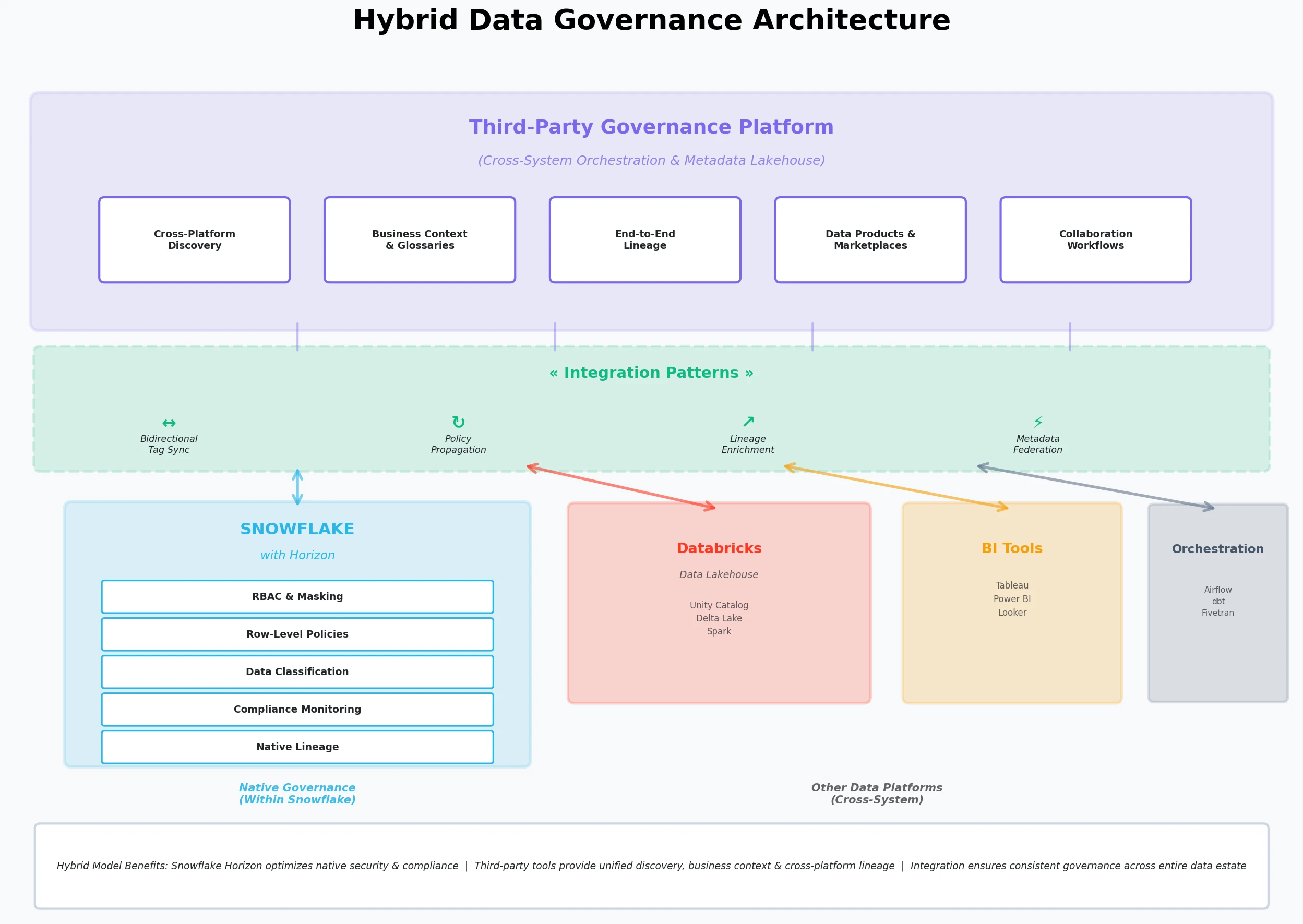
In a hybrid model, Snowflake Horizon handles within-Snowflake governance while third-party tools provide unified control across all platforms.
Hybrid Model in Practice
Permalink to “Hybrid Model in Practice”Here’s how it works end-to-end: A business analyst searches for customer data in your governance catalog (third-party tool), finds a governed data product with clear documentation and quality metrics. She requests access through the catalog interface. The governance platform checks her role and routes approval to the data product owner. Once approved, the platform syncs access permissions to Snowflake where Horizon enforces them—granting her the appropriate role with proper masking based on her department. She queries the data through Tableau, which connects to Snowflake. If she notices data quality issues, she flags them in the catalog where data engineers receive Slack notifications. Engineers trace the issue using cross-platform lineage that shows the data’s journey from AWS S3 through dbt transformations in Snowflake to the Tableau dashboard—visibility that Horizon alone couldn’t provide.
The results speak clearly. Joint Atlan + Snowflake customer base grew 415% in the last two years according to partnership data, suggesting the hybrid model scales more effectively than either approach alone. Organizations report 40% faster time-to-insight when analysts can discover data across platforms instead of hunting through Snowflake alone. Compliance teams complete audits 60% faster with cross-system lineage that connects source data through transformations to final reports.
You keep Snowflake’s robust security intact—masking stays performant, RBAC remains native, and access control operates at database speed. You add cross-system visibility that makes governance actually work across your data estate. The cost of the third-party tool becomes infrastructure investment, not redundant spend, because it enables capabilities Snowflake never intended to provide.
What are the cost implications?
Permalink to “What are the cost implications?”Snowflake governance is included in Enterprise Edition and higher, but “included” means built into your license cost, not zero-cost. You budget for staff time to configure policies, document assets, maintain governance processes, and respond to access requests. The hidden costs accumulate: manual documentation overhead as teams grow, limited scalability when data spans multiple platforms, governance gaps in cross-system environments that create compliance exposure, and analyst productivity loss when discovery takes hours instead of minutes.
Third-party governance platforms charge subscription fees—typically $50K-$500K+ annually depending on data volume, user count, and feature tier. Small teams with under 100 users pay $50-150K annually. Mid-market organizations with 100-500 users pay $150-300K annually. Enterprise deployments with 500+ users, advanced features, and high data volumes pay $300K+ annually. Add implementation services for year one: expect $150-250K for professional services that configure integrations, migrate metadata, and train your teams. The total year-one investment ranges from $200K to $750K for most organizations.
Total Cost of Ownership Comparison
Permalink to “Total Cost of Ownership Comparison”Break down the economics clearly. Native-only total cost of ownership includes Snowflake license (already budgeted), staff time for manual governance (0.5-2 FTEs depending on scale), opportunity cost of limited discovery (analysts waste 40-60% of time finding data), and compliance risk exposure (audit findings cost $100K-$2M to remediate). Third-party total cost of ownership includes subscription fee (annual), implementation cost (year one only), ongoing maintenance (0.5-1 FTE), but delivers savings through automated stewardship, faster time-to-insight, and reduced compliance risk.
The ROI calculation becomes straightforward. If governance gaps cost more than $200K annually in manual work, analyst productivity loss, or compliance exposure, third-party tools typically pay for themselves within 12-18 months. Enterprises often find that reducing analysts’ time-finding-data from 60% to 20% justifies the entire investment—that productivity gain alone generates $500K-$2M in annual value for teams of 50-100 analysts.
Industry research shows most data‑governance spend still goes to people and processes rather than tools, often skewed heavily toward labor, which is why automation has such a strong ROI. The insight? Governance is already expensive through manual processes. Tools reduce the labor burden through automation, shifting costs from people to platforms. Organizations with mature governance automation report 60% reduction in manual stewardship hours while improving coverage and compliance.
Hidden costs of native-only approaches often surprise teams. Compliance audit findings cost $100K-$1M to remediate when you can’t prove data lineage. Data quality issues that reach production cost $500K-$5M annually in bad decisions and customer impact. Analyst turnover driven by frustration with poor data discovery costs $150K per person in recruitment and onboarding. These downstream impacts dwarf the subscription cost of governance tools.
The decision threshold: Calculate your current governance labor costs, add opportunity costs from slow discovery, and assess compliance risk exposure. If that total exceeds $300K annually, third-party tools provide immediate ROI. If you’re under $200K in total governance costs, you might start native-only and expand as you scale.
How long does implementation take?
Permalink to “How long does implementation take?”Snowflake native governance is immediately available but requires configuration and policy setup—expect 4-8 weeks for basic implementation. You spend the first 1-2 weeks setting up roles and access control hierarchies. Weeks 2-4 cover policy configuration: defining masking rules, applying object tags, configuring data classification scans. Weeks 4-8 involve rollout: training teams, documenting processes, and establishing governance workflows. This timeline assumes you have clear requirements and dedicated resources; complex environments with multiple business units can take 12+ weeks.
Third-party tool implementation requires integration and rollout phases—8-12 weeks for a minimum viable product, 4-6 months for enterprise-wide deployment. The first 2-3 weeks cover integration: connecting Snowflake and other platforms, configuring metadata extraction, setting up authentication. Weeks 3-6 focus on a pilot domain: one business unit or data domain where you establish governance patterns, test workflows, and demonstrate value. Months 3-4 expand to enterprise rollout: onboarding additional domains, scaling to more data sources, and training broader user base. Months 5-6 reach full maturity: advanced features activated, federated governance established, and automation optimized.
Implementation Timeline Comparison
Permalink to “Implementation Timeline Comparison”| Phase | Snowflake Native | Third-Party Tool | Key Activities |
|---|---|---|---|
| Initial Setup | 1-2 weeks | 2-3 weeks | Roles, connectors, authentication configuration |
| Pilot Domain | 2-4 weeks | 3-4 weeks | Policy configuration, one business unit governance |
| Enterprise Rollout | 2-4 weeks | 2-3 months | Scale to all domains, train broader user base |
| Full Maturity | Ongoing | 6-12 months | Advanced automation, federated governance |
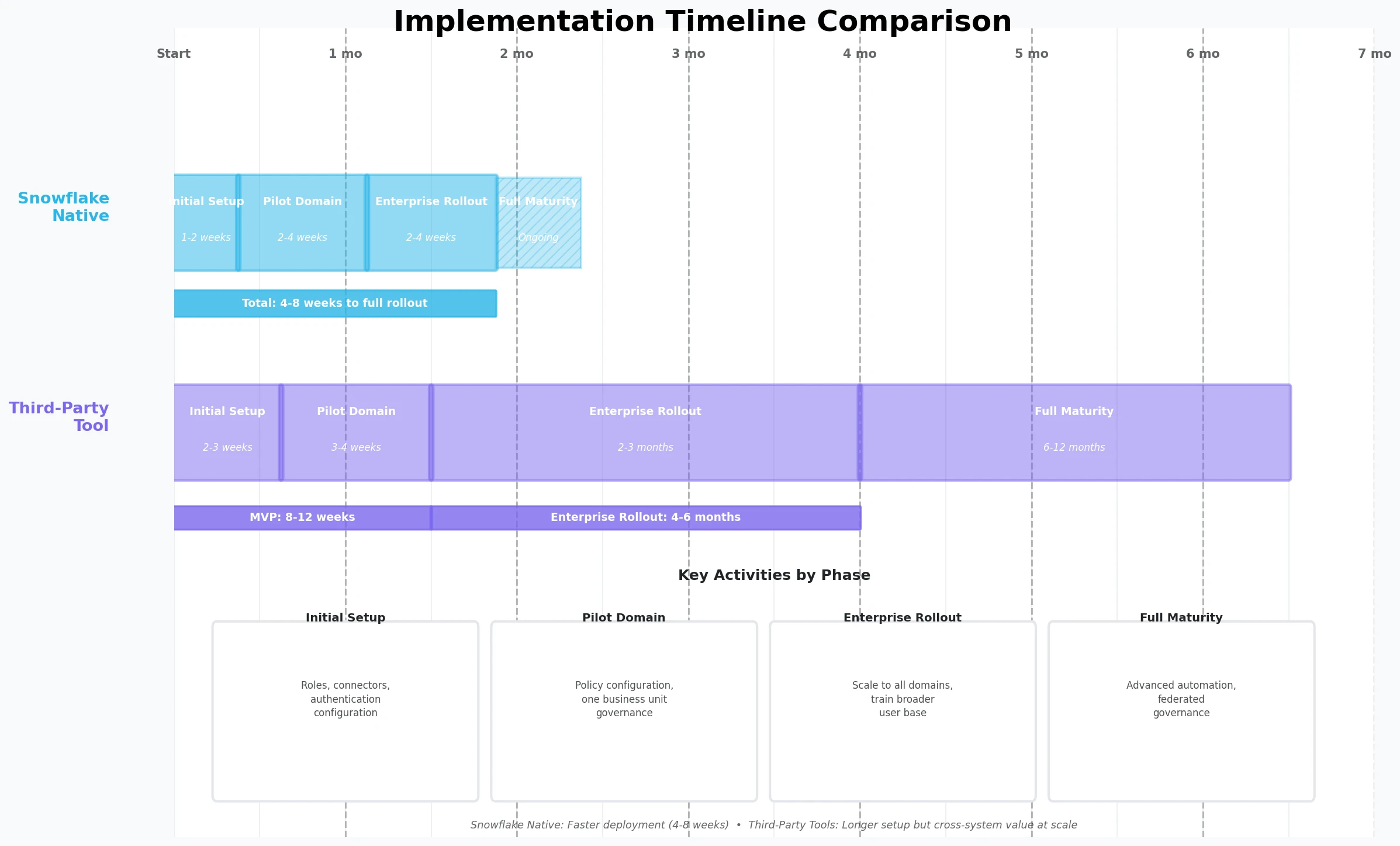
Third-party tools require longer initial setup but provide cross-system value that scales as your data estate grows.
Several factors can affect the timeline significantly. The number of data sources extends implementation—connecting 3-5 systems takes weeks, connecting 20+ takes months. Team size and availability matter—dedicated governance teams implement faster than part-time efforts. Existing governance maturity accelerates adoption—organizations with documented policies and processes implement 40-60% faster than those starting from scratch. Change management determines success—technical setup takes weeks, but adoption takes months of user onboarding and workflow adjustment.
Acceleration strategies help you move faster. Pre-built connectors reduce integration time by 50-70% versus custom API development. Governance blueprints provide templates for policies, workflows, and organizational structures—organizations using blueprints implement 60% faster according to customer data. Phased rollout by domain lets you prove value quickly with one business unit before scaling. DIY setup options in modern platforms let technical teams configure integrations without professional services, though you sacrifice expertise and best practices.
The realistic expectation: Plan for 2-3 months to implement basic governance with either native or third-party approaches when you account for configuration, testing, and adoption. Third-party tools take longer initially but provide cross-platform value that compounds as your data estate grows. Native-only is faster to start but often requires rework when you outgrow its limitations—factor in transition costs if you expect to add platforms within 12-18 months.
How Atlan Complements Snowflake Governance
Permalink to “How Atlan Complements Snowflake Governance”The Challenge
Permalink to “The Challenge”Organizations adopt Snowflake Horizon for native governance but quickly discover limitations when data spans beyond Snowflake’s boundaries. Your Snowflake policies don’t extend to Tableau dashboards. Your analysts spend 60% of their time hunting for data across disconnected systems. Your lineage stops at Snowflake’s edge—you can’t trace upstream sources or downstream BI consumption. Compliance audits demand end-to-end visibility you can’t provide. According to industry research, 85% of enterprises use 4+ data platforms, which means Snowflake-only governance leaves massive blind spots. Data teams need cross-system orchestration that works with Horizon, not instead of it—extending governance across Databricks, BI tools, orchestration platforms, and data science environments while keeping Snowflake as the policy enforcement point.
Atlan’s Approach
Permalink to “Atlan’s Approach”Atlan was named Snowflake’s 2025 Data Governance Partner of the Year for deep integration that makes Horizon more powerful, not redundant. Atlan’s Metadata Lakehouse acts as a control plane—unifying governance across Snowflake and your entire data stack through bidirectional metadata sync. The integration works seamlessly: Atlan reads metadata from Snowflake Horizon, enriches it with business context and cross-platform lineage, then syncs governance tags back to Snowflake where Horizon enforces them. Apply a sensitive data tag in Atlan, and it automatically propagates to Snowflake where masking policies take effect.
The partnership extends into three breakthrough areas. First, Data Quality Studio runs quality checks natively in Snowflake Data Metric Functions—business users define quality rules in Atlan’s collaborative interface, then those checks execute inside your Snowflake environment using your existing compute. Trust signals surface everywhere—in Atlan’s catalog, across BI dashboards, and via Slack notifications—showing instantly whether data is fit for purpose. Second, column-level lineage traces data journeys from source systems through dbt transformations in Snowflake to Tableau dashboards and ML models. You see the complete data flow, not just Snowflake’s internal lineage. Third, AI governance capabilities catalog models, track training data lineage, and enforce responsible AI policies—critical for organizations building production AI on Snowflake Cortex.
The Outcome
Permalink to “The Outcome”The results validate the approach. Joint Atlan+Snowflake customer base grew 415% in two years, with organizations like Workday, Affirm, and Medtronic using the integration to govern AI-native data estates. Workday leverages Atlan + Snowflake to enable governed data products with clear SLAs and ownership—critical for their AI strategy. Medtronic built their Common Data Framework with Atlan on Snowflake, achieving 5x adoption in months and significantly accelerating time-to-insight. The pattern repeats: organizations keep Horizon’s robust security while gaining cross-platform governance that scales with their modern data architecture.
Atlan works alongside the largest, most AI‑forward companies in every industry, collectively valued at over $10 trillion. The metadata lakehouse is becoming the de-facto control plane for data and AI inside Snowflake because it solves the challenge Horizon was never designed for: governing the 85% of your data estate that lives outside Snowflake’s walls. Learn more about the Atlan + Snowflake partnership.
See how Atlan + Snowflake powers AI-native governance
Watch the EventFAQ
Permalink to “FAQ”1. Is Snowflake Horizon free?
Permalink to “1. Is Snowflake Horizon free?”Horizon Catalog is included in Snowflake Enterprise Edition and higher, which means it’s built into your existing Snowflake license cost, not zero-cost. You get discovery interface, object tagging, basic lineage within Snowflake, and security features like RBAC and masking without separate fees. What’s not included: third-party integrations, cross-system governance capabilities, and the staff time required for implementation and ongoing management. Budget for 0.5-2 FTEs to configure policies, maintain documentation, and handle access requests even though there’s no separate software license.
2. Can Snowflake Horizon govern data outside Snowflake?
Permalink to “2. Can Snowflake Horizon govern data outside Snowflake?”No, Snowflake Horizon governs only data within Snowflake’s boundaries. It sees Snowflake databases, tables, views, Iceberg tables managed by Snowflake, and assets in Snowflake Marketplace. Horizon cannot govern Databricks notebooks, BigQuery datasets, Redshift tables, Tableau dashboards, Looker reports, dbt projects, Airflow DAGs, or data lakes in S3. The Polaris Catalog integration extends Horizon to external Iceberg tables, but this doesn’t provide governance for non-Iceberg formats or other cloud platforms. Cross-platform governance requires third-party tools.
3. What’s the biggest limitation of Snowflake native governance?
Permalink to “3. What’s the biggest limitation of Snowflake native governance?”The biggest limitation is Snowflake-centricity—Horizon cannot see or govern data outside Snowflake’s boundaries. If you have Databricks for data science, Tableau for BI, dbt for transformations, and Airflow for orchestration, Horizon offers no visibility into these systems. The impact: governance gaps where policies don’t extend to external tools, blind spots in lineage where you can’t trace complete data journeys, incomplete compliance coverage that fails audits. Most organizations need cross-system visibility, which requires third-party governance platforms that integrate across your entire data estate.
4. How do third-party tools integrate with Snowflake Horizon?
Permalink to “4. How do third-party tools integrate with Snowflake Horizon?”Third-party governance tools integrate via Snowflake APIs and metadata connectors, often with bidirectional sync capabilities. Tools read Snowflake metadata—schemas, tables, lineage, usage statistics, existing tags—then enrich it with business glossary terms, cross-platform lineage, and ownership information. The enriched metadata syncs back to Snowflake through tag propagation and policy updates. For example, apply a “PII-sensitive” tag in Atlan’s catalog, and it automatically syncs to Snowflake where Horizon enforces masking policies. You govern once in your central control plane, then policies enforce everywhere—across Snowflake and all connected platforms.
5. When should I use both Snowflake Horizon and a third-party tool?
Permalink to “5. When should I use both Snowflake Horizon and a third-party tool?”Use both when your data estate spans multiple platforms or when you need business-facing governance features beyond Horizon’s technical capabilities. Common triggers include multi-cloud architecture with Snowflake plus Databricks or BigQuery, BI tool proliferation requiring unified discovery across Tableau and Looker, AI governance for model lineage and feature stores, data product strategy with marketplace and SLAs, or 100+ data users needing self-service discovery. The division of labor: Snowflake Horizon handles within-Snowflake security and compliance, third-party tools provide cross-system discovery, lineage, and collaboration. This hybrid model is how 70% of mature enterprises operate.
6. What are data products and why do I need a third-party tool for them?
Permalink to “6. What are data products and why do I need a third-party tool for them?”Data products are curated, documented datasets with SLAs and ownership contracts that serve specific business use cases—essentially APIs for data. Unlike raw tables, data products include quality guarantees, comprehensive documentation, clear access controls, and consumption metrics that track usage and reliability. Snowflake provides no native data product catalog or marketplace with formal contracts and SLAs. Third-party tools like Atlan fill this gap by creating product marketplaces on top of Snowflake assets where domain teams publish governed datasets, consumers discover them with business-friendly interfaces, and contracts formalize expectations between producers and consumers.
7. How much does third-party data governance software cost?
Permalink to “7. How much does third-party data governance software cost?”Third-party governance platforms typical ranges that we see in the market are $50K-$500K+ annually based on data volume, user count, and feature tier. Small teams with under 100 users pay $50-150K annually for basic features. Mid-market organizations with 100-500 users pay $150-300K annually for advanced capabilities. Enterprise deployments with 500+ users and comprehensive features pay $300K+ annually. Add implementation services for year one: expect $150-250K for professional services covering integration, metadata migration, and training. The ROI threshold: if manual governance costs or compliance risk exceeds $200K annually, tools typically pay for themselves within 12-18 months.
8. Can I start with Snowflake native and add third-party tools later?
Permalink to “8. Can I start with Snowflake native and add third-party tools later?”Yes, starting with Snowflake native governance and expanding to third-party tools later is a common and practical approach. Use Horizon to establish your security baseline—configure RBAC, set up masking policies, and implement basic tagging. Add third-party tools when you hit limitations, typically when adding BI platforms, adopting a second cloud warehouse, scaling beyond 50-100 users, or starting AI initiatives. The migration path is straightforward because third-party tools import Snowflake metadata automatically—your existing tags, policies, and classifications transfer. Plan for 2-3 months transition period for integration, pilot domain rollout, and user training.
9. How does Atlan work with Snowflake Horizon?
Permalink to “9. How does Atlan work with Snowflake Horizon?”Atlan integrates deeply with Snowflake Horizon through bidirectional metadata sync and native execution capabilities. Atlan reads Horizon metadata including schemas, lineage, tags, and usage patterns, then enriches it with business glossary terms, cross-platform lineage, and data product context. Governance tags sync bidirectionally—apply a tag in Atlan, and it automatically propagates to Snowflake where Horizon enforces policies. Data Quality Studio runs checks natively in Snowflake Data Metric Functions, so quality validation executes inside your Snowflake environment. The result: unified control plane for governance across Snowflake and your entire data stack while keeping Snowflake as the policy enforcement point.
10. What is a metadata lakehouse?
Permalink to “10. What is a metadata lakehouse?”A metadata lakehouse is a centralized repository that stores and manages metadata from all tools in your data stack—warehouses, BI platforms, orchestration, transformation frameworks, and data science environments. Unlike traditional catalogs that only capture Snowflake or one platform, a metadata lakehouse unifies metadata from Snowflake, Databricks, Tableau, Looker, dbt, Airflow, and more into one searchable catalog with complete lineage. The architecture enables cross-system governance, AI-ready data pipelines, and single source of truth for discovery. Atlan’s Metadata Lakehouse powers this unified approach, acting as the control plane that brings context and governance to your entire data estate, not just Snowflake.
11. Does Snowflake Horizon support business glossaries?
Permalink to “11. Does Snowflake Horizon support business glossaries?”Snowflake Horizon has limited business glossary capabilities—you can tag objects and add descriptions, but it lacks a formal glossary with term hierarchies, synonym management, and stewardship workflows. There’s no centralized term management interface, no approval processes for term definitions, and no business-friendly collaboration features for non-technical stakeholders. This gap matters because business glossaries provide semantic layers that translate technical table names into business concepts. Third-party governance tools excel here with robust glossaries featuring term relationships, version control, and business-led curation. Pattern: use third-party tools for glossary management, then sync relevant terms to Snowflake as tags for technical enforcement.
12. What’s the ROI of adding a third-party governance tool?
Permalink to “12. What’s the ROI of adding a third-party governance tool?”Organizations typically see ROI within 12-18 months through reduced manual work and increased analyst productivity. Forrester research shows active‑governance platforms deliver 348% ROI over three years with 40% reductions in governance overhead. Cost avoidance adds up: compliance audit savings range from $500K-$1M for financial services firms, avoided data breach penalties from better PII management, and accelerated AI initiatives generating millions in business value. Measure ROI through time-to-access metrics, governance coverage percentage increasing from 30% to 90%+, and analyst satisfaction scores. Break-even occurs when productivity savings and risk reduction exceed subscription plus implementation costs.
Making Your Governance Architecture Decision
Permalink to “Making Your Governance Architecture Decision”Most organizations benefit from a hybrid governance approach—Snowflake Horizon provides robust security and compliance within Snowflake, while third-party tools extend governance across your entire data estate. The decision framework is straightforward. Use native-only governance if you have a true Snowflake-only environment with small teams and simple needs. Add third-party governance tools when your data spans multiple platforms, when business users need self-service discovery, when compliance demands end-to-end lineage, or when you’re scaling beyond 100 users. The 70% of mature enterprises using hybrid models aren’t hedging their bets—they’re leveraging each platform’s strengths to create governance that actually works at scale.
As AI initiatives mature across industries, unified governance becomes non-negotiable. According to recent research, 85% of AI projects fail to reach production due to data trust and quality issues. You can’t build trustworthy AI on ungoverned data, and you can’t govern AI workloads that span Snowflake, Databricks, and ML platforms with Snowflake-only tools. The organizations successfully operationalizing AI combine Horizon’s enforcement capabilities with cross-platform governance that provides the trust layer AI demands. Evaluate your current data estate honestly—map where data lives, identify governance gaps, and calculate the cost of manual overhead versus tool investment. Getting governance architecture right now prevents costly retrofitting when your AI strategy demands it.
Unlock Atlan for Snowflake — Book a Demo
Share this article