

Agent perception is how an AI agent senses and interprets its environment, converting raw signals into structured states it can reason over before it plans or acts. Perception is the observation interface that feeds memory, planning, verification, and tool execution.
Top signals that help agents perceive
- Tool call outputs: Returned rows, API responses, and error messages the agent treats as observations.
- Text and instruction input: Prompts, system instructions, and conversation history read on every invocation.
- Retrieval results: Documents, definitions, and records pulled from an index or context store at inference time.
- Multimodal input: Screenshots, PDFs, charts, images, and audio parsed through vision, OCR, or layout tools.
- State observation across turns: Re-observing the environment each turn, because the model persists nothing between calls.
- Environment and telemetry signals: Logs, sensor readings, GUI or DOM state, and system events.
When agents reach production, it’s clear whether they can read a screenshot or parse a PDF. What’s unclear is whether they have adequate business context.
Without proper context, an agent resolves rev_amt by guessing from the column name, a guess that isn’t traceable or verifiable. That’s where Atlan’s Context Layer for AI plays a decisive role, providing the business context agents need to resolve rev_amt to a definition, an owner, a lineage path to the canonical source, and a freshness signal, in the same call that returns the value.
What is agent perception and why does it need accurate business context?
Every agent loop starts the same way: perceive, decide, act.
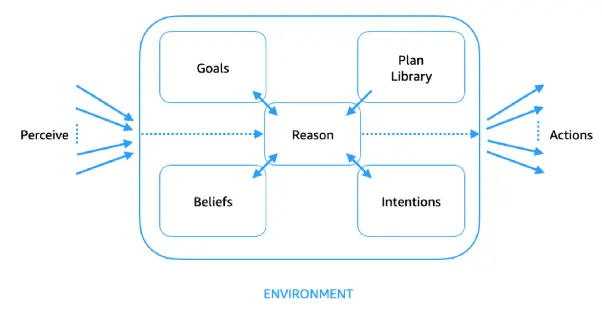
Source: AWS
The agent reads whatever its environment exposes, converts it into tokens, and resolves what those tokens mean. Everything after that, plan quality, tool choice, output accuracy, is conditioned on the resolution being right.
The resolution step is where enterprise agents come apart because of inadequate business context. Perception quality is bounded by the accuracy of the thing being perceived. No model improvement moves that ceiling.
What’s the difference between “perception” and “context” in agent architecture?
Perception is the process of reading and interpreting signals from the environment; context is the definitions, relationships, ownership, policy rules, and quality signals that make interpretation resolvable.
An agent with strong perception mechanics and no context layer can read a value accurately and still have no basis for knowing what it means.
What’s the difference between agent perception and agent memory?
Perception is what the agent takes in from its environment on the current turn: tool outputs, retrieved documents, images, and the messages in front of it.
Memory is what persists across turns or sessions, held in vector stores, summaries, or structured logs.
Perception and memory interact and aren’t interchangeable. An agent can have an excellent memory of a past conversation and still perceive its current environment wrong.
Where does agent perception sit, relative to planning and action?
The arXiv survey on AI agent systems describes an agent as a policy model wrapped in a control loop with explicit interfaces to observations, memory, typed tools, and verifiers.
Perception is the observation interface, and it runs before the model commits to anything:
-
Observe: collect a signal, whether a user message, tool result, retrieved passage, or screenshot.
-
Retrieve memory: pull in relevant prior state alongside the fresh observation.
-
Interpret: resolve parsed signals to meaning, including definitions, ownership, policy rules, and quality scores.
-
Plan: propose an action conditioned on the constructed state.
-
Verify: check the proposal against schemas and constraints before any side effect occurs.
-
Act: execute the tool call; its result becomes the next observation.
What are the input modalities of agent perception?
Teams often engineer these channels separately, even though production behavior treats them as one input surface:
-
Text and instructions: system prompts, tool descriptions, and conversation history. Long histories dilute constraints and raise cost; summarization is a perception decision, not just a cost one.
-
Tool call outputs: Result sets, API payloads, status codes, and error strings. This is the highest-volume channel in most enterprise deployments.
-
Retrieved documents and records: Whatever the retriever surfaces from an index or context store becomes the agent’s picture of the business.
-
Images and screenshots: GUI state, scanned documents, charts, and forms, parsed through vision models, OCR, or layout detection.
-
Audio: Transcribed speech in voice agents and real-time assistants, which carries its own ASR error rate into the observation.
-
Sensor and telemetry data: Job logs, pipeline metrics, freshness signals, and system events describing the operational state of what it’s reading.
Multimodal agents typically decompose perception into discrete tools (OCR, detection, layout parsing), with the model acting as planner. Each tool is an independent failure point that produces text, not an error.
Why do agents re-perceive their environment every turn?
Most LLM agents are stateless between calls: the model answering turn seven is the same stateless function that answered turn one, with no recollection of either. Everything it “knows” was reassembled from what’s in its context window this invocation.
This makes perception a per-turn operation, not a setup step: histories are reread, tool outputs re-perceived, context re-fetched, and progress inferred, not remembered.
Continuous re-reads mean a stale definition gets recalled and reused until someone fixes the source: perception is a context problem before it’s a modeling problem.
If statelessness explains why a bad definition persists, the question is whether richer inputs (vision, audio, document parsing) can catch what text-based perception misses. They extend what an agent can sense, but leave interpretation unsolved.
Build your AI context stack
Get the four-layer blueprint for implementing context graphs across your enterprise, with practical implementation steps for 2026.
Get the Stack GuideWhat is multimodal perception and how does it affect agent output and retrieval?
Multimodal perception is the ability to take in more than one type of signal, typically text alongside images, screenshots, documents, audio, or sensor data.
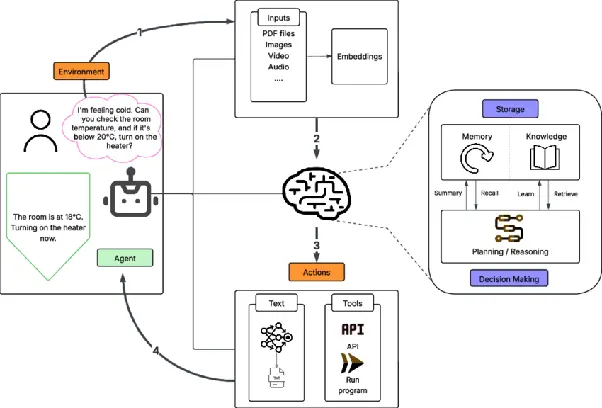
Source: ResearchGate
Multimodal perception extends sensing, not interpretation. Here’s how that affects output and retrieval quality:
-
The output: An agent with flawless OCR can read a revenue figure off a PDF and still not know if it matches finance’s definition, because the meaning wasn’t encoded anywhere it could reach.
-
The retrieval quality: Adding a modality widens what can enter the context window, raising the risk of surfacing irrelevant or conflicting material rather than lowering it.
The common response to inaccurate perception is adding sensors and enlarging the context window. That raises cost and latency without improving perception quality: a wrong definition read at higher fidelity is still wrong.
More modalities cannot fix ungoverned input.
Where does agent perception break?
The failure modes worth instrumenting for, roughly ordered by frequency in production:
-
Ungoverned semantics: The same metric carries three definitions across three teams, none encoded where an agent can read it.
-
Stale context: Definitions drift, tables get deprecated, ownership lapses; the agent reads an eight-month-old definition and delivers wrong outcomes confidently.
-
Environmental distraction: According to Caution for the Environment (ACL 2025), even the strongest generalist and specialist GUI agents can be pulled off task by irrelevant content in the environment.
-
Compounding risk in interactive agents: According to MLA-Trust (2025), the move from static models to agents that act on what they perceive introduces trustworthiness risks that accumulate nonlinearly across steps.
-
No record of what was perceived: When an output turns out wrong six weeks later, most architectures can’t reconstruct what the agent perceived, where decision traces help.
How can you overcome it?
The fix is structural: encode business meaning in a context store all agents can query via MCP-compatible servers, and track freshness as a signal, with definition age, lineage completeness, and unassigned ownership as leading indicators of failure. Pairing column-level lineage with point-in-time queryability keeps the record decision traces need to hold up in an audit.
Find your context gaps
Run a quick assessment to see where agents are likely to perceive stale or ungoverned data before it reaches production.
Try the Context Gap CalculatorHow can you test whether an agent perceived correctly before shipping?
Before shipping your agents, follow these steps to ensure better perception accuracy and quality:
-
Baseline against trusted answers: use certified dashboards and reports as ground truth. When the agent disagrees, treat the dashboard as right until proven otherwise.
-
Assert on the observation, not the answer: confirm the agent resolved the right definition, table, and lineage path, regardless of whether the final number was correct.
-
Capture production traces: log the question, retrieved context, and response together, so a failure traces to the observation.
-
Test conflict cases deliberately: feed the agent terms with more than one definition across teams and confirm it resolves to the governed one.
-
Route corrections back to the source: when a user marks a response wrong, generate a suggested context update.
-
Monitor drift after launch: definition age and unowned terms are the earliest signal that perception is degrading.
What role does Atlan play in improving agent perception?
Atlan is the Context Layer for AI, which in perception terms is what an agent sees when it looks at the business. The most relevant capabilities include:
-
Connectors: Coverage across 100+ input sensors: systems of record, data platforms, knowledge sources, work tools, and runtime signals.
-
Context Agents: Autonomous agents mine column-level lineage, SQL, usage, and BI semantic logic into current definitions, term links, and suggested ownership.
-
Context Lakehouse: The context store, a knowledge graph plus Iceberg-native storage and vector search, queryable over MCP, A2A, SQL, and REST or Graph APIs, so meaning, trust, and approval rules resolve in a single call.
-
Context Engineering Studio: The workspace that validates what an agent will perceive before production, captures traces, and converts user corrections into updates and regression tests.
-
Lineage with time travel: Column-level lineage reverse-engineered from SQL, pipelines, and BI, with point-in-time queryability that answers what an agent perceived and when, for audit.
-
MCP Server: Atlan’s MCP server exposes context to any MCP-compatible agent, from Claude and ChatGPT to Snowflake Cortex, Databricks Genie, or an internal framework.
Real stories from real customers: building enterprise context layers
"Atlan captures Workday's shared language to be leveraged by AI via its MCP server. As part of Atlan's AI labs, we're co-building the semantic layer that AI needs."
— Joe DosSantos, VP Enterprise Data & Analytics, Workday

"Atlan is much more than a catalog of catalogs. It's more of a context operating system…Atlan enabled us to easily activate metadata for everything from discovery in the marketplace to AI governance to data quality to an MCP server delivering context to AI models."
— Sridher Arumugham, Chief Data & Analytics Officer, DigiKey

Check your agent's context readiness
Score how ready your business context is for agents to perceive accurately, before you ship the next one.
Take the Readiness ChecklistMoving forward with agent perception
Perception is the step where an agent’s understanding of the business gets established or corrupted.
Most of the industry’s attention has gone to modality coverage. That matters, but an agent can still perceive the business wrong and deliver costly, confident, inaccurate outcomes.
The way forward: widen the sensor layer, correct the data being perceived, test perception quality, and keep a record of what was seen when something breaks. That’s what scales an agentic ecosystem past the pilot, and it’s where Atlan’s Context Layer for AI plays a central role, keeping the business context an agent perceives accurate and current before it ever calls a tool.
FAQs about agent perception
1. How do AI agents perceive tool-call outputs differently from retrieved documents?
Tool-call outputs are precise but unlabeled: a query returns exact rows with no indication of what they mean or whether the source is current. Retrieved documents are the reverse, rich in descriptive meaning but ranked by similarity rather than by which version is certified, so an agent can surface a plausible passage that contradicts the canonical source. In practice, an agent treats a tool result as ground truth about a value and a retrieved document as context about meaning.
2. What is multimodal perception in an AI agent (text, image, audio, sensor data)?
Multimodal perception means taking in more than text: images, screenshots, documents, audio, or sensor data, usually via specialized tools like OCR or speech recognition feeding results back to the model as planner. Wider modality coverage widens what an agent can sense, not how correctly it interprets what it senses.
3. If LLMs are stateless, how does an agent perceive its own progress across a multi-step task?
The agent infers progress from the trace of what already happened, since the model retains nothing between calls: prior tool calls, results, and turn summaries get replayed into the context window on each invocation. That’s why summarization strategy and trace completeness materially change behavior on long tasks.
4. Why do multimodal GUI agents get distracted by irrelevant environmental content?
A screenshot or DOM doesn’t separate signal from noise, and the model has no reliable way to tell content from instruction. Ads, pop-ups, unrelated panels, and text resembling a directive all enter the observation with equal standing; even the strongest GUI agents are susceptible when neither the user nor the environment is adversarial.
5. How does RAG function as a perception mechanism rather than a memory mechanism?
RAG doesn’t store what the agent has learned; it re-fetches material from an index at inference time and places it in the context window, where the agent reads it as a fresh observation. That makes it a sensing channel: the retriever decides what the agent sees, and anything it fails to surface is invisible that turn, regardless of prior exposure.
6. What happens when an agent perceives stale or inconsistently defined business data?
The agent produces a confident, well-formatted answer built on a wrong observation, and nothing in the output signals anything went wrong. Unlike a broken API call, stale data and conflicting definitions return a valid-looking result rather than an error: a table that was accurate months ago gets reported as current, or a term like revenue resolves to whichever version the agent happened to retrieve, not the one finance actually uses. Because agents are stateless and re-read context every turn, that error recurs until the source is fixed. The fix is making freshness and ownership signals the agent can perceive, so it resolves against a current, canonical source instead of a plausible guess.
7. How is an agent’s perception tested or evaluated before it goes to production?
By testing the observation, not just the output: asserting the agent resolved the correct definition, table, and lineage path, and benchmarking against reports the organization already trusts. Standard metrics like faithfulness will pass an agent that faithfully reports a wrong value, which is why observation-level assertions catch what output metrics miss.
