

Build Your AI Context Stack
Get the blueprint for implementing context graphs across your enterprise. This guide walks through the four-layer architecture, from metadata foundation to agent orchestration, with practical implementation steps for 2026.
Get the Stack Guide
Gemini Enterprise: core capabilities and quick facts
Gemini Enterprise is a Google Cloud enterprise AI platform that combines Google-like search functionality with AI agents that research, plan, and communicate. It integrates with an enterprise’s Google Workspace and other business applications. Google renamed Agentspace to Gemini Enterprise on October 9, 2025, and by 2026 the Agentspace name is retired from Google’s current materials. That is the gap Atlan closes: an enterprise context layer that gives Gemini Enterprise governed access to context beyond RAG, session state, and memory.
Core capabilities
-
Multimodal enterprise search: Google-quality search across your GCP data estate.
-
Pre-built expert agents: Ready-to-use Deep Research and Idea Generation agents, built on the same agent architecture enterprises use to build their own.
-
No-code agent builder: Build custom agents with Agent Designer, no coding required.
-
NotebookLM Enterprise: Synthesizes documents into insights and audio summaries.
-
Pre-built connectors: Drive, SharePoint, Salesforce, ServiceNow, Confluence, etc., giving agents tool use across the systems your teams already run.
-
Security and governance: RBAC, data residency, and HIPAA or FedRAMP compliance.
| Gemini Enterprise (formerly Google Agentspace): Quick Facts | |
|---|---|
| Renamed | Agentspace is now Gemini Enterprise; Google introduced Gemini Enterprise on October 10, 2025 |
| Core services | Vertex AI Search, Gemini Enterprise Agent Platform (formerly Vertex AI Agent Builder), Agent Platform Memory Bank |
| Context sources | RAG (semantic search), session state, persistent memory |
| Pre-built connectors | Google Drive, SharePoint, ServiceNow, Salesforce, Confluence, Jira |
| Compliance | RBAC, data residency, HIPAA, FedRAMP |
| Where a governed context layer fits | Certified definitions, ownership, and lineage for the data agents read, delivered to any MCP client rather than one platform |
Enterprises evaluating Gemini Enterprise are usually also evaluating how enterprises use AI agents more broadly, since the platform is one of several routes to becoming enterprise-ready with AI agents rather than the only one.
Get the CIO Guide to Context Graphs
See how enterprise and AI leaders are building a portable context graph across every cloud and platform, including Google Cloud, and what it takes to keep that graph open, governed, and query-ready for any agent.
Get the Context Graph GuideWhat are the key features of Gemini Enterprise?
Gemini Enterprise enables AI agents to connect with enterprise tooling, deploy expert agents, orchestrate multi-step workflows, and, all the while, ensure security, governance, and compliance.
Google introduced Gemini Enterprise on October 10, 2025, and the agent building and orchestration technology behind Agentspace now powers the platform. Agentspace no longer appears as a current product name in Google’s own materials, so read it as the former name for what Google sells today as Gemini Enterprise.
Here are some of the key features of Gemini Enterprise:
-
Multimodal Google-like enterprise search: For searching across all the apps used across your business, whether they have structured or unstructured data.
-
Expert agents and agent-building tools: For deep research, automation of complex workflows, and taking actions based on the research; you can also build your own agents using no-code/low-code agent creation tools and an Agent Gallery for custom agents.
-
NotebookLM Enterprise summarization: For data synthesis and summarization, whether the data is text, PDF, image, audio, or external links.
-
Pre-built connectors: Commonly used connectors include Google Drive, SharePoint, ServiceNow, Salesforce, Confluence, and Jira.
-
Security, governance, and compliance: With enterprise RBAC, data residency, and compliance controls (HIPAA, FedRAMP, etc.).
These features work together to ensure that the data (and the context from it) is available to autonomous AI agents for search, discovery, and action. After all, how well AI agents do their jobs depends on the quality and quantity of context they receive when they need it, and on whether that context makes agents genuinely context-aware rather than merely well-instructed.
With that in mind, let’s look at how AI agents in Gemini Enterprise get context for the work they do.
Search alone vs. Gemini Enterprise with a governed context layer
| Aspect | Search Alone (RAG / Session / Memory) | Gemini Enterprise + Atlan Context Layer |
|---|---|---|
| Context scope | Within Gemini Enterprise’s connected apps | Cross-estate: BI tools, warehouses, pipelines, and more |
| Governance | Not organizationally governed | Lineage, quality, and policy rules carried as context |
| Consistency | Each agent platform learns its own version | One shared, versioned context served via MCP |
| Currency | Static index until re-crawled | Continuously updated by Context Agents |
| Ownership | Retrieval logic lives inside Google’s platform | Context lives in Atlan’s open Context Lakehouse, portable across agents |
How do AI agents in Gemini Enterprise get context for their work?
The AI agents in Gemini Enterprise use a host of services, such as Vertex AI Search, Gemini Enterprise Agent Platform (formerly Vertex AI Agent Builder), and Agent Platform Memory Bank, to store and retrieve context.
Collectively, these services provide the core foundation of context for AI agents in Gemini Enterprise. Here are some of the ways AI agents get context in Gemini Enterprise:
-
Retrieval-augmented generation (RAG): The most common way of getting up-to-date context using Gemini Enterprise’s enterprise search, built on Vertex AI Search. It uses semantic search over indexed data, and augments the prompt based on the search rather than solely relying on the model’s training data, which could be (and usually is) out of date. This is the same basic pattern behind RAG architecture everywhere, and it inherits the same known limits: RAG accuracy problems show up whenever the retrieved chunk is technically relevant but organizationally wrong.
-
Semantic vector index: The RAG methodology uses Vertex AI Search, which chunks, embeds, and stores data in a managed vector database, exactly what the retrieval call searches against. Teams that want to go beyond the basics can layer in advanced RAG techniques like re-ranking and query rewriting, but none of that fixes context that was never captured in the first place.
-
Session state: Using Sessions in Gemini Enterprise Agent Platform, an AI agent can access the working context of any given interaction, which can help the agent understand the tasks, the steps, and the tool outputs through its reasoning process.
-
Persistent memory: Using the Agent Platform’s Memory Bank, AI agents refer to facts, preferences, and key details that persist across sessions. The underlying memory architecture determines how well this holds up in practice; understanding the different types of AI agent memory explains why agents that seem to “know” a user in one session can still get facts wrong in the next, one of the core reasons AI agents forget things a human colleague never would.
All of these features and services provide context retrieval, but there are a few problems.
First, the retrieved context isn’t governed organizationally; i.e., there are various systems that don’t connect to Gemini Enterprise, yet they have a wealth of relevant context for AI agents. This is the same gap covered in agent context layer vs. RAG: RAG retrieves what’s indexed, a context layer governs what’s true.
Second, if there’s a context catalog where organizational context resides, it seldom reaches AI agents due to insufficient integration. What’s needed in this case is an enterprise context layer that not only collects and aggregates but also organizes and exposes context to humans and AI agents, an approach some teams formalize through a dedicated context repository for AI agents. Atlan is a context layer for AI. Let’s look at how Atlan can provide Gemini Enterprise a fully governed context layer.
How does Atlan give Gemini Enterprise a governed context layer?
Atlan consolidates all context, such as lineage, quality, policy rules, and business context. In addition to the bidirectional Google Cloud Knowledge Catalog integration, Atlan’s context layer is accessible to AI agents in Gemini Enterprise via Atlan’s MCP server, which plugs into Atlan’s Context Lakehouse and powers Gemini Enterprise’s semantic search, allowing agents to access enterprise data across your organization.
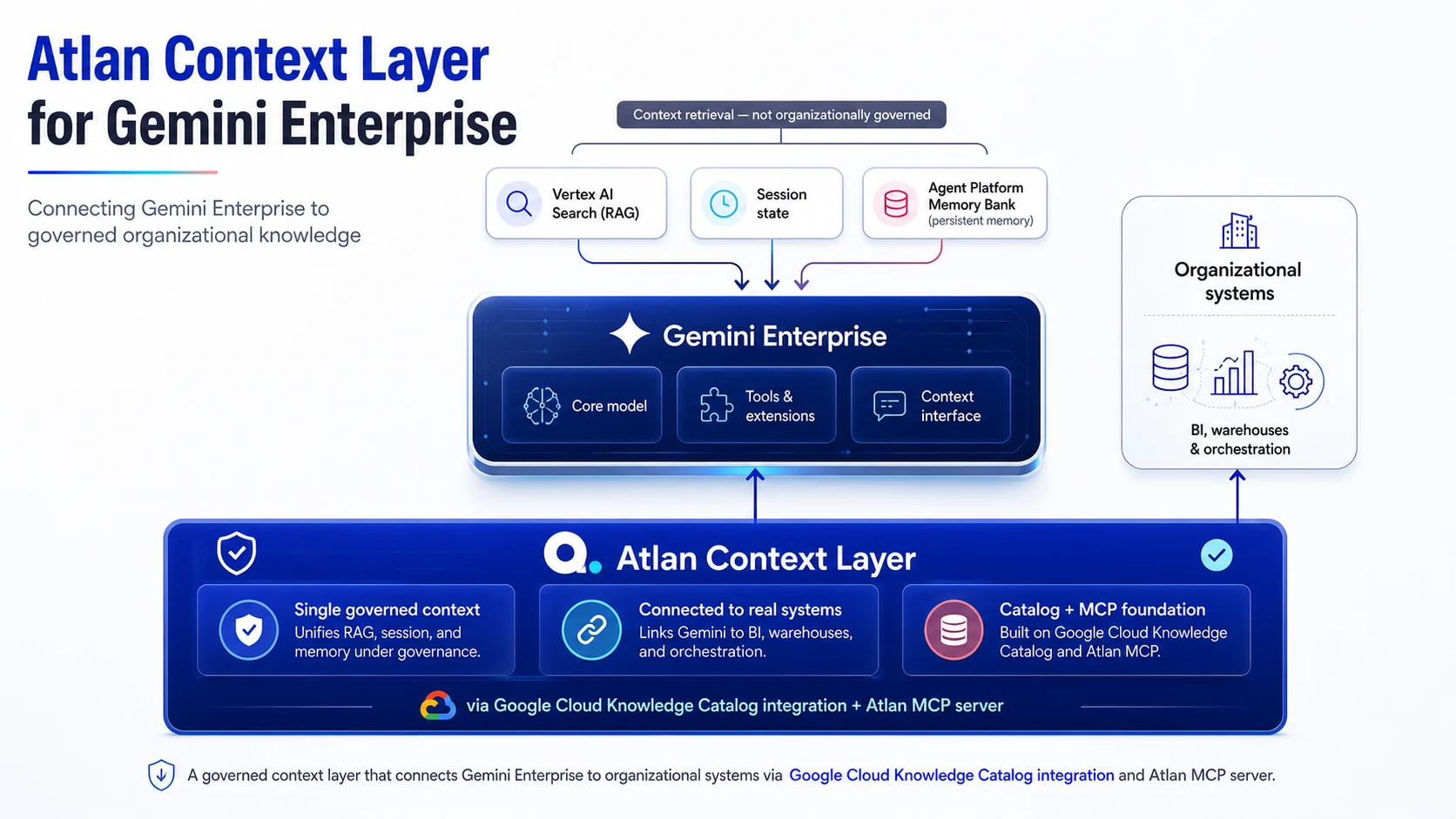
Caption: A governed context layer that connects Gemini Enterprise to organizational systems via the Google Cloud Knowledge Catalog integration and Atlan’s MCP server.
Here are some of the features that are used to create, manage, and organize context within Atlan:
-
Enterprise Data Graph: Accumulated context from a wide variety of connectors with lineage, ownership, certification, and usage, on top of the technical and structural context.
-
Active Ontology: An organized semantic layer capturing glossary terms, domains, products, metrics, and relationships, in compliance with the Open Semantic Interchange standard. This is the same layer underpinning any broader semantic layer for AI agents, and it draws on the same foundations as ontology in AI more generally.
-
Context Engineering Studio: an interface within Atlan that allows you to build Context Repos for specific agents, run evaluations on them, and have agents use them, the practical side of context engineering for AI agents rather than prompt engineering alone.
-
Atlan MCP server: all of this context reaches Gemini Enterprise and other MCP clients via Atlan’s own MCP server, which becomes the facilitator of context to any agent connected to it.
Atlan’s Enterprise Data Graph and Active Ontology are also what separate a context graph from a knowledge graph in practice: a knowledge graph for AI agents or a general-purpose knowledge graph captures entities and relationships, while what a context graph actually is adds the operational metadata (freshness, ownership, policy) that makes those relationships usable by an agent making a real decision. The distinction also shows up in context graph vs. ontology discussions, and in analyst coverage like Gartner’s research on context graphs and work on combining knowledge graphs with LLMs. Whoever owns this layer inside an organization matters too, a question addressed directly in who should own the context layer.
With both the Google Cloud Knowledge Catalog integration and Atlan’s MCP server, the connection between Gemini Enterprise and Atlan has enough bandwidth to flow in both directions. Teams building this out from scratch can follow the same pattern documented in how to implement an enterprise context layer for AI, starting from the same foundational definition of what a context layer is.
Inside Atlan AI Labs & The 5x Accuracy Factor
Learn how context engineering drove 5x AI accuracy in real customer systems. Explore real experiments, quantifiable results, and a repeatable playbook for closing the gap between AI demos and production-ready systems.
Download E-bookWhere Gemini Enterprise’s context ends and Atlan’s begins
Gemini Enterprise (the platform that replaced Agentspace) is a hub and interface for autonomous AI agents to perform enterprise search and action, pulling context via RAG-based Vertex AI Search, session state, and memory. This retrieval of context does quite a bit, but it isn’t enough to carry governed context through different parts of your enterprise stack, and it says little about whether agents are operating inside acceptable risk and guardrail boundaries or under a real AI agent governance program.
This is where the need for an enterprise context layer arises. This layer helps you understand asset certification status, the meaning of metrics, lineage, quality, and policy rules. The context layer has all the information that AI agents need to operate correctly and efficiently, and it is what makes AI agent observability meaningful: knowing an agent ran fast is different from knowing it ran on accurate, current context. This matters even more once an organization moves past single agents into multi-agent coordination patterns, where an ungoverned context gap in one agent quietly propagates into every agent downstream of it.
Gemini Enterprise is Google’s answer to enterprise agent search and action; AWS Bedrock for enterprise agents is the equivalent answer from AWS, built on a different runtime but facing the identical governed-context gap. Whichever cloud an enterprise standardizes on, the pattern repeats: the platform is excellent at retrieval, and it still needs a context layer underneath it.
Atlan is an enterprise context layer for AI, where all context is exposed via Google Cloud Platform’s Knowledge Catalog integration, Atlan’s MCP server, and Context Lakehouse. Find out more about how Atlan gives autonomous AI agents governed context to act on.
FAQs about Gemini Enterprise
1. What context is Gemini Enterprise missing?
Gemini Enterprise has a lot of context through functionality like Vertex AI Search and its vector database, session state (agentic conversation with the platform), and persistent memory.
What it doesn’t have access to is all the curated and governed context in the form of raw and aggregated metadata regarding structure, workflows, lineage, governance, quality, among other things. This missing metadata is crucial context for effective and accurate agentic decision-making and actions.
2. What’s the difference between Agentspace and Gemini Enterprise?
In October 2025, Google merged Agentspace into the Gemini Enterprise product range. Gemini Enterprise is a much broader agent platform. Even after the merge, all of Agentspace’s functionality remains.
3. What is the difference between Agentspace, Gemini, NotebookLM, and Gemini Enterprise?
Gemini is Google’s general-purpose AI assistant and underlying model family for chat, coding, and content, available in free and Workspace-paid tiers. NotebookLM is a focused research assistant that analyzes and summarizes documents you upload, with source-cited answers and audio overviews, available standalone or as NotebookLM Enterprise.
Gemini Enterprise is a Google Cloud platform for AI agents that search and act across business systems like Drive, Salesforce, and Jira, with a no-code agent builder and central governance. Agentspace is the original name for that enterprise platform, now folded into Gemini Enterprise.
Gemini and NotebookLM serve individuals and teams, while Gemini Enterprise (formerly Agentspace) is the organization-wide agent platform. NotebookLM also ships inside Gemini Enterprise as a pre-built agent.
4. Does Atlan replace Gemini Enterprise’s search?
No, Atlan enhances the search experience by providing a curated, governed context for Gemini Enterprise. Atlan has all the technical, business, quality, lineage, and policy context, which makes it very useful for agents to do their work. Gemini Enterprise’s search is one of the key ways agents understand a task’s scope and context. Atlan powers that context.
5. Can Atlan’s context reach agents outside Gemini Enterprise?
Yes, Atlan’s MCP server brings context from everywhere and provides context everywhere. It gathers context from tools across your enterprise stack and delivers it to any MCP client, including Claude, Cursor, and Bedrock AgentCore, not just Gemini Enterprise.
6. How does Atlan connect to Gemini Enterprise?
There are two ways Atlan can connect to Gemini Enterprise. First is the bidirectional Google Cloud Knowledge Catalog integration, and the second is Atlan’s own MCP server. Both these options give Gemini Enterprise access to Atlan’s curated and governed context from the enterprise context layer.
Sources
- Gemini Enterprise App: Best of Google AI for Business, Google Cloud. https://cloud.google.com/gemini-enterprise
- What is NotebookLM Enterprise?, Google Cloud Documentation. https://docs.cloud.google.com/gemini/enterprise/notebooklm-enterprise/docs/overview
- Google Agentspace enables the agent-driven enterprise, Google Cloud Blog. https://cloud.google.com/blog/products/ai-machine-learning/google-agentspace-enables-the-agent-driven-enterprise
- Agent Search on Gemini Enterprise Agent Platform, Google Cloud. https://cloud.google.com/products/gemini-enterprise-agent-platform/agent-search
- Agent Platform overview, Gemini Enterprise Agent Platform, Google Cloud Documentation. https://docs.cloud.google.com/gemini-enterprise-agent-platform/overview
- RAG infrastructure for generative AI using Gemini Enterprise and Agent Platform, Google Cloud Documentation. https://docs.cloud.google.com/architecture/rag-genai-gemini-enterprise-vertexai
- Introducing Gemini Enterprise (October 10, 2025), Google Cloud Blog. https://cloud.google.com/blog/products/ai-machine-learning/introducing-gemini-enterprise
