

Ownership of enterprise AI is splitting three ways, not two. An AI platform leader owns delivery and infrastructure spend, a CAIO owns strategy and the transformation budget, and a CDO owns the data foundation everything else runs on. Per IBM’s Institute for Business Value, CAIO prevalence jumped from 26% of organizations to 76% in a single year, evidence this org chart is still being rewritten. What no existing “CAIO vs CDO” comparison names is the layer all three depend on: a context layer legible to delivery, strategy, and governance at once.

The split shows up sharpest in three places: the budget, the vendor sign-off, and who’s on the hook.
- Budget splits into platform, initiative, and data-foundation spend, each typically owned by a different role below
- Vendor selection reads as shared everywhere it’s studied: technical fit, strategic ROI, and data-privacy compliance pull toward different approvers
- Titles lag reality, per Gartner: more than half of organizations already have a head of AI, and most don’t hold the CAIO title
- Governance sign-off is separate, covered in Atlan’s AI governance operating model and its governance-specific sibling, not here
Quick comparison: AI platform leader vs CAIO vs CDO
| Dimension | AI platform leader | CAIO | CDO |
|---|---|---|---|
| What it is | Owns delivery of the AI/agent platform | Owns AI strategy and value cases org-wide | Owns data quality and governance feeding AI |
| Reports to | CTO, or directly to CAIO | CEO or CTO/CIO | CIO, CDAO umbrella, or CEO |
| Budget owned | Platform/infrastructure, recurring | Initiative/transformation | Data-foundation |
| Vendor role | Technical fit evaluation | Strategic ROI sign-off | Privacy and lineage compliance |
| Best for | Scaling AI in production | One AI accountability point | AI quality tied to the data foundation |
| Prevalence (2026) | Emerging, often unnamed | 76% of orgs, up from 26% | Long-established C-suite role |
What’s the difference between an AI platform leader, a CAIO, and a CDO?
The three roles answer three different questions: an AI platform leader answers “who builds and runs it,” a CAIO answers “who owns the mandate,” and a CDO answers “who makes the data trustworthy enough to act on.” Treating any pair as interchangeable is where accountability gets lost.
Titles haven’t caught up. Per Gartner’s June 2024 poll of more than 1,800 executive leaders, 54% of organizations already have a head of AI or equivalent, but 88% don’t hold the CAIO title. Existing coverage compares CAIO to CDO, or to CIO and CTO, treating platform leadership as a footnote rather than a peer seat, without touching the governance-and-risk half of the question, covered separately here.
What is an AI platform leader?
An AI platform leader owns technical delivery of the AI and agent platform other teams build on, typically reporting into the CTO or, where the seat exists, the CAIO, and holds platform and infrastructure budget authority directly. This is the seat responsible for AI platform architecture and for keeping a context layer queryable at scale, with enterprise data access that doesn’t break under agent load.
This seat is no longer hypothetical. In August 2026, New York Life appointed Zhen Zhao as Chief AI Officer, promoting him directly from his prior role as SVP and Global Head of AI Platform at Chubb, evidence this seat is a credentialing path into a strategy title, not a stepping stone.
Core responsibilities of an AI platform leader
- Platform delivery builds and operates the systems AI teams run on, the discipline covered in LLMOps
- Recurring-spend ownership owns the budget for compute, tokens, and tooling before pilot spend becomes permanent, per LLM cost management
- Technical vendor evaluation leads fit assessment in joint RFPs, including managing multiple LLM providers at scale, distinct from a CAIO’s ROI sign-off
- Cross-team enablement is the routing path for how to build an AI platform team from scratch, often the start of a centralized AI platform
Get the layer-by-layer breakdown
See how platform, strategy, and data-foundation responsibilities map onto the context layer underneath them.
Get the CIO Context GuideWhat is a CAIO (chief AI officer)?
A CAIO owns AI strategy, vision, and the portfolio of value cases across the organization, converting scattered pilots into a governed initiative portfolio with an actual investment thesis. The role orchestrates across functions rather than building the platform directly, a deliberate division of labor from the AI platform leader’s hands-on delivery mandate.
The adoption curve is one of the more citable in enterprise AI. IBM’s Institute for Business Value found CAIO adoption at 26% of more than 2,300 organizations in July 2025, up from 11% in 2023, then jumped to 76% by 2026, a nearly threefold rise in a single year.
Standardization is still years away. Forrester’s “Predictions 2024” found only about 12% of organizations with a solid AI strategy assign it to a CAIO, versus 2% to the CDO; most route it through neither, which is why an explicit ownership answer for the context layer matters more, not less. Dr. David R. Hardoon of Accenture argues: “To effect real change, the CAIO should report directly to the CEO.”
Core responsibilities of a CAIO
- AI strategy and vision sets org-wide direction and the value cases that justify investment
- Initiative and transformation budget owns the “what we invest in” decision, distinct from the platform leader’s recurring spend
- Strategic vendor ROI sign-off is the strategic half of a joint vendor evaluation, paired with the platform leader’s technical fit check
- Responsible-use oversight hands off risk and policy specifics to Atlan’s AI governance operating model, a question this page doesn’t re-litigate
What is a CDO (chief data officer) in the AI era?
Ask “is the data underneath this trustworthy,” and the answer traces back to the CDO before it reaches an AI platform leader or a CAIO. The role owns data quality, access, and the governance AI depends on to work at all, and that data-foundation role has absorbed more responsibility as AI has grown, not less.
Gartner’s May 2025 survey found 70% of CDAOs are now responsible for AI strategy and operating model design, showing the role absorbs AI accountability even without a separate CAIO. A CDO or P5 data and analytics leader is frequently the co-champion or approver on an AI deal even when a CAIO holds the strategic mandate.
Some organizations skip the coordination question by merging the two roles. Nike’s Alan John holds the combined title of Global VP, Chief Data and AI Officer, confirmed on his DataIQ 100 profile, appointed in 2024, collapsing CDO and CAIO accountability under one leader.
Core responsibilities of a CDO
- Data quality and access is the foundation every AI output depends on, covered in data quality for AI agents
- Data-foundation budget owns the third leg of the three-way split, distinct from platform and initiative spend
- Compliance and lineage sign-off is the data-privacy half of joint vendor evaluations, checked against data infrastructure for AI
- Co-champion role closes the gap institutional knowledge loss and tribal knowledge widen when nobody owns it
AI platform leader vs CAIO vs CDO: head-to-head comparison
The sharpest divergence is budget: initiative, platform, and data-foundation spend rarely sit with one person, and “who’s on the hook” depends on which piece failed. The convergence is less obvious: all three depend on the same context. As BCG put it in “Every C-Suite Member Is Now a Chief AI Officer,” AI accountability is spreading across the C-suite, not consolidating into one seat.
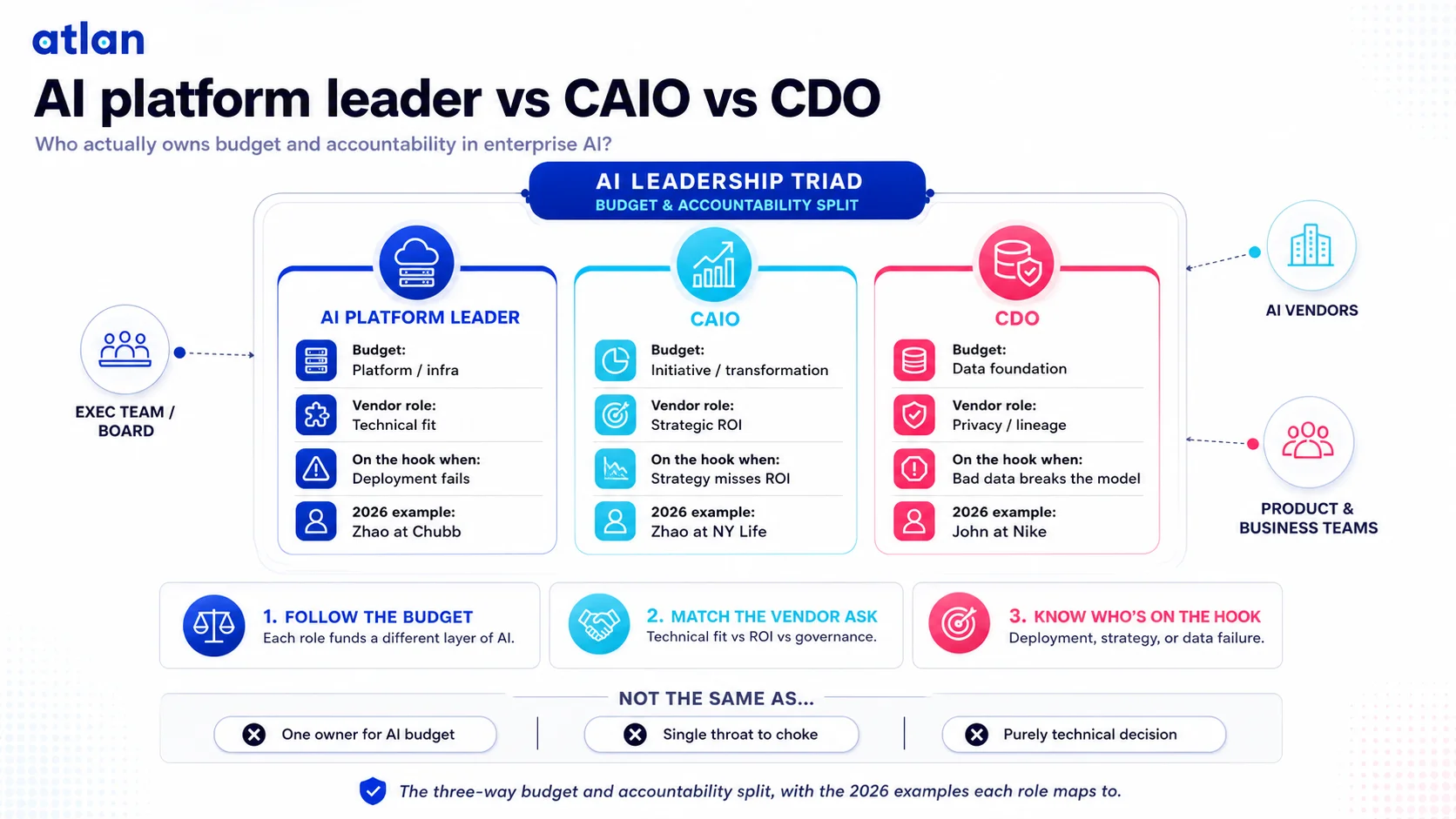
The three-way budget and accountability split, with the 2026 examples each role maps to. Source: Atlan.
Detailed comparison: 10 dimensions
| Dimension | AI platform leader | CAIO | CDO |
|---|---|---|---|
| Primary mandate | Build and run the platform | Set AI strategy and value cases | Govern the data AI depends on |
| Reports to | CTO or CAIO | CEO or CTO/CIO | CIO, CDAO, or CEO |
| Budget owned | Platform/infrastructure | Initiative/transformation | Data-foundation |
| Vendor role | Technical fit | Strategic ROI | Privacy/lineage compliance |
| Accountable for | Deployment failure | Strategy missing ROI | Bad data breaking the model |
| Failure mode when fuzzy | “Temporary” spend becomes unbudgeted | Pilots multiply without scaling | Governance arrives late |
| Appears when | AI moves pilot to production | Org needs one accountability point | Data-platform investment is significant |
| 2026 example | Zhen Zhao, ex-Chubb AI Platform | Zhen Zhao, now CAIO, NY Life | Alan John, CDAO, Nike |
Kieran Gilmurray, CEO of KG & Co, names the failure mode plainly: “Where ownership is fuzzy, pilots multiply without scale, governance arrives late, and value is hard to prove.” One fix is an AI center of excellence that forces the three roles into one room; AI risk registers and a responsible AI framework address the sign-off side once ownership is explicit.
See where your organization actually stands
Run a quick context maturity check before you argue about who should own the next AI investment.
Take the AssessmentWho owns the context layer that AI platform leaders, CAIOs, and CDOs all depend on?
All three roles depend on the same underlying layer of context; they just need different things from it. One needs infrastructure, one needs a governed asset, one needs an auditable input. That structural fact, not a title, is the real answer to “who owns it.”
What each role needs from the context layer
The AI platform leader needs the context layer as infrastructure: queryable and durable enough that it doesn’t break past a pilot, so every new enterprise-ready AI agent doesn’t re-solve the same problem. The CDO needs it as a governed data asset: traceable lineage and quality that hold up under audit, the difference between a data catalog and a context layer. The CAIO needs it as an auditable input: evidence a decision used context that was current and traceable, not stale data dressed up as an answer, which separates real context observability and AI agent accuracy from ordinary uptime monitoring.
Which role should drive investment first
The right owner depends on where the organization is, not an org chart preference. Pre-production, the AI platform leader should drive it, since infrastructure has to exist before anything gets governed. Once AI is customer-facing, the CAIO should drive it, since the audit trail matters more than delivery speed. When the data foundation is the blocker, the CDO should drive it, full stop. Compliance sign-off is out of scope; it’s covered in Atlan’s AI governance operating model and the governance-specific comparison.
How Atlan approaches AI platform, CAIO, and CDO alignment
Treating these three roles as needing one shared owner, instead of three shared dependencies, is what breaks AI initiatives: data foundations a CAIO already funded get gated by a CDO’s org anyway, and platform teams rebuild context work the data organization already governs elsewhere, per how to build a context engineering framework.
The context layer has to be legible to all three roles at once: infrastructure to the platform leader, a governed asset to the CDO, an auditable input to the CAIO. That’s why Atlan builds its Context Engineering Studio and MCP delivery around one shared, governed source, treating ownership as multi-threaded rather than single-buyer: nobody owns AI alone.
See it work across all three roles
Watch how Atlan gives platform, data, and AI leadership the same governed source of context.
Watch a Live DemoReal stories from real customers: context ownership across data and AI leadership
"Atlan captures Workday's shared language to be leveraged by AI via its MCP server. As part of Atlan's AI labs, we're co-building the semantic layer that AI needs."
— Joe DosSantos, VP Enterprise Data & Analytics, Workday

"Atlan is much more than a catalog of catalogs. It's more of a context operating system…Atlan enabled us to easily activate metadata for everything from discovery in the marketplace to AI governance to data quality to an MCP server delivering context to AI models."
— Sridher Arumugham, Chief Data & Analytics Officer, DigiKey

Both leaders sit at this fault line: a VP of enterprise data and analytics co-building the semantic layer AI needs, and a Chief Data and Analytics Officer describing one context system spanning discovery, governance, quality, and MCP delivery. Neither waited for a CAIO title to exist first.
What survives even if the CAIO and CDO titles don’t
The three-way split described here is real, and the AI platform leader seat is no longer hypothetical. It’s worth taking the opposite view seriously, too: CIO.com has argued CDO and CAIO roles might have a built-in expiration date, reabsorbed into the CTO or CIO once AI stops being a novelty.
That argument might be right about the titles. It doesn’t change the responsibilities underneath them. Platform ownership, budget, delivery accountability, and vendor selection don’t disappear when an org chart stabilizes; they move to whoever the surviving title is. The IBM adoption trajectory, 11% to 26% to 76% across three studies, shows an org chart still being rewritten. Whatever the titles look like in three years, who builds it, who pays for it, who’s on the hook when it’s late, and who picks the vendor will still need real owners.
FAQs about AI platform leader vs CAIO vs CDO responsibilities
1. Who owns the AI platform infrastructure budget: the CAIO, the CTO, or a separate AI platform leader?
Platform and infrastructure spend, the recurring line for compute, tooling, and token costs, typically sits with the AI platform leader, who usually reports to the CTO or CAIO. The CAIO owns a separate initiative and transformation budget instead.
2. Does a company need both a CAIO and a CDO?
Most do, since the roles cover different ground: AI strategy versus data quality and access. Some organizations collapse both into one leader, as Nike did with a single Chief Data and AI Officer.
3. What is the difference between a “strategy CAIO” and a “platform CAIO”?
A strategy CAIO focuses on vision and value cases without hands-on delivery. A platform CAIO is typically promoted from a technical role and stays closer to infrastructure and vendor decisions.
4. Should the AI platform team report to the CAIO or the CTO?
Both patterns exist, and the deciding factor is whether AI has moved from an initiative to core infrastructure. Early-stage programs sit under a CAIO’s transformation mandate; production-grade platforms move under the CTO.
5. Who is accountable when an AI project misses its delivery timeline?
Execution accountability typically falls on the AI platform leader, since delivery is their mandate. Accountability blurs whenever ownership was never made explicit, which is exactly the fault line this comparison names.
6. Who signs off on AI vendor selection: CAIO, CDO, or IT procurement?
Vendor selection is genuinely shared rather than owned by one title. The AI platform leader evaluates technical fit, the CAIO signs off on strategic ROI, and the CDO checks data-privacy and lineage compliance, with no single approver deciding alone.
Sources
- Gartner Poll Finds 55% of Organizations Have an AI Board, Gartner, 2024.
- How Chief AI Officers Deliver AI ROI, IBM Institute for Business Value, 2025.
- IBM Study: CEOs Are Reshaping C-Suite Roles for the AI Era, IBM Newsroom, 2026.
- Predictions 2024: Data and Analytics, Forrester
- Gartner Survey Finds 70% of CDAOs Are Responsible for AI Strategy and Operating Model, Gartner, 2025.
- Every C-Suite Member Is Now a Chief AI Officer, BCG, 2024.
- New York Life Appoints Zhen Zhao as Chief AI Officer, AIM Media, 2026.
- Alan John, Global Vice President, Chief Data and AI Officer, Nike, DataIQ, 2025.
- Who Owns AI? The Internal Turf War for Tech Leadership, Kieran Gilmurray (LinkedIn)
- The Making of CDO and CAIO, Dr. David R. Hardoon (LinkedIn)
- CDO and CAIO Roles Might Have a Built-in Expiration Date, CIO.com
- Why Nike Created a Chief AI Officer Role (And What It Signals About the C-Suite’s Future), Chief AI Officer, 2024.
