

Context testing for AI agents checks whether the context an agent retrieves before it answers, documents, memory, prior turns, tool outputs, is accurate, complete, and free of contradictions. Context rot and related drift are estimated to sit behind roughly 65% of enterprise agent failures, which makes this a separate discipline from scoring the final answer, not a footnote to it. Atlan’s Context Engineering Studio treats context the same way: built, tested, and certified through a versioned lifecycle before an agent ever sees it, not left as whatever the retriever happened to find that day.
Most teams that say they “evaluate” their agent are scoring the answer, not the context that produced it. That gap is where confident, fluent, wrong answers come from. An agent can retrieve stale pricing or three irrelevant chunks next to one genuinely relevant one, then generate a response that reads as correct because the writing was fine. The writing was never the problem. The context was.
| Attribute | Detail |
|---|---|
| What it tests | Retrieved documents, memory, tool outputs, and prior conversation turns, before and during a run |
| What it doesn’t test | The model’s reasoning quality or writing fluency on its own, that’s output evaluation’s job |
| When it runs | Pre-production on golden question sets, then continuously against production traces |
| Common techniques | Context-relevance scoring, groundedness checks, context-window audits, retrieval regression testing |
| Depends on | The underlying context layer the retriever draws from being current, deduplicated, and governed |
What breaks when an AI agent’s context isn’t tested?
Three failure modes account for most of what goes wrong when nobody checks the context an agent works from. Each looks like a model problem from the outside and is a context problem underneath.
The first is stale retrieval: an agent answers from a document that was accurate last quarter and has since been superseded, and nothing flags the mismatch because retrieval checks relevance, not currency. The second is contradictory sources: a CRM says a deal closed, a billing system says it didn’t, and the agent silently picks one without surfacing the conflict.
The third, with the most research behind it recently, is what practitioners call context rot: as a session’s window fills with turns, tool outputs, and retrieved chunks, attention to the genuinely relevant portion degrades. According to Memgraph’s 2026 engineering analysis of long-context degradation, context rot and related drift are estimated to contribute to roughly 65% of enterprise AI agent failures, an aggregate figure drawn from model-provider research rather than one controlled study, but directionally consistent with what teams report in production.
A close relative is context poisoning: once bad information enters an agent’s active context or persistent memory, the agent treats it as ground truth, and every subsequent reasoning step builds on that corrupted foundation. According to Redis’s 2026 engineering writeup on agent reasoning failures, the danger compounds because the agent has no built-in reason to doubt information already sitting inside its own context window.
None of these three failure modes show up in a transcript that only scores the final answer’s fluency. They show up when someone checks the context window at generation time, the gap context observability and context testing close from two angles: observability watches production, testing catches it before and during a run. Where context lives matters too: an agent context layer built on RAG carries stale-retrieval risk at the embedding step; an agent relying on long-term memory carries poisoning risk at the write step.
How is context testing different from evaluating an agent’s output?
Output evaluation and context testing check two different things, and treating them as one check is how confident wrong answers ship. Output evaluation, the discipline behind hallucination detection, looks at what the agent said: is the answer accurate and well-formed. Context testing looks at what it was given to say it with: retrieved documents, memory, tool outputs, prior turns.
Each fails differently alone. Output evaluation can score a fluent, plausible answer as correct even when it was built on stale context. Context testing can confirm clean, current retrieval and still miss a bad synthesis step, where the model had the right material and drew the wrong conclusion anyway.
| Dimension | Context testing | Output evaluation |
|---|---|---|
| What’s checked | Retrieved context, memory, tool outputs, prior turns | The generated answer itself |
| When it runs | Before and during generation, on the input side | After generation, on the output side |
| Failure mode caught | Stale, contradictory, or irrelevant context | Wrong, unhelpful, or poorly formed answers |
| Example technique | Context precision and recall scoring | Faithfulness and answer-relevancy scoring |
| Blind spot | A correct synthesis of bad input still passes | A correct answer built on bad input still passes |
Context precision measures whether the chunks that matter rank near the top of what came back. Context recall measures whether everything needed was retrieved at all, a distinct question. According to Confident AI’s 2026 RAG evaluation writeup, the two are complementary, not interchangeable: a step can have perfect precision and still miss half of what was needed. Groundedness, sometimes called faithfulness, connects context back to the answer: according to Braintrust’s 2026 analysis of RAG evaluation, a grounded answer draws only from the source documents provided at generation time, scored per sentence.
The two disciplines are complementary, not competing. Most AI agent evaluation platforms, and the growing list of alternatives to the category’s early leaders, are still built primarily around scoring output, exactly why context testing needs deliberate, separate attention.
What techniques does context testing use?
Most production teams lean on four technique categories, and none of them require exotic tooling to get started.
Context-relevance scoring measures whether retrieved chunks are actually pertinent to the query, distinct from whether the final answer sounds right. Groundedness and faithfulness checks trace each claim back to the retrieved evidence supporting it, catching an agent that states something generally true but unsupported by anything in its context this time.
Context-window audits go further than checking what was retrieved: they check what’s still active in the model’s attention at generation time, since a long session can push earlier, relevant retrieval out of effective use. Regression testing on retrieval sets treats context the way software teams treat code: a golden dataset, a reviewed set of queries with known-correct expected context, gets re-run on every change to a retriever, prompt, or model, and a regression past an acceptable threshold blocks the release.
According to FutureAGI’s 2026 glossary entry on golden datasets, this artifact has become the single most load-bearing reliability asset in production agent stacks, the mechanism that turns “we tested this once at launch” into “we test this on every change.” Building one takes roughly the discipline of building a knowledge graph for AI agents: both require deciding, in advance, what “correct” looks like.
Context Engineering Studio runs a version of this natively: candidate context is simulated against historical traces before a human certifies what becomes canonical, so certification and regression testing are one step, not two systems kept in sync by hand.
Where retrieval sits in the stack changes which technique matters most. Teams running reranking in a RAG pipeline lean harder on relevance scoring, since reranking bets that relevance was scored well upstream. Teams comparing enterprise RAG chatbot frameworks, or weighing a RAG chatbot against a fine-tuned model, need groundedness checks that travel across both architectures. Tooling choice matters too: the growing directory of agent context layer tools and the comparisons between them increasingly treat test-suite support as a selection criterion.
Get the AI Context Stack
A practical breakdown of what actually needs to be in an agent's context, and what belongs in the model instead.
Get the AI Context StackWhen should context tests run, and on what?
Context testing runs on a two-tier cadence, and skipping either tier leaves a gap. The first tier is pre-production: a golden question set with known-correct context runs before any release touching a retriever, prompt template, or context source, the same way a unit-test suite runs before a code merge. The second is continuous: production traces, real agent runs, get sampled and turned into new regression cases, the only way to catch drift a static golden set was never written to anticipate.
Multi-agent pipelines add a wrinkle worth naming. According to FutureAGI’s 2026 glossary entry on LLM regression testing, each agent needs its own prompt set and regression baseline, because a regression introduced upstream can silently degrade a downstream agent without a visible error anywhere in the chain. Catching it before it ships beats debugging the cascade after, the same argument for measuring agent trajectory rather than final output alone.
That’s also why debugging multi-agent systems often starts with the context each agent received, not the code path it ran, and why agent task success rate can look healthy while a regression sits undetected underneath it. Where that baseline lives, inside the agent harness or the framework around it, shapes how fast a team catches the problem.
A suite that only runs once, at launch, is already stale by the time it matters.
Why context testing depends on a trustworthy context layer
Here is the circular problem most context-testing writeups skip: you can build an excellent golden dataset, run it on every change, and still fail in production if the metadata feeding your retriever was stale, duplicated, or ungoverned at the source. A test suite checks whether retrieved context matches what you expected. It cannot check whether what you expected was correct in the first place, if the source system behind it was never audited.
This is the argument for treating the context layer as upstream of context testing, not a separate concern. Atlan’s Enterprise Data Graph and Context Engineering Studio make sure what a retriever pulls from is already versioned, certified, and current, so a context test checks a system built to be checkable. One Atlan customer in insurance saw a projected 12-month context build compress to roughly a month once that layer was in place, a cold-start story rather than a testing metric, but a useful proxy for how much manual verification a governed source removes.
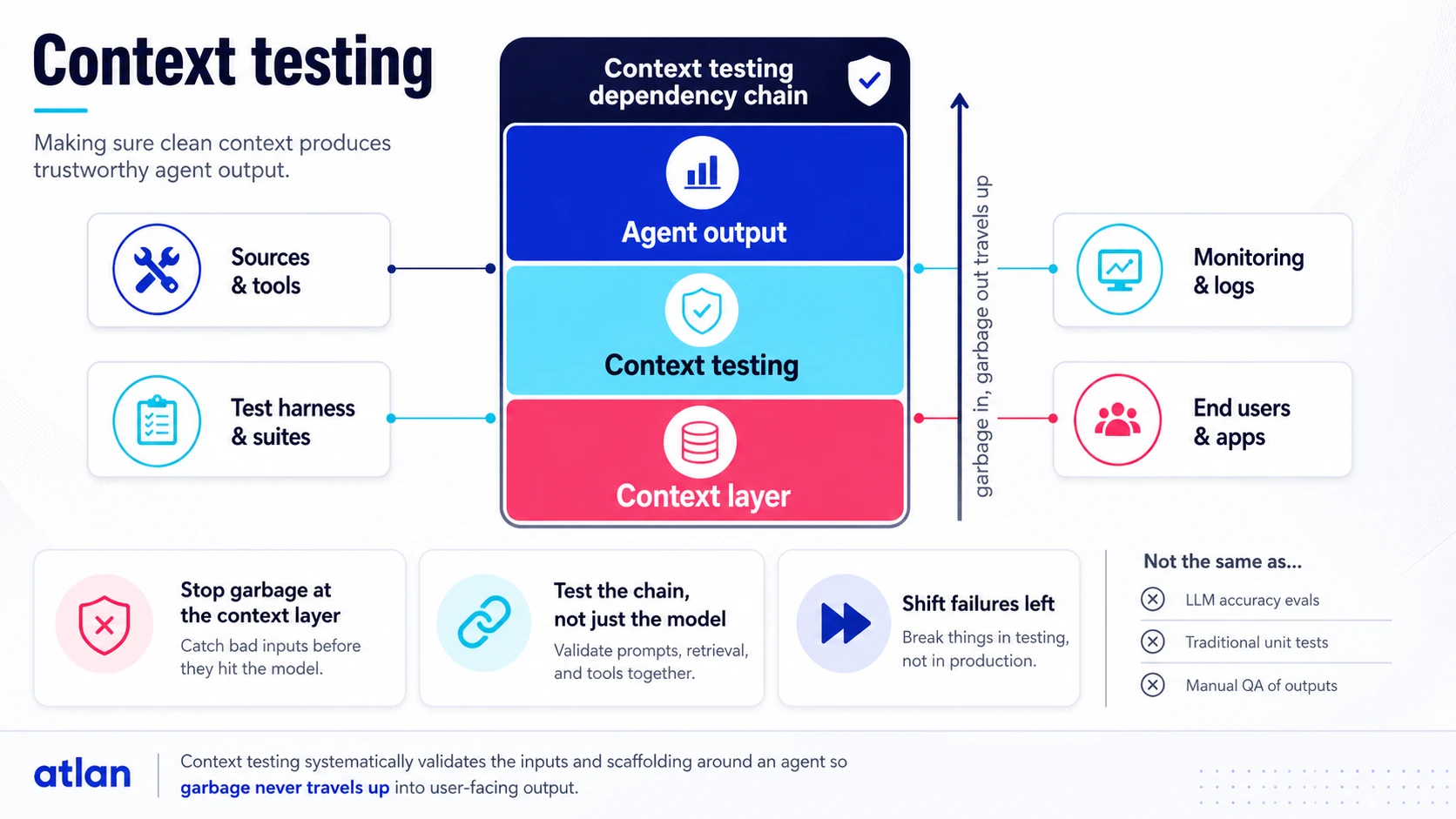
The context-testing dependency chain. Source: Atlan
That upstream layer looks different by architecture. Choosing between an agent context layer and a knowledge base, or deciding how a context layer relates to a knowledge graph versus a vector database, decides how much of the test suite’s job the architecture already does. Early design decisions determine how hard it is to scale that layer later, and a semantic layer resolving business definitions removes a category of contradictory-source failures before testing has to catch them.
Garbage in, garbage out applies to test suites the way it applies to models. A regression suite built against untrustworthy source context will faithfully certify that answers match context, and miss entirely that the context was wrong the whole time.
Context Gap Calculator
See how much of your agent's context is actually reliable today, and where the gaps sit before you build a test suite around them.
Calculate Your Context GapHow Atlan approaches context testing
The Context Engineering Studio treats context as a versioned, testable software asset, not a static document. Its lifecycle runs build, test, review, approve, deploy, learn: candidate context comes from the Enterprise Data Graph, gets simulated against historical traces, and a human certifies what becomes canonical before any agent draws on it in production. Corrections propagate back into the shared layer rather than staying stuck inside one agent, the same problem context mining and the broader context development lifecycle exist to solve at the source.
Two customers describe the outcome in their own words. DigiKey’s Chief Data & Analytics Officer, Sridher Arumugham, says the platform “enabled us to easily activate metadata for everything from discovery in the marketplace to AI governance to data quality to an MCP server delivering context to AI models,” calling it “more of a context operating system” than a catalog. Workday’s VP of Enterprise Data & Analytics, Joe DosSantos, frames the same value differently: it “captures Workday’s shared language to be leveraged by AI via its MCP server,” something the two companies describe as actively co-building, not a one-time delivery.
Neither quote names a formal test suite. Both describe what one depends on: context shared, current, and trusted enough to build on without re-verifying it from scratch. That certified context serves more than one consumer, too: the difference between enterprise memory and enterprise skills determines whether a correction lands as a fact an agent recalls or a procedure it follows, and the same lifecycle certifies both.
See Context Agents Live
Watch how Atlan builds, tests, and certifies context before it ever reaches an agent, in a live walkthrough.
Watch the Live DemoWhy “did it produce a good answer” is the wrong first question
Ask a context question first, and the output question gets easier to answer honestly. Every failure mode this page has covered, stale retrieval, contradictory sources, context rot, context poisoning, looks identical from the outside: a wrong or half-right answer delivered with total confidence. The only way to tell those apart from a genuine reasoning failure is to check what was in the context window when the agent generated its response, not how the response reads.
Worth naming rather than glossing over: the industry hasn’t fully standardized separate vocabulary for context testing versus RAG evaluation yet. Plenty of teams bundle both into one pipeline they call “evaluation.” That’s not wrong, exactly, it just means the distinction this page draws is a useful mental model more than a settled consensus.
What is settled is the dependency underneath both disciplines. A context test suite, however well built, can only certify that an agent’s context matches what a governed, current source system says is true. If that source was never governed to begin with, the suite will pass agents built on it anyway, right up until the gap between what the source says and what’s actually true becomes someone else’s problem to find.
FAQs about context testing for AI agents
1. What is context testing for AI agents?
Context testing checks whether an AI agent’s retrieved context, documents, memory, tool outputs, and prior turns, is accurate, complete, and free of contradictions before or during a run. It’s distinct from output evaluation, which scores the final answer rather than the material that produced it.
2. How is context testing different from evaluating an agent’s final output?
Output evaluation scores what the agent said; context testing scores what it was given to say it with. An agent can pass an output-quality check while still working from stale or contradictory context, and it can have clean context while still generating a wrong synthesis, so the two checks catch different failures.
3. What is context rot, and how does it relate to context testing?
Context rot is the degradation in model attention that happens as a session’s context window fills with accumulated turns, tool outputs, and retrieved chunks, making earlier relevant information harder to use even though it’s still present. Context-window audits are the technique built to catch it.
4. What is a golden dataset used for in context testing?
A golden dataset is a reviewed, versioned set of representative queries paired with known-correct expected context, used to detect whether a change to a retriever, prompt, or model degraded quality. Teams re-run it before every release that touches the retrieval pipeline.
5. How often should context tests run?
On two tiers: a golden question set runs before any release touching a retriever, prompt, or context source, and production traces get continuously sampled into new regression cases afterward. Running a suite only once at launch misses the drift that shows up weeks or months later.
6. Why does context testing depend on the underlying context layer being trustworthy?
A test suite can only certify that retrieved context matches what a source system says is true. If that source is stale, duplicated, or ungoverned, the suite will faithfully pass agents built on wrong information, because it was never designed to audit the source itself, only the retrieval step downstream of it.
Sources
- Context Rot Is Real: Why Your AI Gets Worse Over Time, Memgraph
- Context Poisoning: How Bad Data Breaks Agent Reasoning, Redis
- Golden Dataset, FutureAGI Glossary
- LLM Regression Testing, FutureAGI Glossary
- Groundedness, FutureAGI Glossary
- What Is RAG Evaluation? Measuring Retrieval Quality and Answer Groundedness, Braintrust
- RAG Evaluation Metrics: Assessing Answer Relevancy, Faithfulness, Contextual Relevancy, and More, Confident AI
