

Multi-cloud context layer: core properties and quick facts
A multi-cloud context layer is cloud-agnostic infrastructure that gives AI agents consistent business context, including definitions, policies, and lineage. Atlan builds this as the Context Layer for AI: Iceberg-native, open by default, and readable from whichever cloud your agents run on next.
Since most enterprises already operate several clouds and several data platforms, your context infrastructure cannot be locked inside just one platform. This recreates the silo it was supposed to remove.
The three fundamental characteristics of a genuine multi-cloud context layer are:
- One store, every cloud: Context is written once and read by any agent on any infrastructure.
- Open formats: Context sits in storage the customer owns, not in a proprietary vault.
- Open delivery: Any agent, framework, or engine consumes this unified context through standard protocols (MCP, A2A, APIs).
| Multi-Cloud Context Layer: Quick Facts | |
|---|---|
| Storage format | Apache Iceberg: open table format with ACID transactions, schema evolution, time travel |
| Compute model | Bring-your-own-compute (BYOC) across S3, GCS, and ADLS |
| Delivery protocols | MCP (reads), A2A (agent write-back), SQL, REST/Graph APIs |
| Hybrid cloud adoption | 73% of organizations operate hybrid cloud (Flexera 2026 State of the Cloud Report) |
| Multicloud risk | 50%+ of organizations won’t get expected multicloud results by 2029 (Gartner, May 2025) |
| Ownership test | Can you query your context files directly, without the vendor’s software, using engines you already run? |
Build Your AI Context Stack
Get the blueprint for implementing context graphs across your enterprise. This guide walks through the four-layer architecture, from metadata foundation to agent orchestration, with practical implementation steps for 2026.
Get the Stack GuideAtlan is the Context Layer for AI, built open and portable by default. It connects to all the source systems where context already lives across every cloud environment, stores context in open formats the customer owns, and serves it to any agent through open protocols.
With Atlan, you can establish a multi-cloud context layer that’s Iceberg-native and supports bring-your-own-compute (BYOC). As a result, your enterprise context is never trapped in one vendor’s walls.
Why does single-cloud context break at scale?
A context layer that picks a cloud for you has already failed. Enterprises have numerous source systems and agent platforms across different infrastructure, each with its own slightly different version of the truth.
According to the Flexera 2026 State of the Cloud Report, 73% of organizations use hybrid cloud, an increase from the prior year, and multi-cloud adoption keeps rising even when it’s unintentional. Most enterprises already run more than one cloud, whether by strategy, merger, or inherited architecture.
That heterogeneity is permanent, and it is expensive to ignore. According to Gartner (May 2025), more than 50% of organizations will not get the expected results from their multicloud implementations by 2029, largely because connecting across providers remains hard.
Put the context layer inside any single cloud and two old problems return:
-
Fragmentation: Agents running on one cloud cannot see the definitions, policies, and lineage that live in another, so every platform develops its own partial truth.
-
Lock-in: Context sits inside a vendor’s proprietary store that you do not own, so the switching cost of leaving grows with every definition you add, unless the context itself stays portable.
Context is your company’s IP and should be accessible to every agent on every cloud, stored in open formats you control. A truly multi-cloud context layer is open, portable, and vendor-agnostic.
One of Atlan’s customers, a global energy and fuel-logistics company, puts it plainly: the company isn’t a single-vendor shop. Context has to span everything.
How do open storage and protocols enable portability?
Portability is an architectural property, and it comes from two decisions: where context is stored and how it is served. When you get both right, the same context follows your agents to whichever cloud they run on next.
This portability stack has three parts:
-
Iceberg-native storage: Context lives in Apache Iceberg tables, an open format with ACID transactions, schema evolution, and time travel that any compatible engine can query with standard SQL.
-
Bring-your-own-compute: Context files sit in your own object storage across S3, GCS, and ADLS, and your own engines query them directly.
-
Open delivery protocols: Agents read context over MCP, write observations back over A2A, and integrate through SQL and REST or Graph APIs.
This stack helps you keep one truth across many agents and clouds. You can build shared Context Repos (portable and versioned units of context) once and share them across platforms and agents.
Because agents also write signals back through A2A, that shared context compounds with every interaction instead of drifting apart per platform, which matters most in multi-agent systems where several agents read and write the same context at once.
What is bring-your-own-compute (BYOC) and why does it matter for context?
Bring-your-own-compute (BYOC) means your context is stored in your cloud storage and queried by engines you already run, rather than living inside a vendor’s managed infrastructure. Because the storage format is Apache Iceberg, any compatible engine, from Spark to Trino to DuckDB, reads the same files.
BYOC settles the ownership question in practice by ensuring there is no stranded context. If you change vendors or clouds, the files stay in your buckets and remain readable. Also, since context is queried where it lives, you avoid cross-cloud data movement and its egress costs.
There is a security benefit as well. Context inherits the controls, residency rules, and audit posture of your own storage accounts, so it sits inside the perimeter your teams already manage.
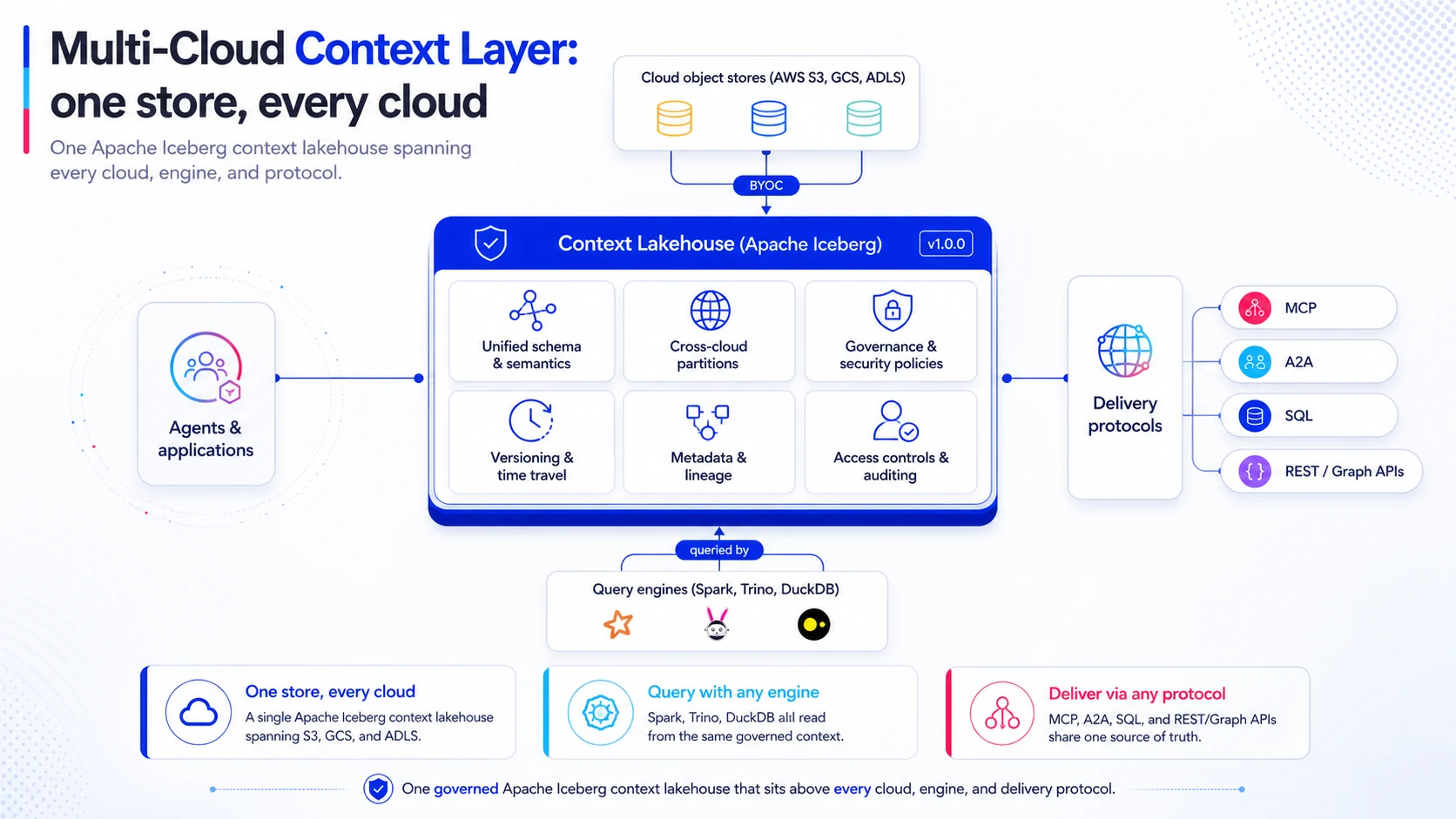
Caption: One governed Apache Iceberg context lakehouse spanning every cloud, engine, and delivery protocol — queried by Spark, Trino, and DuckDB, delivered over MCP, A2A, SQL, and REST/Graph APIs.
Single-cloud/proprietary vs. a genuine multi-cloud context layer
| Aspect | Single-Cloud / Proprietary Approach | Multi-Cloud Context Layer |
|---|---|---|
| Storage | Proprietary vendor-managed store | Open format (Apache Iceberg) you own |
| Compute | Vendor-managed compute only | Bring-your-own-compute (Spark, Trino, DuckDB) |
| Portability | Locked to one cloud or vendor | Works across S3, GCS, and ADLS |
| Delivery | Proprietary SDK per platform | Open protocols (MCP, A2A, SQL, APIs) |
| Consistency | Each cloud develops its own partial truth | One shared truth across every cloud |
| Vendor risk | High switching cost, stranded context | Low: files stay readable if you change vendors |
Get the CIO Guide to Context Graphs
See how enterprise and AI leaders are building a portable context graph across every cloud, and what it takes to keep that graph open, governed, and query-ready for any agent.
Get the Context Graph GuideWhat are the key characteristics of a genuine multi-cloud context layer?
Plenty of tools are deployed on several clouds. A genuine multi-cloud context layer is defined by what you can take with you.
The open storage, protocols, and engine neutrality covered above all serve one outcome: your context keeps working when you change vendors, clouds, or compute. If any of those changes would force you to rebuild context, the layer was never genuinely multi-cloud.
Why ownership and portability are the same question
Context is intellectual property, the same way your products and your culture are. Definitions, policies, lineage, and accumulated agent learnings encode how your business actually works, and that knowledge is a competitive asset.
Ownership and portability turn out to be one architectural decision, viewed from two angles. If context sits in open formats you control, you own it and every agent can reach it. If it sits in a proprietary store, you neither own it nor move it, whatever the contract says.
How to evaluate a multi-cloud context layer: 5 must-have capabilities
Use these five capabilities as the benchmark when comparing options:
-
Context store: This is the core of “multi-cloud”, as context is stored in open formats you own and can query from any engine. So, verify the format is Apache Iceberg or equivalent and the files live in your storage.
-
Open protocol support: Open protocols make sure that any agent on any cloud consumes the same source of truth. Look for MCP, A2A, SQL, and API delivery rather than a single proprietary SDK.
-
Bootstrap context: The multi-cloud context layer can mine context wherever it lives (Salesforce, Snowflake, Databricks, BigQuery, Confluence).
-
Context versioning: Versioned, model-agnostic, portable units of context eliminate re-engineering per platform and let you audit exactly what any agent saw at any point in time.
-
Enterprise-wide data graph: One coherent map across a heterogeneous, multi-cloud estate, not a bare context store or a pile of per-cloud fragments.
Treat these five as a single test, not a shopping list: a layer that passes on store and protocol but fails on versioning or graph coverage will still leave you re-engineering context every time an agent moves clouds.
How does Atlan set up a multi-cloud context layer for your enterprise?
As the Context Layer for AI, Atlan delivers each of those capabilities as part of one architecture:
-
Context lakehouse: Iceberg-native storage combined with a knowledge graph and vector search, with BYOC support across S3, GCS, and ADLS.
-
Open protocol support: Context is delivered over MCP, A2A, SQL, and REST and Graph APIs, so every agent consumes it through the interface it already speaks. Teams already running MCP inside Snowflake or Databricks extend the same context layer to engines like Snowflake Cortex rather than standing up a parallel one for each platform.
-
Connectors: Atlan supports 100+ connectors, which include systems of record, data, knowledge, work, and runtime signals across clouds. So, context is mined where it already lives.
-
Context Repos: Context Repos are portable units where you build context just once and read it from any framework or cloud.
-
Enterprise data graph: A unified graph of what data exists, what it means, and how it connects, with cross-system lineage.
None of this replaces the cloud platforms you already run; it sits alongside them so the context layer, not any single cloud, becomes the constant.
Real stories from real customers: context ownership across clouds
"We're excited to build the future of AI governance with Atlan. All of the work that we did to get to a shared language at Workday can be leveraged by AI via Atlan's MCP server…as part of Atlan's AI Labs, we're co-building the semantic layer that AI needs with new constructs, like context products."
Joe DosSantos, VP of Enterprise Data & Analytics, Workday

"Atlan is much more than a catalog of catalogs. It's more of a context operating system…Atlan enabled us to easily activate metadata for everything from discovery in the marketplace to AI governance to data quality to an MCP server delivering context to AI models."
Sridher Arumugham, Chief Data & Analytics Officer, DigiKey

Calculate Your Context Layer ROI
Run the numbers on time saved and rework avoided before you commit to a multi-cloud context architecture.
Calculate ROIMoving forward with the multi-cloud context layer
Heterogeneity is now the norm, so the practical question has shifted from which cloud wins to how AI agents get one consistent truth across multi-cloud infrastructure.
Answering that question starts with ownership. Context stored in open formats you control, delivered over open protocols, and queryable by any engine will outlast any individual platform decision your company makes, which is exactly why data governance teams increasingly treat the context layer as infrastructure, not a project.
As the Context Layer for AI, Atlan turns scattered enterprise knowledge into a multi-cloud context layer you own, so every agent on every cloud reasons from the same truth.
FAQs about the multi-cloud context layer
1. What is a multi-cloud context layer, in one sentence?
A multi-cloud context layer is cloud-agnostic infrastructure that stores enterprise context in open formats you own and serves it to any AI agent on any cloud through open protocols.
2. Why does a single-cloud context layer break down at scale?
Enterprises run many source systems and agent platforms across several clouds. A context layer inside one cloud cannot reach the others consistently, so each platform develops its own partial truth and the vendor’s store becomes a new form of lock-in.
3. What makes a context layer genuinely multi-cloud vs. just “supported on” multiple clouds?
A genuinely multi-cloud context layer stores context in open table formats inside your own storage, delivers it over open protocols, and works with any compatible query engine, even if the vendor disappears tomorrow.
4. How do you keep one truth across agents running on different clouds?
Store context once in a shared, governed store and serve it through standard protocols. Portable, versioned context units let every framework read the same definitions, and agent write-back keeps that shared context current instead of letting each platform drift.
5. What is bring-your-own-compute (BYOC) and why does it matter for context?
BYOC means context files live in your own cloud storage (S3, GCS, or ADLS) and are queried by engines you already operate. It matters because your context stays readable, in place, regardless of which vendors or clouds you use in the future.
6. How is context delivered across clouds (MCP, A2A, SQL, API)?
MCP serves governed context reads to agents, A2A lets agents write observations and quality signals back, SQL over open table formats supports any compatible engine, and REST or Graph APIs handle custom integrations. Together they let any consumer on any cloud reach the same context.
7. Who owns the context, you or the vendor?
In an open architecture, you do. The practical test is simple: can you query your context files directly, without the vendor’s software, using engines you already run? If yes, the context is yours.
Sources
- Flexera 2026 State of the Cloud Report: The Convergence of Cloud and Value, Flexera. https://www.flexera.com/blog/finops/flexera-2026-state-of-the-cloud-report-the-convergence-of-cloud-and-value/
- Gartner Identifies the Top Trends Shaping the Future of Cloud, Gartner, May 2025. https://www.gartner.com/en/newsroom/press-releases/2025-05-13-gartner-identifies-top-trends-shaping-the-future-of-cloud
- Apache Iceberg, Apache Software Foundation. https://iceberg.apache.org/
- Model Context Protocol (MCP). https://modelcontextprotocol.io/
- Linux Foundation Launches the Agent2Agent Protocol Project, The Linux Foundation, June 2025. https://www.linuxfoundation.org/press/linux-foundation-launches-the-agent2agent-protocol-project-to-enable-secure-intelligent-communication-between-ai-agents
- A Survey of Context Engineering for Large Language Models, Mei et al., arXiv, 2025. https://arxiv.org/abs/2507.13334
