
























Why do you need dynamic metadata discovery?
Permalink to “Why do you need dynamic metadata discovery?”Applications (web, desktop, or mobile) are constantly evolving to provide enhanced features, a better user experience, and increased efficiency.
A major factor in this endeavor is the storage, handling, and transfer of data between applications, data platforms, and end-users. With such fast-paced application development, the data structure, its properties, and its metadata are always changing, i.e., the metadata is dynamic.
To fully utilize this metadata for data analysis, reporting, business intelligence, or business process improvement, you need to be able to discover changes to the metadata in real-time.
This is called dynamic metadata discovery, which can be enabled using a combination of the following:
- Automated metadata extraction from source systems
- Automated propagation of metadata to downstream systems
- Real-time change data capture and stream consumption
- Metadata enrichment for better discoverability
How does dynamic metadata discovery work?
Permalink to “How does dynamic metadata discovery work?”Dynamic metadata discovery continuously identifies, collects, and updates metadata across your data ecosystem to reflect changes as they happen.
Modern platforms use a combination of pull-based and push-based mechanisms to ensure metadata stays accurate as schemas, pipelines, and workloads evolve:
- Pull-based extraction: The system periodically queries APIs, logs, or catalog tools (such as Snowflake Information Schema or Databricks Unity Catalog) to fetch the latest metadata on a schedule.
- Push-based ingestion: Tools, pipelines, or event streams send metadata directly to the metadata engine using change data capture, webhooks, streaming logs, or OpenLineage events.
To establish an always-current view of data assets and their relationships, modern metadata control planes work by:
1. Automatically scanning diverse systems
Permalink to “1. Automatically scanning diverse systems”The discovery engine scans databases, warehouses, data lakes, pipelines, cloud platforms, file systems, and BI tools to extract structural and operational metadata. This includes schemas, table and column information, query history, pipeline definitions, job runs, and process dependencies.
This eliminates manual documentation and ensures broad coverage across modern architectures.
2. Harvesting metadata in real time
Permalink to “2. Harvesting metadata in real time”In addition to scheduled scans, modern platforms monitor system logs, execution plans, schema-change events, and transformation code updates. This provides near-real-time visibility into:
- New or modified tables
- Schema drift
- Pipeline failures
- Model version updates
- BI dashboard refreshes
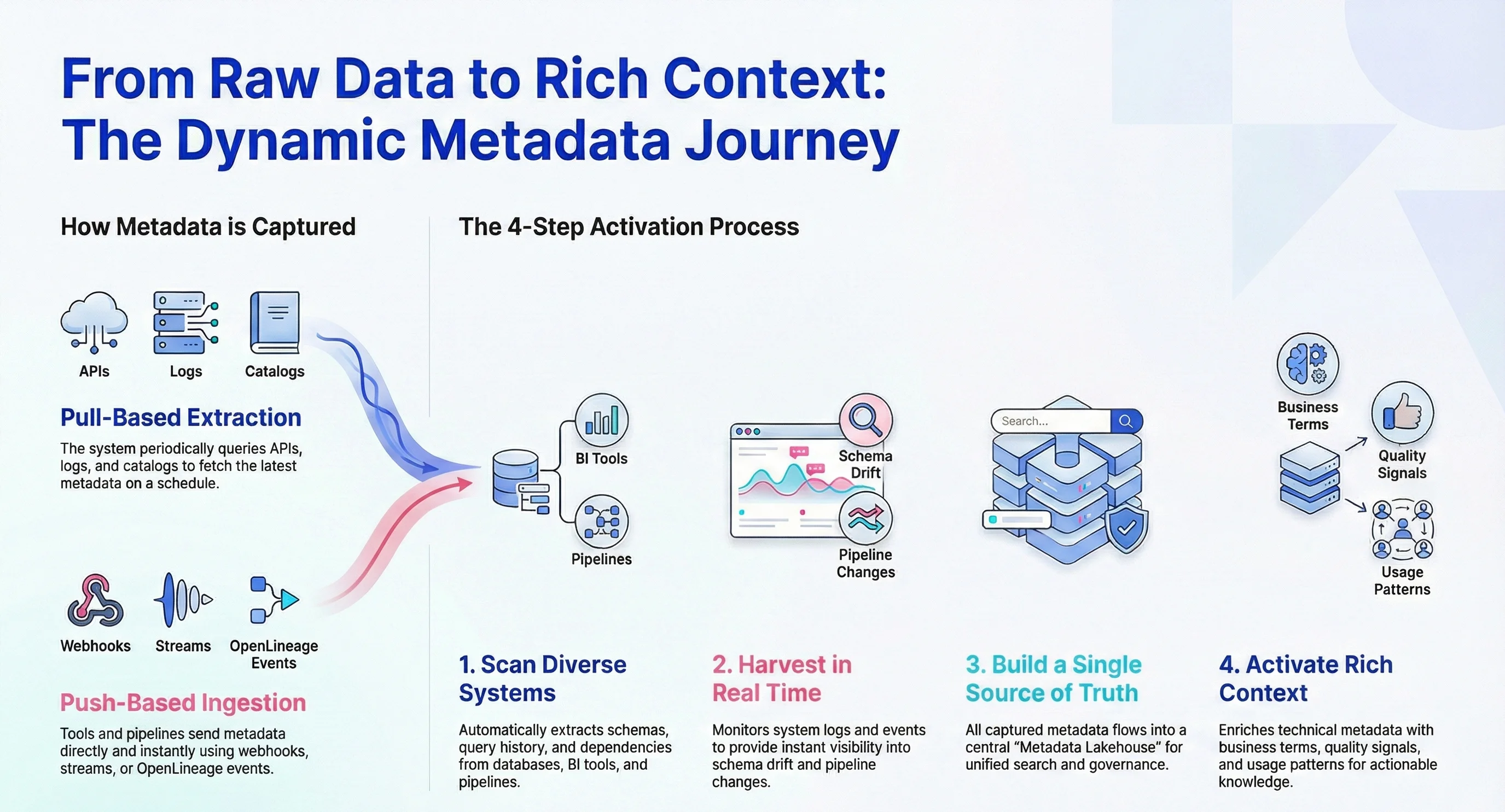
How does dynamic metadata discovery work?. Source: Atlan.
3. Building a single source of truth with a centralized metadata repository (metadata lakehouse)
Permalink to “3. Building a single source of truth with a centralized metadata repository (metadata lakehouse)”All captured metadata flows into a central metadata repository or control plane – think of it as a metadata lakehouse that silos across platforms and enables:
- Cross-platform asset search and discovery
- End-to-end lineage construction
- Unified governance across systems
- AI-driven enrichment and recommendations
4. Activating data context and meaning across your data ecosystem
Permalink to “4. Activating data context and meaning across your data ecosystem”Dynamic discovery goes beyond technical metadata extraction. It attaches rich context, such as:
- Data origin and transformation logic
- Usage patterns and popularity metrics
- Data quality signals and anomaly patterns
- Ownership and domain assignments
- Business glossary terms and policy tags
This enrichment transforms raw metadata into meaningful, actionable knowledge–crucial for trust, explainability, discovery, and active governance.
How can you ensure success with dynamic metadata discovery?
Permalink to “How can you ensure success with dynamic metadata discovery?”Two key factors central to ensuring the success of dynamic metadata discovery are:
- The ability to automate
- The ability to produce and consume metadata in real-time
You can ensure this by adopting a platform that:
- Continuously searches for new metadata in the source systems.
- Creates an up-to-date knowledge graph.
- Uses this knowledge graph to offer an up-to-date view of all your systems (with discovery capabilities).
What are the biggest use cases of dynamic metadata discovery?
Permalink to “What are the biggest use cases of dynamic metadata discovery?”Dynamic metadata discovery enables real-time visibility, automation, and intelligence across modern data ecosystems. Here are the most impactful use cases.
1. Data lakes and warehouses
Permalink to “1. Data lakes and warehouses”Continuously catalogs large-scale repositories like Snowflake, BigQuery, Databricks, and S3 to improve data discovery, unify technical and business context, and keep schema information current as data evolves
2. Hybrid and multi-cloud environments
Permalink to “2. Hybrid and multi-cloud environments”Automatically integrates metadata across on-prem systems, cloud platforms, and SaaS tools, creating a unified metadata layer in environments where data is distributed across many locations.
3. Business intelligence and analytics
Permalink to “3. Business intelligence and analytics”Keeps BI tools supplied with accurate, timely metadata so teams can trust their dashboards. Dynamic updates ensure analysts always understand data freshness, quality, lineage, and usage patterns.
4. Automated data lineage and impact analysis
Permalink to “4. Automated data lineage and impact analysis”Feeds lineage engines with up-to-date metadata to map data flows, trace dependencies, and calculate downstream impact whenever schemas, pipelines, or transformations change.
5. API and service integrations
Permalink to “5. API and service integrations”Allows applications and services to dynamically detect the structure of remote objects, supported operations, and contract changes, improving integration reliability in microservice and event-driven architectures.
6. Governance, compliance, and policy enforcement
Permalink to “6. Governance, compliance, and policy enforcement”Continuous metadata updates ensure that sensitivity tags, access rules, and compliance policies remain accurate, even as data evolves. This is essential for PII detection, access audits, and regulatory reporting.
7. Cost optimization and asset rationalization
Permalink to “7. Cost optimization and asset rationalization”Helps teams identify unused tables, redundant pipelines, or stale dashboards using real-time metadata and usage signals.
8. AI and ML readiness
Permalink to “8. AI and ML readiness”Enables explainability, provenance tracking, model monitoring, and AI-assisted data discovery. AI agents depend on real-time metadata to correctly understand and navigate an organization’s data estate.
What are the benefits of dynamic metadata discovery?
Permalink to “What are the benefits of dynamic metadata discovery?”Unlike static metadata, dynamic metadata reduces manual, high-maintenance effort required to maintain updated information about your data sources, apps, systems, etc.
As a result, you reap multifaceted benefits, such as:
- Automation-first data and AI ecosystem: Lay the foundation for metadata activation by enabling an automation-first approach to metadata handling.
- Faster data discovery: Speeds up how quickly teams can search, explore, enrich, and use data assets, accelerating analytics and AI development.
- Greater trust in your data: Drive more trust in data by enabling more secure data handling, while also improving data quality.
- Significant time savings: Reduce the manual work required to catalog, update, and reconcile metadata across teams and tools, freeing up engineering and governance capacity.
- Simplified data governance: Provide an always-accurate view of data assets, their movement, and usage patterns, making compliance and audit readiness far easier.
- Enhanced data management: Gives teams a clear, current picture of the entire data estate, simplifying stewardship, lifecycle management, and cross-system coordination.
- AI readiness: Real-time metadata updates can power AI-driven context building for assets, enabling contextual search, semantic recommendations, and intelligent navigation far beyond traditional filtering or manual tagging.
What are the biggest challenges to implementing dynamic metadata discovery?
Permalink to “What are the biggest challenges to implementing dynamic metadata discovery?”Implementing dynamic metadata discovery is difficult because most organizations still operate with fragmented systems, inconsistent metadata models, and limited automation. These gaps make it hard to capture, unify, and activate metadata in real time.
The biggest challenges include:
- Fragmented metadata across silos: Many teams lack the connectors, infrastructure, or ingestion pipelines needed to pull metadata from diverse warehouses, lakes, BI tools, pipelines, and SaaS systems.
- No unified or standardized metadata schema: Without a common structure, metadata from different systems cannot be harmonized, compared, or interpreted consistently.
- Rigid or non-extensible metadata models: Legacy catalogs cannot adapt to evolving schemas, real-time pipeline changes, or new asset types (like AI models or unstructured data).
- Incomplete or inaccurate source metadata: Many systems either expose limited metadata or require complex workarounds to extract operational, semantic, or usage context.
- Limited or no support for real-time metadata updates: Batch-based ingestion creates stale context, making it impossible to reflect schema drift, pipeline changes, or new assets as they occur.
- Inability to link assets for lineage, governance, or quality: Without granular, connected metadata, teams cannot assemble lineage graphs, enforce policies, or propagate tags across systems.
- Lack of open standards and interoperability: Closed architectures restrict integration with modern data platforms, observability tools, BI systems, and AI workflows.
While the issues are varied, most of them stem from the lack of a unified control plane that can consolidate all metadata, store it in a consistent schema, and facilitate effective management.
This unified control plane can then serve as the foundation for the real-time handling of dynamic metadata through automation and activation. Let’s see how.
How does a metadata control plane enable dynamic metadata discovery?
Permalink to “How does a metadata control plane enable dynamic metadata discovery?”One of the most challenging aspects to address to enable dynamic metadata discovery is the difficulty organizations face in consolidating all their metadata in one place.
Even if an organization manages to do so in a DIY manner or using an external tool, dynamic metadata discovery can only be efficiently unlocked if it has the right set of features, processes, and workflows in place to leverage the dynamic metadata.
Atlan’s unified metadata control plane is built on the very premise of solving all these use cases for an organization with its AI-driven automation-first metadata activation philosophy at the core.
Key capabilities that enable dynamic metadata discovery include (but aren’t limited to):
- Metadata lakehouse foundation on open standards and OSS projects like Apache Iceberg.
- Real-time AI-driven context for all your data assets, leveraging the metadata lakehouse.
- Metadata enrichment using custom metadata for business context, lineage, collaboration, etc.
- Data quality-driven data asset discovery and usage with Data Quality Studio.
- Automatic tagging, classification, and propagation to offer additional context for discovery.
Let’s see how some of Atlan’s customers have been discovering and using data assets in real-time using Atlan.
Real stories from real customers: Driving dynamic metadata discovery with Atlan
Permalink to “Real stories from real customers: Driving dynamic metadata discovery with Atlan”
From Hours to Minutes: How Aliaxis Reduced Effort on Root Cause Analysis by almost 95%
"A data product owner told me it used to take at least an hour to find the source of a column or a problem, then find a fix for it, each time there was a change. With Atlan, it's a matter of minutes. They can go there and quickly get a report."
Data Governance Team
Aliaxis
🎧 Listen to the podcast: How Aliaxis Reduced Effort on Root Cause Analysis
How Atlan helps to setup a connected data ecosystem
Book a Personalized Demo
53 % less engineering workload and 20 % higher data-user satisfaction
"Kiwi.com has transformed its data governance by consolidating thousands of data assets into 58 discoverable data products using Atlan. 'Atlan reduced our central engineering workload by 53 % and improved data user satisfaction by 20 %,' Kiwi.com shared. Atlan's intuitive interface streamlines access to essential information like ownership, contracts, and data quality issues, driving efficient governance across teams."
Data Team
Kiwi.com
🎧 Listen to the podcast: How Kiwi.com Unified Its Stack with Atlan
Ready to activate your data estate to drive dynamic metadata discovery?
Permalink to “Ready to activate your data estate to drive dynamic metadata discovery?”Dynamic metadata brings numerous benefits to an organization–reducing manual work through automation and more accurate data discovery and usage.
However, it also presents challenges. Some complications arise from the variety and complexity of all the systems involved in the data production and consumption lifecycle.
For dynamic metadata discovery to work, teams must be able to see and understand metadata changes in real time—whether they’re analysts, BI engineers, data engineers, or business consumers. Without a unified control plane, delivering this experience is difficult.
That’s where a platform like Atlan becomes essential.
Atlan is a metadata activation platform that focuses on dynamic metadata discovery, collaboration, governance, and quality, utilizing an AI-driven and automation-first approach to streamline all data-related workflows within your organization.
If your organization depends on fast-changing data and needs clear, trusted, real-time context, dynamic metadata discovery powered by Atlan provides the foundation for a modern, intelligent data ecosystem.
FAQs about dynamic metadata discovery
Permalink to “FAQs about dynamic metadata discovery”1. What is dynamic metadata?
Permalink to “1. What is dynamic metadata?”Dynamic metadata is metadata that keeps changing as the source and target systems change. Static data, in contrast, is more rigid and changes infrequently.
Dynamic metadata can help lay the foundation for various types of automation, from graceful error handling in data pipelines to maintaining an up-to-date discovery engine.
2. What is active metadata, and how does it relate to dynamic metadata?
Permalink to “2. What is active metadata, and how does it relate to dynamic metadata?”Dynamic metadata is metadata that keeps changing.
Active metadata, whether static or dynamic, refers to the metadata used for automation. Dynamic metadata is the most useful in terms of adapting to changes using metadata activation.
Some key examples of metadata activation include tagging, categorization, and lineage propagation from one system to another, as changes occur.
3. How does dynamic metadata help with data discovery?
Permalink to “3. How does dynamic metadata help with data discovery?”Dynamic metadata provides the most up-to-date representation of the source data assets, ensuring that it contains the latest metadata attributes, tags, categories, classification, lineage, governance, and compliance-related information.
With the right metadata platform, you can ingest this wealth of metadata and utilize it for contextualization and the discovery of data assets in natural language.
4. What tools are needed for enabling dynamic metadata discovery?
Permalink to “4. What tools are needed for enabling dynamic metadata discovery?”First and foremost, you need a tool that can ingest and manage real-time changes in data assets from source systems.
At the same time, it should also integrate metadata from disparate systems and bring it into a unified schema and storage engine–preferably based on open standards for wider compatibility.
Once you have this, you have enabled dynamic metadata discovery, which, in turn, enables real-time data discovery.
5. What is a metadata lakehouse?
Permalink to “5. What is a metadata lakehouse?”A metadata lakehouse is an architecture pattern that supports the ingestion, storage, and organization of every type of metadata that you have in your organization using open standards.
The benefit of using a metadata lakehouse is that it future-proofs metadata handling within your organization, while also providing the foundation for a unified, AI-driven, contextualized data discovery, governance, quality, lineage, and collaboration experience.
Share this article
