



What are the six stages of data lifecycle management?
Although there are no set rules or patterns for the stages of the lifecycle of data, here is what a typical data data lifecycle might look like.
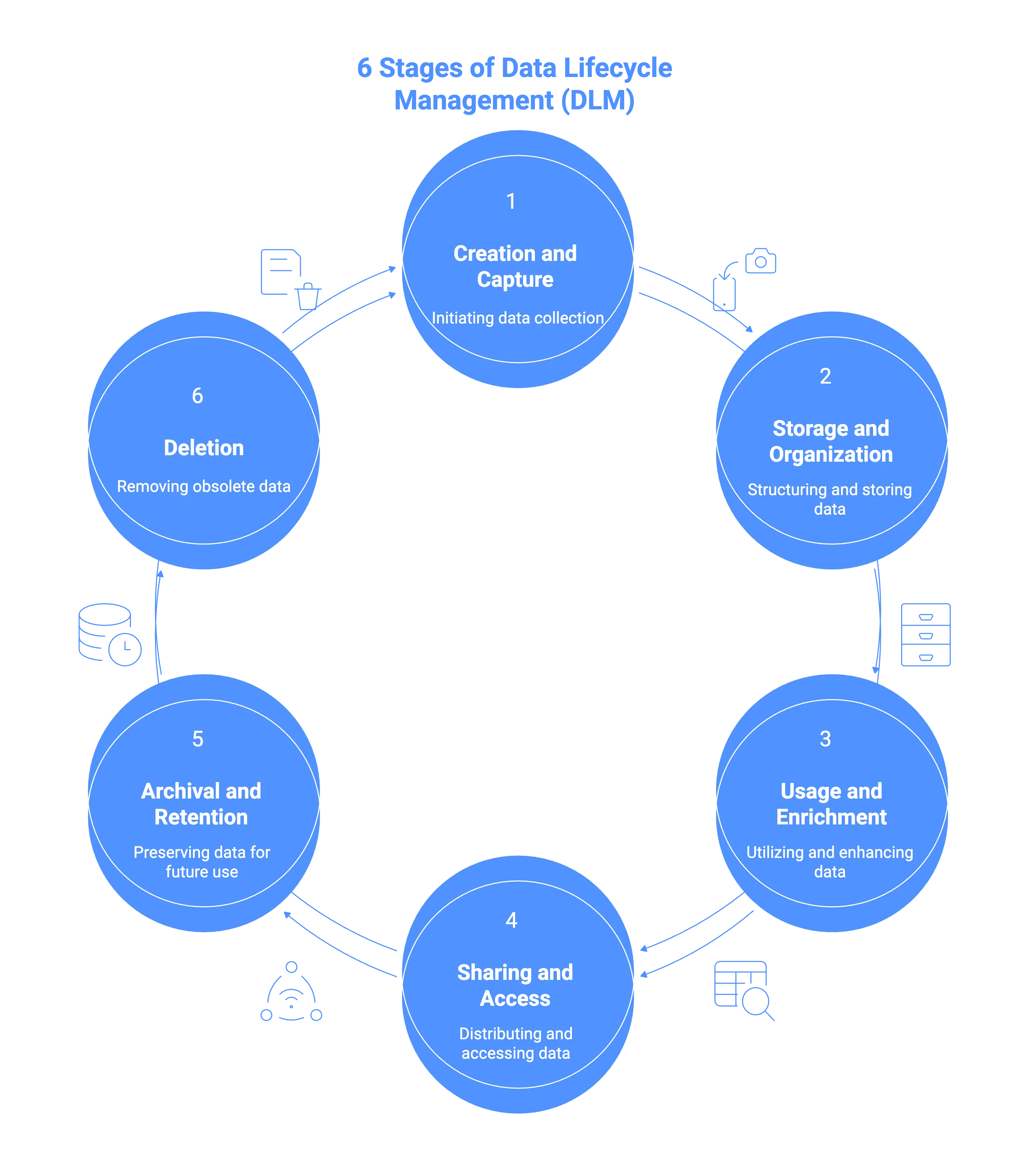
The six broad stages of data lifecycle management (DLM). Image by Atlan.
1. Creation and capture
Data gets created in-house or acquired from outside systems through integrations and APIs.
2. Storage and organization
Data is stored in a database, a data lake, or a data lakehouse. It gets structured for discovery, ownership, access control, and classification, then becomes available for processing, which may include cleansing, transformation, and remodeling.
3. Usage and enrichment
Data moves through pipelines (ETL or ELT), gets cleaned, transformed, and enriched for downstream use. This prepared data is then consumed by analytics tools, dashboards, AI agents, and business applications to drive decisions.
4. Sharing and access
Data is shared internally or externally with proper permissions, masking, auditing, and security controls to prevent unauthorized use, by a person or an agent.
5. Archival and retention
Inactive or infrequently accessed data gets archived based on business, legal, or compliance retention requirements. Archival can happen because of degrading quality, outdated information, or simple cost optimization: most data assets move to cheaper, less frequently accessed storage once they have served their use case.
Some regulations require long-term archival for compliance purposes, meaning the data cannot be permanently deleted. Others require the opposite: destruction, because the regulation prohibits keeping a copy at all.
6. Deletion
Some data needs to be fully and securely destroyed across every system it touched, whether for regulatory compliance, cost reduction, or reducing exposure risk.
These are the broad stages, and more can be added depending on specific functions like governance, sharing, or review. The real goal across all of them is movement, getting data from one stage to the next, and automation is what makes that possible.
Build your governance framework in 3 minutes
Get 90-Day DG RoadmapWhat role does automation play in data lifecycle management?
Automation is what actually moves data between stages. Before it can do that, it needs rules and conditions, stored as data lifecycle management policies.
These policies typically cover:
- Data storage tiering: For retention, archival, disposal, and destruction of data
- Data freshness or staleness: To flag whether a data asset is still valid or should be marked deprecated
- Data usage and popularity metrics: To adjust storage or availability tiers based on actual use
- Data quality and integrity metrics: To change an asset’s certification status automatically
- Data access control: To move data to a more or less protected area as its sensitivity changes
Policy as code is what makes this run without a person checking each rule manually. A retention rule defined once in the context layer applies automatically to every asset it covers, and updates everywhere the moment the rule changes.
How can you integrate data lifecycle management with data governance?
Data lifecycle management and data governance work together. Governance lays the foundation, and lifecycle policy uses that foundation to move data automatically instead of by hand.
- Ownership, custodianship, and stewardship-led data lifecycles: Data lifecycles can look different across teams, business units, owners, and custodians within the same organization. That is not a problem on its own, as long as the process is automated and documented consistently.
- Tags, categories, and governed context: Governance frameworks tag data for protection, certification, and more, and those tags can trigger lifecycle movement directly. A deprecated certification, for example, can trigger automatic archival to a deprecated storage tier.
- Handling sensitive data, especially PII, PHI, and financial data: A core goal of any governance framework is protecting sensitive data, typically through classification, access controls, auditing, and observability. Lifecycle management ties into this directly, triggering actions based on monitoring events or classification changes as they happen.
Build your governance framework in 3 minutes
Get 90-Day DG RoadmapWhat are the benefits of effective data lifecycle management?
A strong data lifecycle management (DLM) strategy delivers clear value across business, security, and compliance priorities:
- High data quality: Ensures accurate, up-to-date, and trustworthy data for analytics, AI, and business decisions.
- Security and reduced risk: Minimizes risk exposure by controlling access, enforcing retention policies, and reducing data sprawl.
- Availability: Ensures the right people can access the right data at the right time.
- Privacy and compliance: Supports compliance with privacy and data protection laws like GDPR, CCPA, and HIPAA.
- Cost optimization: Moves cold or redundant data to lower-cost storage tiers and deletes what’s no longer needed. Also, reduce compute costs by not processing stale and outdated data.
- Operational efficiency: Maintains a cleaner, more manageable data estate, improving discoverability and governance.
Next, let’s look at some of the key challenges in implementing data lifecycle management for an organization.
Build your governance framework in 3 minutes
Get 90-Day DG RoadmapWhat are the key challenges in implementing data lifecycle management?
Across all the stages of the data lifecycle, numerous challenges arise, most of which are related to the spreading out of data or its growth, and many others are associated with the lack of visibility of data assets in an organization.
It begs the question - if an organization doesn’t know where, how, and why all of its data is stored, processed, and used, how can it implement a data lifecycle management framework effectively?
Let’s take a closer look at specific issues:
- Data siloes and scale: When data growth is accompanied by rising data siloes, it leads to poor visibility and governance gaps.
- Unavailability of data quality metrics: Data assets can be moved to different stages based on their quality and usability. If this information isn’t available, DLM can’t be implemented properly.
- Lack of accountability and auditing: Governance and compliance-based automation is possible when you can track data access activities, lineage, etc using metadata. Lack of auditable, lineage metadata prevents you from implementing DLM consistently.
- Insufficient infrastructure for policy enforcement: Without the right infrastructure for policy enforcement, i.e., even if they have the metadata but cannot activate that metadata for policy enforcement automation, DLM is ineffective.
These challenges underscore why governance and metadata activation are foundational to DLM success. Let’s see how a unified metadata control plane helps solve these problems.
How does a governed context layer enable data lifecycle management?
A governed context layer is the single place an organization’s data, definitions, and policy live, the foundation lifecycle automation runs on. Instead of a separate metadata repository bolted onto a warehouse, the context layer is built into how data gets discovered, governed, and used at every stage.
Atlan runs on this principle, with a few specific capabilities behind it:
-
Enterprise Data Graph: Connects business systems into one living graph, so lifecycle policy applies consistently across the whole estate, not one tool at a time.
-
Context Agents: Draft descriptions, tags, and quality context automatically, so lifecycle stage decisions are based on current information instead of documentation nobody updated.
-
Data Quality Studio: Runs quality checks directly inside Snowflake, Databricks, or BigQuery, feeding the freshness and integrity signals that trigger stage changes.
-
Column-level lineage: Traces dependencies between assets, so archiving or deleting one thing does not silently break another.
-
Atlan’s MCP server: Lets people and AI agents query the same governed context through natural language, under identical access rules.
Real stories from real customers: Automating governance across the various stages of an asset’s lifecycle

Modernized data stack and launched new products faster while safeguarding sensitive data
"Austin Capital Bank has embraced Atlan as their Active Metadata Management solution to modernize their data stack and enhance data governance. Ian Bass, Head of Data & Analytics, highlighted, 'We needed a tool for data governance… an interface built on top of Snowflake to easily see who has access to what.' With Atlan, they launched new products with unprecedented speed while ensuring sensitive data is protected through advanced masking policies."

Ian Bass, Head of Data & Analytics
Austin Capital Bank
🎧 Listen to podcast: Austin Capital Bank From Data Chaos to Data Confidence

One trusted home for every KPI and dashboard
"Contentsquare relies on Atlan to power its data governance and support Business Intelligence efforts. Otavio Leite Bastos, Global Data Governance Lead, explained, 'Atlan is the home for every KPI and dashboard, making data simple and trustworthy.' With Atlan's integration with Monte Carlo, Contentsquare has improved data quality communication across stakeholders, ensuring effective governance across their entire data estate."

Otavio Leite Bastos, Global Data Governance Lead
Contentsquare
🎧 Listen to podcast: Contentsquare's Data Renaissance with Atlan
Let's help you build a robust data governance framework
Book a Personalized DemoReady to automate data lifecycle management?
Data lifecycle management matters for any organization dealing with multiple data systems, a growing number of data assets, and regulatory compliance across jurisdictions. Done well, it strengthens your data privacy and protection posture while lowering storage and consumption costs.
Getting there is difficult without a solid foundation of governed context to enforce lifecycle policies automatically. A governed context layer fills that gap: one place where policy lives and every stage change happens because a rule is fired, not because someone remembered to run a review.
FAQs about data lifecycle management
1. What is data lifecycle management (DLM)?
Data lifecycle management is an approach for managing data in an organization from creation to destruction, across its entire journey within, and sometimes outside, the organization. DLM uses policies and automation to move data through its lifecycle, based on usage patterns, retention and disposal requirements, and exposure risk. Done properly, it reduces storage and consumption costs while supporting more accurate, timely decisions.
2. What are the six core stages of data lifecycle management?
The stages vary by organization, but most data assets move through: data creation and capture, storage and organization, usage and enrichment, sharing and access, archival and retention, and deletion and disposal. The exact lifecycle depends on the tools, cloud platforms, and data platforms in use.
3. What are the goals of data lifecycle management?
The top goals are security (protecting confidentiality and preventing breaches), integrity (keeping data accurate and trustworthy), availability (the right access at the right time), compliance (meeting requirements like GDPR and CCPA), and cost optimization (archiving or deleting data no longer needed).
4. What are the benefits of data lifecycle management?
Implementing DLM reduces storage and compute costs, supports compliance with data privacy laws, reduces the attack surface for breaches, and improves data quality across the organization.
5. What are the risks of not having data lifecycle management?
Three risks stand out. Data leakage and breaches, since ungoverned data tends to sit in one place under the same access rules regardless of sensitivity. Quality and integrity problems, since data that should be deprecated for being outdated or degraded keeps feeding reports and dashboards instead. And compliance failures, since most data protection laws require lifecycle controls DLM is built to provide.
6. How does DLM tie into AI readiness?
By enforcing freshness, lineage, and deletion at each stage, DLM keeps AI agents working from reliable, current data instead of stale or duplicate inputs. This matters more than most teams assume, since an agent has no way to tell the difference between current data and data that should have been archived months ago. Governed context is measurable too: Atlan found that it lifted natural-language query accuracy by 38% across 522 evaluations.
7. What metrics should teams track to assess DLM effectiveness?
Useful metrics include data freshness or staleness, the percentage of data with defined lineage, the number of obsolete assets still sitting in active storage, storage cost per terabyte, and the pass rate on compliance audits.
