

Why does long-term context management matter for AI agents?
Long-term context management does more than store facts for longer. It maintains a record of how business context changes over time: which definition got replaced, which policy applies now, who owns the next step, and which source wins when systems disagree.

Think about a customer onboarding agent. Over six months, the company changes its package names, updates security review requirements, and transfers implementation ownership from one team to another. Each change affects how the agent should interpret the next onboarding request.
To do the work reliably, the agent needs to know:
- Which package definition is current
- Which team owns the next step
- Which source wins when two systems disagree
That is where context differs from memory. Memory helps an agent recall prior interactions. The context layer helps the agent understand the current state of the business, how that state changed, and which rules decide what is trusted.
Atlan’s role here is to make changing context usable at runtime. Context Engineering Studio helps teams build, test, govern, and refresh Context Repos, the same discipline covered in Atlan’s context layer harness engineering guide. Enterprise Memory turns corrections, evals, and traces into governed learning, and the Atlan MCP Server lets agents retrieve approved context when they work.
The problem becomes sharper as agents move from single-session chat to long-running work. A one-off assistant can answer from a snapshot. A production agent needs an evolving record of changes, approvals, conflicts, and replacements.
That is why the AI agent cold-start problem goes beyond launching a new agent with memory of prior sessions. The agent also needs to inherit the definitions, lineage, policies, change history, and examples that experienced teams already use to do the work.
Long-term context management addresses that problem by providing agents with a governed way to carry business context forward.
How is long-term context different from long-term memory?
Long-term memory and long-term context overlap, but they are not the same.
LangChain’s memory overview describes long-term memory as information stored across conversations, often organized by custom namespaces. It can include semantic memory, episodic memory, and procedural memory: facts, experiences, and instructions an agent may reuse later.
That framing helps engineering teams. It does not fully solve the enterprise problem.
In enterprise AI, the harder question is not “can this agent remember?” It is “what should the agent remember, who certified it, where did it come from, when did it change, and which agents are allowed to use it?”
The difference becomes clearer when you compare what each layer stores and what can go wrong with each.
| Layer | What it stores | What can go wrong |
|---|---|---|
| Short-term memory | Current chat history, task state, tool outputs | The agent carries forward stale or distracting session context |
| Long-term memory | User facts, prior episodes, learned preferences, reusable instructions | The agent persists facts that were never verified or are no longer true |
| Long-term context | Certified definitions, semantic models, lineage, policies, owners, evals, traces | The business context becomes stale, fragmented, or unclear across agents |
Memory tools remain useful because they avoid replaying the full conversation each time. The Mem0 paper describes a memory architecture that extracts important information from conversations, consolidates it, and retrieves it when needed. According to Mem0’s authors (2025), this approach cuts latency by roughly 91% and token cost by more than 90% compared with full-context baselines, which is what improves multi-session continuity in production.
But memory systems also expose the next problem. A 2026 long-term memory benchmark, Memora, found that memory agents can reuse invalid or obsolete memories when user facts change over time. In an enterprise, that obsolete memory might be a retired policy, a deprecated metric, or a table that no longer feeds the certified dashboard.
This is where long-term and short-term AI memory need to be separated from the memory layer and context layer. The memory layer optimizes recall. The context layer governs meaning.
The distinction also clarifies the types of AI agent memory enterprises need to manage:
- Semantic memory: Business facts, definitions, entities, relationships, and metric logic.
- Episodic memory: Past workflows, decisions, tool calls, and user feedback.
- Procedural memory: Skills, runbooks, approval paths, and operating constraints.
Long-term context management packages the durable parts of those memories into a governed context that multiple agents can reuse.
Build your AI context stack
Get the blueprint for implementing context graphs across your enterprise. This guide walks through the four-layer architecture, from metadata foundation to agent orchestration, with practical implementation steps for 2026.
Get the Stack GuideHow should long-term context architecture work for AI agents?
A long-term context architecture for AI agents separates working memory from governed context.
The agent can still keep session state, use a memory store, and retrieve past interactions. But long-term business context should come from a governed path that checks identity, scope, freshness, certification, and version before the agent acts.
For long-term context management, the architecture has five parts:
- Short-term memory: The current thread, task state, and tool outputs.
- Long-term agent memory: Prior user facts, episodes, and reusable instructions.
- Context gateway: The policy-aware access path for enterprise context.
- Context Repo: The versioned package of the approved domain context.
- Trace and review loop: The record of which context was used, what changed, and what needs owner review.
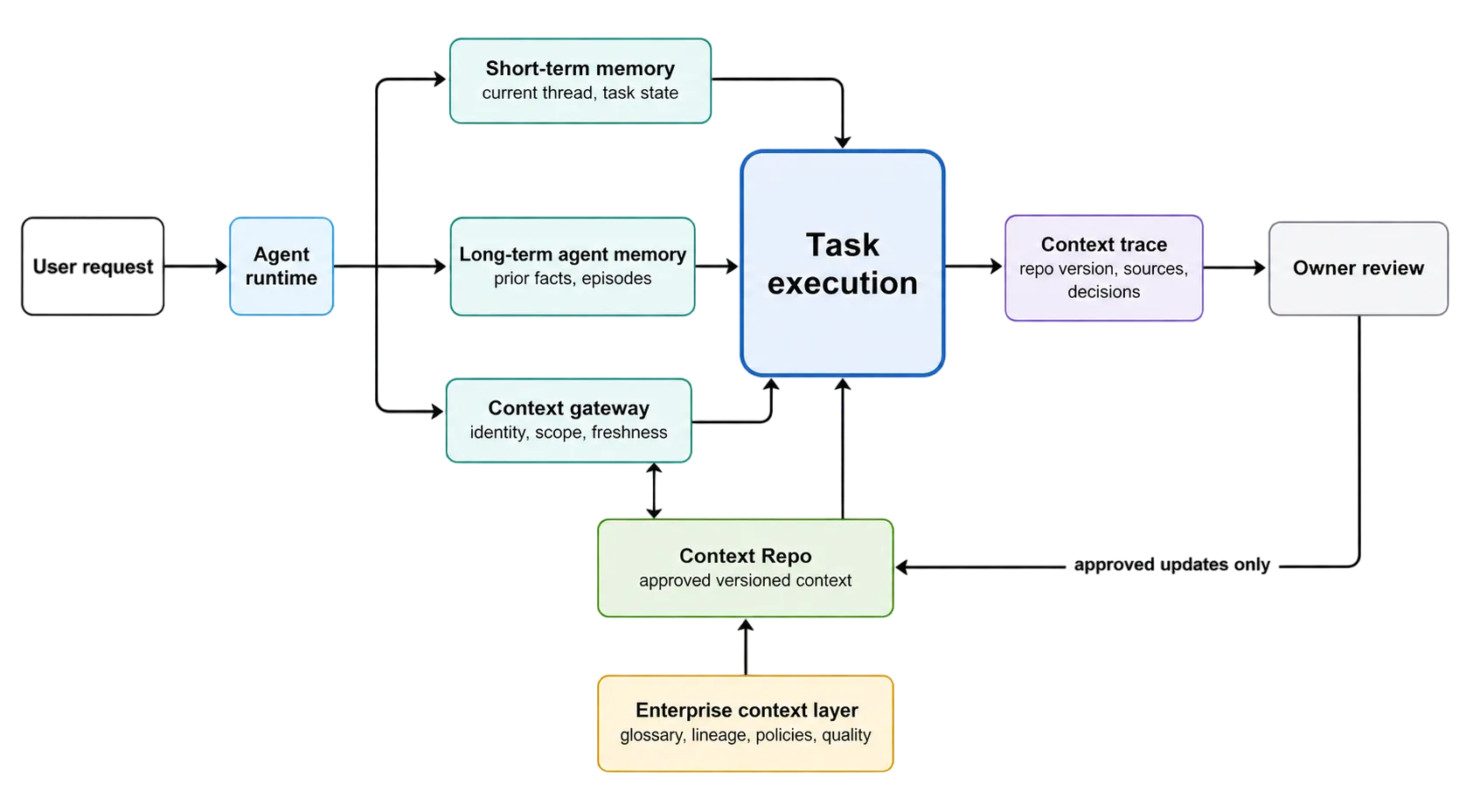
Once these parts are in place, the next question is how the agent actually reaches the governed context layer at runtime. That is where a standard interface matters.
MCP fits naturally into this access layer.
MCP gives AI applications a standard way to connect to external data sources, tools, and workflows. In this pattern, MCP is a delivery path between the agent and the governed context layer.
MCP does not decide which context is approved. That is the job of the enterprise context layer: the shared infrastructure that turns metadata, glossary terms, lineage, governance rules, and institutional knowledge into context that an agent can use at runtime.
For agents, the approved context needs a practical unit of delivery. That unit is the Context Repo: a versioned package of domain context that the gateway can serve, trace, and update over time.
For data leaders evaluating where to start
Atlan's CIO guide to context graphs walks through a practical four-layer architecture from metadata foundation to agent orchestration.
Get the CIO GuideWhat does a Context Repo contain?
A Context Repo is a versioned package of approved context for a domain, agent, or workflow.
Think of it as GitHub for an enterprise context. Not a literal code repository, but a reviewable unit with owners, versions, change history, tests, and promotion rules.
A practical Context Repo contains several context types:
| Component | What it gives the agent |
|---|---|
| Business definitions | Canonical terms from a business glossary |
| Semantic model | Metrics, dimensions, joins, filters, synonyms, and exceptions |
| Trusted assets | Certified tables, dashboards, documents, contracts, and data products |
| Lineage and provenance | Source paths, transformations, ownership, and data lineage |
| Policy rules | Access, privacy, approval, retention, and purpose limits |
| Quality and freshness | Certification, review dates, quality warnings, and active metadata signals |
| Evals | Golden questions, expected answers, policy tests, and regression checks |
| Trace requirements | Context version, source IDs, and policy decisions behind every agent run must be recorded |
The repo is broader than a semantic layer. A semantic layer standardizes metric logic. A Context Repo can include that logic, but it also carries policy, lineage, quality, skills, evals, and feedback loops.
This is what makes long-term context portable. Instead of rebuilding the same definitions, policies, and source rules in every agent tool, teams maintain a single approved context package. Different agents can use that package through the gateway. Each answer still records the version, sources, and policy decisions behind it.
How can agents persist context across workflows?
Context persistence across workflows works when context access and context updates share the same contract.
The agent does not directly write a durable context. It asks for an approved context package, records which version it used, and sends any proposed updates into a review path.
Here is a simplified example using the customer onboarding workflow from earlier:
from dataclasses import dataclass
from typing import Any

@dataclass
class ContextRequest:
    domain: str
    task: str
    workflow_id: str
    agent_role: str
    user_id: str

@dataclass
class ContextPackage:
    repo_id: str
    version: str
    context_ids: list[str]
    definitions: dict[str, str]
    policies: list[str]
    trusted_sources: list[str]

class ContextGateway:
    def fetch(self, request: ContextRequest) -> ContextPackage:
        """Return the smallest approved context package for this role and task."""
        return ContextPackage(
            repo_id="customer-onboarding-context",
            version="2026.06.18",
            context_ids=["package-def-enterprise", "security-review-policy"],
            definitions={"enterprise_package": "Current enterprise onboarding package"},
            policies=["security_review_required_for_enterprise_package"],
            trusted_sources=["product_catalog", "security_review_playbook"],
        )

    def record_trace(
        self,
        request: ContextRequest,
        package: ContextPackage,
        output: dict[str, Any],
    ) -> str:
        """Persist the evidence trail behind the agent answer."""
        trace = {
            "workflow_id": request.workflow_id,
            "agent_role": request.agent_role,
            "context_repo": package.repo_id,
            "context_version": package.version,
            "context_ids": package.context_ids,
            "trusted_sources": package.trusted_sources,
            "policy_decisions": output["policy_decisions"],
            "answer_id": output["answer_id"],
        }
        return save_trace(trace)

    def propose_update(
        self,
        package: ContextPackage,
        trace_id: str,
        suggestion: dict[str, Any],
    ) -> None:
        """Route context improvements to domain owners before promotion."""
        create_review_ticket(
            repo_id=package.repo_id,
            base_version=package.version,
            evidence_trace_id=trace_id,
            proposed_change=suggestion,
            required_approver="customer-onboarding-owner",
        )

request = ContextRequest(
    domain="customer_onboarding",
    task="prepare_enterprise_onboarding_plan",
    workflow_id="onboarding-4829",
    agent_role="onboarding_planner",
    user_id="u_123",
)

gateway = ContextGateway()
package = gateway.fetch(request)

trace_id = gateway.record_trace(
    request=request,
    package=package,
    output={
        "answer_id": "ans_789",
        "policy_decisions": ["security_review_required"],
    },
)

gateway.propose_update(
    package=package,
    trace_id=trace_id,
    suggestion={
        "type": "ownership_change",
        "context_id": "implementation-owner",
        "current_value": "solutions_team",
        "suggested_value": "customer_success_team",
        "reason": "Recent onboarding workflows route enterprise implementation to customer success.",
    },
)
This example is intentionally plain. The storage backend can be a context graph, catalog, vector index, semantic layer, database, or file format. The principle matters more than the syntax:
-
Fetch approved context by domain, task, workflow, role, and identity.
-
Return a versioned package, not loose chunks.
-
Record the context version, context IDs, trusted sources, and policy decisions behind the answer.
-
Route durable updates through owner review with the trace as evidence.
In this case, the proposed update is an ownership change: recent onboarding workflows suggest that enterprise implementation now belongs to customer success rather than the solutions team. The agent can propose that change, but the Context Repo only changes after the customer onboarding owner reviews it.
That is the persistence pattern enterprises need. Agents can surface what appears to have changed, but the shared context layer changes only after review.
How should teams govern long-term context?
Long-term context governance should start with change.
The question is not only “how do we build the first context package?” It is “what happens when the business changes after that package is already feeding agents?”
A practical governance loop should answer seven questions:
-
What changed? A definition, policy, source system, owner, quality signal, or workflow pattern changed.
-
What does it conflict with? The new signal is compared with existing glossary terms, semantic logic, policies, and repo versions.
-
Which agents are affected? Teams identify which workflows, roles, and context packages use the changed context.
-
What should be tested? Golden questions, policy checks, and regression tests run against the proposed version.
-
Who must approve it? Domain owners, governance teams, or data stewards review the change before it becomes durable context.
-
What version gets published? Approved changes create a new Context Repo version with owner, timestamp, source, and reason.
-
What stays available for audit? Older versions, traces, and approval history remain available for replay, review, or rollback.
This aligns with broader AI governance expectations. NIST’s AI Risk Management Framework frames AI risk management across design, development, use, and evaluation. The EU AI Act, Regulation (EU) 2024/1689, is a binding 2024 EU regulation, and its stricter data-governance requirements for high-risk AI systems become applicable in August 2026.
For agent context, the practical implication is direct: teams need evidence of what changed, who approved the new version, which agents used it, and whether the older version can still be explained later.
How does Atlan support long-term context management?
Atlan supports long-term context management by making business-context changes visible, reviewable, and usable by agents.
The foundation is Atlan’s Enterprise Data Graph: a connected map of assets, glossary terms, lineage, owners, policies, quality signals, usage patterns, and agent traces. When a definition changes, a source gets deprecated, or ownership moves, those signals can become part of the context layer instead of staying buried in separate tools.
For long-term context, the important workflow is not just build and deploy. It is detect, review, version, serve, and improve.
Detect change: Active metadata surfaces changes in schemas, ownership, quality, usage, and certification status.
Review impact: Context Engineering Studio gives teams a workspace to test whether a change affects the agents, questions, and policies tied to a Context Repo.
Version context: Context Repos preserve approved definitions, policies, source rules, and change history as versioned context packages.
Serve approved context: The Atlan MCP Server gives agents a governed way to retrieve the current approved version at runtime.
Keep evidence: AI governance workflows, traces, and approvals show what context an agent used and who approved the update.
Together, these capabilities turn long-term context into a managed system that agents can rely on as the business changes.
Book a demo to see how Atlan helps teams build, test, and deliver governed long-term context for enterprise AI agents.
Context outlives the conversation
Long-term context management gives agents something memory alone can’t: a way to know which business context is current, which assumptions have changed, and which source to trust.
That requires more than a memory store. It requires governed context packages, version history, traces, review workflows, and a runtime path for agents to access approved context while working.
The goal is simple: agents should not carry business context forward blindly. They should carry it forward with evidence, approval, and a clear record of what changed.
FAQs about long-term context management for AI agents
1. Is long-term context the same as long-term memory?
No. Long-term memory usually refers to information an agent stores across sessions, such as user facts, prior actions, or reusable instructions. Long-term context refers to approved organizational knowledge, including definitions, lineage, policies, semantic models, and ownership. Memory helps the agent remember. Context tells the agent what is true enough to use.
2. Does every agent need its own Context Repo?
Not always. Context Repos work best when they are scoped by domain or workflow, not by every individual agent. Several agents can use the same revenue repo if they need the same approved definitions and policy rules. A separate repo makes sense when the ownership, data boundary, or approval workflow changes.
3. Can vector databases manage long-term context by themselves?
No. Vector databases can store and retrieve similar content, which is useful for memory and retrieval augmented generation. They do not automatically certify definitions, enforce policy, resolve metric conflicts, or record who approved a context version. Long-term context needs storage plus governance, provenance, freshness, and lifecycle controls.
4. Who owns long-term context management?
Ownership is shared. AI platform teams usually operate the runtime and context gateway. Data platform teams manage metadata, lineage, and trusted assets. Domain owners approve definitions and semantic logic. Governance teams define policy, access, and audit requirements. The best operating model makes those responsibilities explicit inside the repo lifecycle.
5. How often should long-term context be updated?
Long-term context should update whenever the business context changes, not on a fixed quarterly schedule. Schema changes, glossary edits, policy updates, data quality incidents, and failed agent traces should all trigger review. The key is not constant automatic rewriting. The key is fast proposal, human approval, and versioned promotion.
Sources
- LangChain. “Memory overview.” https://docs.langchain.com/oss/python/concepts/memory
- Chhikara, P. et al. “Mem0: Building Production-Ready AI Agents with Scalable Long-Term Memory.” 2025. https://arxiv.org/abs/2504.19413
- “Memora: A Long-Term Memory Benchmark for AI Agents.” 2026. https://arxiv.org/abs/2604.20006
- Model Context Protocol. “Getting started.” https://modelcontextprotocol.io/docs/getting-started/intro
- NIST. “AI Risk Management Framework.” https://www.nist.gov/itl/ai-risk-management-framework
- European Union. “Regulation (EU) 2024/1689 (EU AI Act).” 2024. https://eur-lex.europa.eu/eli/reg/2024/1689/oj/eng
