

A vector database retrieves whatever looks similar to a query. It does not decide whether that content is trustworthy, current, or allowed. In Diffbot’s KG-LM Accuracy Benchmark, relayed by FalkorDB (Diffbot, 2023; via FalkorDB, 2025), LLM answers grounded in a knowledge graph reached 56.2% accuracy across 43 business questions, against 16.7% ungrounded. That gap is why a governed context layer exists on top of retrieval. Below: how the two differ head-to-head, how they work together, and where a context graph and memory fit inside the same governed system.

Two existing comparisons already cover pieces of this question: context graph vs. vector database, and agent memory vs. vector database. This page answers the fuller version: how the whole context layer, graph, memory, and policy rules together compare to a vector database standing alone. Short answer: a vector database is one governed component inside a context layer.
| Dimension | Context Layer | Vector Database |
|---|---|---|
| What it is | The governed system deciding what gets embedded, connected, and delivered to agents | A database that stores and retrieves content by embedding similarity |
| Best for | Multi-agent, multi-platform deployments with compliance requirements | Single-session document Q&A, support search, code search |
| Questions it answers | What’s trusted, current, connected, and allowed? | What’s similar to this query? |
What’s the difference between a context layer and a vector database?
A vector database’s job stops at retrieval: embed the content, then return whatever is closest by similarity. A context layer’s job starts a step earlier. It decides what’s worth embedding, tracks where content came from, catches stale entries, and checks whether the requesting agent is allowed to see the result. The vector database answers “what’s similar.” The context layer answers “what’s trusted, current, and allowed.”
This isn’t a new claim. SurrealDB, a database vendor with no stake in the “context layer” term, argued in 2026 that a production context layer combines vector search, graph traversal, structured queries, and recency signals, the same superset framing used here. The term is contested: Glean uses it too, so the claim is architectural, not a trademark dispute. Confusion persists because a vector database is often the first, and sometimes only, piece an early AI project builds; LangChain and Reddit’s r/AI_Agents threads have reached the same conclusion: vector-only retrieval isn’t enough once an agent needs to reason across systems or sessions.
This page is not Context Graph vs. Vector Database, which compares the vector database to one component. This page compares it to the full governed system, the same superset argument Context Layer vs Semantic Layer makes for a narrower concept. Vector databases aren’t going away; the question is whether one sits inside a governed context layer or stands alone.
Get the CIO's Guide to Context Graphs
See how the governed layer above your vector database turns similarity search into decisions your agents can actually act on.
Get the GuideWhat is a vector database?
A vector database converts content into embeddings, numerical representations of meaning, and retrieves the most similar matches through approximate nearest-neighbor (ANN) search. An agent embeds its query, the database returns the K closest vectors by cosine similarity, and the agent uses those chunks as grounding. This is the retrieval mechanism behind most retrieval-augmented generation (RAG) pipelines in production, and the RAG architecture most teams start with.
The category is growing because it solves a real problem cheaply. Per MarketsandMarkets (2025), the RAG market reached $1.94 billion in 2025, projected to hit $9.86 billion by 2030, tracking the underlying vector database market as more teams adopt embeddings-based retrieval as the default grounding layer for the AI agents they’re shipping.
Vector databases aren’t standing still. Per a May 2026 market scan, LanceDB has started adding read-freshness headers directly into its index, a feature addition to a retrieval primitive, not a governance system: freshness headers tell an agent when a vector was last updated, not whether the fact is still true, who owns it, or whether policy allows its use. Advanced RAG techniques like hybrid RAG narrow that gap further, but they extend the retrieval layer, they don’t govern it.
Core components of a vector database
- Embeddings: numerical vector representations of text, code, or other content
- Similarity or ANN search: approximate nearest-neighbor retrieval, typically via cosine similarity
- Indexing layer: HNSW or IVF-style structures that make similarity search fast at scale
- Metadata filters: basic attribute filters (team, timestamp, document type) bolted onto vector results
- Freshness controls: an emerging feature, LanceDB’s read-freshness headers among the first
What is a context layer?
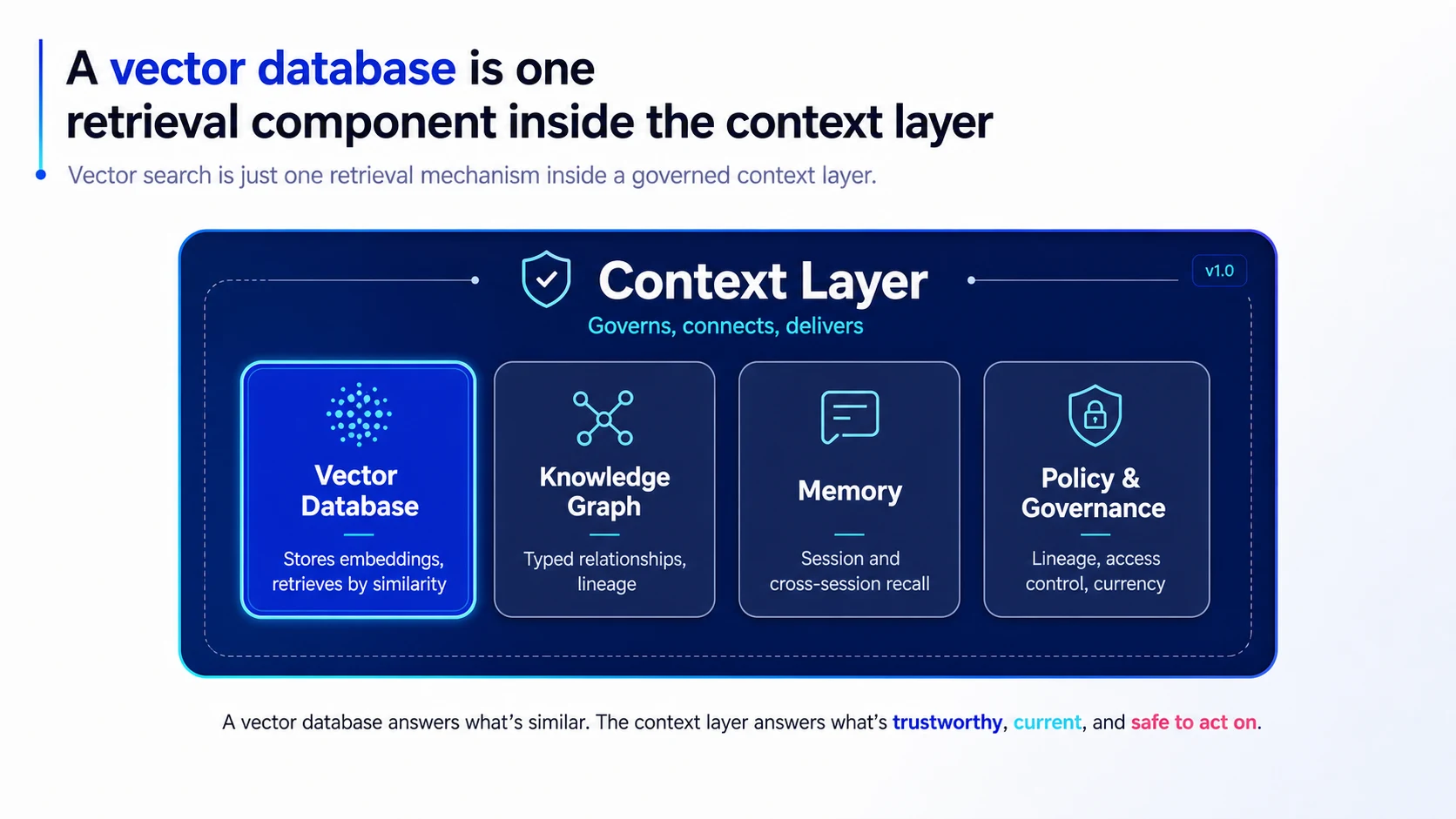
A context layer is the governed system that decides what gets embedded or indexed, binds it to lineage and business meaning, keeps it current as source systems change, and enforces policy context the moment an agent asks for it, delivering that context to every agent across every platform.
This matters because the accuracy gap most teams hit isn’t a model problem. Per a Gartner press release (May 2026), organizations that prioritize semantics in AI-ready data could see agentic AI accuracy rise up to 80% and costs fall up to 60% by 2027. Rita Sallam, Distinguished VP Analyst at Gartner: “Agentic AI outcomes depend on context including semantic representations of data… Context with semantic coherence will become a cost-control and trust strategy, not a nice-to-have.”
The runtime delivery mechanism is typically the Model Context Protocol (MCP), a uniform interface exposing semantic search, relationship traversal, and policy checks to any agent that asks. A vector database returns ranked chunks; a context layer’s MCP Server returns governed context plus policy and provenance.
Core components of a context layer
- Context or knowledge graph: typed relationships, lineage, and cross-system entity resolution a flat vector index can’t maintain, built on the same data graph primitive underneath it
- Vector-native search: embeddings and similarity retrieval as one governed component, not excluded or replaced
- Memory: continuity across sessions and agents, covered on its own comparison page
- Policy context: access rules and provenance enforced at the moment of inference, not bolted on after
- Curation layer: keeps inputs trustworthy before anything is ever embedded, upstream of “garbage in, garbage out”

Context layer vs vector database: head-to-head comparison
The sharpest differences show up in ownership, governance enforcement, and what happens when a query needs more than similarity. A vector database excels at fast recall across unstructured content; a context layer excels at deciding whether that recall is trustworthy, current, and allowed. Both hold genuine strengths: a vector database’s low latency, mature tooling, and simplicity for single-corpus use cases are real advantages, not weaknesses to talk around.
That governance gap shows up directly in accuracy. In Diffbot’s KG-LM Accuracy Benchmark, relayed by FalkorDB (Diffbot, 2023; via FalkorDB, 2025), LLM answers grounded in a knowledge graph reached 56.2% accuracy across 43 business questions against 16.7% ungrounded, and traditional vector RAG scored 0% in two of the four question categories, Metrics & KPIs and Strategic Planning. Note what that test measured: LLM accuracy with and without graph grounding in general, not any one product. Diffbot sells a knowledge graph, so read it as one knowledge-graph vendor’s evidence for the value of knowledge graphs rather than as an independent evaluation. The direction it points is the same one GraphRAG exists to exploit. Emma McGrattan, CTO at Actian, draws the same line from outside the data-catalog space: “Vector databases solve semantic retrieval. They don’t solve governance, context, data quality, deployment architecture or operational resilience.”
| Dimension | Context Layer | Vector Database |
|---|---|---|
| Enforces | Lineage, business meaning, policy, currency | Vector distance (cosine similarity) |
| Multi-hop relationships | Native, via the context/knowledge graph | Structurally limited; flat embedding space |
| Freshness/currency | A governed property | Improving at some vendors (e.g., LanceDB) but not systemic |
| Cross-platform reuse | One governed layer serves every agent platform (a precise “N systems, one governed layer” figure is pending Product/CS confirmation; qualitative framing used until confirmed) | Each platform rebuilds its own index |
| Failure mode | Incomplete coverage if curation lags | Confident but wrong answers from stale vectors |
| Maturity | Newer, converging vendor language | Mature, well-understood scaling patterns |
A common pattern: a team builds an agent directly on a vector store. Early results look good, accuracy lands around 80% on straightforward queries. Then queries start requiring multi-hop reasoning or trust signals the index was never designed to carry, and the setup starts returning confident, wrong answers. The fix is additive, not a rebuild: keep the vector store, add ownership signals, a domain ontology, and hybrid ranking. The question isn’t vector database or context layer, it’s whether the vector database already in place is governed, or standing alone.
Assess Your Context Maturity
Find out whether your vector database sits inside a governed context layer, or stands alone, in about five minutes.
Take the AssessmentHow do a context layer and a vector database work together?
A context layer and a vector database aren’t competing architectures. In production, they operate at different layers of the same stack.
Hybrid retrieval: vector search plus graph ranking
Vector similarity and graph traversal combine into one ranked result. The vector database contributes fast semantic similarity; the context graph adds ownership signals, domain ontology, and structured relevance, the pattern behind the “80% accuracy on vector-alone, then a wall” scenario. A governed layer moves past that ceiling without replacing the store underneath it.
Cross-platform context reuse
A single governed context layer can serve Copilot, Databricks, Snowflake Cortex, and other agent platforms at once. What doesn’t travel across those platforms is the meaning behind the index: the shared glossary, catalog, and policy context telling any of them what a result means and who can use it. (A specific “N systems, one governed layer” figure is pending Product/CS confirmation.)
Temporal and multi-source reasoning
A temporal knowledge graph sits alongside the vector index for time-aware, multi-hop queries a similarity score can’t answer, “what was this dataset’s certification status on a given date.” Per arXiv 2501.13956 (Zep/Graphiti, 2025), a temporal knowledge-graph architecture achieves an 18.5% accuracy improvement on LongMemEval tasks, with a 90% reduction in response latency.
When to prioritize one over the other
Start with a vector database alone for single-session document Q&A, support search, or code search. Start with a context layer when multiple agents or platforms share context, or compliance requirements govern retrieval. Invest in both on any greenfield build spanning more than one surface.
The winning stack isn’t the fastest vector search; it’s the one where every agent draws from the same governed source.
See Atlan in Action: Live Context Layer Demos
Watch how a governed context layer adds lineage, memory, and policy context on top of the vector search you already run.
Watch a Live DemoHow Atlan approaches the context layer and vector database
Most production agentic AI failures trace back to one root cause: context rebuilt from scratch, per agent, per platform, with no shared governed layer underneath. That’s expensive: per McKinsey’s State of AI research, 60% of enterprise AI budgets go to data preparation, not model training. A vector database alone can’t prevent that repeated work; it answers similarity queries, not what’s reusable.
Atlan is the context layer for AI. Its Context Lakehouse pairs Iceberg-native storage with a knowledge graph and vector-native search in one system, so vector search stays native, not replaced. Its Enterprise Data Graph supplies typed relationships, lineage, and entity resolution across 108 connectors, the structure a vector index can’t maintain alone. Context Agents bootstrap that graph upstream of the embedding pipeline. An MCP Server delivers semantic search, lineage, and policy checks as one uniform interface across Claude, ChatGPT, Gemini, Cursor, and Copilot Studio.
Real stories from real customers: governing what the vector database can’t
"We're excited to build the future of AI governance with Atlan. All of the work that we did to get to a shared language at Workday can be leveraged by AI via Atlan's MCP server…as part of Atlan's AI Labs, we're co-building the semantic layer that AI needs with new constructs, like context products."
— Joe DosSantos, VP of Enterprise Data & Analytics, Workday

"Atlan is much more than a catalog of catalogs. It's more of a context operating system…Atlan enabled us to easily activate metadata for everything from discovery in the marketplace to AI governance to data quality to an MCP server delivering context to AI models."
— Sridher Arumugham, Chief Data & Analytics Officer, DigiKey

Why a governed context layer decides whether your vector database is enough
One is a retrieval primitive: similarity search over embedded content. The other decides what that primitive is allowed to retrieve, how current it stays, and who’s permitted to see it. Neither replaces the other. The real question was never vector database or context layer. It’s whether the vector database already running in production sits inside a governed context layer, or stands alone, answering similarity queries with no lineage, no policy check, and no way to tell an agent when an answer has gone stale.
As agentic AI spans more platforms per enterprise, Copilot here, Databricks there, a custom agent somewhere else, ungoverned, per-platform retrieval becomes the bottleneck, not the vector index. Readers starting from scratch can see what a context layer for AI agents actually requires; teams further along can compare it against the RAG or knowledge base setups they may already run. The vector index was never the constraint; the governance around it was.
FAQs about context layer vs vector database
1. What is the main difference between a context layer and a vector database?
A vector database stores embeddings and retrieves matches by similarity. A context layer is the governed system deciding what gets embedded, binding it to lineage and business meaning, keeping it current, and enforcing policy the moment an agent asks for it. One is a retrieval mechanism, the other is the governance around it.
2. Is a vector database part of a context layer, or a replacement for one?
A vector database is a component inside a context layer, not a replacement for it. Vector-native search sits alongside a context graph, memory, and policy enforcement as governed pieces of the same system.
3. What does a context layer add that a vector database doesn’t have?
A context layer adds lineage, business meaning, policy enforcement at inference time, and currency guarantees a similarity index has no native mechanism to provide. It also adds cross-platform reuse: one governed layer serving every agent instead of each platform rebuilding retrieval from scratch.
4. What is the difference between a context layer, a context graph, and a vector database?
A vector database retrieves by embedding similarity. A context graph is one governed component inside a context layer, modeling typed relationships, lineage, and entity resolution. A context layer is the full governed system containing both, plus memory and policy enforcement, as named components.
Sources
- Why Vector Databases Won’t Solve Your Enterprise AI Problem, Forbes Technology Council. https://www.forbes.com/councils/forbestechcouncil/2026/07/16/why-vector-databases-wont-solve-your-enterprise-ai-problem/
- Gartner Says Lack of Semantics Causes Inaccurate AI Agents and Wasted Spending, Gartner Newsroom. https://www.gartner.com/en/newsroom/press-releases/2026-05-11-gartner-says-lack-of-semantics-causes-inaccurate-artificial-intelligence-agents-and-wasted-spending
- KG-LM Accuracy Benchmark, Diffbot (2023), relayed by FalkorDB, 2025-04-07. https://www.falkordb.com/blog/graphrag-accuracy-diffbot-falkordb/
- Zep/Graphiti Temporal Knowledge Graph, arXiv 2501.13956. https://arxiv.org/abs/2501.13956
- RAG Market 2025-2030, MarketsandMarkets. https://www.marketsandmarkets.com/Market-Reports/retrieval-augmented-generation-rag-market-135976317.html
- Context Layers, Semantic Layers, and Knowledge Graphs, SurrealDB. https://surrealdb.com/blog/context-layers-semantic-layers-and-knowledge-graphs-the-modern-data-architecture-for-ai
- Knowledge Graph vs Vector Database: How to Choose Your Retrieval Architecture, Glean. https://www.glean.com/blog/knowledge-graph-vs-vector-database
- McKinsey State of AI. https://www.mckinsey.com/capabilities/quantumblack/our-insights/the-state-of-ai
