

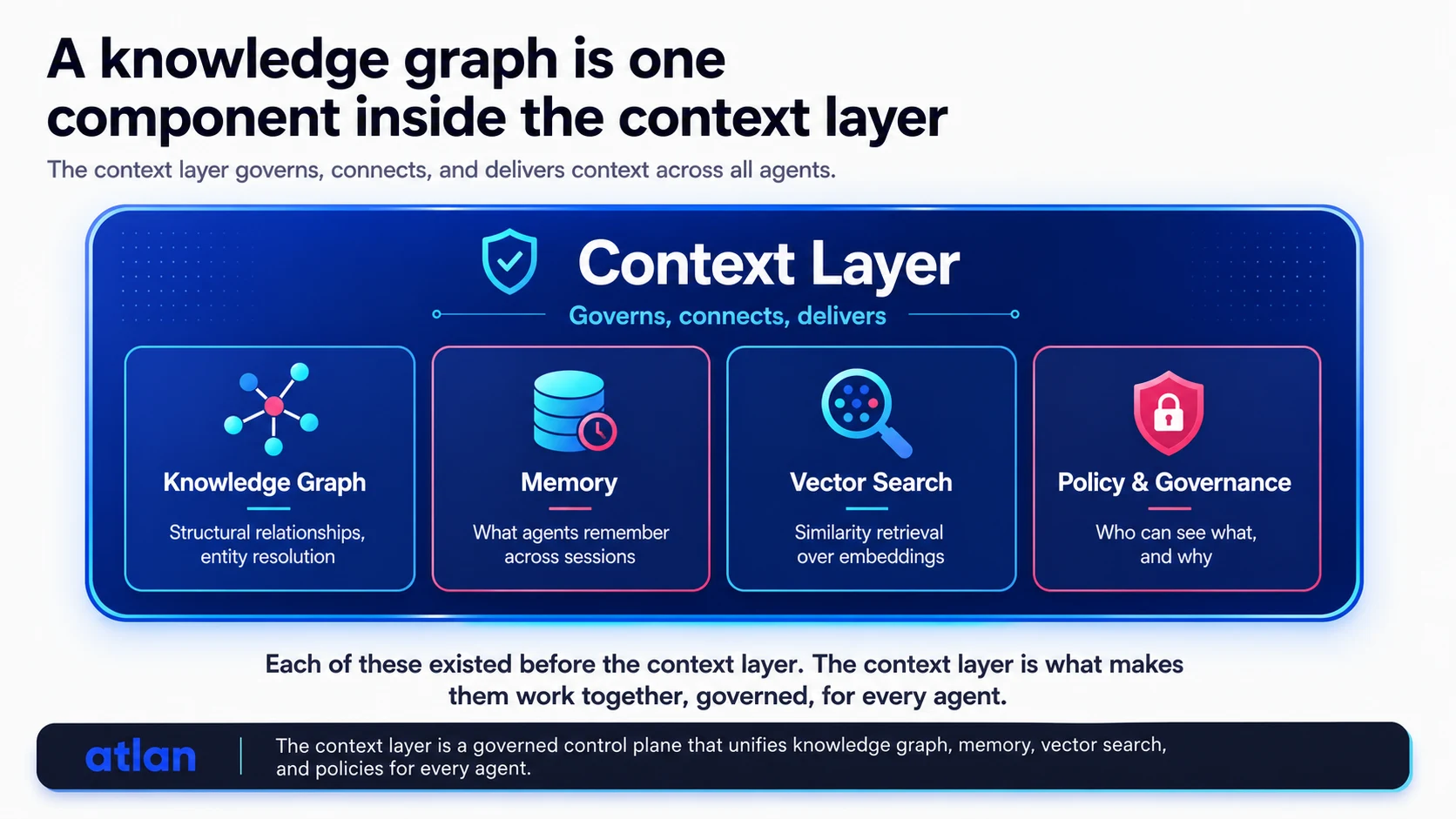
A knowledge graph models entities and relationships, the structural substrate of what connects to what. A context layer is the governed system around it: mining, lifecycle, activation, governance, and compounding learning that turn that graph into runtime-ready context for AI agents. Atlan names the graph as one of three Core Foundation parts inside the layer, not a rival, and a graph fed once and left alone risks going stale unnoticed. Most vendor content compares graph to graph; almost none asks whether the graph is a rival system, or one governed part of something larger, the gap this page fills.

Quick comparison: context layer vs. knowledge graph
| Dimension | Knowledge graph | Context layer |
|---|---|---|
| What it is | Entities, relationships, and (with an ontology) their meaning | Mining, lifecycle, activation, governance, compounding learning |
| What it answers | What connects to what | Is this current, approved, safe to act on now |
| Who owns it | Architects, ontologists, knowledge engineers | Platform, AI, and governance teams |
| Scope | Single domain, stable schema | Cross-domain, cross-agent runtime |
| Update cadence | Periodic modeling cycles | Continuous mining and re-activation |
| Delivery | Graph queries (Cypher, SPARQL) | MCP and APIs, any agent |
See the full definition of a knowledge graph
Get the base definition: entities, relationships, and where ontology fits.
Get the CIO Context GuideContext layer vs knowledge graph: what’s the difference?
The difference comes down to scope. A knowledge graph is one structural component; a context layer is the operating system that mines, governs, and activates that structure for every agent that needs it. A graph is typically a bounded project with an end date; a layer is a standing system, since source data keeps changing.
Vendors keep drawing new lines between semantic layer, ontology, knowledge graph, and context graph, often framed as a “scope and grounding” distinction: world-model versus organization-model, a contrast that still stays graph to graph. Buyers with real prior investment in ontology and knowledge-graph thinking reasonably ask whether a new term relabels what they already built. The closest live comparison is context graph vs. knowledge graph, which stays graph to graph; this page asks the same question one level up.
What is a knowledge graph?
A knowledge graph represents entities (nodes) and relationships (edges) as a traversable structure, often layered with an ontology giving those relationships formal meaning. It increasingly feeds GraphRAG pipelines that ground retrieval in structure, a case made in combining knowledge graphs with LLMs.
Knowledge graphs draw more attention now because LLMs and agents need structured grounding beyond flat text retrieval. According to MarketsandMarkets (2026), the market is projected to grow from $1.90 billion in 2026 to $9.88 billion by 2032, a 31.6 percent CAGR. Andreas Blumauer, SVP of Growth at Graphwise, frames the category as an evolution, describing a context graph as a knowledge graph extended with operational metadata (Graphwise, 2026), one graph type maturing into another, not the layer-level question this page answers.
Core components of a knowledge graph
- Entities, relationships, and ontology: customers, products, contracts; connections like “owns,” “depends on”; rules defining what’s valid
- Inference and query: logic deriving new facts, such as transitive ownership, via Cypher, SPARQL, or a custom agent context graph API
A knowledge graph answers “what connects to what” with precision; it doesn’t, alone, answer whether that connection is current or approved for an agent to act on today. See what is a data graph and how to build a knowledge graph for AI agents for the primitive and construction steps.
What is a context layer?
A context layer is the governed operating system, mining, lifecycle, activation, governance, and compounding learning, that keeps a knowledge graph current and delivers the right context to every agent at decision time, adding the temporal and decision awareness a graph alone lacks: what changed, who approved it, where it can flow.
Vendors describe the same idea as an “AI-optimized knowledge base,” a “context graph,” or a “company brain.” Atlan co-founder Prukalpa frames the shift in “The Context Layer: Knowledge Graph’s Second Act”: the graph doesn’t disappear, it becomes the substrate a governed layer operates on top of (LinkedIn, 2026). What’s settled is that the graph is a named Core Foundation part inside the layer’s five capabilities, not a peer, the same logic applying in data catalog vs. context layer.
Core components of a context layer
- AI-Ready Data and Knowledge Graph: the structural substrate
- Semantics and Ontology: formal meaning layered on the graph’s structure
- Skills: governed capabilities agents can invoke against that structure
- Mining, activation, and governance: extracting context from lineage, usage, and source systems through a build, test, review, approve, deploy, learn loop
- Delivery interfaces: MCP and APIs exposing governed context to any agent
A context layer without a knowledge graph has nothing concrete to mine or activate. Base definitions: what is a context layer and what an enterprise context layer actually is. Atlan’s own implementation is documented in what is enterprise data graph.
Context layer vs knowledge graph: head-to-head comparison
The sharpest differences are summarized in the table above. The same graph-versus-layer pattern shows up in adjacent comparisons, including context graph vs. vector database and vector database vs. knowledge graph for agent memory.
Example: the buyer who already has a graph. An enterprise data team with a knowledge graph already built often asks: does this replace what we built? It doesn’t. The existing graph becomes a governed, continuously mined Core Foundation part, an input the layer extends. See knowledge graph vs. graph database for the deeper distinction between a graph and the database it runs on.
Is a context layer just a rebranded knowledge graph?
Two credible voices argue this page’s superset claim is wrong: one says the knowledge graph already is the context layer, the other says “context layer” is marketing for work that already has a name.
Paige Leidig, Chief Marketing Officer at TigerGraph, argues the knowledge graph is the context layer itself: “A knowledge graph fills that gap, providing the structural context and logic that ties the signals together… A model predicts and approximates, and the knowledge graph explains and validates” (TigerGraph, 2025). Where it holds: a well-built graph genuinely provides the explanatory, validating context an LLM lacks alone. Where it stops short: it doesn’t say who approved a relationship or how five agents get the same governed answer at once, the gap a context layer closes.
A sharper challenge comes from outside the vendor world. Julius Hollmann, writing on Medium in “Context Graphs or Just Better Knowledge Graphs? A Reality Check,” argues that “‘Context Graph’ is a solution in search of a problem that already has a name: data and process discipline” (Medium, 2026), prescribing one disciplined, top-down graph over what he calls an emergent, bottom-up layer that is “noisy, unreliable, and ungovernable.” Where it holds: the real work in both camps is the same discipline to capture and maintain decisions, not new graph technology.
The skeptic is right that discipline is the real work, but it doesn’t solve runtime activation, multi-agent delivery over MCP, or decision-history awareness. A disciplined graph still needs an operating system to keep it fed and serve every agent, which is why the context layer wraps a disciplined graph rather than replacing the need for discipline. See context graph vs. ontology for the adjacent comparison.
How does a knowledge graph fit inside a context layer?
The graph is one governed input to the layer, not a competing investment. Its entities, relationships, and ontology become the substrate the layer’s mining and activation continuously refresh with lineage, ownership, and quality signals, staying current instead of degrading into “built once, never fed again.” A graph alone requires each agent to query it directly with no shared governance; a context layer exposes it through MCP and APIs, with access policy and decision history attached, the same problem an enterprise memory layer solves for what agents remember.
When a graph alone is enough: a single, bounded domain with a stable schema, one team owning the model, and a human reviewing queries before decisions.
When the full layer is needed, or both together: multiple agents querying the same estate, multiple domains needing to stay in sync, and runtime governance a static graph can’t answer alone, per knowledge graphs vs. RAG and AI memory vs. RAG vs. knowledge graph. Invest in both for a greenfield multi-agent deployment where governance is day one, or an existing graph investment extending into a governed, agent-facing system, per agent context layer vs. RAG.
Assess your own context maturity
See where your knowledge graph ends and a governed context layer begins.
Take the AssessmentHow Atlan approaches knowledge graphs and the context layer
Atlan treats the knowledge graph as a governed, continuously mined Core Foundation part of the context layer, not a project with an expiration date.
Atlan’s Context Lakehouse combines the knowledge graph with Iceberg storage and vector-native search in one governed system: both, not graph versus vector. Context Agents such as Orion mine graph structure continuously from lineage, SQL, and usage, through the Context Engineering Studio’s build, test, review, approve, deploy, learn lifecycle.
No public case study yet shows a customer replacing a standalone graph with Atlan’s context layer, but buyers arrive with ontology thinking already in place, a valuable input, not a governance substitute, per the context layer for AI and why AI agents need an enterprise context layer.
Atlan in Action: Live Context Layer Demos
Watch how Atlan mines, governs, and activates a knowledge graph inside a full context layer.
Watch a Live DemoReal stories from real customers: knowledge graphs as one governed input
"We're excited to build the future of AI governance with Atlan. All of the work that we did to get to a shared language at Workday can be leveraged by AI via Atlan's MCP server...as part of Atlan's AI Labs, we're co-building the semantic layer that AI needs with new constructs, like context products."
— Joe DosSantos, VP of Enterprise Data & Analytics, Workday

"Atlan is much more than a catalog of catalogs. It's more of a context operating system…Atlan enabled us to easily activate metadata for everything from discovery in the marketplace to AI governance to data quality to an MCP server delivering context to AI models."
— Sridher Arumugham, Chief Data & Analytics Officer, DigiKey

Why the knowledge graph is a part, not a peer, of the context layer
The “context layer vs. knowledge graph” question is not a rivalry, it is a scope question, and both the TigerGraph view and the Medium skeptic’s critique get half of it right.
What both miss is that discipline alone doesn’t activate a graph for every agent, track who approved what, or keep mining it as source systems change. That’s the operating system Atlan calls the context layer. Organizations that treat the graph as an input to govern, not a project to finish, are the ones whose agents still trust it a year from now, the lesson the enterprise context layer research points to, and why a unified context layer treats the graph as one governed part among several.
For teams past the definitional question, how to implement an enterprise context layer for AI covers the build sequence, and what is context engineering covers the discipline that runs on top. The same exercise repeats one layer over in memory layer vs. context layer, if the next question is what an agent remembers rather than what it knows.
FAQs about context layer vs knowledge graph
1. Is a context layer the same thing as a knowledge graph?
No. A knowledge graph is a structure: entities and relationships. A context layer is the governed system around it, with capabilities including mining, activation, and governance that keep that structure current and deliver it to AI agents. The knowledge graph is one component inside the context layer, not the whole system.
2. What is the difference between a context layer, a context graph, and a knowledge graph?
A knowledge graph models entities and relationships as a world-model. A context graph, per most industry framing, is an operationalized knowledge graph scoped to one organization. A context layer is broader still: the operating system that makes either graph type current and deliverable to agents at runtime, not just queryable.
3. Does a context layer replace my existing knowledge graph?
No, it extends it. A context layer treats an existing knowledge graph as one of three named Core Foundation parts, continuously mining and activating it rather than discarding it. Prior ontology or knowledge-graph investment is kept, and the context layer adds governance and runtime delivery on top.
4. Do I still need a knowledge graph if I have a context layer?
Yes. The context layer is not a substitute for the structural modeling a knowledge graph provides. It is the operating system that keeps that structure current and governed. Without a knowledge graph, a context layer has nothing concrete to mine, activate, or deliver to agents.
5. Is “context layer” just a rebranded knowledge graph?
Partially, and the honest answer matters. One credentialed skeptic argues it is marketing for disciplined knowledge-graph work that already has a name, and process discipline is genuinely the real work. Where the critique misses: a disciplined graph alone still lacks runtime activation, decision history, and multi-agent delivery.
6. What are the three parts of an enterprise context layer’s Core Foundation?
AI-Ready Data and Knowledge Graph, Semantics and Ontology, and Skills. The knowledge graph is the structural substrate, semantics and ontology add formal meaning, and skills are the governed capabilities agents can invoke against both. Five operating capabilities run across all three.
7. When do I need a full context layer instead of just a knowledge graph?
When multiple agents query the same estate, when relationships span multiple domains, or when runtime governance, such as who approved this and is it current, matters and a human cannot review every query first. A single-domain, human-reviewed graph can often run without the full layer.
8. What common mistakes happen when enterprises treat a knowledge graph as their entire context strategy?
The most familiar mistake is modeling the graph once and never feeding it again. Without a continuous mining and governance loop, the graph goes stale, and agents querying it inherit outdated relationships with no signal that the answer should be distrusted.
Sources
- Knowledge Graph Market Worth $9.88 Billion by 2032, MarketsandMarkets, 2026. https://www.marketsandmarkets.com/PressReleases/knowledge-graph.asp
- From Data Exchange to Knowledge Exchange: Why Context Is the Missing Layer in Enterprise AI, Graphwise, 2026. https://graphwise.ai/blog/from-data-exchange-to-knowledge-exchange-why-context-is-the-missing-layer-in-enterprise-ai/
- The Context Layer: Knowledge Graph’s Second Act, Prukalpa Sankar, LinkedIn, 2026. https://www.linkedin.com/pulse/context-layer-knowledge-graphs-second-act-prukalpa--efthe
- Knowledge Graphs as the Missing Context Layer for AI, Paige Leidig, TigerGraph, 2025. https://www.tigergraph.com/blog/knowledge-graphs-as-the-missing-context-layer-for-ai/
- Context Graphs or Just Better Knowledge Graphs? A Reality Check, Julius Hollmann, Medium, 2026. https://medium.com/@juliushollmann/context-graphs-or-just-better-knowledge-graphs-a-reality-check-732e8c7a6af0
