

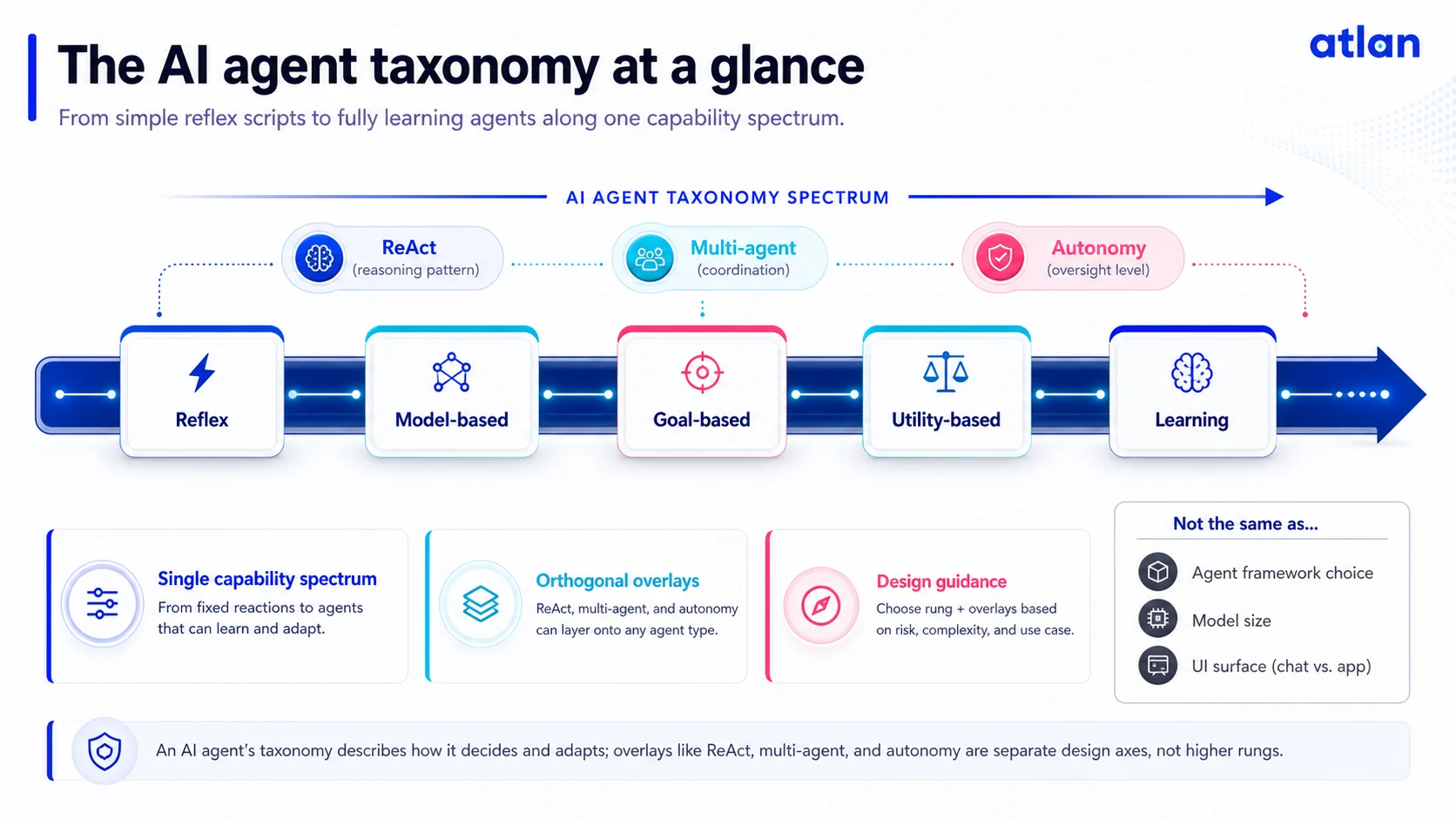
AI agents are typically grouped along two axes: how a system is built to decide, and how it behaves once it coordinates with other agents and operates with less oversight. Atlan, the context layer for AI, gives every point on that spectrum the same governed business definitions to draw on, so the taxonomy below is a map of decision-making styles, not a ranking of sophistication.
- Reflex agents: Rule-based responses to current inputs
- Model-based agents: State-aware decisions using an internal model
- Goal, utility, and learning agents: Planned, optimized, or feedback-driven behavior
- ReAct agents: Iterative reasoning, action, and observation
- Multi-agent and autonomous systems: Coordinated roles and varying levels of independent action
Jump to: Foundational agent types | ReAct agents | Multi-agent systems | Autonomous agents | Choosing the right type | FAQs
What are the foundational types of AI agents?
The foundational taxonomy classifies AI agents by how they interpret their environment and select actions, progressing from fixed responses to systems that maintain state, plan toward goals, or compare the utility of outcomes. The same AI agent primitives show up in each design, and learning can be added to any of them.
| Agent type | How it works | Example |
|---|---|---|
| Reflex agents | Predefined condition-action rules, no memory or planning | A routing agent that assigns tickets based on keywords |
| Model-based agents | Tracks state, using an internal model to interpret what changed | An inventory agent that reroutes orders to a fulfillment center |
| Goal-based agents | Evaluates actions and plans a sequence to a defined objective | A deployment agent planning steps to release a new version |
| Utility-based agents | Compares outcomes and picks the highest expected utility | A scheduling agent balancing cost, speed, and capacity |
| Learning agents | Uses feedback to update its model, policy, or behavior over time | A support agent improving its strategy from resolution outcomes |
A goal-based agent asks whether an action reaches the desired outcome; a utility-based agent asks which outcome balances competing priorities best. Learning is not exclusive to one category, but it only compounds if the agent can draw on a reliable record of what it got wrong last time.
Greater decision complexity does not guarantee AI agent accuracy: an agent can follow the right rule or reach its goal while relying on the wrong definition of “customer” or “revenue.” Atlan, the Context Layer for AI, provides the shared business definitions agents need to interpret data consistently.
What is a ReAct agent?
ReAct (Reasoning and Acting) is not a separate category in the foundational taxonomy; it is a reasoning-and-action pattern usable across several agent types. According to the original ReAct paper by Yao et al. (2022), the pattern interleaves three steps: the agent reasons about what it needs, acts through AI agent tool use, and observes the result, then reasons again.
Consider a sales agent assessing a customer’s renewal risk, combining the renewal date from the CRM with unresolved issues from support:
- Think: “I need to find the customer’s renewal date and support history.”
- Act: Query the CRM for the renewal date.
- Observe: The renewal is in 45 days.
- Think: “Now I need to check recent support tickets.”
- Act: Query the support system.
- Observe: Three open tickets, one marked critical.
- Answer: Synthesize both results into a risk assessment.
ReAct solves the problem of single-pass generation, where an agent makes one call and hopes the answer is complete; reasoning step by step lets it adapt based on what it discovers. But the pattern has trade-offs: each loop adds latency and cost, and errors compound, if the agent misreads an early observation, every later step builds on that mistake. Without context freshness at each observe step, the loop amplifies stale or conflicting information rather than correcting it.
Brief: The AI Context Stack
A ReAct loop is only as reliable as what it retrieves at each observe step. This brief maps the four-layer stack that keeps every tool call grounded in current, governed context.
Get the BriefWhat is a multi-agent system?
Like ReAct, a multi-agent system is not a separate category; it is a coordination architecture where two or more agents work together, each with its own role, tools, and reasoning loop. Frameworks like AutoGen and CrewAI implement variations of this pattern.
Multi-agent systems commonly use three coordination patterns:
| Coordination pattern | How it works | Example |
|---|---|---|
| Orchestrator-worker | A central agent delegates tasks to specialists and combines their outputs | A research agent assigns market, customer, and financial analyses to specialist agents |
| Peer | Agents collaborate as equals, sharing findings and responding to one another | Separate agents review an application for security, accessibility, and performance |
| Hierarchical | Multiple layers of agents delegate and supervise work | A supply chain agent coordinates regional agents managing individual locations |
Anthropic’s multi-agent research system is an example of the orchestrator-worker pattern, similar in shape to a model council that routes a question to several specialist models and reconciles their answers.
This architecture works best when a task divides into independent workstreams that benefit from parallel execution. A simple, sequential task usually needs no more than one well-designed agent; adding more just adds cost and complexity. Left unmanaged, this is also how agent sprawl starts: more agents added for narrow tasks than anyone is tracking.
Multi-agent systems also introduce complexity:
If specialists use different definitions of “revenue,” “customer,” or “active,” they can create multi-agent memory silos and produce conflicting outputs even when each completes its own task correctly.
The architecture coordinates the work. Shared context coordinates the meaning.
What is an autonomous AI agent?
Autonomy describes how much an agent can decide and execute without case-by-case human approval. It is not a separate category: a reflex, goal-based, ReAct, or multi-agent system can operate at different autonomy levels, and moving any of them into an enterprise-ready deployment means raising that level on purpose, not by default.
The autonomy spectrum can be understood through three broad levels:
| Autonomy level | What the agent can do | Example |
|---|---|---|
| Low autonomy | Analyzes or prepares an action, waits for human approval | A sales agent drafts a renewal offer for a manager to approve |
| Moderate autonomy | Executes low-risk tasks within set rules, escalates exceptions | A support agent resolves routine requests, routes unusual cases to a specialist |
| High autonomy | Plans and executes multi-step tasks within operating boundaries, minimal review | An inventory agent transfers stock and reorders within approved budget limits |
As autonomy increases, human oversight shifts from approving individual actions to setting boundaries, monitoring behavior, and reviewing exceptions, the same shift that shows up once an agent moves from a pilot to running at scale in production. Keeping a Human ON the loop still matters even when the agent acts independently.
The NIST AI Risk Management Framework does not prescribe autonomy levels, but its risk-based approach matches oversight to an AI system’s potential impact:
- Clear policy context
- Approval thresholds against an enterprise guardrails checklist
- Decision traces
- Intervention mechanisms
Anthropic’s guidance on building effective agents recommends adding agentic complexity only when it produces measurable value. The goal is not maximum autonomy, but the lowest oversight level that keeps the agent useful, controlled, and appropriate for the task’s risk.
Where do these three axes overlap?
ReAct, multi-agent architecture, and autonomy describe different properties of an agent system, so they can overlap. ReAct describes how an agent reasons and acts, multi-agent describes how work is coordinated, and autonomy describes how independently the system can operate.
Consider a software incident-response system. A coordinator delegates log analysis, dependency analysis, and remediation planning to specialist agents, making it a multi-agent system. Each specialist uses a ReAct loop to query monitoring tools, inspect the results, and determine its next action. It operates at different autonomy levels:
- Recommending a fix for engineer approval
- Executing low-risk remediation within defined limits
- Resolving incidents independently and notifying the team afterward
Each specialist can also follow a foundational design, such as goal-based planning or utility-based decision-making, and the choice of underlying agentic framework shapes how easily a team can swap one specialist’s design for another. These labels are not competing choices; they describe different aspects of how the same system decides, coordinates, and acts.
Combining these dimensions explains how the system operates, not whether every agent has the shared context needed to interpret information consistently.
Tool: Context Gap Calculator
Before adding another agent, loop, or autonomy level, find out where your context actually breaks down and get a scored view of where definitions, freshness, and access controls fall short.
Calculate Your GapWhat do AI agent taxonomies leave out?
AI agent taxonomies explain how a system reasons, coordinates, learns, and acts. They do not establish whether the system has the business context required to interpret information correctly.
Consider an agent asked whether a customer incident breached its contractual SLA. It may query the right support and contract systems but still return the wrong answer if the support system measures elapsed hours while the contract defines resolution time in business hours only.
Agent architecture and context readiness are separate considerations. A well-designed multi-agent ReAct system can still produce unreliable output if its agents interpret “resolution time,” “incident severity,” or “business hours” differently; a simpler context-aware agent grounded in consistent definitions may be more dependable.
This gap creates several failure modes:
- Conflicting definitions across agents: Specialist agents interpret the same business terms differently, producing outputs that cannot be reconciled.
- Stale observations in ReAct loops: An agent retrieves outdated information, and without version history showing what changed and when, it cannot tell a stale read from a current one.
- Ungrounded autonomous decisions: An agent acts independently without the policy context needed to determine what is permitted.
- Fragmented learning: Feedback improves one agent’s behavior but does not update the definitions or rules used by other agents.
Architecture determines how an agent executes a task. Context determines how it interprets information, applies policies, and supports its decisions.
How do you choose the right agent type?
The right agent design depends on how the task is structured, how decisions are made, and how much independent action is appropriate.
| Task shape | Suitable agent design | Why it fits and what it requires |
|---|---|---|
| Predictable lookup or classification | Simple reflex or model-based agent | Needs accurate definitions and current state |
| Multi-step task with a defined outcome | Goal-based agent using a ReAct loop | Needs live, reliable context |
| Decision with competing priorities | Utility-based agent | Needs an agreed utility function and weighting |
| Parallel work across domains | Multi-agent system | Needs shared definitions and coordinated state |
| Repeatable action within defined boundaries | Agent with bounded autonomy | Needs policy rules and audit trails |
| Improvement through feedback | Learning agent layered onto another design | Needs reliable feedback shared across the system |
Anthropic’s guidance on building effective agents recommends starting with the simplest architecture that works, the same discipline behind a well-scoped data agent blueprint built around one clear job before adding coordination or autonomy.
The right choice depends on the task and the context available to support it.
How does a context layer support every AI agent type?
Agent architecture determines how a system reasons and acts. Context provides the definitions, relationships, policies, and current information the agent needs to make that useful in a specific business.
Atlan, the Context Layer for AI, makes that context shared, governed, and machine-readable, and what it needs to supply varies by agent design:
| Agent type | Context required and how it gets delivered |
|---|---|
| Reflex and model-based agents | Need accurate rules, definitions, and state information. Context Agents surface the business context used to interpret inputs and maintain state. |
| Goal-based and utility-based agents | Need clear definitions for goals, metrics, constraints, and trade-offs. A semantic layer for AI agents provides shared meaning for the concepts they optimize around, often backed by an agent context graph linking those concepts to the systems where they live. |
| Learning agents | Need reliable feedback, corrections, and evaluation results. Shared traces support compounding learning loops, rather than improvements staying isolated within a single agent. |
| ReAct agents | Need current, versioned information at every observation step. The Context Lakehouse makes context available through MCP as the agent reasons and uses tools. |
| Multi-agent systems | Need shared definitions and synchronized corrections across agents. Context Repos give specialists a common source of meaning rather than separate, conflicting interpretations. |
| Autonomous agents | Need policy context, permissions, approval thresholds, and decision records to keep independent actions controlled and auditable. |
Agent design determines how work gets done. A shared context layer gives every design consistent definitions and current information to operate on. Explore demos to see this in practice.
Demo: Atlan in Action
See how enterprise teams put a shared context layer behind reflex, ReAct, multi-agent, and autonomous agents, in a live walkthrough.
Watch Live DemosMoving forward with the right AI agent type
Choosing an agent type is rarely a one-time architectural decision. Most production systems combine several: a goal-based agent using a ReAct loop, coordinating with peer agents on parallel work, operating at moderate autonomy that increases as trust builds. What stays constant across every combination is the need for shared, current, governed business context. Without it, a well-architected agent can still act on the wrong definition of “customer” or “revenue.” Atlan’s context layer gives reflex, model-based, goal-based, utility-based, learning, ReAct, multi-agent, and autonomous agents alike the same consistent foundation to reason from.
FAQs about types of AI agents
1. What are the main types of AI agents?
The foundational types are simple reflex, model-based, goal-based, utility-based, and learning agents. ReAct is a reasoning-and-action pattern, multi-agent is a coordination architecture, and autonomy describes how independently a system operates.
2. What is the difference between goal-based and utility-based agents?
A goal-based agent chooses actions that reach a specific goal. A utility-based agent compares outcomes and selects the best one, useful when the decision involves trade-offs like cost, speed, or risk.
3. Is ReAct a type of AI agent?
ReAct is a reasoning-and-action pattern, not a separate foundational type. The agent reasons, acts, observes the result, and repeats as needed, most useful for tasks involving multiple tool calls or retrieval steps.
4. When should you use a multi-agent system instead of a single agent?
A multi-agent system coordinates specialist agents, while a single agent handles the complete task itself. Multiple agents help when work divides across domains or runs in parallel; a single agent is usually simpler otherwise.
5. Can an agent be both ReAct and part of a multi-agent system?
Yes. Each specialist in a multi-agent system can use its own ReAct loop to reason, use tools, and respond to results. ReAct describes agent behavior, while multi-agent describes system coordination.
6. What is an autonomous AI agent, and how does autonomy affect oversight?
An autonomous agent can make and execute decisions with varying levels of human approval. As autonomy increases, oversight shifts toward boundaries, monitoring, and exception handling, with higher-impact actions requiring stronger policy context and audit records.
Sources
- ReAct: Synergizing Reasoning and Acting in Language Models (Yao et al., 2022)
- How we built our multi-agent research system (Anthropic, 2025)
- Building effective agents (Anthropic, 2024)
- AI Agents: Evolution, Architecture, and Real-World Applications (arXiv, 2025)
- AI Risk Management Framework (NIST)
