























Data lineage and impact analysis: An overview
Permalink to “Data lineage and impact analysis: An overview”What is data lineage and how does it work?
Permalink to “What is data lineage and how does it work?”Data lineage maps the complete journey of data, from its origin to its final destination, showing how it moves, transforms, and interacts across systems.
Lineage answers two critical questions:
- Where does data originate?
- How was it transformed?
Data lineage solutions help you with root cause and impact analysis, monitor data quality, propagate tags to child and downstream assets, and improve your overall compliance posture.
Lineage exists at multiple levels of depth:
- Table-level lineage: Tracks how datasets move through pipelines.
- Column-level lineage: Captures precise transformations of individual fields.
- Business-level lineage: Links technical assets to KPIs, metrics, dashboards, and business definitions.
How data lineage works
Modern data lineage works by:
- Automatically scanning metadata
- Capturing dependencies, transformation logic, and schema changes across your data and AI estate
- Connecting this context into an end-to-end, visual data flow
In a modern metadata control and context plane like Atlan, lineage is:
- Automated: No manual documentation or stitching.
- Cross-system: Spans warehouses, lakes, ETL, BI, notebooks, and AI pipelines.
- Column-level: Granular enough for compliance audits and AI governance.
- Actionable: Drives impact analysis, root cause analysis, policy propagation, etc.
- Extensive: Built across 100+ connectors to support cloud, hybrid, and on-prem environments.
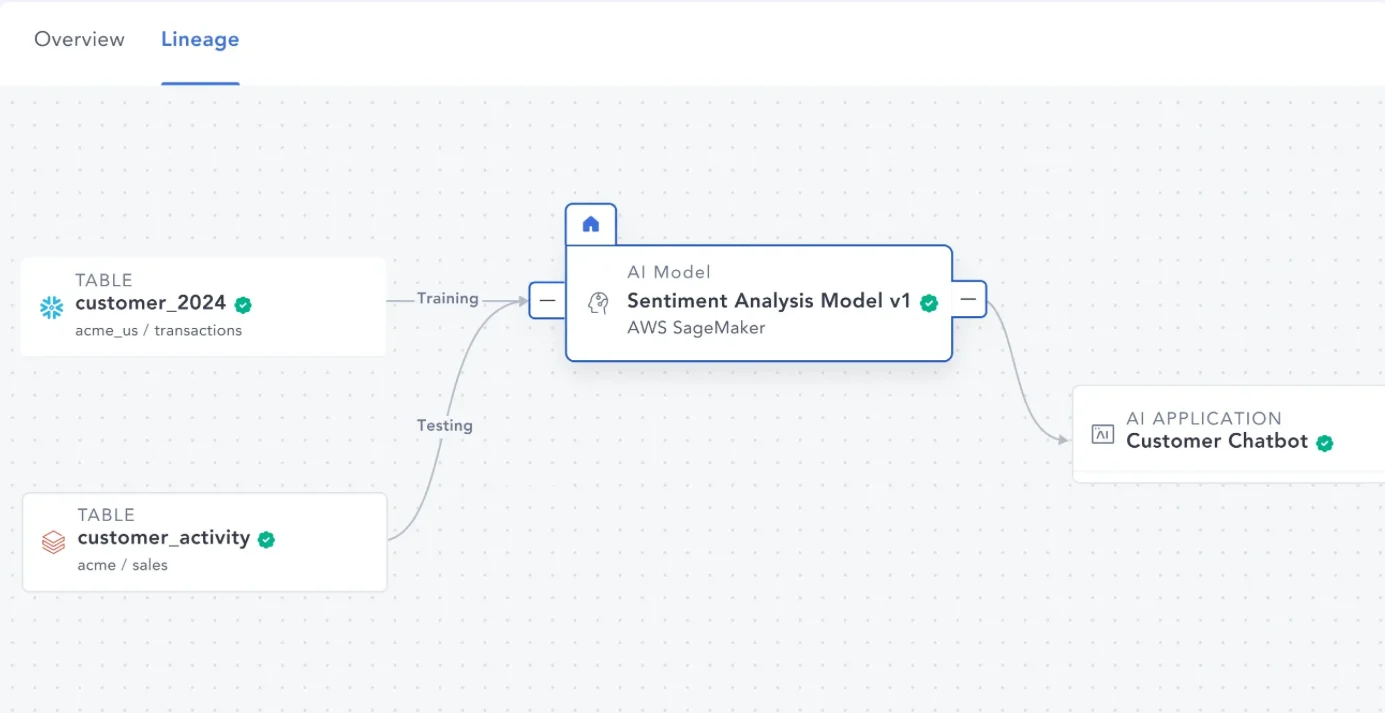
Get end-to-end visibility into how your data and AI is used, enabling data and AI governance. Source: Atlan.
What is impact analysis?
Permalink to “What is impact analysis?”Impact analysis is the strategic assessment of how a proposed change to a data workflow, system, or asset may propagate across the organization.
Unlike root cause analysis, which investigates the origin of existing issues, impact analysis helps you proactively forecast potential consequences to make informed decisions. This supports proactive change management, risk assessment, faster debugging, and audit readiness.
Impact analysis answers two critical questions:
- Where else is this used?
- What will break if I change this?
How impact analysis works
Modern data governance platforms perform impact analysis by:
- Identifying dependencies by mapping all data pipelines, reports, dashboards, and applications connected to the change within a context graph.
- Assessing risks by looking at systems, metrics, or business outcomes that could be affected.
- Estimating potential impact on decision-making, compliance, data quality, etc.
A modern metadata control plane like Atlan supports impact analysis by bringing data lineage into the tools, reviews, and automations that your teams already use.
By surfacing this context inside GitHub or GitLab pull requests, developers can examine an immediate blast-radius view of proposed changes, leading to safer and more informed deployments.
For instance, before a dbt model change goes live, you already know which reports, models, and teams will feel the downstream impact.
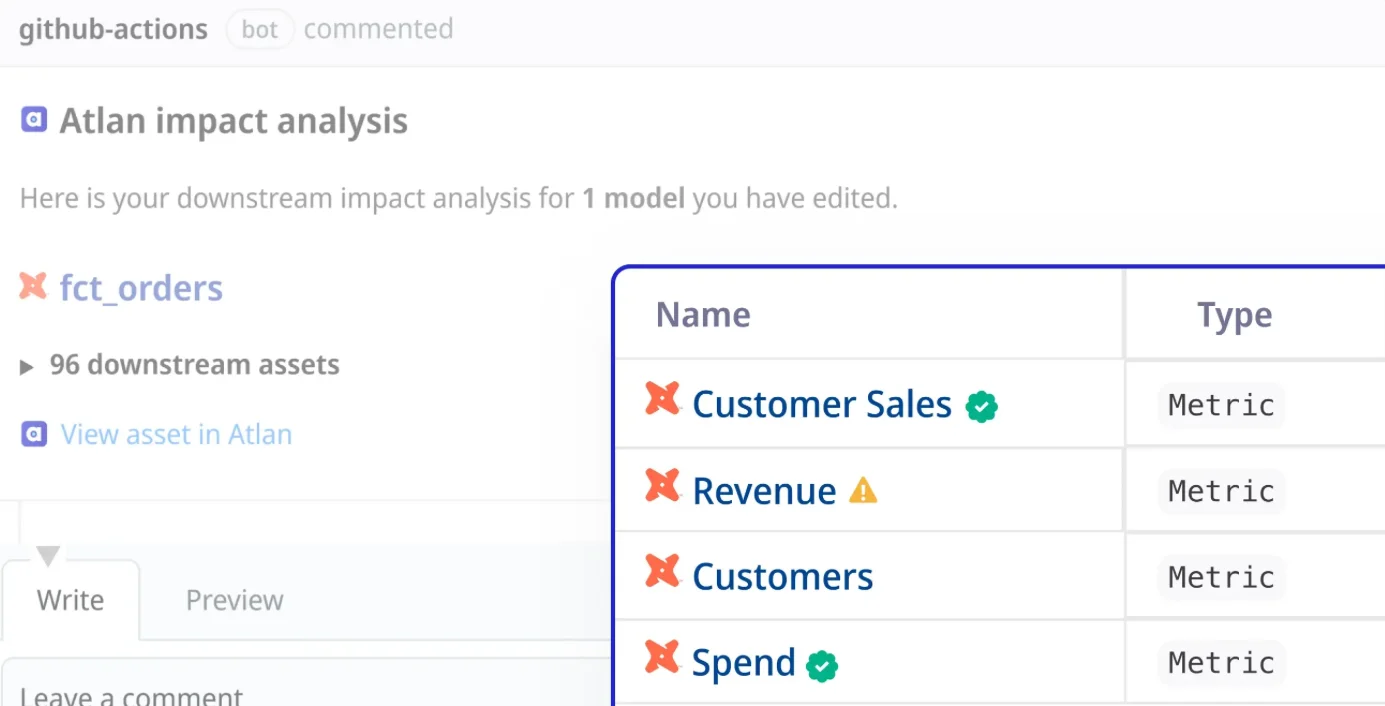
Proactive impact analysis in Atlan. Source: Atlan.
How do they work together?
Permalink to “How do they work together?”Data lineage and impact analysis are complementary:
- Lineage provides the “upstream view”—where data comes from and how it arrived in its current form.
- Impact analysis provides the “downstream view”—who and what will be affected when something changes.
In other words, lineage provides the map, while impact analysis delivers the what-if lens.
Who uses data lineage and impact analysis?
Permalink to “Who uses data lineage and impact analysis?”Data lineage and impact analysis are used across technical, analytical, and business teams:
- Data Engineers can debug broken pipelines, validate code changes, manage migrations and schema changes.
- Analytics and BI Teams can use data product & domain lineage to see how metrics, dashboards, and business entities connect across the organization.
- Data Stewards and Governance Managers can monitor sensitive data flows, activate governance with tag propagation, and maintain accurate audit trails automatically.
- DataOps teams can identify unused assets to reduce storage and compute costs.
- Business Managers can gain clarity into how KPIs and metrics are produced.
- AI/ML Teams can track full model lineage: training sets → features → transformations → model versions → predictions.
What are the top use cases of data lineage and impact analysis?
Permalink to “What are the top use cases of data lineage and impact analysis?”Data lineage tracking and impact analysis help teams troubleshoot issues faster, prevent breakages, support compliance, and build trust in analytics and AI.
The most common enterprise use cases include:
- Faster debugging and root cause analysis within minutes
- Compliance by showing how PII data flows, where it’s stored, and how it’s protected
- Proactive change management
- Data cleanup and cost reduction for your data and AI estate
- Data quality monitoring and observability
- Data and AI governance
How can you implement data lineage and impact analysis for your data and AI estate with Atlan?
Permalink to “How can you implement data lineage and impact analysis for your data and AI estate with Atlan?”Implementing lineage and impact analysis with Atlan means you get automated depth, enterprise scale, AI-native context, and open interoperability—all delivered through a modern metadata control plane.
Atlan constructs lineage by combining assets and processes:
- Assets represent the inputs and outputs of processes, such as databases, dashboards, etc.
- Processes represent the activities that move or transform data between the assets.
Atlan chains these together into a flow of data from various source systems using SQL parsing, native connectors, and open APIs.
Built on JanusGraph and powered by an open, interoperable metadata lakehouse, Atlan can handle lineage for 25–50M+ assets, making it ideal for the world’s largest, most complex data estates.
As a result, you can make lineage actionable to:
- Trace issues upstream for fast root-cause analysis.
- Surface impacts directly in Jira, GitHub/GitLab, etc.
- Automatically propagate tags, classifications, glossary terms, and sensitivity labels along lineage to child and downstream assets.
- Sync policies bi-directionally with Snowflake, Databricks, and more.
- View, download, and export impact analysis reports to collaborate with others in your organization.
- Give AI agents and automations direct access to lineage context using Atlan MCP, so they can work smarter, safer, and with full awareness.
Real stories, real customers: How modern enterprises deployed automated, active lineage at scale for their data ecosystem
Permalink to “Real stories, real customers: How modern enterprises deployed automated, active lineage at scale for their data ecosystem”
Improved time-to-insight and reduced impact analysis time to under 30 minutes
"I've had at least two conversations where questions about downstream impact would have taken allocation of a lot of resources. actually getting the work done would have taken at least four to six weeks, but I managed to sit alongside another architect and solve that within 30 minutes with Atlan."
Karthik Ramani, Global Head of Data Architecture
Dr. Martens
🎧 Listen to AI-generated podcast: Dr. Martens' Journey to Data Transparency

Massive Asset Cleanup: Mistertemp's Lineage-Driven Optimization to Deprecate Two-Thirds of Their Data Assets
"Using Atlan's automated lineage, started analyzing [data assets in] Snowflake and Fivetran. They could see every existing connection, what was actually used. We kept those, and for everything else, we would disconnect."
Data Team
Mistertemp
🎧 Listen to AI-generated podcast: Mistertemp's Lineage-Driven Optimization

Improved root cause and impact analysis with Atlan's native integration to Snowflake
"One of the great things is that rather than everyone trying to scramble around and remember what they changed and where, we can literally just pop into the lineage view in Atlan and trace that back to say 'Here's the dashboard, there's the dataset it's getting the data from, that's the table, and that's where it's ingested.' We can track that all the way back and find where the change was made."
Graham Lannigan, Head of Data Platform
Indicia Worldwide
🎧 Listen to AI-generated podcast: Snowflake & Atlan: Powering Indicia Worldwide's Data Platform
Ready to choose the best platform for future-proof data lineage and impact analysis?
Permalink to “Ready to choose the best platform for future-proof data lineage and impact analysis?”Data lineage and impact analysis give teams the visibility, trust, and control they need to ship changes safely, fix issues faster, and govern data and AI with confidence. With every transformation and dependency traceable, decisions become clearer, risks shrink, and your data ecosystem stays reliable as it grows.
And if you want lineage that’s automated, actionable, and built for enterprise and AI-native workloads, Atlan makes it simple to implement across your entire estate.
In the 2025 Gartner® Magic Quadrant™ for Metadata Management Solutions report, Atlan scored highest for data lineage and impact analysis, with customers praising its ease of use—making it one of the fastest ways to put lineage to work across your enterprise.
FAQs about data lineage and impact analysis
Permalink to “FAQs about data lineage and impact analysis”1. What is data lineage analysis?
Permalink to “1. What is data lineage analysis?”Data lineage analysis examines the complete lifecycle of data—where it originates, how it moves, how it transforms, and where it is ultimately consumed. It helps teams verify accuracy, trace errors, understand dependencies, and maintain transparency across the data ecosystem.
2. What is data impact analysis?
Permalink to “2. What is data impact analysis?”Data impact analysis identifies all downstream assets—reports, dashboards, pipelines, ML models, APIs—that rely on a particular data asset. It shows what will break, who will be affected, and how risky a change is before it happens.
3. What is the purpose of performing impact and lineage analysis?
Permalink to “3. What is the purpose of performing impact and lineage analysis?”The purpose of performing data lineage tracking and impact analysis is to improve data reliability, reduce breakages, and enable confident decision-making, so that you:
- Diagnose issues faster
- Validate changes before deployment
- Meet compliance and audit requirements
- Provide transparency for business users
- Ensure AI/ML systems rely on trusted, well-understood data
4. What are the risks of not having data lineage?
Permalink to “4. What are the risks of not having data lineage?”Without lineage, organizations face:
- Frequent data breakages with no clear root cause
- Higher compliance and audit risk due to lack of traceability
- Slow troubleshooting and longer data downtime
- Unsafe change management that breaks dashboards and models
- Low trust in metrics, AI outputs, and business reporting
5. What are the business benefits of data lineage and impact analysis?
Permalink to “5. What are the business benefits of data lineage and impact analysis?”The six biggest benefits of data lineage and impact analysis are:
- Faster troubleshooting: Quickly trace issues back to their source, reducing incident resolution time from days to minutes.
- Lower operational costs: Identify unused or redundant data assets to reduce storage, compute, and maintenance overhead.
- Safer change management: Understand downstream dependencies before making changes, preventing breakages in dashboards, models, and pipelines.
- Stronger regulatory compliance: Maintain an audit-ready record of data flow and transformations for privacy and industry regulations.
- Higher data trust: Give business users clear visibility into where metrics come from and how they’re created, increasing confidence in decision-making.
- Stronger AI governance: Link training data to models and outputs, enabling explainability, risk assessment, and compliance for AI/ML systems.
Share this article
