

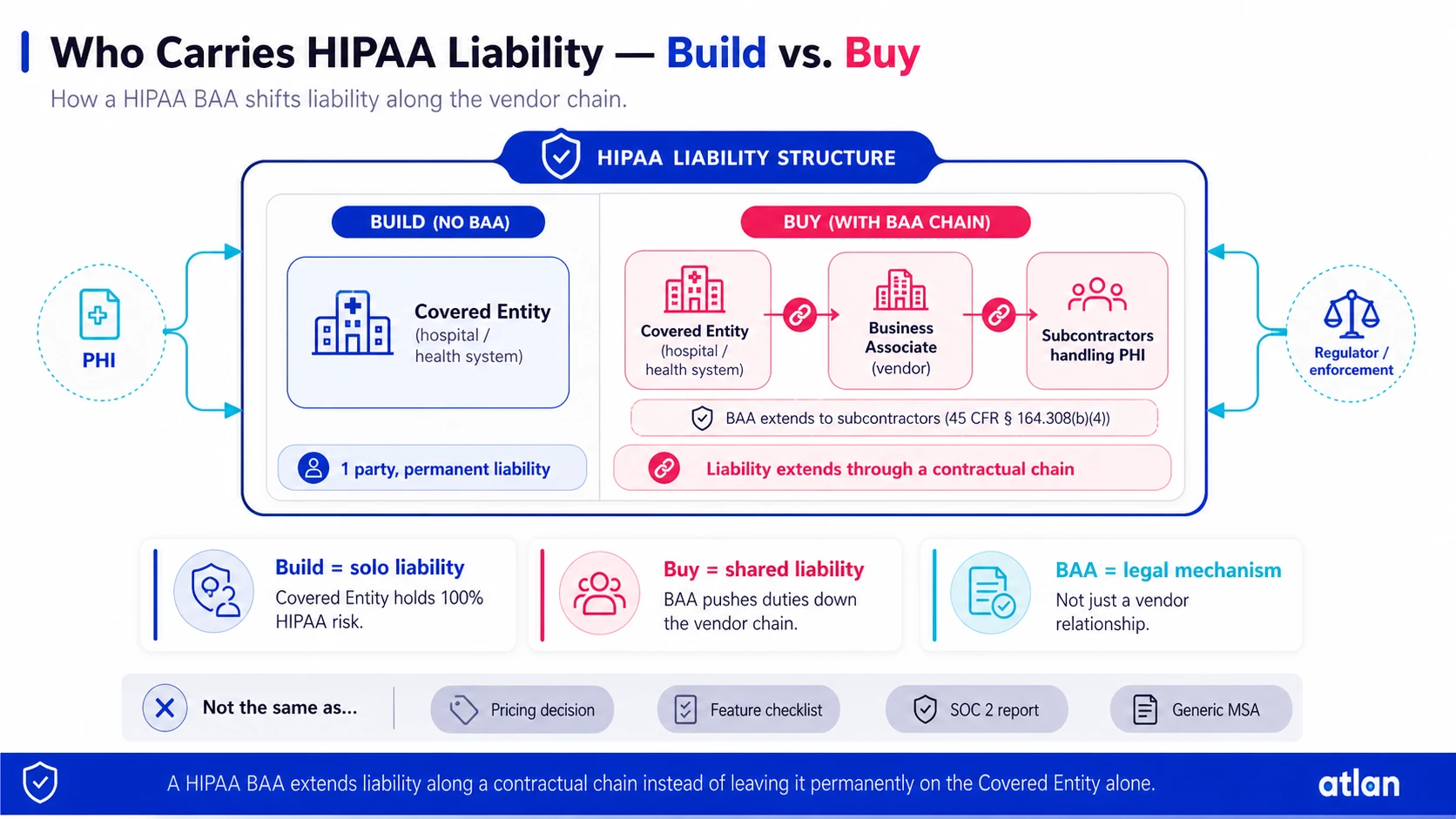
Build vs. buy for healthcare AI context infrastructure is a liability decision before a cost one. A Business Associate Agreement (BAA) contractually extends HIPAA compliance obligations to a vendor; a custom build carries those obligations alone, indefinitely. Predictive AI adoption in US hospitals rose from 66% to 71% between 2023 and 2024, per the Office of the National Coordinator for Health IT, so this decision is no longer theoretical.

- Minimum-necessary access enforced at retrieval time, per HHS de-identification guidance
- De-identification method: Safe Harbor’s 18 identifiers or Expert Determination’s risk assessment
- BAA subcontractor chains under 45 CFR § 164.308(b)(4)
- Mandatory, retrievable audit trails for every AI interaction touching PHI
| Dimension | Build in-house | Buy a governed context layer |
|---|---|---|
| What it is | Custom-built PHI-scoping and audit infrastructure, owned end-to-end | A layer enforcing PHI scoping, de-identification policy, and audit trails as a service |
| Who carries HIPAA liability | The covered entity, alone, indefinitely | Shared through a BAA with the vendor and its subcontractors |
| Time to a compliant first deployment | Months of building before audit-ready | Controls and logging exist from day one |
| De-identification approach | Team builds and maintains the pipeline | Vendor enforces it; org still chooses the method |
| Audit trail for PHI-touching AI | Built and maintained internally | Built in; decision traces by default |
| Multi-agent PHI-rule consistency | Re-implemented per agent, each a new audit surface | Defined once, enforced everywhere |
| Best for | Proprietary clinical or research context, such as an IRB-tied warehouse | Multiple clinical AI use cases across EHRs and agent platforms |
Build vs. buy for healthcare AI context: what makes this decision different?
Healthcare’s build-vs-buy calculus is shaped by regulatory mechanics a generic enterprise never has to weigh. Outside healthcare, the decision is mostly engineering headcount and time to value. Inside healthcare, three constraints change the math.
First, HIPAA’s minimum-necessary standard requires an AI tool to retrieve only the PHI strictly required, and per HHS guidance, enforcement happens at retrieval, not the database layer. Second, a BAA is a legal liability-transfer mechanism: under 45 CFR § 164.308(b)(4), a subcontractor processing PHI must also be bound by a BAA, a chain that doesn’t exist for an internal build. Third, BAA coverage on a general-purpose AI tool is granted per product and per tier, not per vendor, so the tier in use decides whether PHI is in scope.
The decision that looks like “build vs. buy a product” elsewhere in software becomes “who legally owns the compliance risk” in healthcare specifically, the single most useful lens for evaluating either path, and one that applies just as directly to context layer for financial services teams under a different regulatory stack.
What does building healthcare AI context infrastructure in-house actually involve?
Building means designing and permanently operating four systems: PHI classification, a de-identification pipeline, retrieval-time access controls, and audit logging, evaluated in context layer evaluation criteria. None of it is one-time work; clinical terminology, drug databases, and HIPAA’s interpretations keep changing, so the pipeline needs ongoing attention.
Teams with three or more data engineers most commonly attempt this, and the sentiment is consistent: it works, but never stops being maintenance. One clinical informatics lead described building a pipeline after vendor quotes ran past $400,000 a year, then discovering it still needed two full-time engineers to keep audit-ready. Teams scoping this should start with DIY context layer before committing to headcount.
UCSF shows build working well: it built its own de-identified clinical data warehouse to align de-identification with its own IRB processes, the kind of question also covered in context layer ownership: data teams or AI teams.
Core components of an in-house build
- PHI classification and tagging: labeling PHI-bearing assets before any pipeline touches them
- De-identification pipeline: Safe Harbor’s 18-identifier removal, or Expert Determination’s risk assessment, built internally
- Retrieval-time access controls: enforcing minimum-necessary the moment an agent queries data
- Audit logging infrastructure: a queryable, retained log of every AI interaction touching PHI
The pipeline is never done the way a shipped feature is done. It has to stay audit-ready every day it exists, a permanent staffing line, not a milestone, echoing why AI agents need an enterprise context layer for any regulated estate.
What does buying a governed context layer for healthcare provide?
Buying this infrastructure is a different decision than buying a finished clinical AI product. Most content ranking for these queries today addresses whether to build or buy the AI application itself: developer guides to clinical agents, care-navigation platforms, voice tools. Buying the context layer for AI agents underneath those applications is narrower and earlier: PHI-scoping, de-identification, and audit requirements defined once by the vendor and reused across every clinical AI system.
CareQuest Institute for Oral Health illustrates the pattern. Rather than building from scratch, the nonprofit partnered with PwC to build a Health Data Exchange on Microsoft Azure, buying the compliant cloud foundation and building its own oral-health business context model on top. Cedars-Sinai bought Microsoft Fabric while building its own semantic models across clinical, administrative, and research silos, the same problem covered in context layer for data governance teams.
Core components of a bought platform
- PHI-scoped retrieval: access controls enforcing minimum-necessary the moment an agent queries data
- De-identification policy enforcement: the org chooses the method; the platform enforces it across every source
- Audit-traceable decision trails: every output linked back to its source, policy, and authorizing role
- Portability across agents: PHI rules defined once, not re-implemented per tool, the model-agnostic principle
Buying does not remove an organization’s compliance responsibility. It changes who else is on the hook when something goes wrong, and removes the burden of re-engineering PHI scoping for every new use case, whether that spans one system or the kind of multi-cloud estate spanning an EHR and a separate payer system.
Build vs. buy for healthcare AI context: head-to-head on liability, not just cost
The sharpest differences show up in who bears risk, not sticker price, the same distinction separating context layer vs. semantic layer and data catalog vs. context layer comparisons, scoped here to build-or-buy.
| Dimension | Build in-house | Buy a governed context layer |
|---|---|---|
| HIPAA liability ownership | Covered entity carries it alone, indefinitely | Shared via BAA with vendor and subcontractor chain (45 CFR § 164.308(b)(4)) |
| Engineering and maintenance burden | Two or more engineers commonly cited for pipeline upkeep alone | Shifts to configuration and adoption |
| Vendor and subcontractor risk exposure | None to a vendor, but full exposure to build quality | Requires vetting the vendor’s own BAA chain |
| Multi-agent consistency | Re-implemented per agent, each a new compliance surface | Defined once, enforced across every agent |
Consider a medical center running Epic alongside three clinical AI pilots: ambient documentation, prior authorization, and care coordination. Each pilot re-implementing its own PHI-scoping logic means three audit surfaces instead of one, the failure agent context layer vs. knowledge base warns against. A governed agent context layer collapses that to one set of rules every pilot inherits, distinct from plain RAG retrieval alone.
The AI Context Stack
See where build and buy decisions sit inside the four-layer stack behind any enterprise AI agent, and where compliance risk actually accumulates.
Get the BriefWhen does building your own healthcare AI context infrastructure make sense?
Build makes sense when an organization’s clinical or research context is itself proprietary expertise, not a generic compliance obligation. UCSF’s research warehouse fits this: owning de-identification let it align precisely with its own IRB processes. Oscar Health, a technology-driven insurer, favors building more internally, reflecting stronger engineering capacity and lower direct clinical risk than a hospital treating patients.
Buy makes more sense once an organization runs clinical AI across more than one system, or needs an audit-ready posture faster than a build timeline allows, the threshold covered in how to implement an enterprise context layer for AI. Cedars-Sinai and CareQuest illustrate this: multi-system environments where re-deriving PHI-scoping for every new source would multiply the audit surface, exactly what a context layer ROI analysis quantifies.
Most organizations do both: buy the PHI-scoped infrastructure no team should reinvent per agent, and build the clinical semantics genuinely their own expertise, the domain counterpart to agent context layer tools compared. That split, not a single winner, is what the case studies show.
What goes wrong when healthcare teams get this decision wrong?
Three failure modes show up repeatedly, and none is primarily a cost overrun.
On the build side: teams underestimate that de-identification and audit logging are permanent maintenance, not one-time engineering, commonly requiring two or more full-time engineers just to keep a homegrown pipeline audit-ready.
On the buy side: assuming a signed BAA transfers all responsibility to the vendor. It does not. The organization still owns choosing the de-identification method and vetting the vendor’s subcontractor chain, work related to the general AI model governance and AI risk management every regulated buyer still has to do.
On either path: assuming a general-purpose assistant either is or is not covered, without checking. Both vendors sign BAAs, but only for named products and tiers. OpenAI covers the API Platform and ChatGPT Enterprise and Edu, and its API eligibility depends on the org being provisioned with Modified Retention; ChatGPT Business gets no BAA. Google’s HIPAA Business Associate Addendum has covered the Gemini app, the Gemini Mac App, and Gemini in Workspace since August 31, 2026, and excludes Gemini in Chrome. The tier, not the brand, decides whether PHI can go near it.
The common thread is not that a team spent too much money. It is discovering, usually during an audit, that it misjudged who was actually accountable for a PHI-handling requirement, a liability failure, not a budgeting one.
Context Layer ROI Calculator
Model where build, buy, and hybrid paths actually land for your own healthcare AI estate.
Calculate Your ROIHow Atlan approaches healthcare AI context infrastructure
Healthcare organizations that treat compliance as a separate system tend to re-solve the same PHI-scoping and audit-logging requirements inside every new clinical AI pilot, the same gap covered from the memory side in context layer as AI memory foundation and memory layer vs. context layer. Atlan’s approach sits inside the buy column, one part of a hybrid strategy, not a verdict against building.
Atlan classifies PHI and propagates that classification through lineage, so sensitive-field restrictions travel into every downstream agent pipeline. Access controls enforce minimum-necessary, role-scoped retrieval before PHI reaches a model, and every output carries a decision trace back to its source, policy, and role. Delivered through MCP, SQL, and REST or graph APIs, rules are defined once and reused across every agent as part of a unified foundation. Scripps Health uses this to simplify PHI and PII classification for HIPAA compliance.
| Healthcare requirement | What Atlan provides |
|---|---|
| Minimum-necessary PHI access at retrieval time | Role- and task-scoped access controls enforced at retrieval |
| De-identification method enforcement | Consistent enforcement of the org’s chosen policy across every source |
| Audit trail for every AI interaction with PHI | Decision traces linking every output to source, policy, and role |
| PHI-rule consistency across multiple agents | Rules defined once, reused across every agent runtime |
The healthcare AI overview linked at the top of this guide covers the broader case for why this infrastructure matters at all. Context layer 101 and what is context engineering cover the vocabulary this page assumes.
See Context Agents in Action
Watch how a governed context layer enforces PHI-scoping and audit trails across a multi-system healthcare estate without rebuilding the rules per agent.
Watch the DemosWhy the healthcare build-vs-buy decision is a liability question first
Every credible source here, from HHS’s regulatory text to practitioners weighing the decision in real health systems, converges on the same point: a Business Associate Agreement is a legal risk-transfer mechanism a custom build cannot replicate. Building means carrying HIPAA’s minimum-necessary enforcement, de-identification documentation, and audit-trail obligations alone, for as long as the system exists. Buying means sharing that liability contractually, while still owning method choice, vendor vetting, and clinical semantics that no BAA can hand off.
The organizations getting the most value from either path did not pick build or buy as an identity. They were honest about which pieces of the compliance surface they would own indefinitely, and which they would share with a vendor under a BAA, the same discipline behind a well-run AI agent harness or a properly scoped semantic layer rollout.
Real stories from real customers: trust in regulated data environments
"AI initiatives require more context than ever. Atlan's metadata lakehouse is configurable, intuitive, and able to scale to hundreds of millions of assets. As we're doing this, we're making life easier for data scientists and speeding up innovation."
- Andrew Reiskind, Chief Data Officer, Mastercard

"Context is the differentiator. Atlan gave our teams the shared vocabulary and lineage to move from reactive data management to proactive AI enablement."
- Kiran Panja, Managing Director, Cloud and Data Engineering, CME Group

FAQs about build vs. buy for healthcare AI context infrastructure
1. What is the difference between building and buying healthcare AI context infrastructure?
Building means an organization designs and permanently maintains its own PHI classification, de-identification, access control, and audit-logging systems. Buying means a vendor provides those under a BAA, so the org configures policy instead of constructing infrastructure. The deeper difference is liability: a BAA shares HIPAA risk; a custom build carries it alone.
2. Is it cheaper to build or buy HIPAA-compliant AI infrastructure?
Buying is usually cheaper over multiple years once headcount is counted honestly; teams building their own pipelines commonly staff two or more engineers to keep the system audit-ready, a cost that never ends. In healthcare, cost is secondary to who is accountable when an audit fails.
3. What does a Business Associate Agreement actually cover for AI vendors?
A Business Associate Agreement is a contract required whenever a vendor creates, receives, or transmits PHI for a covered entity, requiring HIPAA’s Privacy, Security, and Breach Notification Rules. Under 45 CFR § 164.308(b)(4) it extends to any subcontractor handling that PHI. Without one, a vendor cannot legally process patient data.
4. Can healthcare organizations use ChatGPT or Gemini with patient data?
Yes, on the right product and tier, with a signed BAA in place. OpenAI executes BAAs for the API Platform, no enterprise agreement required, and for ChatGPT Enterprise and Edu; API HIPAA eligibility requires the organization to be provisioned with Modified Retention, and ChatGPT Business is not covered. Google’s HIPAA Business Associate Addendum has covered the Gemini app, the Gemini Mac App, and Gemini in Workspace since August 31, 2026, with Gemini in Chrome excluded. Coverage is per product and per tier, so confirm it for the exact tier in use before patient data goes near it.
5. What are the hidden costs of building custom PHI de-identification?
The build itself is rarely the expensive part. The ongoing cost is keeping the pipeline current as note formats, specialties, and HIPAA interpretations evolve, plus the audit logging to prove it works, commonly two or more engineers permanently, a cost most initial estimates miss.
6. How does vendor lock-in risk compare to build risk in regulated healthcare environments?
The two risks are not symmetric. Vendor lock-in with a portable, open architecture is mainly a switching-cost risk. Build risk in a HIPAA context is compliance risk carried alone, indefinitely, with no party to share it. Vetting a vendor’s portability and BAA chain narrows lock-in; there is no equivalent way to narrow build risk.
7. What audit trail does HIPAA require for AI systems that touch PHI?
HIPAA’s Security Rule requires a retrievable log of what PHI was accessed, by whom, when, and for what purpose. It must reconstruct access after the fact and flag unauthorized use. General-purpose observability tools are often not HIPAA-ready out of the box, making audit logging one of the most underestimated build costs.
8. Should a hospital build its own clinical AI context layer, or buy one?
Most hospitals running clinical AI across more than one system are better served buying, since PHI-scoping rules and audit trails only need defining once. Building tends to make sense where the context itself is proprietary expertise, such as a research center’s de-identified warehouse tied to its own IRB processes.
Sources
- ONC Data Brief: Hospital Trends in Predictive AI Adoption. https://www.healthit.gov/data/data-briefs
- HHS Office for Civil Rights: HIPAA De-identification Guidance (Safe Harbor and Expert Determination). https://www.hhs.gov/hipaa/for-professionals/privacy/special-topics/de-identification/index.html
- eCFR: 45 CFR Part 164, Business Associate and Subcontractor Requirements. https://www.ecfr.gov/current/title-45/subtitle-A/subchapter-C/part-164
- Linford & Co: Business Associate Agreements and AI Vendor Compliance. https://www.linfordco.com/
- TechTarget: How Health Systems Can Build an AI-Ready Data Infrastructure. https://www.techtarget.com/healthtechanalytics/feature/How-health-systems-can-build-an-AI-ready-data-infrastructure
- PwC: CareQuest, Building an AI-Enabled Health Data Platform. https://www.pwc.com/us/en/library/case-studies/carequest-ai-enabled-health-data.html
- UCSF Data: How to Get De-Identified Clinical Data for Cohort Studies, Pattern Recognition, and More. https://data.ucsf.edu/research/deid-data
- KLAS Research: Healthcare AI Update 2025. https://klasresearch.com/report/healthcare-ai-update-2025-what-use-cases-are-adopted-the-most/3912
- McKinsey: Generative AI in Healthcare, Adoption Matures as Agentic AI Emerges. https://www.mckinsey.com/industries/healthcare/our-insights/generative-ai-in-healthcare-current-trends-and-future-outlook
- ECRI Institute: Misuse of AI Chatbots Tops Annual List of Health Technology Hazards. https://home.ecri.org/blogs/ecri-news/misuse-of-ai-chatbots-tops-annual-list-of-health-technology-hazards
- OpenAI Help Center: How can I get a Business Associate Agreement (BAA) with OpenAI? https://help.openai.com/en/articles/8660679-how-can-i-get-a-business-associate-agreement-baa-with-openai
- OpenAI Help Center: HIPAA-eligible products and functionality. https://help.openai.com/en/articles/20001069-hipaa-eligible-products-and-functionality
- Google Workspace: HIPAA Included Functionality, effective August 31, 2026. https://workspace.google.com/terms/2015/1/hipaa_functionality/
- Google Cloud: HIPAA Compliance on Google Cloud. https://cloud.google.com/security/compliance/hipaa
