

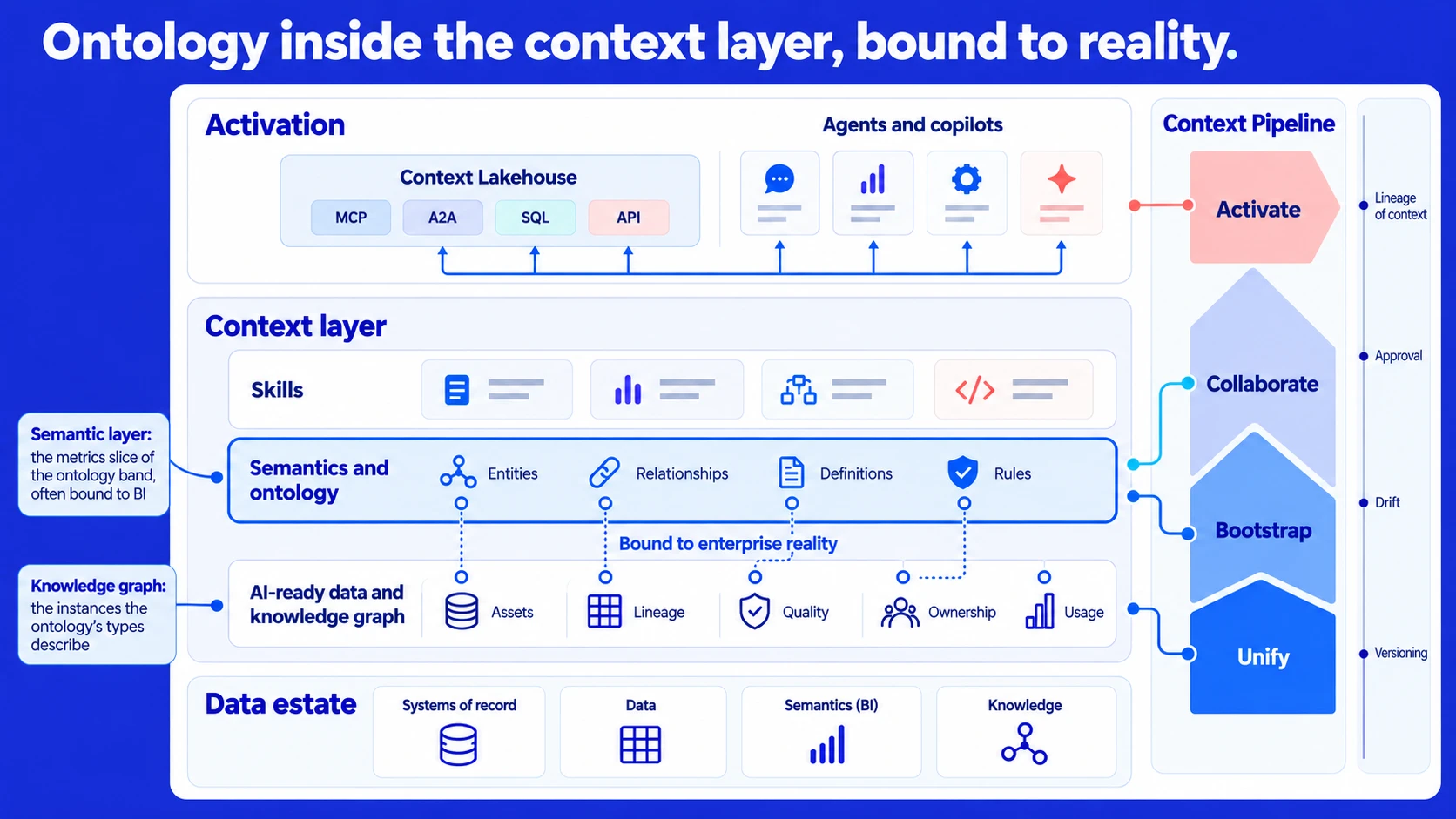
Each ontology component maps to a context-layer capability, then the lifecycle that keeps the ontology current, then what the context layer adds if you already run a knowledge graph and a semantic layer.
What roles do an ontology and a context layer play in enterprise AI architecture?
Atlan, the Context Layer for AI, treats the ontology as a first-class part of its context foundation. An ontology in AI defines business entities and terms such as Customer, Order, and Revenue, their relationships, and the rules that ensure their consistent use. These core components of an ontology correspond to classes, properties, and individuals in the W3C’s OWL 2 overview, though an enterprise ontology does not have to be written in OWL to serve agents.
The enterprise context layer, on the other hand, supplies the context and controls that keep meaning connected, current, and usable. It binds entities and terms to real assets, adds lineage, quality, ownership, usage, and policy context, and then governs and serves the approved version. These core context-layer components show why agents need an enterprise context layer around the ontology. Ananth Packkildurai describes an ontology for AI agents as a system rather than a single file or graph. An essay on ontology, context, and semantic data layers makes the same distinction between meaning and the machinery that applies it.
Without a context layer, an ontology can become a static model. If an underlying table or column changes, a binding, such as Customer to the customer_id key, can become stale unless the surrounding system detects the schema change and routes the mapping for review. Teams that keep their mappings in version control with schema checks already cover part of this, for the systems those mappings reach. The gap opens where bindings live in BI tools, SQL, and documents outside that pipeline. Closing it is the difference between a static model and an active ontology whose connections stay aligned with operational reality.
Without an ontology, a context layer can govern assets without establishing shared meaning across them. It may hold complete descriptions, lineage, quality scores, owners, and access policies, yet two agents can still interpret Customer differently because no shared semantic model connects those signals or records which definition applies to which domain.
Research on the ontology side supports the first half of that argument. In an event-driven simulation, Zhu et al. reported 98.74% tool-chain F1 for ontology-governed decisions, while the frontier-model baselines reached 24% to 36% F1 despite about 80% accuracy. The April 2026 study evaluates one ontology-governed system, not a context layer or a general enterprise benchmark, but it shows how semantic constraints can narrow interpretation. Gartner’s framework, as reported by Mexico Business News in July 2026, separately identifies semantics, operational state, and provenance as context components.
With both, the enterprise gets governed meaning that remains connected to its operational reality. With neither, teams fall back on definitions embedded in prompts, code, and individual applications. A separate guide compares a context graph vs. an ontology as artifacts; here, the focus is on how context-layer capabilities operate around the ontology.
From Ontology to Context Layer: What Actually Changed With AI?
Source: Atlan on YouTube
How do ontology components map to context-layer capabilities?
An ontology becomes operational when each of its components has a corresponding context-layer responsibility. Entities need bindings, relationships need evidence, definitions need approval, rules need policy context, and every change needs a traceable path to consumption.
The architectural responsibilities and their implementation in Atlan map as follows:
| Ontology component | What does the context layer do to it | Context Pipeline stage | Atlan capability |
|---|---|---|---|
| Entities, such as Customer, Order, and Account | Collects the tables, columns, dashboards, and documents that represent each business entity across systems, as candidate bindings | Unify | 100+ connectors and the Enterprise Data Graph |
| Relationships | Uses lineage, common joins, and usage patterns to propose relationships for review | Bootstrap | Orion Context Agent, supported by data lineage for AI |
| Definitions, including terms and metrics | Drafts glossary terms, connects columns to business definitions, and surfaces conflicting metric logic | Bootstrap to Collaborate | Lexis, Nexus, Sage, and Context Engineering Studio |
| Rules and constraints | Attaches policy context, required filters, access rules, and quality signals to the concepts they govern | Collaborate | Bounded Context Spaces for domain-scoped review, and Vera quality scores |
| Ownership and certification | Records who approved each definition, the domain it applies to, and any permitted exceptions | Collaborate | Context Engineering Studio review and approval |
| Change over time | Flags upstream changes that may cause drift, preserves version history, and supports rollback | Ongoing, across all stages | Versioned Context Repos with rollback, lineage-based impact, and Context Lakehouse time travel |
| Consumption | Serves the certified ontology, its asset bindings, and relevant context to authorized agents and tools | Activate | Context Lakehouse through MCP, A2A, SQL, and APIs |
The mapping shows that an ontology cannot remain separate from the systems it describes. Its entities must stay bound to assets, its relationships need evidence, its rules require approval context, and every deployed ontology version needs a traceable record of what changed, who approved it, and which bindings or rules were affected. A context-layer reference architecture places these responsibilities within the broader AI stack, while enterprise skills provide agents with approved procedures for working with the shared concepts.
The next section follows this lifecycle from Unify through Activate.
How does the Context Pipeline keep the ontology alive?
The Context Pipeline is how the context layer keeps the ontology current as data assets, definitions, owners, policies, and business usage change. Its four stages divide the work across Unify, Bootstrap, Collaborate, and Activate.
Unify: Bind concepts to the data estate
The Unify stage connects the ontology to technical and business signals distributed across the enterprise. Through context mining, Atlan gathers schemas, lineage, SQL patterns, BI logic, usage, quality signals, and existing definitions in the Enterprise Data Graph.
This evidence reveals which tables, columns, dashboards, documents, owners, and policies relate to a business term or entity. It can also expose competing definitions of a term such as Revenue. This stage does not decide which definition is correct. It gives domain owners the evidence needed to make that decision.
Bootstrap: Draft entities, relationships, and definitions
The Bootstrap stage turns the signals gathered during Unify into a reviewable first version of the ontology. Specialist Context Agents, including Lexis, Nexus, Sage, Vera, and Orion, contribute different parts of this initial version. Lexis drafts terms, Nexus connects definitions and metrics to relevant assets, Sage surfaces conflicting metric logic, Vera adds quality signals, and Orion proposes entities and relationships across domains.
Each agent output carries a confidence score. Lower-confidence proposals route to people for review, and domain owners decide what is certified for agents to use. The owners decide things like what the term Customer means, which Revenue calculation is authoritative, and whether the proposed relationships and asset bindings reflect how the business operates. Guidance on designing an ontology for AI covers the modeling choices. The pipeline covers how those choices reach an approved state.
Collaborate: Test, approve, version, and monitor
The Collaborate stage turns the proposed ontology into an approved, versioned release. In Context Engineering Studio, domain experts review definitions, correct relationships, document exceptions, test the definitions against business questions, and approve what agents can use. The released definitions and bindings are packaged in a context repository.
Each release needs versioned context so teams can see what changed, who approved it, and which bindings or rules were affected. Context drift can occur when a business definition changes without a column rename or when a schema change breaks a previously valid binding. The two cases are not equally visible. A schema change shows up in the source metadata, and lineage shows which bindings and downstream assets depend on the changed column. A definition that changes with no schema change shows up only when its evidence changes: Sage surfaces it when two teams’ logic for the same metric disagrees and routes the conflict to stewards, or a steward records the change in review. A change that leaves no trace in SQL, BI logic, or a review can still go unnoticed, which is why releases are tested as well as monitored. Detecting drift connects the visible changes to lineage, ownership, usage, and downstream dependencies so the affected part of the ontology can be reviewed again.
Testing checks whether the current definitions, bindings, and rules produce acceptable results before release. In a June 2026 pilot by Luong Tuan and Sanyal across four regulated industries, scenarios generated from an ontology scored 48.3% on regulatory coverage, measured against 125 primary-source regulatory requirements, compared with 33.1% for a persona-based baseline. Their advantage over plain and retrieval-augmented prompting did not survive Bonferroni correction, and the authors present the framework as a deployment gate that complements runtime governance. The study supports using ontology-derived scenarios as one input to pre-deployment testing. It does not test a context layer; context quality testing is where each release keeps a comparable record of evidence, results, and approvals.
Activate: Serve approved meaning
The Activate stage makes the approved ontology, its asset bindings, and relevant operational context available to authorized agents and tools. The Context Lakehouse stores and serves this context via MCP, A2A, SQL, and APIs, allowing teams to use MCP to deliver business context without redefining the ontology in every agent or tying it to a single platform’s stack. Atlan’s hosted MCP server runs every tool call with the permissions the caller already has in Atlan, so “authorized” means the same roles and policies that govern people. Activation delivers approved meaning; the protocol itself does not create, test, or certify that meaning.
Workday’s experience speaks to the delivery half, shared language reaching AI through MCP. DigiKey’s speaks to scope, context that extends into operational systems:
“Atlan captures Workday’s shared language to be leveraged by AI via its MCP server.”
Joe DosSantos, VP, Enterprise Data and Analytics, Workday
“Atlan is our context operating system to cover every type of context in every system including our operational systems.”
Sridher Arumugham, Chief Data Analytics Officer, DigiKey
Where do the semantic layer and knowledge graph fit?
If you already run a knowledge graph and a semantic layer, much of the meaning work is done. A production knowledge graph can hold the ontology itself alongside its instances, mappings to source tables, and provenance. A semantic layer models entities, joins, and metrics, and executes approved query logic. The guides on ontology vs. knowledge graph and ontology vs. semantic layer cover those boundaries in depth.
Analysts now describe the context layer as the place where both converge. Forrester’s proposed definition, published in August 2026, calls it the next evolution of semantic layers and knowledge graphs: it combines the business semantics and governance of a semantic layer with the ontological modeling of a knowledge graph, and it continuously takes in runtime context such as events, decisions, and outcomes. In the Gartner framework as Mexico Business News reports it, the semantics component lists business ontologies and knowledge graphs alongside metadata, policies, business rules, and standardized metrics.
The context layer adds the work that neither tool owns on its own. It keeps one inventory of bindings across tools, so the Revenue concept is tied to the warehouse table, the semantic-layer metric, the BI dashboard, and the policy document at once, and a change in any of them traces back to the concept. It uses lineage to show which concepts, metrics, and consumers a broken binding affects. It lets Finance and Sales each certify their own Revenue, with owner, scope, and exceptions recorded, instead of one global definition overwriting the other. And it releases the ontology and its bindings as one versioned unit that several agent runtimes can read.
The knowledge graph can stay the system of record for instances, and the semantic layer can stay where metrics execute. The context layer binds the ontology’s classes to the assets that hold those instances and to the metrics that compute them. A guide to context graph vs. ontology clarifies the boundary between the semantic model and its surrounding context.
How do you get the architecture right by starting with one domain?
To get the ontology and context-layer architecture right, start with one domain where a wrong definition changes a visible business decision. Finance’s definition of Revenue or a customer-eligibility decision works well because the owners, source assets, acceptance tests, and consumers can all be named. Designing an ontology for AI covers how to scope that domain. The rollout below tests the operating model around it, ending with the maintenance loop.
Use a bounded rollout to prove the full operating model:
- Choose the domain and decision: Inventory the semantic models that already exist for it, such as an ontology, semantic-layer metrics, or a glossary, then define the business question, scope, and accountable owners.
- Bind meaning to evidence: Connect the domain’s entities and definitions to authoritative assets, lineage, quality signals, and policy context.
- Certify the first version: Resolve conflicting definitions, review the proposed bindings, and approve a minimum useful ontology.
- Version and serve it: Release the approved ontology and its bindings to one authorized agent or workflow.
- Test the maintenance loop: Make two changes. Rename a source column, then change the Revenue logic without touching the schema. For each, confirm which bindings are flagged, who reviews them, that the tests rerun, and that the result ships as a new version or rolls back.
This sequence turns an ontology-first AI architecture into an operating practice. Once it works for one domain, teams can extend the ontology beyond one warehouse or pair a platform-native ontology with a context layer without rebuilding the lifecycle.
A broader guide covers how to implement an enterprise context layer. An operational ontology may later connect the same concepts to approved actions. The first proof is simpler: when something changes, can the enterprise keep that domain’s meaning accurate?
Real stories from real customers: Shared meaning at enterprise scale
"Context is the differentiator. Atlan gave our teams the shared vocabulary and lineage to move from reactive data management to proactive AI enablement."
Kiran Panja, Managing Director, Cloud and Data Engineering, CME Group

"AI initiatives require more context than ever. Atlan's metadata lakehouse is configurable, intuitive, and able to scale to hundreds of millions of assets. As we're doing this, we're making life easier for data scientists and speeding up innovation."
Andrew Reiskind, Chief Data Officer, Mastercard

Keep the ontology true
An ontology gives enterprise AI a shared language. The context layer keeps that language connected to the business as assets, owners, policies, and definitions change. Define the meaning per domain, then operate it continuously: bind it to evidence, keep domain owners on the loop, version every release, and serve each authorized consumer the approved release for its domain.
FAQs about ontology and context layer
1. Is an ontology the same thing as a context layer?
No. An ontology defines shared business entities, relationships, definitions, and rules. A context layer binds that meaning to real assets, keeps it current, governs changes, and makes it available to authorized consumers.
2. Where does the ontology sit in an enterprise AI architecture?
The ontology sits inside the semantic foundation of the context layer. It connects business meaning to the data, systems, and knowledge sources it describes. Lifecycle and delivery capabilities around it review, version, monitor, and serve the approved meaning.
3. Which comes first: the ontology or the context layer?
Start with what already exists. If a domain has an ontology, semantic-layer metrics, or a governed glossary, keep them as the starting model and use context signals from that domain to find missing bindings and conflicting definitions. If it has none, use those signals to draft the first ontology version. Either way, the ontology gives the signals a shared structure, while the context layer keeps the resulting model connected and current. In practice, they mature together rather than as separate projects.
4. What happens to an ontology when the underlying schemas change?
The affected entities, definitions, bindings, and downstream uses must be identified. The team reviews the impact, updates the relevant bindings, reruns its tests, and releases a new version. Without this process, the ontology may remain logically correct while pointing to outdated assets.
5. Can a context layer work without an ontology?
A context layer can collect and govern context without a formal ontology, but it lacks a shared model for interpreting it. Agents may receive current lineage, policies, and definitions yet still disagree about terms such as Customer or Revenue. The ontology supplies the consistent entities, relationships, and rules.
6. Who owns the ontology, and who owns the context layer around it?
Business domain owners approve definitions, relationships, and exceptions. Data and architecture teams maintain the technical model, asset bindings, lifecycle, and delivery infrastructure. AI teams contribute tests and report gaps found during use.
7. How do the semantic layer and knowledge graph relate to the ontology inside a context layer?
The ontology defines the types that both follow. The knowledge graph can remain the store of instances and the semantic layer the place where metrics execute. The context layer adds what neither owns alone: bindings from each concept to assets in every tool, lineage-based impact when one of them changes, domain-scoped approval, and versioned delivery to agents.
8. How is an ontology versioned and kept current?
Version the ontology and its asset bindings together. Record each change, approval, dependency, test result, and effective date while monitoring for schema or definition drift. Review the impact, rerun the tests, and publish or roll back the next version.
Sources
- Ontology, Context and Semantic Data Layers
- What an Ontology for AI Agents Actually Needs
- Context Layer Is Key to Scalable AI Agents: Gartner
- The Next Evolution Of AI Will Rely On Context Layers
- From Business Events to Auditable Decisions: Ontology-Governed Graph Simulation for Enterprise AI
- Toward Pre-Deployment Assurance for Enterprise AI Agents: Ontology-Grounded Simulation and Trust Certification
- OWL 2 Web Ontology Language Document Overview
