


| Quick fact | Details |
|---|---|
| Number of alternatives reviewed | 10 |
| Best overall alternative | Atlan (Gartner MQ Leader, Forrester Wave Leader 2025) |
| Best for regulated industries | Collibra |
| Best for Azure/Microsoft environments | Microsoft Purview |
| Best for mid-market / fast setup | CastorDoc (14-day free trial, from $10,000/year) |
| Best open-source option | OpenMetadata (Apache 2.0, 84+ connectors, free to self-host) |
| Alation typical deployment time | 3 to 9 months with professional services |
| Atlan deployment time | Days to weeks, DIY |
| Alation pricing | Not publicly disclosed; enterprise contracts from ~$170k/year |
| Data last updated | February 2026 (G2 and Gartner Peer Insights) |
Alation alternatives at a glance
| Tool | Best for | Pricing tier | Setup time |
|---|---|---|---|
| Atlan | Cloud-native data teams, AI governance | Custom (contact sales) | Days to weeks |
| Collibra | Regulated industries, compliance governance | $170k–$510k+/year | 6–12 months |
| Microsoft Purview | Azure/Microsoft 365 environments | ~$34–$55/user/month or pay-as-you-go | Weeks (Azure-native) |
| IBM Knowledge Catalog | IBM ecosystem, Watson ML workloads | Custom (contact sales) | 3–9 months |
| CastorDoc | Mid-market, fast time-to-value | From $10,000/year | Days (14-day trial) |
| Select Star | Automated lineage, Snowflake cost intelligence | From ~$300/month (Pro) | 24 hours |
| data.world (part of ServiceNow since July 2025) | Knowledge graph, semantic layer | Free tier to enterprise; enterprise quotes now run through ServiceNow | Weeks |
| OpenMetadata | Engineering teams, open-source control | Free (self-hosted) | Weeks (infra required) |
| Alteryx | Analytics-first, data prep + governance | Contact for pricing | Days to weeks |
| Google Dataplex | GCP-native environments | Pay-as-you-go GCP pricing | Days (GCP-native) |
Why consider Alation alternatives?
Alation was a pioneering data catalog built for search, discovery and stewardship in traditional BI environments. For many organizations, those strengths no longer match their data stack or their governance goals.
Why do Alation implementations take 3 to 9 months?
Alation deployments commonly require 3 to 9 months with professional services involvement. Teams evaluating alternatives often cite time-to-value as the primary driver: they need a catalog operational in weeks, not quarters.
How does Alation handle Snowflake, Databricks and dbt integrations?
Alation’s architecture predates the Snowflake/Databricks/dbt era. Organizations running modern cloud data stacks frequently find that Alation’s integrations are shallower or require more manual configuration than purpose-built alternatives.
Why does Alation’s manual stewardship model break down at scale?
Alation’s core workflow relies on human stewards to curate, tag and document assets. As data volumes scale, this creates bottlenecks. Teams moving to active metadata platforms (which propagate tags automatically and push governance signals into source systems) find they can govern more data with less manual effort.
Why is Alation’s total cost of ownership hard to predict?
Alation pricing is not publicly disclosed and is negotiated per customer, making total cost of ownership difficult to estimate and benchmark before committing to a proof of concept.
Top 5 Alation alternatives: Deep profiles
1. Atlan: what it means in practice
Best for: Modern data teams running cloud-native stacks (Snowflake, Databricks, dbt, Airflow, Looker, Power BI)
G2: 4.5/5 | Gartner Peer Insights: 4.6/5 | Analyst recognition: Gartner MQ Leader 2025, Forrester Wave Leader 2025
Atlan is an active metadata platform and metadata control plane. Where Alation is a catalog teams document assets into, Atlan is a layer that connects to your existing data stack, propagates governance context across it automatically and pushes metadata back into the tools teams already use. This distinction matters at scale: instead of requiring stewards to maintain documentation manually, Atlan automates tag propagation across lineage paths, surfaces quality signals inside Snowflake and Databricks and writes enriched context back to BI tools and notebooks.
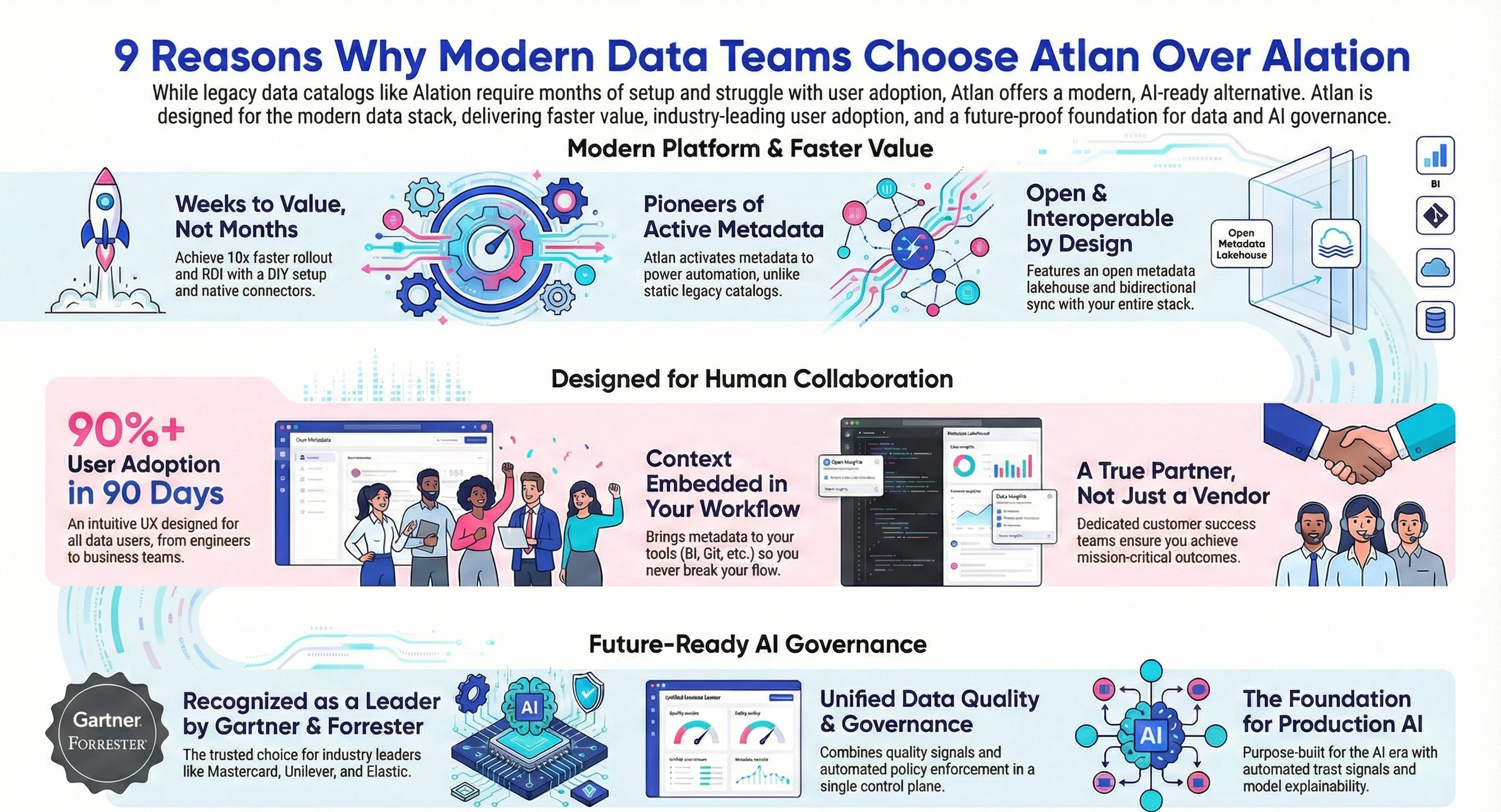
Reasons why Atlan is the best Alation alternative. Source: Atlan.
Key capabilities:
- 100+ native connectors spanning warehouses, pipelines, BI tools, ML platforms and SaaS applications
- Column-level, cross-system automated lineage out of the box, including dbt, Airflow, Fivetran, Looker and Tableau
- Active metadata engine that propagates governance tags automatically across lineage paths
- Bidirectional sync with Snowflake (tag-level), Databricks (Unity Catalog), Looker and Power BI
- AI governance module covering model lineage, AI asset registry, risk visibility and policy enforcement for agentic workflows
- DIY setup in days to weeks with no professional services required
- App framework for building custom AI-native governance applications on top of Atlan’s metadata lakehouse
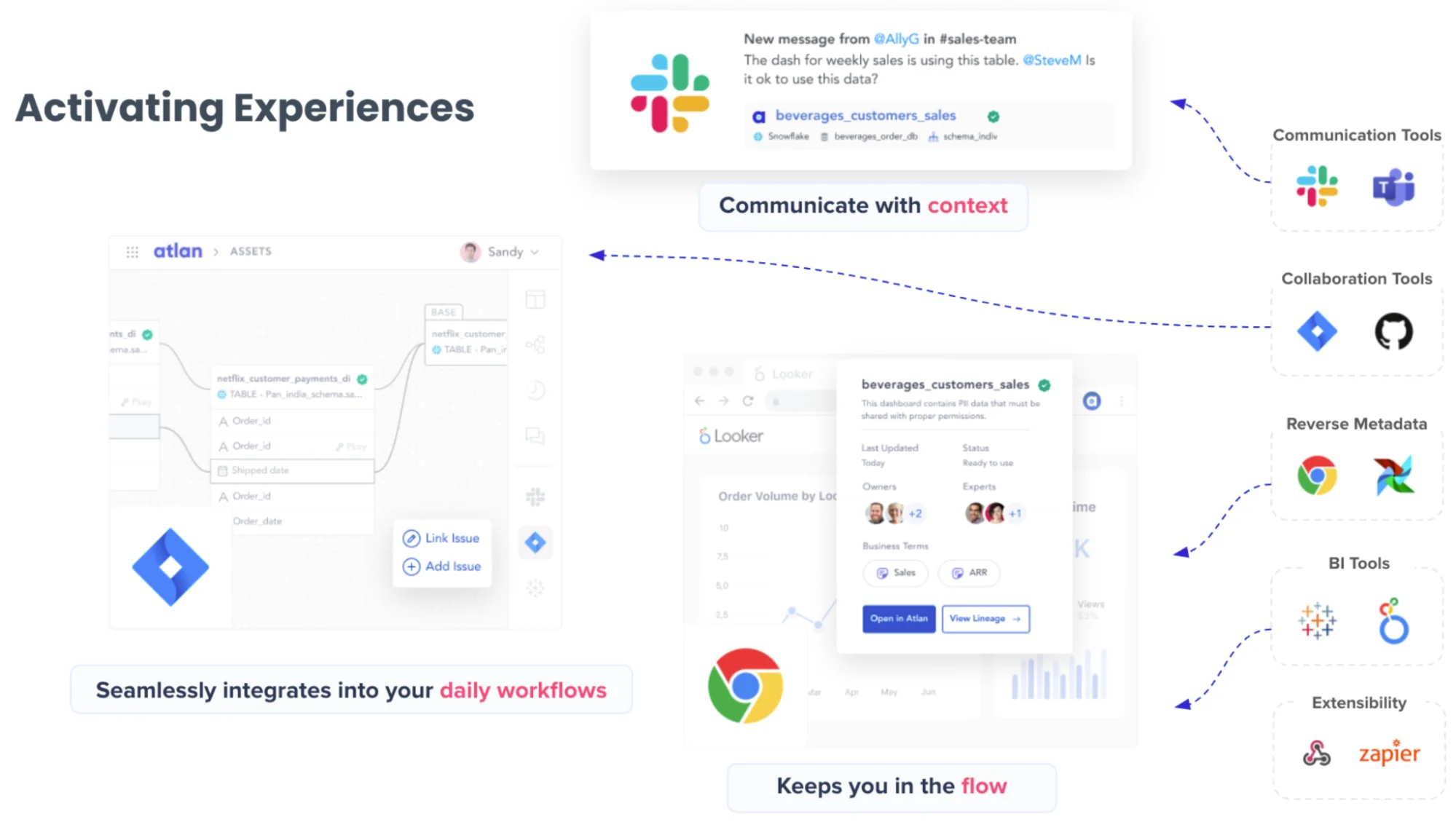
Visual representation of how Atlan activates metadata to keep you in the flow. Image by Atlan.
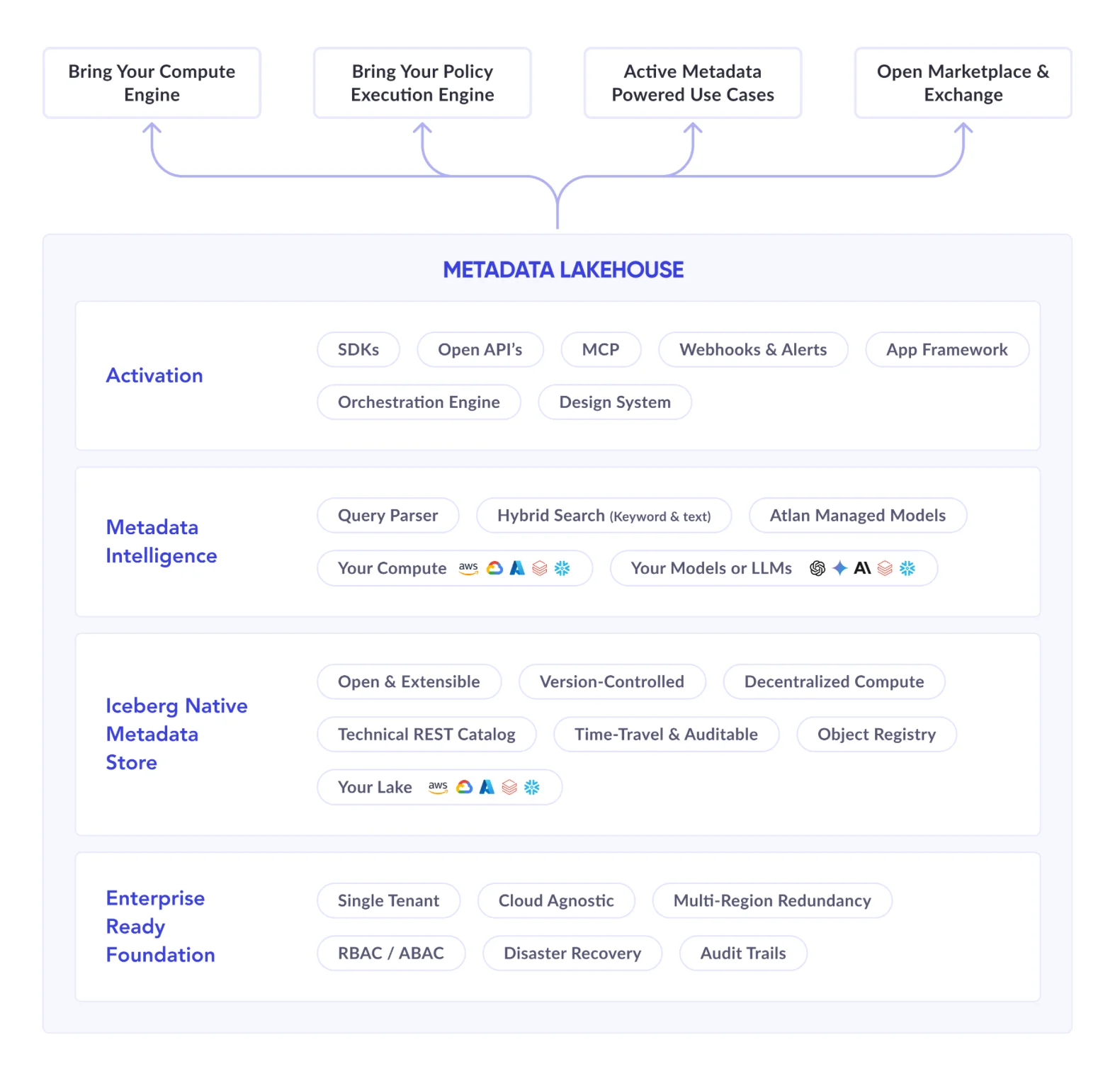
How Atlan's open metadata lakehouse future-proofs and activates your data estate. Image by Atlan.
Check out this video for a quick rundown of 20 active metadata use cases in 20 minutes.
Atlan and dbt Labs at Coalesce 2022. Source: dbt.
Pricing: Custom, contact sales. No public list pricing. Atlan positions as a premium platform; however, total cost of ownership (including professional services) is frequently lower than Alation, Collibra, or IBM when implementation time is factored in.
Analyst and peer recognition:
Atlan was named a Gartner Magic Quadrant Leader for Metadata Management Solutions in 2025 and a Leader in the Forrester Wave: Data Governance Solutions, Q3 2024. On G2, it outscores Alation on Ease of Setup, Quality of Support and Meets Requirements.
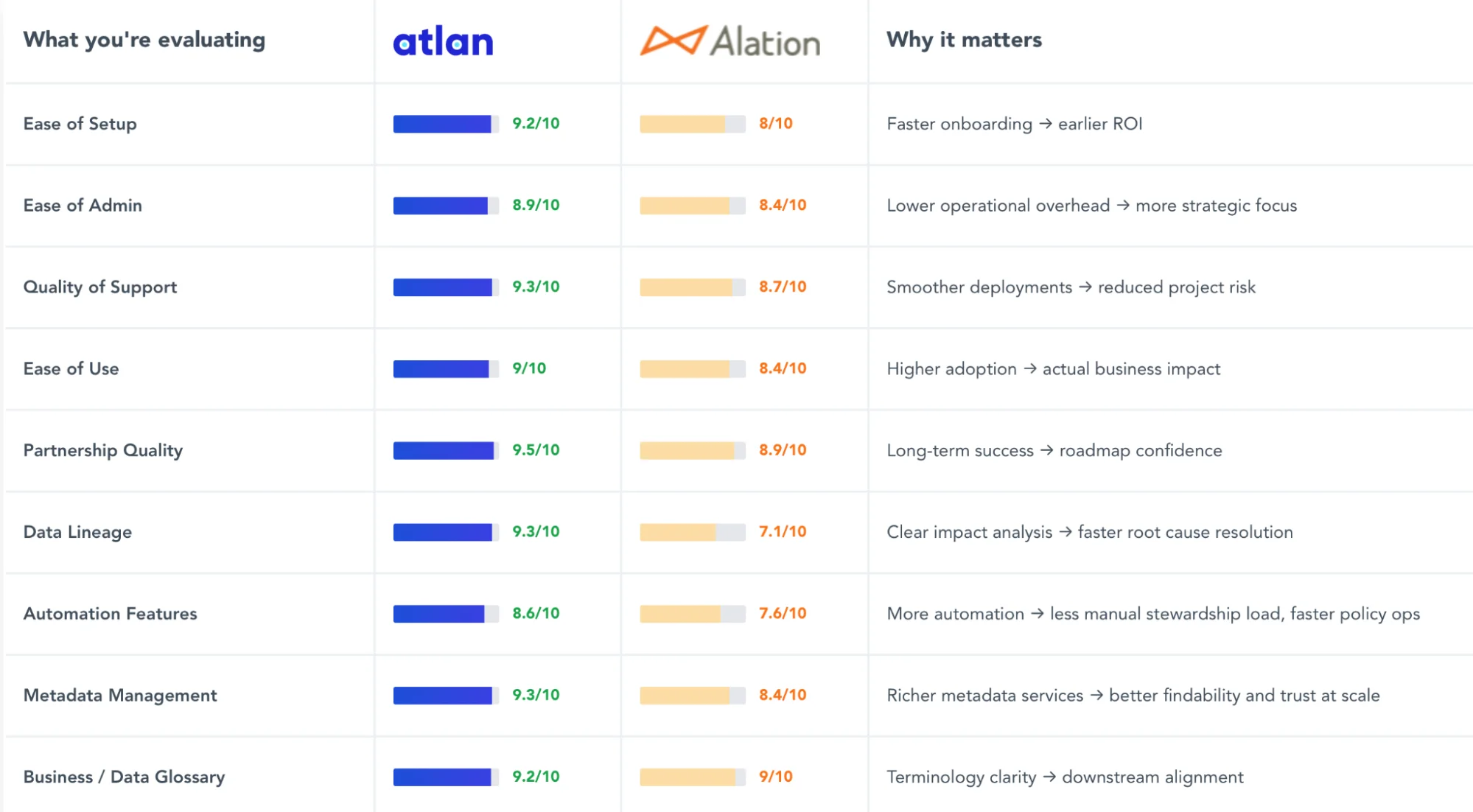
G2 data on how Atlan offers faster ROI, broader adoption, and lasting value. Image by Atlan.
Customer evidence:
Purple, Algolia, Autodesk, Mastercard, Workday and GM are among the organizations that have switched to or built on Atlan. Purple’s data governance manager noted that Atlan was already solving issues during the proof of concept before Alation was fully connected.
Not the best fit if: Your stack is predominantly on-premise, heavily IBM-centric, or you need a native Microsoft Fabric integration as your primary use case.

Why Purple chose Atlan over Alation to improve trust, context, and governance
"When it came down to it, our final two were Atlan and Alation. With Atlan, we were able to plug in our tech stack for the Proof of Concept, and we were able to do that in a matter of minutes. Our Data Engineering team were already solving issues in Atlan before Alation was even turned on, and while we were waiting for it to be connected."
Tony Baker, Data Governance Manager
Purple
2. Collibra: what it means in practice
Best for: Large regulated enterprises with complex stewardship workflows (financial services, healthcare, pharma, insurance)
G2: 4.2/5 | Gartner Peer Insights: 4.6/5 | Analyst recognition: Gartner MQ Leader, Forrester Wave Leader
Collibra is the most established governance-first platform in the enterprise data catalog market. Founded in 2008, it built its reputation on policy management, business glossary and structured stewardship workflows designed to meet regulatory requirements in financial services and healthcare. If your organization needs documented approval chains, role-based stewardship assignment and audit trails for regulatory bodies, Collibra’s workflow engine remains the deepest in the market.
Key capabilities:
- Mature workflow engine for approval, escalation, certification and policy enforcement processes
- Comprehensive business glossary with term lifecycle management and ownership assignment
- Reference data management with change tracking and lineage
- Enterprise-grade policy authoring, access governance and reporting dashboards
- Data marketplace for self-service data discovery and data product publishing
- Collibra AI Governance module for AI asset tracking and model risk management
Pricing: Enterprise contracts typically range from $170,000 to $510,000+ per year depending on modules, users and data volume. Implementation typically adds $150,000 to $500,000 in professional services costs, with deployment timelines of 6 to 12 months being common for full rollouts. Collibra does not publish list pricing.
Considerations:
Collibra’s strength is also its limitation for modern data teams: the platform is designed for governance programs with dedicated stewards, not self-service deployment. Implementation complexity is comparable to Alation and, in many cases, higher. Teams looking for fast time-to-value or a DIY setup experience should evaluate lighter-weight alternatives. G2 reviewers frequently cite complexity of configuration and the learning curve for business users as ongoing pain points.
Not the best fit if: You need fast setup, self-service onboarding, or a cloud-native-first integration experience. Collibra implementations are structured enterprise projects similar in scope to Alation.
3. Microsoft Purview: what it means in practice
Best for: Organizations standardized on Azure, Microsoft 365, or Microsoft Fabric
G2: 4.7/5 | Analyst recognition: Gartner MQ Leader, Forrester Wave Strong Performer
Microsoft Purview is Microsoft’s unified data governance and compliance service. It consolidates what were previously separate Microsoft products (Azure Purview for data governance, Microsoft 365 compliance tools and Microsoft Information Protection) into a single platform. For organizations with significant Azure or Microsoft 365 footprint, Purview offers integration depth that no third-party catalog can match: native scanning of Azure Data Lake, Azure Synapse, Microsoft Fabric and direct flow of Microsoft Information Protection sensitivity labels across the entire estate.
Key capabilities:
- Native automated discovery, scanning and classification for Azure Storage, Azure SQL, Synapse Analytics and Microsoft Fabric
- Microsoft Information Protection sensitivity labels flow natively into Purview and back into M365 and Azure services
- Unified compliance posture across Microsoft 365 and Azure data
- Data Map for automated lineage across the Azure ecosystem
- Data Policy for access governance tied to Microsoft Entra identity
- Pay-as-you-go consumption pricing; portions of Purview are included at no additional cost for organizations already on Azure
Pricing: Per-user licensing ranges from approximately $34 to $55 per user per month depending on tier, with pay-as-you-go consumption pricing for Data Map and classification features (per asset scanned or per GB processed). For Azure-heavy organizations already paying for the platform, effective incremental cost is often low. Outside Azure, Purview requires additional connectors and configuration that increase cost and complexity.
Considerations:
Purview’s integration depth outside the Microsoft ecosystem is meaningfully thinner than multi-cloud platforms like Atlan or Collibra. Snowflake, Databricks, dbt and non-Microsoft BI tools have limited native Purview support and typically require custom connector work or third-party integration. G2 reviewers note that Purview is best treated as a Microsoft-native governance layer rather than an enterprise-wide catalog. Teams running multi-cloud or AWS-primary environments frequently find Purview inadequate as a standalone solution.
Not the best fit if: Your stack spans multiple clouds, relies heavily on Snowflake or Databricks as primary platforms, or includes non-Microsoft BI tools as the primary consumption layer.
4. IBM Knowledge Catalog
Best for: Enterprises with IBM Db2, IBM Cloud Pak for Data, or Watson ML workloads
Analyst recognition: Gartner MQ Leader 2024
IBM Knowledge Catalog (formerly Watson Knowledge Catalog) is part of IBM’s Cloud Pak for Data platform. It uses Watson AI for automated metadata enrichment, data classification and quality scoring. IBM Knowledge Catalog is purpose-built for the IBM data fabric architecture and is most powerful in organizations already running IBM DataStage, IBM Db2, or Watson-based ML workflows.
Key capabilities:
- Watson AI for automated metadata classification, tagging and data quality scoring
- Tight native integration with IBM DataStage, Db2, IBM OpenScale and Cloud Pak for Data
- Policy enforcement for regulated industries via IBM OpenPages integration
- Data virtualization capabilities through IBM Watson Query
- Business glossary, lineage and data profiling built into the IBM ecosystem
- Connectivity to 100+ data sources through IBM’s connector library
Pricing: IBM Knowledge Catalog pricing is not publicly disclosed and requires direct engagement with IBM sales. Enterprise contracts are typically negotiated as part of broader IBM Cloud Pak for Data agreements. Based on analyst research and community reporting, costs are comparable to Collibra in scale, typically ranging from $100,000 to $500,000+ per year for enterprise deployments.
Considerations:
IBM Knowledge Catalog’s primary limitation outside the IBM ecosystem is integration complexity. Connecting to non-IBM data sources, cloud-native pipelines, or modern BI tools typically requires significant configuration effort. G2 and Gartner reviewers consistently cite the UI complexity and steep learning curve as barriers to broad adoption. The platform is optimized for IBM-trained administrators, not self-service deployment by data engineers or analysts. Teams running AWS, GCP, or Snowflake-primary environments frequently find IBM Knowledge Catalog misaligned with their stack.
Not the best fit if: You run a multi-cloud or AWS/GCP-primary environment, need fast time-to-value, or want a modern UI that business users can navigate without training.
5. CastorDoc: what it means in practice
Best for: Mid-market data teams wanting ease of use and fast setup without an enterprise procurement cycle
G2: 4.8/5
CastorDoc is a modern data catalog built for mid-market data teams that want fast time-to-value and AI-assisted documentation without the complexity of enterprise platforms. It has earned notably high G2 scores on usability dimensions, outscoring Alation, Collibra and many other platforms on Ease of Use and Ease of Setup. CastorDoc’s AI assistant helps teams automatically generate data dictionary entries, answer natural language questions about data assets and surface documentation gaps.
Key capabilities:
- AI-powered documentation: automatic generation of data dictionary entries and column descriptions using AI
- Natural language search across all cataloged data assets, including support for conversational queries
- Automated data lineage with visual lineage explorer
- Data quality integration for monitoring freshness and completeness
- Business glossary with term linking to physical assets
- 14-day free trial with self-service onboarding, no sales cycle required
- Transparent, tiered pricing starting at $10,000/year for the Starter plan
Pricing: CastorDoc publishes pricing tiers starting at approximately $10,000/year for the Starter plan. Growth and Enterprise tiers are priced at higher thresholds. This is considerably more affordable than Collibra, IBM, or Alation at comparable feature levels.
Considerations:
CastorDoc’s trade-off is depth versus breadth. The platform is strong on usability, AI documentation and fast deployment, but lighter on enterprise-grade lineage depth, complex governance workflows and the connector breadth needed for large, heterogeneous data estates. Organizations with hundreds of data sources, complex cross-system lineage requirements, or mature governance programs typically outgrow CastorDoc or require supplementary tooling. It is best evaluated for teams in the 10 to 100 data practitioner range looking for a catalog that is operational within a sprint.
Not the best fit if: You need enterprise-grade lineage across 50+ data sources, complex policy enforcement workflows, or coverage for a large and diverse connector library.
5 additional Alation alternatives: Snapshot profiles
The five additional Alation alternatives worth evaluating are Select Star (best for automated column-level lineage, starting at ~$300/month), data.world (best for knowledge graph and SPARQL use cases, and part of ServiceNow since July 2025), OpenMetadata (open-source, Apache 2.0, 84+ connectors, free to self-host), Alteryx (analytics-first teams that need data prep alongside governance) and Google Dataplex (GCP-native environments, replacing Google Cloud Data Catalog as of January 2026).
Select Star
Best for: Teams prioritizing automated column-level lineage and Snowflake cost intelligence
G2: 4.5/5
Select Star differentiates on the speed and depth of automated lineage. It claims 24-hour activation for core catalog and lineage features and offers Snowflake query cost analysis as a built-in capability, a practical feature for teams managing cloud data warehouse spend. Pricing is transparent and connector-based; plans start at approximately $300/month for Pro. Contact Select Star for current tier pricing.
Key strengths: Column-level lineage across all integrations, automated ERD generation, Snowflake cost analysis, same-day setup.
Limitations: Not a full governance workflow engine. Limited policy enforcement, business glossary and AI governance capabilities compared to enterprise platforms.
data.world (now part of ServiceNow)
Best for: Organizations with knowledge graph requirements, semantic layer use cases, or federated data architectures
G2: 4.2/5
ServiceNow announced its acquisition of data.world in May 2025 and closed it in July 2025, per ServiceNow’s own second-quarter results. The product is no longer an independent purchase; it is sold inside the ServiceNow AI Platform. data.world takes a graph-based approach to data cataloging, making it a strong fit for teams that need SPARQL querying, linked data standards, or federated catalog patterns across business domains. It has a strong collaborative layer and a community edition for smaller teams.
Key strengths: Graph-native architecture for rich relationship modeling, SPARQL and federated query support, strong data product collaboration features, open-source community edition available.
Limitations: Automated technical lineage from cloud data platforms is not a core strength. Best suited for semantic enrichment and knowledge graph use cases rather than pipeline lineage tracking.
OpenMetadata: what it means in practice
Best for: Engineering teams that want full open-source control with no vendor lock-in
OpenMetadata is an API-first, fully open-source metadata platform under Apache 2.0 license. Teams that prefer self-hosting, deep customization and zero licensing cost can deploy OpenMetadata on their own infrastructure. The platform has 84+ connectors, active lineage, data quality integration and profiling built in.
Key strengths: No licensing cost, API-first architecture with 84+ connectors, active community, full customizability, data quality and profiling built in.
Limitations: Requires internal engineering effort for deployment, maintenance, upgrades and connector management. No enterprise SLAs or managed cloud option without the commercial OpenMetadata Cloud tier.
Alteryx
Best for: Analytics-first organizations wanting data prep, cataloging and governance in one platform
G2: 4.6/5
Alteryx is primarily an analytics and data preparation platform that has added data cataloging and governance capabilities. It is a fit for organizations that want to reduce the number of tools in their stack and have Alteryx already as their analytics layer. Pricing varies by product tier and is available on request.
Key strengths: Unified analytics and data prep, AI-assisted workflow building, strong BI integration, accessible to non-technical users.
Limitations: Cataloging and governance are secondary capabilities, not the platform’s core strength. Not a viable standalone catalog replacement for teams with mature governance requirements.
Google Dataplex
Best for: GCP-native environments looking for a native data governance layer
G2: 4.3/5
Google Dataplex is Google Cloud’s unified data governance and metadata management service. It replaced the deprecated Google Cloud Data Catalog in January 2026. Dataplex provides automated discovery, classification, data quality monitoring and lineage for assets in Google Cloud Storage, BigQuery and other GCP services, with pay-as-you-go pricing tied to GCP consumption.
Key strengths: Deep native GCP integration, automated discovery and classification across Google Cloud, no additional vendor procurement needed for GCP-native teams.
Limitations: Connector coverage and governance depth outside the Google Cloud ecosystem is limited. Not a multi-cloud catalog. Teams running hybrid or AWS/Azure-primary stacks will find Dataplex insufficient as a standalone solution.
Atlan vs. Alation: Side-by-side comparison
| Capability | Atlan | Alation |
|---|---|---|
| Setup time | Days to weeks (DIY) | 3–9 months (professional services) |
| Deployment model | SaaS, fully managed | SaaS or on-premise |
| Connectors | 200+ native | ~100 (narrower modern stack coverage) |
| Automated lineage | Column-level, cross-system, automated | Table-level; column-level requires configuration |
| Tag propagation | Automated via active metadata engine | Manual stewardship |
| AI governance | AI asset registry, model lineage, agentic policy enforcement | Limited; roadmap-dependent |
| BI integration | Bidirectional sync with Tableau, Looker, Power BI | One-directional catalog sync |
| Pricing transparency | Custom, no public list | Custom, no public list |
| G2 rating | 4.5/5 | 4.4/5 |
| Gartner MQ | Leader 2025 | Visionary 2025 |
| Forrester Wave | Leader 2025 | Strong Performer |
| Ease of setup (G2) | 9.2/10 | 8.1/10 |
Source: G2 February 2026
How to choose the right Alation alternative
Use this decision framework to narrow your evaluation:
Choose Atlan if: You run a cloud-native stack (Snowflake, Databricks, dbt), need automated lineage and governance at scale, want DIY deployment without a multi-month services engagement, or are building toward AI governance and agentic workflow oversight.
Choose Collibra if: You are in a heavily regulated industry (financial services, healthcare, pharma) with a governance program that requires structured approval workflows, policy documentation and regulatory audit trails as primary requirements.
Choose Microsoft Purview if: Your organization is standardized on Azure and Microsoft 365, you are already paying for Azure infrastructure and your governance scope centers on Microsoft Fabric and M365 rather than a multi-cloud estate.
Choose IBM Knowledge Catalog if: Your data estate is built primarily on IBM Db2, IBM DataStage, or Watson ML and your IT organization has existing IBM licensing and IBM-trained administrators.
Choose CastorDoc if: You are a mid-market data team (10 to 100 practitioners) that wants a catalog operational within days, values AI-assisted documentation and does not need enterprise-grade lineage or complex policy workflows.
Choose Select Star if: Automated column-level lineage and Snowflake cost intelligence are your top two requirements and you want transparent, per-connector pricing with same-day activation.
Choose OpenMetadata if: You have engineering capacity to self-host, want full open-source control with zero licensing cost and need a highly customizable API-first catalog.
Choose data.world if: Your use cases center on knowledge graph modeling, SPARQL querying, linked data standards, or federated catalog patterns across business domains rather than pipeline lineage tracking, and you are willing to buy through ServiceNow.
Choose Alteryx if: You already use Alteryx as your analytics and data preparation layer and want to consolidate cataloging and governance into that existing platform rather than adding a separate tool.
Choose Google Dataplex if: Your data estate lives primarily in Google Cloud and you want native governance without adding a third-party vendor to your stack.
Frequently asked questions
What are the best Alation alternatives in 2026?
The leading Alation alternatives in 2026 are Atlan, Collibra, Microsoft Purview, IBM Knowledge Catalog, CastorDoc, Select Star, data.world (part of ServiceNow since July 2025), OpenMetadata, Alteryx and Google Dataplex. Atlan is most frequently cited as the top alternative due to its active metadata platform, DIY setup in weeks, 100+ native connectors and Gartner/Forrester Leader recognition. For mid-market teams, CastorDoc and Select Star offer faster time-to-value with transparent pricing.
What is the difference between Alation and Atlan?
Alation is a traditional catalog focused on search, stewardship and BI documentation, typically requiring 3 to 9 months to deploy with professional services. Atlan is an active metadata platform that automates tag propagation across lineage paths, embeds governance context into source systems and deploys in days to weeks via a DIY process. Atlan covers AI governance and agentic workflow oversight; Alation’s AI governance is limited. Atlan holds Gartner and Forrester Leader positions in 2025; Alation holds Visionary and Strong Performer positions respectively.
What are the open-source alternatives to Alation?
The primary open-source alternatives to Alation are OpenMetadata (Apache 2.0, 84+ connectors), Apache Atlas, and DataHub (by LinkedIn, Apache 2.0). Amundsen is still widely deployed but is no longer a candidate for a new build: the project was archived in September 2026 and its repository is read-only. All require internal engineering effort for deployment and maintenance but carry no licensing cost, making them attractive for engineering-led teams with infrastructure capacity.
Is Atlan easier to set up than Alation?
Yes. Atlan’s DIY setup uses automated connector configuration and prebuilt workflows to get teams operational in days to weeks. Alation’s typical deployment timeline is 3 to 9 months, often requiring a professional services engagement. G2 rates Atlan’s Ease of Setup at 9.2/10 versus Alation’s 8.1/10.
How does Alation compare to Microsoft Purview?
Alation has broader connector coverage outside the Microsoft ecosystem. Purview has deeper native integration with Azure, Fabric and M365 than any third-party vendor can match. For Azure-standardized organizations, Purview is cost-effective as portions are included in existing Azure licensing. For multi-cloud environments, neither Alation nor Purview offers the cross-cloud automation depth of modern alternatives like Atlan.
Which Alation alternatives work best for AI and LLM governance?
Atlan leads for AI governance with an AI asset registry, model lineage, risk visibility and policy enforcement for agentic workflows. Collibra has added AI governance focused on policy and compliance documentation. Microsoft Purview covers AI governance within the Microsoft Fabric and Azure AI ecosystem. IBM Knowledge Catalog integrates AI governance through Watson and IBM OpenScale.
What should I consider before migrating from Alation?
Key evaluation factors include connector coverage for your stack, automated lineage depth (column-level, cross-system), AI governance readiness, DIY setup availability, business-user adoption design, policy enforcement capabilities and long-term total cost of ownership including implementation services. Run a proof of concept that tests lineage accuracy, search relevance and policy enforcement on a representative subset of your actual data assets before committing.
How much does Alation cost compared to alternatives?
Alation pricing is not publicly disclosed. Comparable alternatives: Collibra enterprise contracts typically run $170,000 to $510,000+ per year. Microsoft Purview ranges from approximately $34 to $55 per user per month depending on tier. CastorDoc starts at $10,000 per year. Select Star starts at approximately $300 per month for the Pro plan. OpenMetadata is free to self-host. Atlan pricing is custom; total cost of ownership when implementation time is factored in is frequently lower than Alation, Collibra, or IBM.
What is Google Dataplex and is it an Alation alternative?
Google Dataplex is Google Cloud’s unified data governance service that replaced Google Cloud Data Catalog in January 2026. It provides automated discovery, classification and lineage for GCP-native data assets with pay-as-you-go pricing. It is a viable Alation alternative for organizations with a GCP-primary stack. Outside the Google Cloud ecosystem, its connector coverage is limited compared to multi-cloud alternatives.
What is the cheapest Alation alternative?
OpenMetadata is free under Apache 2.0 license with no licensing cost (infrastructure and engineering effort required). CastorDoc offers the lowest commercial entry point at $10,000 per year with a 14-day free trial. Select Star offers transparent connector-based pricing starting at approximately $300 per month for the Pro plan. Microsoft Purview can be near zero incremental cost for Azure-heavy organizations already paying for Microsoft cloud infrastructure.
