
























What are the six stages of the data product lifecycle?
Permalink to “What are the six stages of the data product lifecycle?”Although there is no formal agreement on the exact stages of the data product lifecycle, the following six broadly align with most implementations. Each data product lifecycle stage includes strong governance checkpoints.
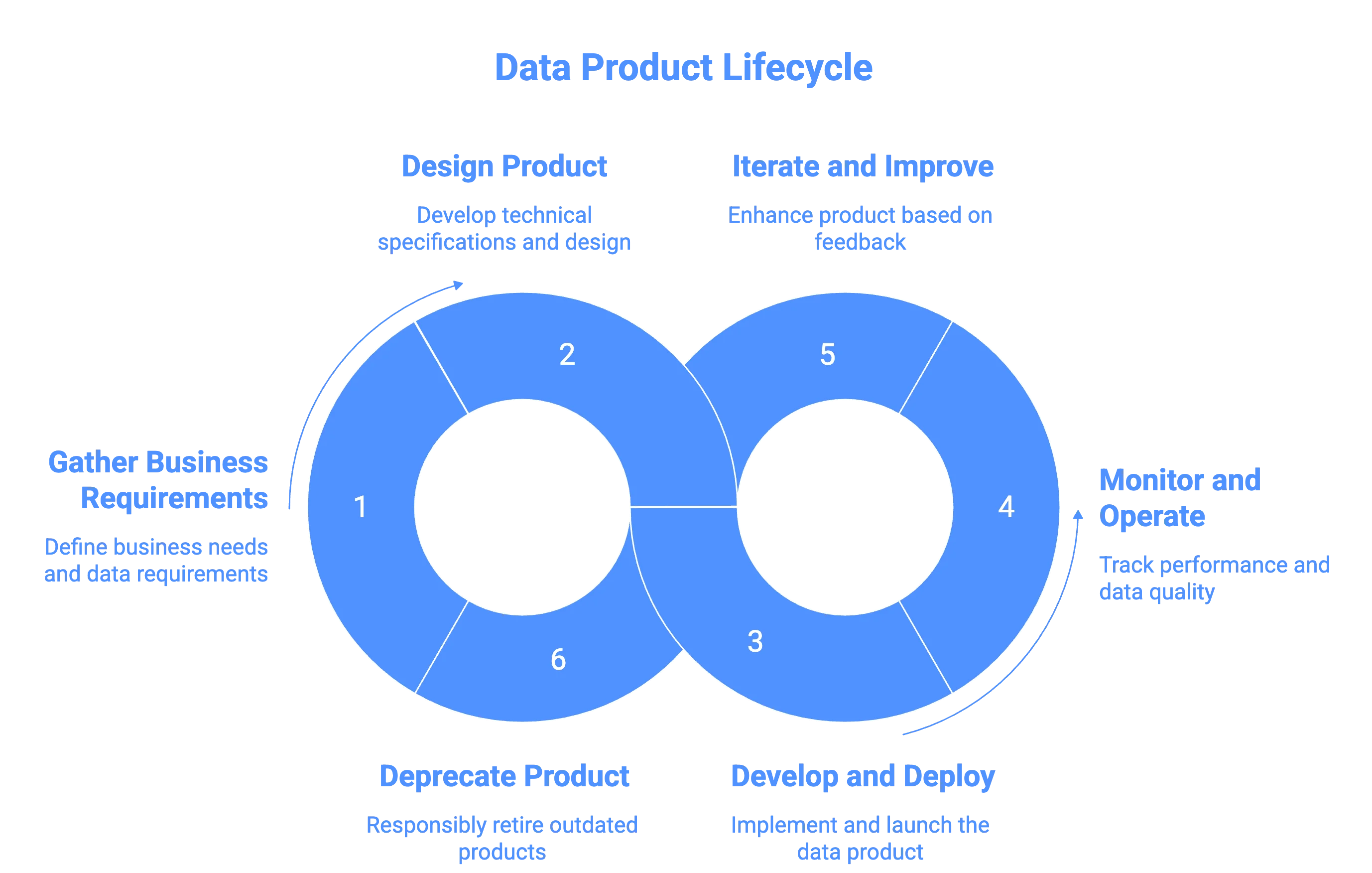
The six stages of a data product lifecycle. Source: Atlan.
1. Business requirement gathering: in practice
Permalink to “1. Business requirement gathering: in practice”Define the business problem or use case clearly. Also establish core governance requirements—ownership, data quality, security, compliance.
2. Data product design: in practice
Permalink to “2. Data product design: in practice”Draft the product’s technical design, including schemas, lineage, metadata, and governance guardrails.
Define data contracts to formalize expectations between producers and consumers. This step also aligns the data product with naming conventions and domain-specific standards.
3. Development and deployment: in practice
Permalink to “3. Development and deployment: in practice”This is where you do the technical implementation of the data product based on the requirements and design completed in the previous steps. Make sure that you:
- Build the product using clean, documented, high-quality data.
- Test functionality, usability, and data integrity.
- Deploy to internal or external users.
- Make it searchable, discoverable, accessible, and usable via catalogs or APIs.
- Embed governance with metadata tracking, versioning, access roles and levels, audit logs, active lineage, etc.
4. Monitoring and operations: in practice
Permalink to “4. Monitoring and operations: in practice”Track usage, performance, data freshness, quality, and SLA compliance.
Address compliance needs (like audit trails, subject access requests, or data masking) and resolve issues flagged by consumers.
5. Iteration and improvement: in practice
Permalink to “5. Iteration and improvement: in practice”Continuously iterate over the data product requirements and implement the changes without breaking the experience or usage patterns for business users already using the product.
Use feedback and telemetry to improve usability and trust, triggering iterative improvements.
6. Deprecation: in practice
Permalink to “6. Deprecation: in practice”Once the data product has served its purpose or reaches its end of life—due to low usage, redundancy, or risk—it must be responsibly decommissioned.
Archive or remove datasets, revise permissions, update documentation, and prevent outdated outputs from being used. Notify consumers, archive relevant assets, revoke access, and update lineage to reflect the deprecation.
Reminder: These stages might vary depending on your data stack, architecture, and organizational maturity.
For instance, Databricks recommends seven phases, such as “Inception → Design → Creation → Publish → Operate & Govern → Consume → Retire.”
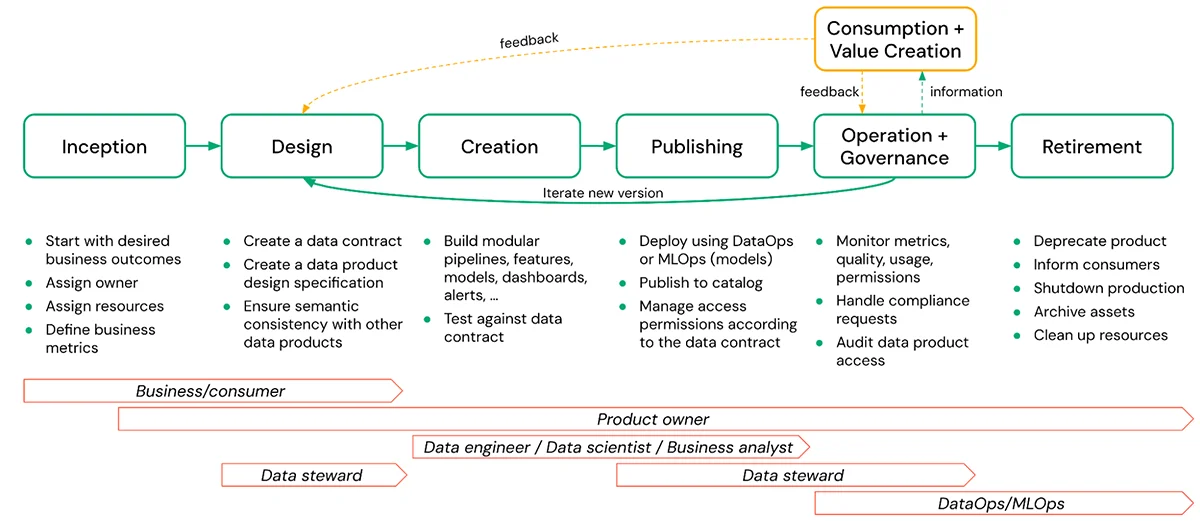
Data product lifecycle stages, according to Databrickss. Source: Databricks.
Meanwhile, Snowflake suggests a simpler, four-stage model: Discovery → Design → Development → Deployment.
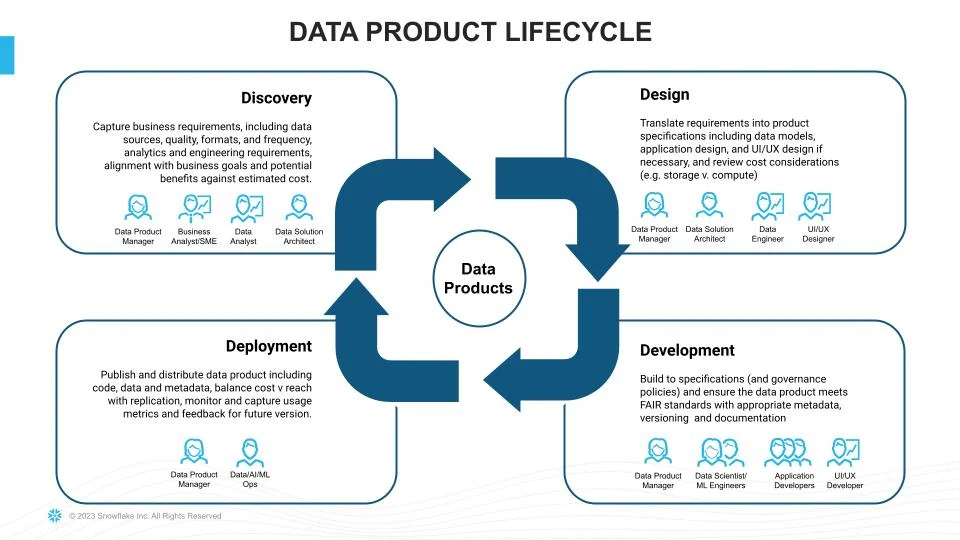
Data product lifecycle stages, according to Snowflake. Source: Snowflake.
Next, let’s look at the steps involved within each of the six data product lifecycle stages, starting with documenting requirements.
How can you define data product requirements?
Permalink to “How can you define data product requirements?”To define a data product, you first need to understand why the data product is required in the first place. Then you understand the criticality of this data product to any process within the organization.
These initial findings are narrowed down to the following four steps, which are captured in a product requirements document (PRD) for a data product. Each step should embed governance, quality, and ownership from the start.
Step 1: Identify the business purpose
Permalink to “Step 1: Identify the business purpose”- What business problem or use case does this data product solve?
- Which business outcome or decision process will it support?
- Early governance check: Define data domain, privacy classification, and high‑level owner at this stage.
Step 2: Map the intended functionality
Permalink to “Step 2: Map the intended functionality”- What applications, dashboards, AI models or interfaces will consume this data product?
- How will users access it (catalog tools, API, analytics tool)?
- Governance check: Define access model, user personas, and stakeholder roles up front.
Step 3: Define expected quality requirements
Permalink to “Step 3: Define expected quality requirements”- What standards for data quality apply (accuracy, completeness, freshness, consistency)?
- What SLAs or contracts must the product meet?
- Governance check: Record metadata requirements, approval checkpoints, and audit trails ahead of build.
Step 4: Establish clear ownership
Permalink to “Step 4: Establish clear ownership”- Who is accountable for development, deployment, maintenance, and retirement of the data product?
- What processes govern access, stewardship, and usage?
- Governance check: Data product owner, data steward roles, policy enforcement, and lifecycle controls get assigned here.
These four steps set the tone for the rest of the lifecycle.
While no universal standard exists for every data product PRD, using your organization’s product‑development and governance frameworks ensures alignment and adoptability.
What are the steps involved in data product design?
Permalink to “What are the steps involved in data product design?”Once business goals and requirements are clear, the design phase turns them into a technical and governance-ready blueprint.
This activity builds upon the product requirements and captures the next level of detail for the data product, such as:
- Structural and conceptual model of the data product
- Physical data model, i.e., schema, table design, file format, transformation logic, etc.
- Core functionality of the data product (purpose, metrics, etc.), along with DQ rules
- Embed data governance, security rules, privacy and compliance policies
- Documentation and planning for making the data product available – ensure metadata, access, and monitoring are in place for launch
The design phase should capture enough detail, both conceptual and technical, of the data product so that you can continue with the other lifecycle phases without friction.
How should you develop and deploy a data product?
Permalink to “How should you develop and deploy a data product?”The development stage is where your data product moves from spec to production — with governance, quality, and deployment workflows built in.
This is the phase where you apply all the DevOps principles and ensure the integration of tests, data contracts, security, and governance checks, among other things, all within the deployment pipelines.
You’ll iterate through the following steps until the product is ready for launch via automated pipelines:
- Build a functional prototype or the MVP data product
- Request early feedback for validation or course correction
- Run tests, document, and publish results as you go
- Test with real data and at production scale
- Deploy via Git-driven automated workflows and CI/CD pipelines – promote the product through environments (
Dev → Test → SIT → UAT → Prod)
How can you iterate on an existing data product?
Permalink to “How can you iterate on an existing data product?”A data product is created for a specific purpose or use case for a business at a point in time. Sometimes, the use case is long-running, while other times it may just be short-lived.
For instance, tracking the performance metric of a sales team is typically a long-term use case, while tracking the performance of an experimental marketing campaign is one that is in the short term.
Iterating on both use cases involves slightly different thought processes, but generally, here’s what you need:
- Monitor usage: Track who is using the data product and how it is getting used.
- Collect user feedback: Engage business stakeholders, analysts, and consumers to capture insights, frustrations, and improvement ideas.
- Assess performance: Track reliability, trustworthiness, availability, and usability metrics.
- Update governance and security: Reflect evolving access rules, privacy classifications, compliance requirements, and policy updates.
- Calculate return on investment: Track business outcomes using ROI metrics, such as adoption, decision‑impact, cost savings, or productivity improvement.
- Plan for deprecation and retirement of data products: When value diminishes or risk increases, deprecate responsibly—notify users, archive or remove assets, revoke access, and adjust lineage accordingly.
How should you deprecate stale and obsolete data products?
Permalink to “How should you deprecate stale and obsolete data products?”When a data product reaches the end of its useful life, it’s essential to retire it in a controlled, transparent way. This prevents confusion, misuse, and data quality issues.
Follow these best practices:
- Notify stakeholders: Timely communication with stakeholders about the plans for deprecation.
- Tag clearly: Tagging and certification process for marking them usable, stale, deprecated, etc.
- Plan archival or disposal: Archival, retention, and disposal plan, in accordance with the legal requirements.
- Update catalogs and docs: Synchronization with data product documentation and data catalogs.
- Redirect users: Documentation on any new data products that can be used instead of the one deprecated.
Responsible deprecation protects business trust and keeps your data ecosystem clean, usable, and compliant.
What are some of the key challenges with data product lifecycle management?
Permalink to “What are some of the key challenges with data product lifecycle management?”Each phase of the data product lifecycle comes with its own set of hurdles. The primary challenge areas are:
- Unclear or evolving business requirements at the start of the lifecycle
- Lack of discoverability and accessibility: If data products and their metadata aren’t searchable or understandable, adoption suffers.
- Inconsistent enforcement of data contracts: Without clear agreements between producers and consumers, expectations around quality, availability and usage go unmet.
- Weak governance, stewardship and ownership: When roles and responsibilities around data products are unclear, governance gaps emerge.
- Poor traceability and observability: Without reliable lineage tracking, audit logs and metadata-driven insights, it’s difficult to prove compliance and understand impacts.
- Siloed metadata and tools: Many organizations struggle with disconnected systems, inconsistent definitions and limited automation of metadata management
These challenges, more often than not, arise from the inability of an organization to access and activate in the form of insights, automation, reports, or documentation.
Metadata is key to building a product-driven production and consumption ecosystem. The proper use of metadata, i.e., via metadata activation, leads to:
- Improved discoverability and accessibility of existing data products
- Ability to enforce data contracts for all data products
- Advanced support for data governance, ownership, custodianship, and stewardship
- Assured end-to-end traceability and observability of data for auditing and compliance
A single, unified control plane for metadata like Atlan solves this by bringing all your metadata in one place. This interoperable, automated, and AI-native setup activates metadata for a slew of use cases–data discovery, contracts, governance, sharing, etc.
How to set up an end-to-end data product lifecycle with Atlan
Permalink to “How to set up an end-to-end data product lifecycle with Atlan”Atlan’s unified metadata control plane is built on the premise of integrating all of your organization’s metadata into one central repository, activating it through events, webhooks, API calls, log entries, alerts, and notifications.
Beyond this, Atlan supports an end-to-end data product lifecycle by allowing you to create domains, subdomains, domain policies, and data products within a domain. Once published, these products become discoverable, governable and optimizable across your enterprise.
All of this enables a data‑product‑driven ecosystem, characterized by automated development, observability, visibility, ownership, and quality management.
Explore how you can set up an efficient data product lifecycle with Atlan
Real stories from real customers: Activating metadata and scaling data governance with Atlan
Permalink to “Real stories from real customers: Activating metadata and scaling data governance with Atlan”
Modernized data stack and launched new products faster while safeguarding sensitive data
"Austin Capital Bank has embraced Atlan as their Active Metadata Management solution to modernize their data stack and enhance data governance. Ian Bass, Head of Data & Analytics, highlighted, 'We needed a tool for data governance… an interface built on top of Snowflake to easily see who has access to what.' With Atlan, they launched new products with unprecedented speed while ensuring sensitive data is protected through advanced masking policies."

Ian Bass, Head of Data & Analytics
Austin Capital Bank
🎧 Listen to podcast: Austin Capital Bank From Data Chaos to Data Confidence

53 % less engineering workload and 20 % higher data-user satisfaction
"Kiwi.com has transformed its data governance by consolidating thousands of data assets into 58 discoverable data products using Atlan. 'Atlan reduced our central engineering workload by 53 % and improved data user satisfaction by 20 %,' Kiwi.com shared. Atlan's intuitive interface streamlines access to essential information like ownership, contracts, and data quality issues, driving efficient governance across teams."
Data Team
Kiwi.com
🎧 Listen to podcast: How Kiwi.com Unified Its Stack with Atlan
Ready to build automated, AI-native data product lifecycles?
Permalink to “Ready to build automated, AI-native data product lifecycles?”Data products are gaining popularity by the day, thanks to the increasing adoption of the concept through data mesh and data lakehouse architecture patterns. Since data products are self-contained, they’re extremely portable, shareable, and easy to use.
To implement data products successfully, however, you need tools that support automated data quality, data contract enforcement, data discovery, governance, and security, as well as well-defined processes.
Atlan is purpose-built to support all stages of the data product lifecycle across domains and subdomains.
Atlan helps you enforce data contracts, automate quality checks, tagging, and certification (using the Data Quality Studio), and adopt an AI-native, automated approach to lifecycle management.
Combined with structured development and governance practices, it helps your organization turn data products into a scalable, trusted foundation for business success.
FAQs about data product lifecycle
Permalink to “FAQs about data product lifecycle”1. What is the data product lifecycle?
Permalink to “1. What is the data product lifecycle?”The data product lifecycle is the end-to-end process of defining, designing, building, deploying, monitoring, improving, and eventually retiring a data product.
It ensures that data products remain high-quality, trustworthy, governed, and aligned with evolving business needs.
2. What is a data product and how is it different from a data asset?
Permalink to “2. What is a data product and how is it different from a data asset?”A data asset is simply a table or view intended to be populated by an application or data pipeline. It is not specifically designed to address a particular business need. The data sources, transformation code, tests, CI/CD setup, and data contracts are all managed separately for a data asset.
A data product packages all of these in a self-contained entity, making it easy to share and use.
3. What are the stages of the data product lifecycle?
Permalink to “3. What are the stages of the data product lifecycle?”While the number of stages is not fixed, the data product lifecycle follows a directional path of discovery, design, development, deployment, usage, and retirement.
It is important to note that many stages can repeat in cycles as the data product evolves. This can be handled by Git-style versioning of the data product.
4. What “product” features does a data product have?
Permalink to “4. What “product” features does a data product have?”Like a software product, a data product is also searchable, secure, and reliable in its functionality.
Every product solves a purpose, a core need. The same applies to a data product. For instance, a data product might address the analytics requirements for a one-week campaign that you are planning to run.
5. Can a data product only be used with a data mesh pattern?
Permalink to “5. Can a data product only be used with a data mesh pattern?”The data mesh architecture popularized data products, but a data product can exist without that architecture, as long as product thinking is applied to data.
It should fulfill the definition of a data product, i.e., a self-contained entity of data that serves a specific business use case.
6. What role do data contracts play in data products?
Permalink to “6. What role do data contracts play in data products?”Data contracts serve as agreements between data product creators (producers) and users (consumers), ensuring the quality, reliability, and usability of the data. They define data’s structure, format, quality standards, and usage rights, preventing issues from unexpected changes in upstream systems and fostering trust and collaboration across teams.
By enforcing these agreements, data contracts facilitate more efficient data management, resulting in more trustworthy and valuable data products.
Share this article
