

Microsoft Agent Framework is an open-source SDK and runtime for building, orchestrating, and deploying AI agents and multi-agent workflows in .NET and Python. It is the direct successor to Semantic Kernel and AutoGen, and it shipped version 1.0 on April 3, 2026, with stable APIs and a long-term support commitment. Orchestration frameworks like this one decide how an agent plans and calls tools; they say nothing about whether the data behind those calls is current, certified, or governed, which is the gap Atlan’s context layer for AI closes underneath them.
| Quick facts | |
|---|---|
| Vendor | Microsoft |
| License | MIT (open source) |
| Predecessor frameworks | Semantic Kernel (public repo March 2023) and AutoGen (maintenance mode since October 2, 2025) |
| Public preview | October 2025 |
| Version 1.0 GA | April 3, 2026 |
| Languages | .NET, Python, and Go (public preview) |
| Model providers | Microsoft Foundry, Azure OpenAI, OpenAI, Anthropic, AWS Bedrock, Ollama |
| Standards support | MCP, A2A, AG-UI, OpenAPI |
What does Microsoft Agent Framework do?
Microsoft Agent Framework (MAF) gives .NET and Python developers a clean programming model for agent logic: chat clients, tools, context providers, middleware, and multi-step workflows.
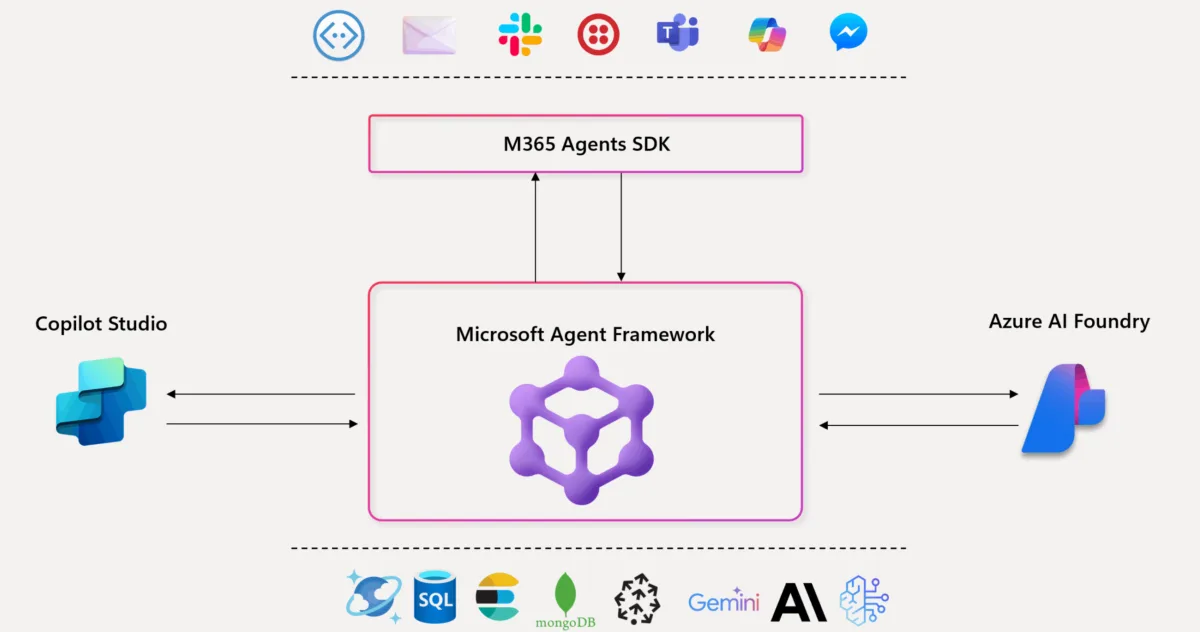
Source: Microsoft Foundry Blog
It combines three existing Microsoft solutions:
- Semantic Kernel for agent orchestration.
- AutoGen for multi-agent collaboration.
- Microsoft.Extensions.AI for providing the standardized AI building blocks for .NET developers.
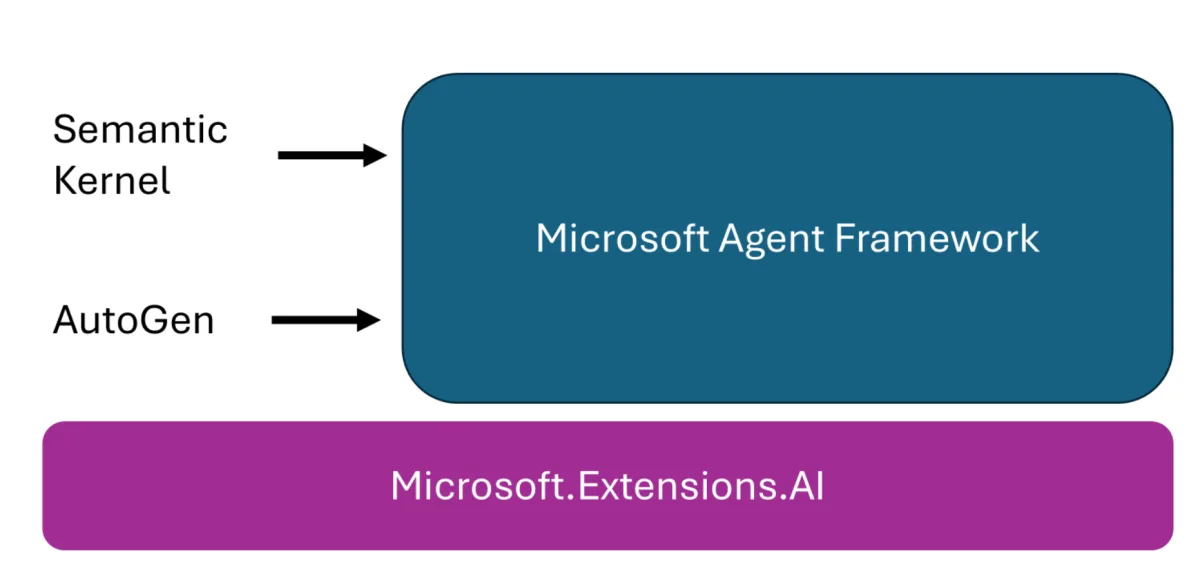
Source: Microsoft .NET Blog
Microsoft shipped version 1.0 on April 3, 2026, positioning MAF as its primary path for developers building AI agents, with deep hooks into Azure, Microsoft Foundry, and broad model support.
9 key capabilities of Microsoft Agent Framework
Its top capabilities:
-
Single-agent abstractions: AIAgent gives one interface for any model behind Microsoft.Extensions.AI’s IChatClient, with type-safe function tools that let agents call your code.
-
Harness Agent: A Harness Agent is an opinionated, ready-made agent for long, multi-step autonomous work, wrapping a chat client with planning, todo tracking, context compaction, file-based memory, approval-gated tools, and pre-wired telemetry in a single call. See agent harness vs agent framework for how it differs from a hand-rolled agent loop.
-
Multi-agent workflows: Functional and graph-based workflows give explicit control over execution paths: sequential, concurrent, handoff, and group chat patterns, plus research patterns like Magentic-One.
-
Integrations: Connections to model providers, agent services, tools, middleware, evaluation services, and UI frameworks.
-
Memory management: Sessions and threads manage conversation state across turns and long-running tasks.
-
Context providers: The memory mechanism supplying agents persistent knowledge between sessions, distinct from retrieval-augmented generation over a document store.
-
Middleware: Interception points for agent actions where teams add access controls, guardrails, and policy logic.
-
Observability: Built-in OpenTelemetry integration emits traces, logs, and metrics following the GenAI Semantic Conventions, giving teams agent observability inside the monitoring stack they already run.
-
Open standards support: Native support for MCP for tool discovery, A2A for cross-runtime coordination, AG-UI for streaming agent output to frontend surfaces, and OpenAPI for wrapping any API as a tool.
Which capabilities are still in preview?
MAF 1.0 is stable, but several surfaces are still maturing:
-
Go SDK: The Agent Framework for Go is in public preview; declarative agents, RAG, CodeAct, and functional workflows aren’t available there yet.
-
CodeAct: Writing one short program to call multiple tools ships in alpha packages, with sandboxed execution in isolated Hyperlight micro VMs.
-
Beta integrations: Foundry hosting, Gemini, Mistral, and other tooling packages sit at beta, below the stable tier.
-
AF Labs: Experimental packages cover benchmarking, reinforcement learning, and research, isolated from the stable installation surface used at production scale.
-
DevUI: A development interface for local testing, not a production surface.
This is orchestration mechanics moving fast. What an agent is allowed to know and trust is decided a layer down, and nothing here changes that.
Who is Microsoft Agent Framework for?
MAF targets teams taking agents from prototype to production rather than hobbyist experimentation. Four groups get the most value from it, and each is solving a slightly different problem with the same framework.
-
Enterprise .NET and Python teams: Organizations already invested in Microsoft’s developer stack get one consistent agent model across both languages, instead of maintaining separate mental models for a .NET service layer and a Python data science team building the same kind of agent.
-
Semantic Kernel and AutoGen users: Both communities are directed to MAF as the successor, with migration assistants that analyze existing code and generate step-by-step plans, closing the fragmentation two competing frameworks created. A team that spent a year choosing between the two no longer has to defend that choice going forward.
-
Azure and Foundry shops: Teams deploying on Azure AI Foundry gain observability, durability, and compliance hooks without building hosting infrastructure themselves, which matters more the moment an agent moves from a demo to something a customer or regulator can see.
-
Teams choosing between frameworks: Anyone still weighing MAF against LangGraph, CrewAI, or a cloud-native option like Google ADK or AWS Bedrock Agents benefits from a structured framework comparison rather than a feature-by-feature guess; see how to choose an agentic framework for the enterprise.
None of these four groups picks MAF for the same reason, but they run into the same wall once the agent is live: the framework tells you it executed successfully, not whether the answer it gave was the right one.
Semantic Kernel vs. Microsoft Agent Framework: What has changed?
Microsoft describes MAF as Semantic Kernel v2.0, built by the same team. The table below breaks down what moved.
| Semantic Kernel + AutoGen (before) | Microsoft Agent Framework (now) |
|---|---|
| Two separate frameworks: one for enterprise plumbing, one for multi-agent chat | A single SDK carrying Semantic Kernel’s enterprise features (session state, type safety, filters, telemetry, wide model support) plus AutoGen’s agent abstractions |
| Prompt-based planners decide the next step | Graph-based workflows with sequential, concurrent, handoff, and group chat patterns, streamed and checkpointed |
| Kernel-centered construction | Agent and chat-client primitives |
| MCP, A2A, and AG-UI added later, unevenly | MCP, A2A, and AG-UI ship natively from day one |
What is the current status of Semantic Kernel and AutoGen?
Microsoft has committed to supporting Semantic Kernel v1.x for at least one year after MAF’s general availability, which was April 3, 2026, and to keep addressing critical bugs and security issues in that window. Microsoft has not published a fixed end date. AutoGen moved to maintenance mode on October 2, 2025: it receives critical bug fixes and security patches, no new features, and is community managed going forward.
New features land only in Agent Framework, so stable production systems can stay put for now, but new projects should start on MAF. For a deeper look at that decision, see Atlan’s guide to Semantic Kernel’s features, status, and successor.
What are the top use cases for Microsoft Agent Framework?
The biggest use cases of Microsoft Agent Framework involve multi-agent orchestration, where the value comes from splitting a task across specialists rather than asking one model to do everything. Examples include:
-
Copilots and assistants grounded in company tools and APIs, from support triage bots that pull order status and policy terms before replying, to internal knowledge assistants that answer a question once instead of routing it to three different Slack channels.
-
Multi-agent business workflows, such as a handoff workflow routing a customer query between a knowledge agent and a billing specialist, or a group chat of research, drafting, and review agents that iterate on a document the way a small team would, with checkpoints instead of a single unreviewed pass.
-
Long-running, human-in-the-loop processes like approval chains, compliance reviews, and document pipelines that pause for people, checkpoint state, and resume days later, without a person having to re-explain the task from scratch each time they return to it.
-
Cross-runtime agent fleets, where A2A messaging lets MAF agents coordinate with agents built on other frameworks, vital for heterogeneous AI estates that span LangChain and homegrown tooling alike, since few enterprises standardize on one agent framework across every team.
Every one of these patterns still assumes the agent already knows what “the customer,” “the invoice,” or “compliant” means inside your business. MAF doesn’t supply that part, and neither does any other orchestration framework; it is a decision the enterprise has to make and maintain separately, on purpose.
Why does Microsoft Agent Framework need an enterprise context layer for AI?
MAF solves how agents run, but not what they know. Microsoft’s own documentation notes that developers remain responsible for quality, reliability, and trustworthiness of what they build. In enterprise deployments, those properties depend on context the framework never sees.
Three gaps show up consistently once teams move past pilots.
-
Shared business meaning sits outside the SDK: MAF’s documented surface is agents, tools, workflows, context providers, middleware and telemetry. Business semantics are not in it, so nothing in the framework settles which of several conflicting definitions of “revenue” is canonical, or which dataset was certified.
-
Freshness and lineage come from upstream systems: An agent can execute a workflow perfectly over a stale metric or a broken pipeline, producing confident answers that are wrong in the business sense.
-
Consistency across agents is an architecture decision, not a framework setting: Ten well-built MAF agents across finance, sales, and operations can still give ten different answers, because each assembles its own context in isolation, the same context management problem that shows up whether the agents run on MAF, LangGraph, or CrewAI.
This is where the context layer sits in the enterprise AI stack: below orchestration frameworks and above raw data, supplying the governed definitions, lineage, quality signals, and policy rules every agent should share. Atlan, the Context Layer for AI, fills exactly this gap.
Atlan’s Context Engineering Studio turns existing enterprise knowledge into agent-ready context, packaged as versioned, model-agnostic context repositories, while Agentic Data Stewards keep that context current as the data estate changes.
The connection point is the standard MAF already speaks. Atlan’s MCP server exposes the context layer to any MCP-compatible agent, so a MAF agent can check what an asset means, whether it is trusted, and which policies apply at reasoning time instead of guessing, and that same context travels with the agent if the team later migrates orchestration frameworks.
How does Atlan give Microsoft Agent Framework agents trusted context over MCP?
Both Microsoft Agent Framework and Atlan’s MCP server implement the same open protocol. That protocol, not a dedicated integration between the two products, is what lets an Agent Framework agent reach governed context: it connects to any MCP-compliant server through a local tool pattern such as MCPStreamableHTTPTool, discovers the tools that server exposes, and hands them to the agent, the same connect, discover, and call sequence any MCP client and server share. Atlan’s MCP server is one of those servers: a standard, spec-compliant endpoint exposing tools for search, lineage, and metadata curation, functioning as a context layer reachable over MCP, not a custom bridge built for this framework.
Atlan’s MCP server speaks the same protocol Agent Framework’s MCP tools already know how to call: no Agent Framework-specific integration is required, and none is currently documented on either side. Atlan’s own MCP documentation names Microsoft Copilot Studio as a supported client; Agent Framework is not named there. That means the connection is architecturally possible, not confirmed or tested by either company today.
Take a finance analyst who asks an Agent Framework agent, “What was Q3 revenue, and can I trust this number?” Without a context layer, the agent calls whichever tool resolves “revenue” fastest, a Fabric semantic-model measure or a Power BI column, and returns a confident figure with no way to know if it’s deprecated or duplicated. With Atlan’s MCP server registered as a tool source, the agent calls search_assets for “revenue” and gets back several candidates instead of one silently chosen: a certified glossary term, a semantic-model measure, and an older, deprecated column. It calls traverse_lineage on the top candidate to confirm what feeds it and whether the upstream pipeline is current, surfacing the owning team. Certificate status, the field update_assets writes to, comes back with the asset, so the agent can state the figure, name it as the certified definition, credit the owner, and flag that two other same-named assets exist and went unused.
Agent Framework decided which tool to call and in what order. Atlan’s MCP server is what let it know which answer to trust: the certified definitions and ownership that turn a guess into an answer with receipts.
Building on Microsoft Agent Framework without the context gap
Microsoft Agent Framework is a credible choice for agent development on the Microsoft stack. Version 1.0 delivers stable APIs, real multi-agent orchestration, open standards support, and a path from laptop to Foundry-hosted production. Teams on Semantic Kernel or AutoGen have clear migration guides and a support window generous enough to move deliberately, rather than a hard cutoff that forces a rewrite under deadline pressure.
The framework decision, however, is only half the architecture. Agents built on MAF will only be as accurate as the context they can reach, and no orchestration layer, this one included, supplies governed definitions, lineage, or policy rules on its own. That work doesn’t disappear just because the SDK handles planning and tool calls; it moves to whichever team owns the data the agent reads from, whether anyone assigned it to them or not.
Pair the framework with an enterprise context layer for AI like Atlan that keeps enterprise knowledge current, consistent, and queryable over MCP, so the question isn’t whether an agent CAN call a tool, but whether it should trust what that tool just told it.
FAQs about Microsoft Agent Framework
1. Is Microsoft Agent Framework still in preview?
No. It entered public preview in October 2025, reached Release Candidate on February 19, 2026, and shipped version 1.0 on April 3, 2026 with stable APIs and a long-term support commitment from Microsoft.
2. How is Microsoft Agent Framework different from Semantic Kernel?
Microsoft Agent Framework is the direct successor to Semantic Kernel, built by the same team. It combines Semantic Kernel’s enterprise features with AutoGen’s agent abstractions and adds graph-based workflows.
3. Does Microsoft Agent Framework support MCP and A2A?
Yes. Agents can dynamically discover and invoke tools exposed by MCP-compliant servers, and the A2A protocol enables structured coordination with agents running in other frameworks. OpenAPI integration covers conventional APIs.
4. Why should you use Microsoft Agent Framework?
Use it when you need a supported path from agent prototype to production. It gives you one programming model across .NET and Python, multi-agent workflows with checkpointing and human-in-the-loop control, and built-in enterprise controls like OpenTelemetry observability and middleware, plus Microsoft’s long-term support commitment and a managed deployment target in Foundry Hosted Agents.
5. Does Microsoft Agent Framework only work with Azure OpenAI?
No. Through the IChatClient abstraction it supports Microsoft Foundry, Azure OpenAI, OpenAI, Anthropic Claude, AWS Bedrock, Ollama, and other providers, and you can swap providers without rewriting agent code.
6. How is Microsoft Agent Framework different from LangChain or CrewAI?
All three are orchestration frameworks, but Agent Framework differentiates on first-class .NET support, a unified .NET and Python programming model, enterprise durability features like checkpointing and sessions, and native deployment into Foundry Agent Service. LangChain and CrewAI remain Python-centric with broader community tooling.
7. Should I migrate from Semantic Kernel to Microsoft Agent Framework?
For new projects, start on Agent Framework directly. For stable production systems, migration can wait: Microsoft has committed to critical bug and security fixes for Semantic Kernel v1.x for at least one year after Agent Framework’s general availability, which was April 3, 2026.
Sources
- Introducing Microsoft Agent Framework, Microsoft Azure Blog
- Introducing Microsoft Agent Framework (Preview): Making AI Agents Simple for Every Developer, Microsoft .NET Blog
- Agent Harness, Microsoft Learn
- Workflows, Microsoft Learn
- Introducing Microsoft Agent Framework: The Open-Source Engine for Agentic AI Apps, Microsoft Foundry Blog
- Semantic Kernel and Microsoft Agent Framework, Microsoft Agent Framework Blog
- Migrate Your Semantic Kernel and AutoGen Projects to Microsoft Agent Framework Release Candidate, Microsoft Agent Framework Blog
- Microsoft Agent Framework Version 1.0, Microsoft Agent Framework Blog
- Microsoft Agent Framework at BUILD 2026, Microsoft Agent Framework Blog
- Microsoft Agent Framework Overview, Microsoft Learn
- Semantic Kernel to Microsoft Agent Framework Migration Guide, Microsoft Learn
- microsoft/agent-framework, GitHub
- Magentic-One: A Generalist Multi-Agent System for Solving Complex Tasks, Microsoft Research
