



What are the key factors to consider for data governance readiness assessment?
An agent inherits the governance rules of the data it reads. Without governance, agents leak data they shouldn’t. A readiness assessment tells you whether your organization can set those rules reliably before agents start acting on your data.
A readiness assessment should evaluate your organization across these factors:
- Current state of data and context management
- Data governance goals and objectives, such as regulatory compliance, analytics enablement, or AI readiness
- Data governance maturity level, identifying strengths and weaknesses in current practices
- Stakeholders and their roles, responsibilities, and skills across teams
- Data governance processes for policy setting, enforcement, and lifecycle management
- Data governance technology for context management, lineage tracking, and quality monitoring
- AI and automation capabilities available to operationalize governance
- Data governance risks and challenges
- Implementation roadmap and change management as needs evolve
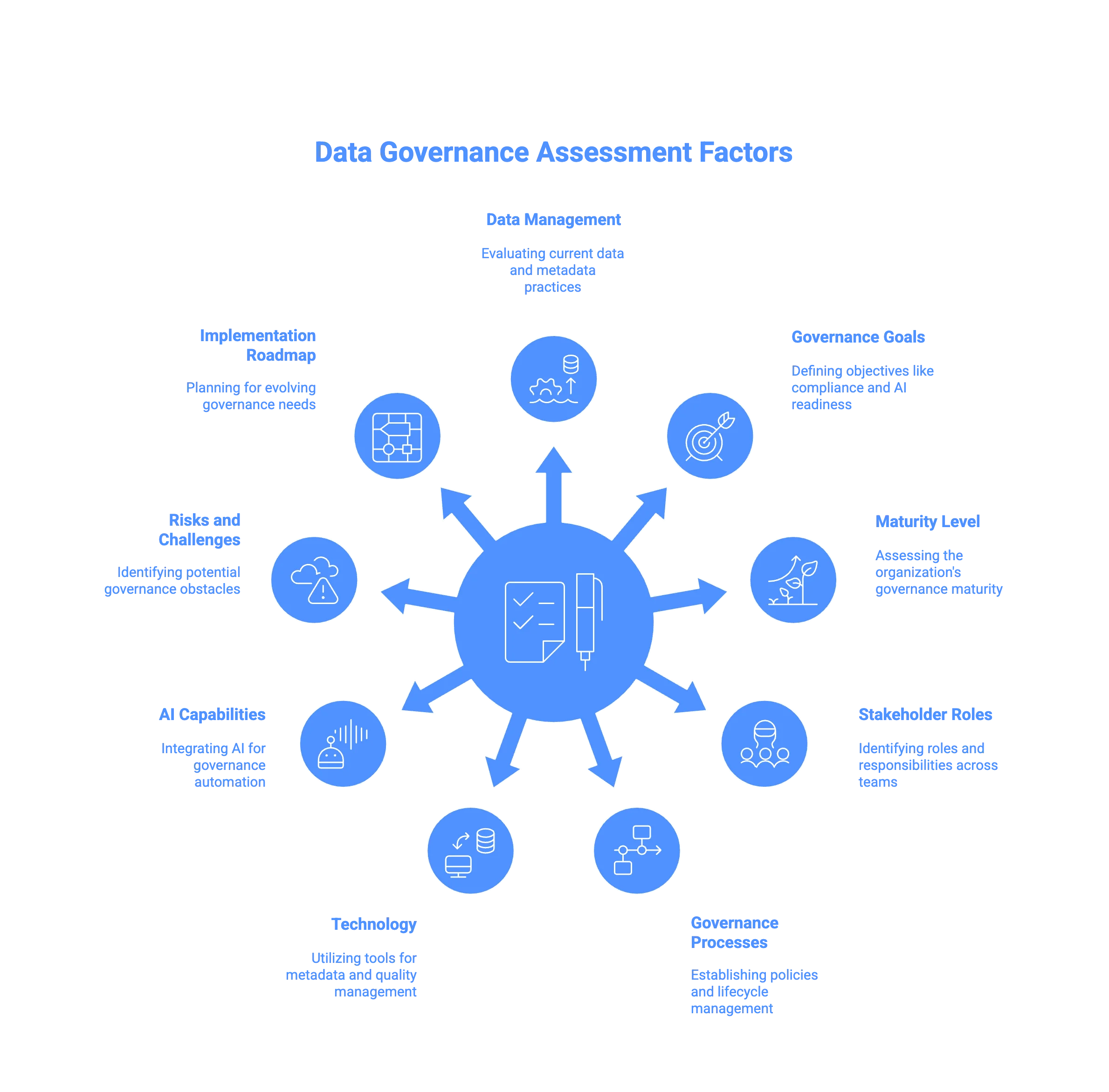
Key factors for data governance readiness assessment - Image by Atlan.
Move from readiness to results—answer 12 quick questions and get your 90‑day governance roadmap.
Get your personalized 90-day governance roadmap
Get My Governance RoadmapWhat are the benefits of conducting a data governance readiness assessment?
A data governance readiness assessment is vital for any organization looking to maximize the value of its data assets and achieve its business objectives.
The readiness assessment can offer direct and indirect benefits, such as:
- Improved data quality: Helps identify and address data quality gaps to ensure accuracy, completeness, and reliability.
- Informed decision-making: Supports building a stronger data governance framework, which bolsters governance foundations so leaders can make decisions backed by trusted, reliable data.
- Alignment with business goals: Ensures governance practices are in sync with broader organizational objectives and strategic priorities.
- Cost savings: Efficient data governance reduces costly data errors, increases operational efficiency, and minimizes compliance penalties.
- Enhanced compliance and security: Evaluating compliance posture and risk management helps mitigate data-related risks and meet regulatory requirements.
Benchmark your governance maturity against peers and turn it into a 90‑day roadmap you can execute.
Benchmark your governance maturity now
Get My Governance RoadmapHow this fits in the context layer
Data governance is one piece of the broader context layer, the bedrock that makes every AI agent in your business useful, accurate, and trustworthy. It connects to:
- Data lineage: How an agent traces an answer back to source so the output is auditable and trustworthy.
- The context layer’s asset index: Where an agent finds the right table to answer a business question, its index of trusted assets.
- Compliance: The policy guardrails an agent inherits so every answer respects GDPR, HIPAA, EU AI Act, and internal rules from the first token.
Together, these surfaces give every agent, be it Genie, Cortex, Claude, Cursor, and the next one, the same governed view of your business.
How to perform a data governance readiness assessment in 9 steps
A structured approach ensures your assessment delivers actionable insights. Here’s the process:
- Assess the current state of data and context management: Use a structured evaluation to review existing processes, workflows, and tools.
- Define goals and objectives: Clarify why you’re conducting the assessment, whether that’s regulatory compliance, AI enablement, or data quality.
- Assemble your assessment team: Include data owners, stewards, governance leads, technical teams, and business stakeholders.
- Gather data and document it: Collect policies, standards, data inventories, lineage diagrams, and existing governance workflows.
- Conduct stakeholder interviews: Understand how different teams manage, access, and use data in practice.
- Assess organizational readiness: Evaluate culture, skill levels, resources, and willingness to change.
- Rate maturity level: Score each factor against predefined maturity levels to find strengths and weaknesses.
- Document risks and identify gaps: Note compliance risks, technical limitations, process inefficiencies, and AI governance challenges.
- Develop recommendations and a roadmap: Address high-impact gaps first, and track progress against it.
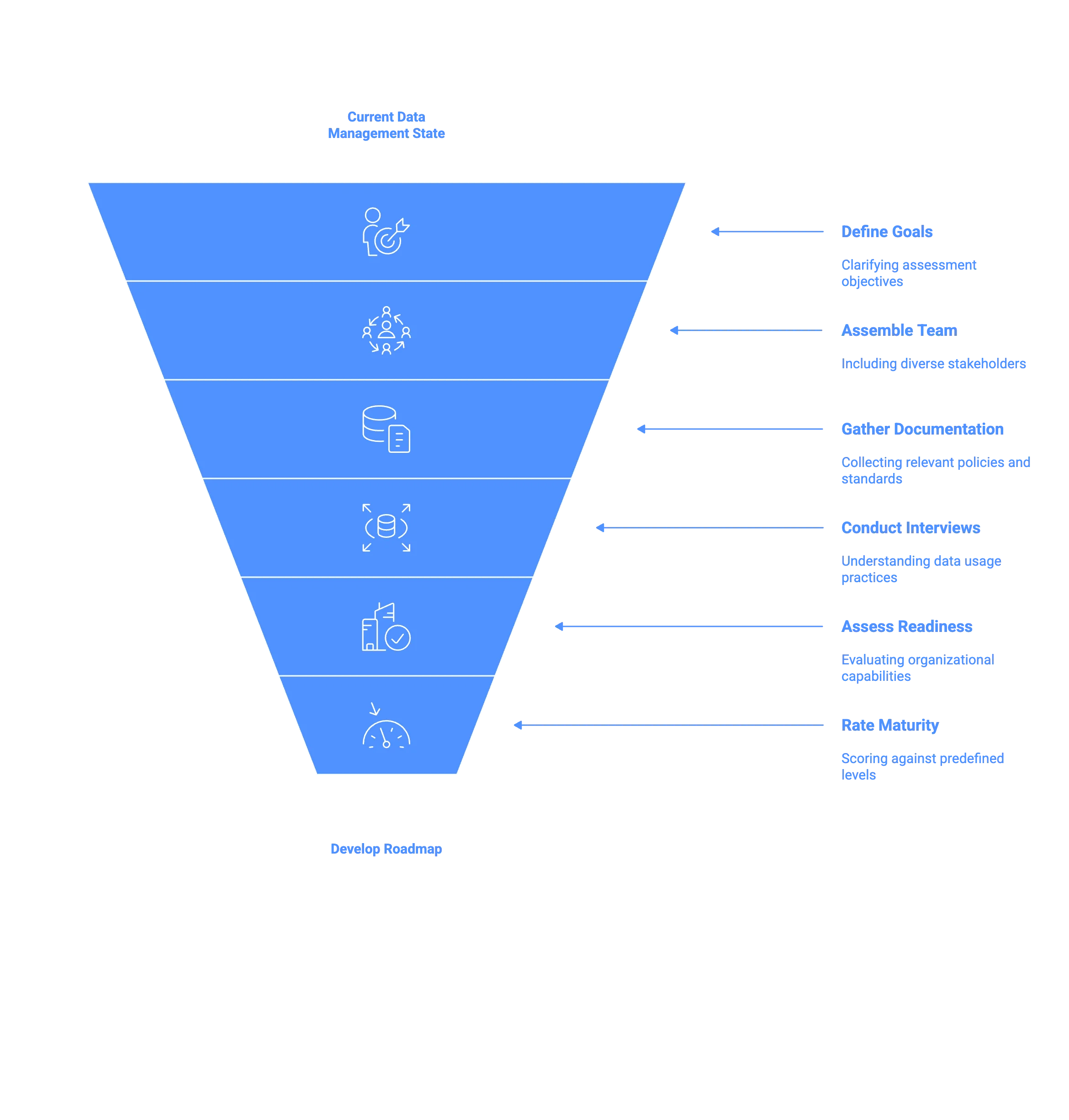
Key steps to conduct a data governance readiness assessment - Image by Atlan.
What is included in the data governance readiness assessment questionnaire?
A structured questionnaire ensures consistent, comparable input from stakeholders. It should cover all the key factors above, using a mix of Yes/No, rating scale, and open-ended questions.
Here are the essential questions to ask.
Section 1: Current state of data management
- [ ] Do we have a defined process for data collection, storage, processing, and usage? (Yes/No)
- [ ] Is there a consistent understanding of data definitions, usage, and ownership across the organization? (Yes/No)
- [ ] Do we maintain a centralized, governed source of context for our data? (Yes/No)
- [ ] Is that context accurate, complete, and kept current automatically? (Yes/No)
- [ ] Are all data assets consistently classified and tagged? (Yes/No)
Section 2: Goals and objectives of data governance
- [ ] Have we clearly defined our goals and objectives for a governance program? (Yes/No)
- [ ] Do our objectives align with overall business strategy? (Yes/No)
- [ ] Which primary driver applies to us? (Regulatory compliance / AI readiness / Data quality / Other)
Section 3: Assessment team and ownership
- [ ] Have we identified key stakeholders for the governance program? (Yes/No)
- [ ] Do we have top management support for implementing governance? (Yes/No)
- [ ] Are business and technical stakeholders both represented in governance decisions? (Yes/No)
Section 4: Documentation
- [ ] Do we have up-to-date data policies and standards? (Yes/No)
- [ ] Is there an enterprise-wide index of governed data assets? (Yes/No)
- [ ] Do we maintain current lineage diagrams for critical datasets? (Yes/No)
- [ ] Have we documented our current data quality practices? (Yes/No)
Section 5: Stakeholder interviews
- [ ] How do you currently access data for your role? (Open-ended)
- [ ] What challenges do you face finding or trusting data? (Open-ended)
- [ ] Do you have access to AI-assisted tools for data search, discovery, or analysis? (Yes/No)
Section 6: Organizational readiness
- [ ] Are we culturally prepared for the changes governance brings? (Yes/No)
- [ ] Do we have adequate budget, staff, and tools to support governance? (Yes/No)
- [ ] Are teams trained to use AI and automation in governance workflows? (Yes/No)
Section 7: Data governance maturity level
- [ ] Have we assessed our maturity using a standard model? (Yes/No)
- [ ] Does that model measure data quality, lineage, context infrastructure, automation and AI, and compliance readiness? (Yes/No)
- [ ] Are we aware of the gaps in our current practice? (Yes/No)
Section 8: Risk and challenges identification
- [ ] Have we identified risks and challenges in implementing a governance program? (Yes/No)
- [ ] Are there known blind spots in lineage, quality, policy enforcement, or context coverage? (Yes/No)
- [ ] What governance-related incidents or audit findings occurred in the past year? (Open-ended)
- [ ] Do we have a mitigation plan for identified risks? (Yes/No)
Section 9: Recommendations and roadmap
- [ ] Have we defined clear responsibilities, timelines, and metrics for the program? (Yes/No)
- [ ] Which gaps should we address in the next 3–6 months? (Open-ended)
- [ ] What governance improvements would have the highest impact? (Open-ended)
- [ ] Which AI-driven capabilities should we prioritize next? (Open-ended)
- [ ] Do we have a process for continuous reassessment? (Yes/No)
For each Yes/No question, a “Yes” signals readiness to build on, and a “No” highlights a gap to address before rolling out the program fully. Every “No” should trigger a deeper conversation about root cause, risk, and what it takes to move it to a “Yes.”
Get your personalized 90-day governance roadmap
Get My Governance RoadmapHow should you interpret the results of the data governance readiness assessment questionnaire?
Interpreting the results means spotting patterns, quantifying readiness, and identifying where impact would be highest.
Here’s how you can interpret the results:
1. Quantify your readiness score: Assign numeric values to Yes/No answers (Yes = 1, No = 0) and average them per section. This produces a readiness score per factor, such as context management, AI readiness, or compliance. A score above 80% usually signals strong readiness, while anything below 50% points to critical gaps.
2. Look for high-impact “No” answers: One “No” in regulatory compliance, data quality, lineage, or AI governance can carry more risk than several smaller gaps combined. Flag these for immediate follow-up.
3. Identify systemic weaknesses: If several sections score low, especially ones tied to context accuracy, ownership, or change management, that often points to a deeper cultural or organizational issue rather than a tooling gap.
4. Map maturity against your goals: Compare results with stated objectives, like enabling AI use cases or meeting a regulatory deadline. Current maturity might be sufficient for some goals and not others.
5. Prioritize quick wins and strategic investments: Some gaps close with a simple process change, others need investment in tooling or a skills program.
6. Develop an actionable roadmap: Cover how and when each element rolls out, who owns each task, and how progress gets tracked.
7. Reassess regularly: Treat this as a living baseline. Re-run the assessment quarterly or twice a year to measure progress and adjust course.
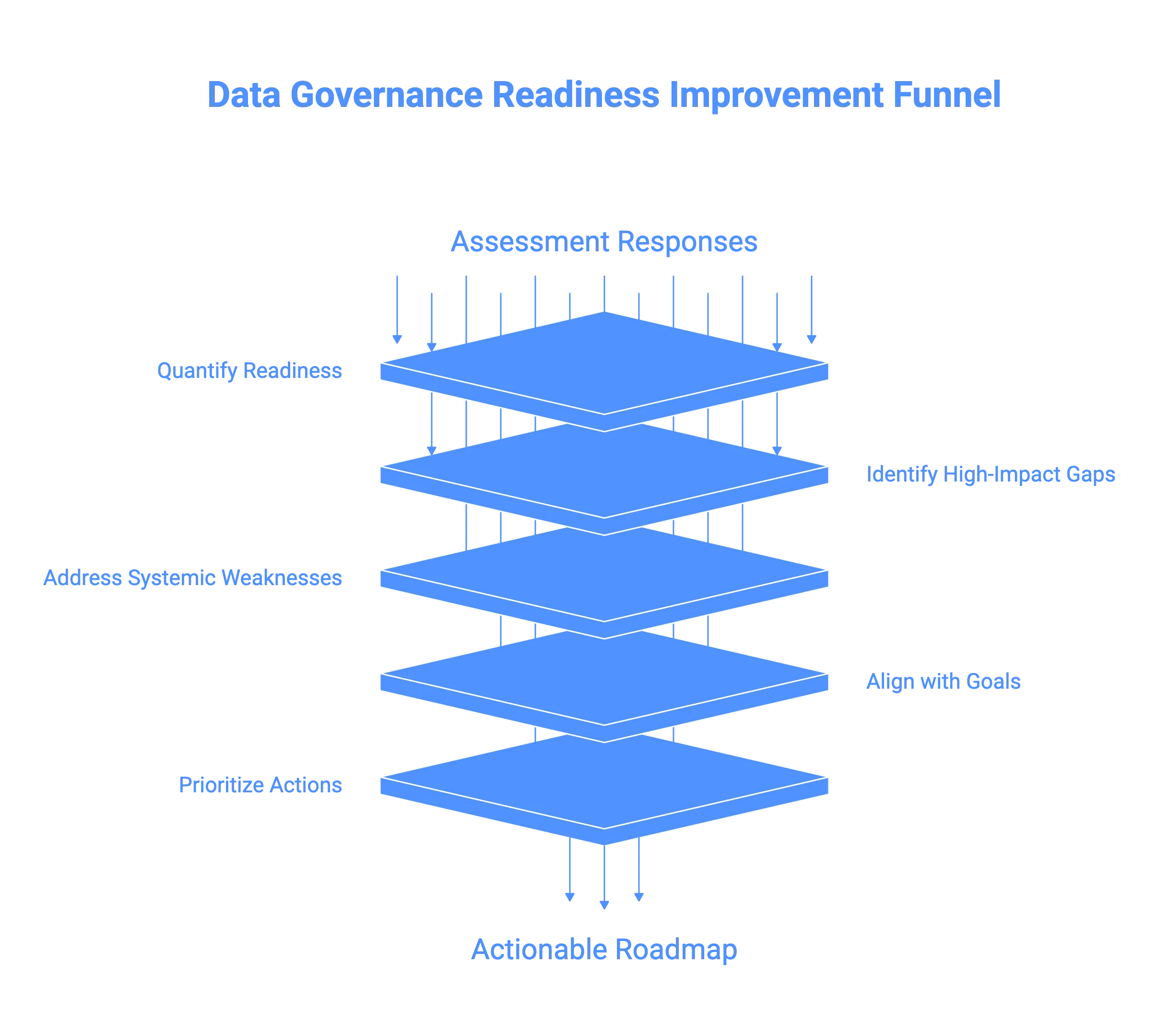
How to interpret the results of your data governance readiness assessment - Image by Atlan.
Get your personalized 90-day governance roadmap
Get My Governance RoadmapHow do modern teams improve their data governance readiness profiles?
Improving your readiness profile means closing the gaps your assessment surfaced and preparing governance to handle evolving regulatory, business, and AI demands.
The first step is building a governed context foundation, since that’s what your automation and AI readiness actually run on.
Forward-looking data teams unify context in a single layer, like Atlan, rather than leaving it scattered across a dozen disconnected tools:
Data governance area | Before a context layer | After a context layer |
|---|---|---|
Context and metadata | Scattered across tools, systems, and teams | Unified in one governed layer, kept current automatically |
Workflow automation | Manual, time-consuming, and error-prone | AI-driven classification, lineage tracking, quality monitoring, and policy enforcement |
Data definitions | Inconsistent or missing | A standardized business glossary that mirrors your actual business domains |
Governance policies | Ad hoc, with inconsistent enforcement | Policy as code, enforced automatically, with a live dashboard showing coverage across the estate |
Data lineage | Incomplete, updated infrequently | Real-time, column-level lineage that updates automatically |
Data quality | Reactive, with limited monitoring | Proactive checks run inside the warehouse, with AI-assisted anomaly detection |
Governance integration | An afterthought, a separate step | Embedded in tools teams already use, Jira, Slack, and BI dashboards, for adoption with no added friction |
Get your personalized 90-day governance roadmap
Get My Governance RoadmapReal stories from real customers building enterprise context layers
"AI initiatives require more context than ever. Atlan's metadata lakehouse is configurable, intuitive, and able to scale to hundreds of millions of assets. As we're doing this, we're making life easier for data scientists and speeding up innovation."
— Andrew Reiskind, Chief Data Officer, Mastercard

See how Atlan can help implement data governance for AI
Book a Personalized Demo"Context is the differentiator. Atlan gave our teams the shared vocabulary and lineage to move from reactive data management to proactive AI enablement."
— Kiran Panja, Managing Director, Cloud and Data Engineering, CME Group

Join Data Leaders Scaling with Automated Data Governance
Book a Personalized DemoReady to improve your data governance readiness?
A data governance readiness assessment is your blueprint for a governance program that works today and adapts as AI takes on more of the work.
Understanding your current state, defining clear goals, and closing gaps across people, process, and technology sets up governance that’s compliant, AI-ready, and tied to real business value.
With a governed context layer like Atlan, teams operationalize governance directly inside daily workflows instead of bolting it on afterward, giving every decision, human or agent-made, a trusted foundation.
Discover how a modern data governance platform drives real results - Book a personalized demo
Discover how a modern data governance platform drives real results
Book a Personalized DemoFAQs about data governance readiness assessment
1. What is a data governance readiness assessment?
A data governance readiness assessment measures how prepared an organization is to implement or scale a data governance program. It examines data management practices, governance goals, and maturity levels.
2. What key components should be included in a data governance readiness assessment?
Key components include evaluating current data management practices, defining governance goals, assessing maturity levels, identifying risks, and building a roadmap for implementation.
3. What is the purpose of a data governance readiness assessment?
It evaluates how prepared your organization is to implement or scale governance, helping identify gaps, risks, and opportunities before you commit resources to a full rollout.
4. Who should participate in the readiness assessment?
Key stakeholders: data owners, data and context stewards, governance leads, compliance officers, technical teams, and the business users who rely on data for decisions.
5. How long does a readiness assessment take?
It varies with scope and complexity, from a few weeks to several months, especially across multiple departments or geographies.
6. What are common challenges faced during a data governance readiness assessment?
Resistance to change, a lack of skilled personnel, budget constraints, and difficulty aligning governance practices with organizational culture are the most common. A clear strategy and real stakeholder involvement address most of these directly.
7. How often should we run a data governance readiness assessment?
Most organizations reassess annually or twice a year, or before a major initiative like an AI deployment, a merger, or a new regulatory compliance project.
8. How does AI factor into the readiness assessment?
Modern assessments measure AI readiness directly, checking whether context, lineage, and governance workflows can actually support AI and automation at scale, not just whether they exist on paper.
9. What tools help improve readiness after the assessment?
A governed context layer like Atlan centralizes context, automates lineage and quality checks, and embeds governance into everyday tools like Jira, Slack, and BI dashboards, rather than requiring a separate portal no one remembers to check.
